Wild Wild East
This blog entry about the events of Tuesday, August 17, 2004 was originally posted on August 24, 2004.
DAY 304: I’ve never been a cowboy in the traditional old American Wild Wild West sort of way, but I’ve seen a lot of classic Westerns. Actually, that’s not true, I’ve only see a couple — or three if you include Mel Brooks’ western parody Blazing Saddles. In any case, the point I’m trying to make is that the landscape of the Gorkhi-Terelj National Park was reminiscent of being in the old American west — especially when you are on the back of a horse all day wearing a sort of cowboy hat.
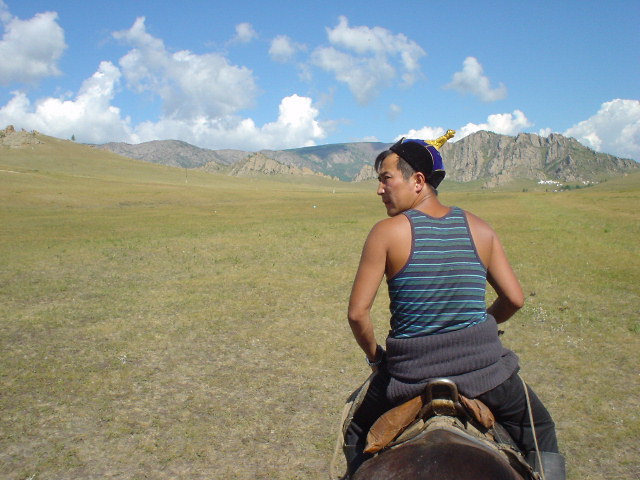
With Tatiana’s help the day before, I had managed to book a horse for seven hours at the price of three. The unofficial timer started five hours after sunrise at around 11:15 in the morning when Davaabat (picture above), a 28-year-old Mongolia guy from a nearby Mongolian yurt camp came over to our camp with two horses, one for each of us.
Wearing my full-brimmed cowboy-esque sun hat, I rode my horse named Har, who was attached to a long rope held by Davaabat who was riding his horse named Hehr. Trailing behind Davaabat for most of the day wouldn’t have been so bad if it weren’t for the sounds of farts every two minutes.
* Urrrrrnnnt! *
Wait, was that my guide or his horse? I thought it was best not to ask.
We continued on through the vast landscape, passed herds of cattle, a stream and some French tourists from a package tour bus that took pictures of the two of us, probably thinking that I was one of the locals with my East Asian-looking face and all. At times, riding the beautiful northern Mongolian steppe landscape, I could imaging myself riding alongside the great Ghenghis Khan in the 12th century — it was his home territory — but then I’d hear the * Arrrruummmmmmppppf! * from the backside of my guide and his horse and be immediately reminded of the famous fart scene in Blazing Saddles, and then be transported back to the old American west.
My goal of the day was to reach the remote Guunjin Sün temple, a former religious temple created in Manchu style during the Manchu occupation. We trotted long passed Turtle Rock, the farthest most of the tourists go, and continued about another hour through the grassy valley and towards the mountains.
“Sün!” Davaabat pointed out in the distance. A red building was about halfway up a steep hill — I noticed its Chinese architecture with its Chinese roof. Davaabat had his traditional Mongolian hat on and again I was transported back to a time of feudal Mongolia and China, when Mongols and Manchus duked it out with bows and arrows atop their horses. The Eastern mood was broken again though, when I heard the ringing of a cell phone coming from Davaabat’s boots. He grabbed the mobile out of his leg and took the call.
We tied the horses to a tree at the base of the Guunjin Sün temple and proceeded on foot over a rickety suspension bridge over a small gorge. Soon we were at the foot of the stairs that ascended as steep as the hill’s incline and walked up to the temple itself. It had recently been converted to the Aryabat Initiation and Meditation Center for Tibetan Buddhists — the main religion of the country. Inside the building was prayer and meditation space and a golden Buddha statue with money in its hands.
After admiring the view from the temple
and trying on each other?s hats, I realized that we had completed the one goal I had of the day relatively early. There was still a good five hours of riding time that was agreed upon and so I used my Mongolian-English dictionary to point to “river,” which translated to “upside-down L, O, Pi, M, theta, P, theta, H” since I hadn’t reached the river the day before as planned. Davaabat slapped his horse on the ass to get a move on and it farted almost immediately after contact like a four-legged whopping cushion. Then again, maybe he timed it that way to hide his own flatulence?
AS COOL AS IT WAS TO RIDE ON THE TOP OF A TRAIN IN ECUADOR, the novelty of it wore off after a couple of hours, and I thought to myself, What the hell am I doing on the top of a moving train? Riding on the top of a horse is different though; the novelty lasts a long time, at least for me as I rode through the magnificent landscape of Gorkhi-Terelj National Park, passed other Mongolian horsemen and scurrying chipmunks below, still pretending that I was some sort of cowboy in the Wild Wild West. Davaabat was even jokingly twirling his rope like a lasso when we approached some cattle. For a while he gave me all the rope of my horse — full control — and I managed to steer my horse with my fellow Far Eastern Mongolian cowboy.
Conversations with Davaabat was not so much a chore; most of the time we just pointed to single words in my dictionary. We sat out by the Tuul River and had a sort of finger-point conversation. He knew I came from New York and wanted to know more about me. He pointed to “backwards N, p, r, 3, H.” Translation: “citizen.”
“Yes,” I said, nodding my head.
He pointed to another: “backwards R, a, X with a vertical line down the center.” “How, which way, in what manner.”
I pointed to “born.”
He pointed to rectangular U with a tail on the right side, a, Pi, backwards N, H. “Wages, pay, salary, scholarship.”
I wrote down “$30,000” in my notepad to give him an average starting salary from my estimation. I figured it was too complicated to tell him I was actually unemployed.
He pointed to “Cap.” “Month, moon.”
I wrote down “$2200.”
He flipped through the pages and pointed to the words for “send, deliver” and “life,” and spoke the word, “money.” But I didn’t get it. “Send money life?” “Deliver life?”
“Deliver life, like a baby?” I said.
He looked for another way to express himself, but just got frustrated with the book and told me to forget it.
FOR KICKS, we switched horses for our final leg of the day, westbound into the setting sun, through more incredible grasslands and forests, just like in some of the classic westerns. The two horses, animals I’ve admired for years for their incredible strength and endurance, hiked up steep mountains on rocky territory, all while we were on their backs. My new horse however, turned out to be the culprit of the day, continuing to fart its through the landscape.
The day ended when Davaabat dropped me off back at camp. Immediately, Shirka the camp cook that I met that morning, signaled me to eat the late lunch he had prepared for me — only to serve me dinner just two and half hours later. In between meals, he and two of the Mongolian girls on staff invited me to join them in a karaoke session in the mess yurt, so I could sing them American songs that they punched in: The Beatles’ “Let It Be,” George Michael’s “Last Christmas,” Madonna’s “Papa Don’t Preach,” and Laura Branigan’s “Self Control.” My little concert with them didn’t last too long because that night the machine was overtaken by a Korean tour group that had come for the night.
Alone in my yurt I could hear them wailing their vocal chords out to Korean love songs and I knew that I was no longer in the Wild Wild West but the Wild Wild (and sometimes off-key) East. However, I don’t know what Shirka the cook put in my Mongolian beef dish because it was me that was farting now — just like in that Mel Brooks movie back in the West.
Next entry: Will The Real Mongolian Please Stand Up?
Previous entry: Little Yurt On The Prairie
Commenting is not available in this channel entry.
Comments for “Wild Wild East”
I can’t believe it….I got 1st again!
Posted by .(JavaScript must be enabled to view this email address) on 08/23 at 08:14 PM
I’m still behind… stay tuned though!
HONG KONG HOOK-UPS: Are there any out there? I might be in HK for a few days; that is, if I’d have to place to crash… There are rumors there might be…
Posted by .(JavaScript must be enabled to view this email address) on 08/23 at 08:16 PM
E!, coo date-kinda romantic, Yo the “Herds of Cattle ” link pic is broken ... and no Hotel California? Thats the universal Karaoke standard !
Posted by .(JavaScript must be enabled to view this email address) on 08/23 at 08:20 PM
Wow….Farting in the open plain makes me giggle. It’s like you’re brought a little bit of your culture (WITH YOUR ASS) and left it for them to smell,...
Your blog is awesome…
keep up the good work, FOR ME TO POOP ON!Posted by Moedoggie on 08/23 at 08:23 PM
SIMF2P: Picture working now… thanks for the heads up…
OH RIGHT… “Hotel California.” Yes… that should go without say…
Posted by .(JavaScript must be enabled to view this email address) on 08/23 at 08:24 PM
Hi Erik, beautiful pictures. Did you get my email?
Posted by .(JavaScript must be enabled to view this email address) on 08/23 at 08:25 PM
MOEDOGGIE: It was my Little Fart On The Prairie.
Posted by .(JavaScript must be enabled to view this email address) on 08/23 at 08:28 PM
ARABELA: Yes… How often do you go to TX?
Posted by .(JavaScript must be enabled to view this email address) on 08/23 at 08:31 PM
Erik TGT: at least once every year. My mom’s family lives even closer to TX, so whenever we visit them we go there.
Posted by .(JavaScript must be enabled to view this email address) on 08/23 at 08:37 PM
Did that horse have some beefaroni to eat that morning or what?
Posted by .(JavaScript must be enabled to view this email address) on 08/23 at 08:55 PM
Great pic’s Erik…..there is a saying
“There is nothing funnier than a fart” Is this correct…. were you laughing?Posted by .(JavaScript must be enabled to view this email address) on 08/23 at 09:09 PM
Laura Brannigan’s “self control”?! haha.
Posted by .(JavaScript must be enabled to view this email address) on 08/23 at 09:21 PM
markyt: is the beefaroni a Seinfeldism?
Erik: from last days messages….yes I am another Canadian….Rose is my aunt, Janice is my mother, and Liz is my cousin! I have read back to the beginning of Russia, and now will start going through your archives….and of course will keep up to date!
Posted by .(JavaScript must be enabled to view this email address) on 08/23 at 09:48 PM
LISA - sure is…
If erik was actually feeding the horses, we could make a Half-Baked reference….
Posted by .(JavaScript must be enabled to view this email address) on 08/23 at 10:19 PM
ERIK - Hector from Ghostwriter is on the cast of Real World Philly!
Posted by .(JavaScript must be enabled to view this email address) on 08/23 at 10:40 PM
when Davaabat was asking you about money and stuff and pointing out words, maybe he meant:
“send or deliver money so i can have a life or i can live or live a better life”
i don’t know…just my 2 cents…great entries and pics! i want a yurt too :o)
Posted by .(JavaScript must be enabled to view this email address) on 08/24 at 12:40 AM
Really interesting terrain - and awesome pics as usual… I forget what it is that makes horses fart a lot - I think that there is a certain food… my horse used to do it too… highly amusing… Glad you could chare in my laughter!!
Posted by .(JavaScript must be enabled to view this email address) on 08/24 at 12:54 AM
I agree with stephanie - the guy was probably asking you to deliver money to him for life LOL
Gosh, its a regular family reunion here for me - hi Lisa!

Posted by Liz on 08/24 at 01:55 AM
I think its from eating too much wild grass, not enough hay. Maybe he was asking for money so his horse can not fart?
Steinfeld flashback was hilarious, as the references to Blazing saddles and hlaf baked! lol…
The landscape looks awesome! Wish I was there.
Why was he leading your horse with a rope?? With all that open space, and the famed Mongolian riders, I’d think you could ‘rome’ around more.
And…if I was in the middle of Mongolia and was surrounded by a gang of kareokiers I’d be bugging out! lol…But maybe thats just me, I do live in Flushing afterall.
Posted by .(JavaScript must be enabled to view this email address) on 08/24 at 02:10 AM
Can’t believe there is cellphone service in the boonies of Mongolia!
Check out the pic where Davaabat “took the call.” Upper right hand corner - rock formation looks like Clifford the Big Brown Dog! (Well, to me it does…...and no, I’m not on drugs!)
Posted by .(JavaScript must be enabled to view this email address) on 08/24 at 03:01 AM
JANICE - you must be on drugs cuz clifford is the Big RED dog…
hehe..

Posted by .(JavaScript must be enabled to view this email address) on 08/24 at 06:59 AM
Janice, I was thinking the same thing. Why is it that he gets cell service in the steppes of Mongolia, yet in some places in Northeastern NJ, I do not have any? ha.
Posted by Alyson on 08/24 at 07:14 AM
Which letters have to go upside-down for “Can you hear me now?”
Posted by .(JavaScript must be enabled to view this email address) on 08/24 at 05:30 PM
Hey Erik!!! Looking good. I just wanted to give you a tip from when I was in Mongolia, though I think you might have already left. They don’t like it when you call their dwelling yurts, as I found out rather awkwardly. Call them gers, which is the local word rather than the bastardized Russian version of what they call them in Kazakstan- or something like that.

Oh yeah, I’m home again and hating life.
Keep it coming.
Posted by .(JavaScript must be enabled to view this email address) on 08/24 at 07:31 PM
PC: WOW, back so soon? Has it been a year of traveling for you already?
Don’t worry, I called them ‘gers’ locally, I wrote them here as ‘yurts’ because that’s the name I’ve heard back in the States; (this audience is pretty much a Western audience)...
Posted by .(JavaScript must be enabled to view this email address) on 08/25 at 04:15 AM
Eric,
With regards to “Little Yurt on the Prairie”, I can admit that I was a huge fan of “Little House”, okay, I am a dork! But you are mistaken oh worldly traveler you, it was actually little Carrie, Laura’s younger sister who fell down running down the hill. By the way, “do you need a Sh*^load of dimes?
Posted by .(JavaScript must be enabled to view this email address) on 08/25 at 05:25 AM
PATRICK: Carrie, huh? You are more man than me for admitting you know that.
Posted by .(JavaScript must be enabled to view this email address) on 08/25 at 06:58 AM
Hey Erik.
Yup, it’s been a year. Flew by eh??? I want to go back out again… this whole working in a cube farm with no daylight is killing me. I’m getting a fluorescent light tan… which is to say greenish.
Where are you off to next??
Posted by .(JavaScript must be enabled to view this email address) on 08/25 at 04:16 PM
PHOTOCHICK: You’re already back in the Cube Farm? Now THAT was fast!
Posted by .(JavaScript must be enabled to view this email address) on 08/25 at 07:14 PM
Janice & Alyson: I was also thinking the same thing. What gives with the cell service in Mongolia? I mean really… if he can get a call there, why can’t I get one in Jefferson Twp., NJ?
ERIK: Great pics again of the countryside. Funny you were thinking Wild West & Blazing Saddles. And yes, farts are ALWAYS funny. I think that since the dawn of time, through the Rennaisance, the Enlightenment, the Industrial Age, and the Computer Age… farts have always made people laugh. PPPPFFFFTTTT!
The scenery had me thinking of Conan the Barbarian. Odd that you mention Laura Branigan. She died the other day. True. Anuerism (sp?). BTW, that’s my hubbie who knew the true LHOTP tripping-down-the-hill kid. Pitty me.
Posted by .(JavaScript must be enabled to view this email address) on 08/30 at 02:05 AM
SHARE THIS TRAVEL DISPATCH:
Follow The Global Trip on Twitter
Follow The Global Trip in Instagram
Become a TGT Fan on Facebook
Subscribe to the RSS Feed
This blog post is one of over 500 travel dispatches from the trip blog, "The Global Trip 2004: Sixteen Months Around The World (Or Until Money Runs Out, Whichever Comes First)," originally hosted by BootsnAll.com. It chronicled a trip around the world from October 2003 to March 2005, which encompassed travel through thirty-seven countries in North America, South America, Africa, Europe, and Asia. It was this blog that "started it all," where Erik evolved and honed his style of travel blogging — it starts to come into focus around the time he arrives in Africa.
 Praised and recommended by USA Today, RickSteves.com, and readers of BootsnAll and Lonely Planet's Thorn Tree, The Global Trip blog was selected by the editors of PC Magazine for the "Top 100 Sites You Didn't Know You Couldn't Live Without" (in the travel category) in 2005.
Next entry:
Will The Real Mongolian Please Stand Up?
Previous entry:
Little Yurt On The Prairie
THE GLOBAL TRIP GLOSSARY
Confused at some of the jargon that's developed with this blog and its readers over the years? Here's what they mean:
BFFN: acronym for "Best Friend For Now"; a friend made on the road, who will share travel experiences for the time being, only to part ways and lose touch withThe Big Trip: the original sixteen month around-the-world trip that started it all, spanning 37 countries in 5 continents over 503 days (October 2003–March 2005)
NIZ: acronym for "No Internet Zone"; a place where there is little to no Internet access, thus preventing dispatches from being posted.
SBR: acronym for "Silent Blog Reader"; a person who has regularly followed The Global Trip blog for years without ever commenting or making his/her presence known to the rest of the reading community. (Breaking this silence by commenting is encouraged.)
Stupid o'clock: any time of the early morning that you have to wake up to catch a train, bus, plane, or tour. Usually any time before 6 a.m. is automatically “stupid o’clock.”
The Trinidad Show: a nickname of The Global Trip blog, used particularly by travelers that have been written about, who are self-aware that they have become "characters" in a long-running story — like characters in the Jim Carrey movie, The Truman Show.
WHMMR: acronym for "Western Hemisphere Monday Morning Rush"; an unofficial deadline to get new content up by a Monday morning, in time for readers in the western hemisphere (i.e. the majority North American audience) heading back to their computers.
1981ers: people born after 1981. Originally, this was to designate groups of young backpackers fresh out of school, many of which were loud, boorish and/or annoying. However, time has passed and 1981ers have matured and have been quite pleasant to travel with. The term still refers to young annoying backpackers, regardless of year — I guess you could call them "1991ers" in 2013 — young, entitled millennials on the road these days, essentially.
Spelling or grammar error? A picture not loading properly? Help keep this blog as good as it can be by reporting bugs.