A Trainful of Tourists
This blog entry about the events of Tuesday, November 11, 2003 was originally posted on November 12, 2003.
DAY 24: Once upon a time in Ecuador, the railway system was the fast way to go north or southbound through the Andean countryside. Over the years, this railway system was replaced by the faster and cheaper bus network. But there is one train that still runs, so that tourists can ride on the roof and take pictures of the countryside faster than the locomotive.
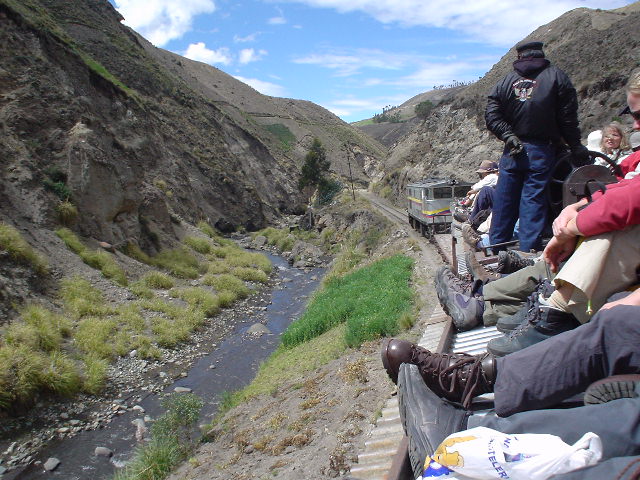
Chris, Pepe and I were up by 5:30 and out of the hostel by six. When we got to the train station, there were probably 100 people on the roof already, mostly from big European tour groups. We met up with Anna and Andrew and snagged a spot on the roof amongst the sea of people.
The train wasn’t a fancy train by any means; it was merely a freight train with a hard metal roof with a two-inch piece of steel railing which kept you and your bag from sliding off. Vendors capitalized on this by renting cushions for a buck each, which was well worth it.
At seven on the dot, the gas-powered locomotive started moving with its trainful of about 250 tourists behind. We rode out of the city and out of the suburbs and into the countryside. We waved at villagers who waved backed at us, as dogs chased the train, barking until they tired out.
Anna, Pepe and Andrew were on my right while Chris was on my left, just enjoying the scenery. Unlike everybody else, he didn’t have a camera and just took it all in with just his eyes. Everyone else — including myself — took pictures like crazed paparazzi of the lush Andean countryside where animals would roam freely and graze. Daredevil vendors walked back and forth as the train cruised from 20-40 mph, selling snacks. In Ecuador, they’ll do anything for a buck.
WE STOPPED IN GUAMOTE, a small town along the train route. If the train only exists for tourism, then it seems the town only exists for the train. Vendors sold textiles and sodas and banana empanadas. I stretched my legs for a bit and chatted with Anita, who was on the car ahead.
Afterwards, the landscape dramatically switched from lush green farmlands to arid, desert-like conditions. The train zig-zagged through the mountains as the sun blared from above, which really heated things up when the train derailed in a desert valley. This of course got the tourists all excited and snap happy and everyone got off the train with their cameras to record the event on film. Luckily the train staff was used to this sort of thing and successfully rerailed the wheels by use of wooden planks and rocks.
We arrived in Alausi about six hours after leaving Riobamba and stayed on the train to go down the Nariz del Diablo (The Devil’s Nose), a steep mountain with a series of rail switchbacks for a train to come down. The Devil’s Nose promised to be a major thrill, but it was sort of anti-climactic — we had seen better views on the first six hours of the train ride. It seemed the only reason to go down The Devil’s Nose was to be stuck in a valley so that there would be no escape from the vendors selling Devil’s Nose t-shirts and pins, and conductor’s hats. The conductor’s hats were $7 and were very convenient if, in the middle of nowhere in the Andes, you had the uncontrollable urge to look like one of the Village People.
Pepe and I got off the train at the base of the “nose” for some photos and climbed back onto the train as it started moving again. To get to my spot on the roof, I fulfilled a childhood cowboy fantasy of jumping from the roof of one car to another on a moving train.
AFTER SEVEN HOURS, the novelty of being on top of a train wears off and you say to yourself, “Jesus, why the hell am I on the roof of a train under the hot sun for?” Everyone had put their cameras down and just looked beat — that is, until there was another derailment. As soon as the train wobbed and the engine stopped, a short indigenous vendor who was sitting next to Anna got up, smiled and started yelling “Colas! Colas! Colas!”
“Alright, everyone get off the train to take pictures again,” I announced. Sure enough, the paparazzi responded.
THERE WAS A LONG LINE at the baggage claim when we arrived back in Alausi, so I decided to make a quick trip to the bank a block away to get some cash at the ATM since I had spent my last five bucks on an advance bus ticket to Cuenca. There was no ATM, but luckily they could cash traveller’s checks. However, they had to hold onto my passport until they could get a photocopy made — which wasn’t going to happen until the teller finished dealing with the six other people on line. Meanwhile, my bag was still on the train which was about to leave.
I risked leaving my passport at the bank and ran to the station. Luckily, Pepe had told them where I was and they put my bag away. I grabbed it and ran back to the bank where the copy still hadn’t been made. Meanwhile, my bus was about to leave. The irony was, I needed to get cash because I used my last bit of cash for that bus ticket.
Luckily, another guy came over to make the photocopy since the teller was just too busy and I got my passport back and hopped on the bus in time. Everything worked out in the end because an advance ticket was necessary since some woman was making a big deal about assigned seats. Three people who didn’t buy advance tickets had to sit on the floor or stand for the entire bumpy four and a half ride through curvy mountain roads.
We arrived in Cuenca at night. Chris, Pepe and I split another cab and another room and went out for dinner. I was too tired to do anything else after sitting on my ass on trains and buses all day.
Next entry: For The Better of Humanity
Previous entry: Crossroads of Ecuador
Commenting is not available in this channel entry.
Comments for “A Trainful of Tourists”
muhahahaha… first post!
Sorry, couldn’t resist. Can we get a / . compaign going? OR do you wanna fix this damn comment system first so you don’t get spammed like a post-WW2 airdrop?
Keep up the good work.
D.
Posted by .(JavaScript must be enabled to view this email address) on 11/12 at 02:15 PM
“can’t sit here…”
Posted by .(JavaScript must be enabled to view this email address) on 11/12 at 02:18 PM
ELAINE/CATHY & CLASS: There’s a map of Ecuador on the worldguide on http://www.lonelyplanet.com ...
Posted by .(JavaScript must be enabled to view this email address) on 11/12 at 04:26 PM
blast it! i wanted first post!
anyway, where’s the pictures???
Posted by .(JavaScript must be enabled to view this email address) on 11/12 at 04:27 PM
eek..nevermind.
great pics. btw, what if ALL those ppl didn’t wanna sit on the roof? where would they sit? inside the freight cabs?
Posted by .(JavaScript must be enabled to view this email address) on 11/12 at 04:32 PM
WOW! The train ride sounds amazing. What a great experience. Try it in NY when you get back! or not
Posted by Neven on 11/12 at 05:07 PM
“you can sit here if ya want…”
Posted by .(JavaScript must be enabled to view this email address) on 11/12 at 05:28 PM
Erik, I’m glad that you got to fulfill another childhood fantasy. It’s funny because I’ve always wanted to do that too!
Posted by .(JavaScript must be enabled to view this email address) on 11/12 at 05:39 PM
That’s not what the Devil’s nose looks like.
Posted by matto on 11/12 at 05:40 PM
wow the train derails as much as the stupid nj transit northeast corridor service!
Posted by .(JavaScript must be enabled to view this email address) on 11/12 at 05:41 PM
Macho, macho man…. I want to be a macho man….
Posted by .(JavaScript must be enabled to view this email address) on 11/12 at 05:59 PM
umm yea, don’t try that at home.. did u hear about the kid who went subway surfing recently? not pretty..
u had me in suspense there with the passport and the bus incident..
Posted by .(JavaScript must be enabled to view this email address) on 11/12 at 08:05 PM
mmmm… banana empanadas!
great pics as always!
Posted by .(JavaScript must be enabled to view this email address) on 11/12 at 09:23 PM
choo-choo.. what a great way to ride a TRAIN!
chris has no camera!! WHAT!(#&@! how does he live? i would feel naked w/out one.
i looked on an atlas and i now know where quito, banos & riobamba is. you’re heading south! look at that, i’m learning some geography.
(i’m jealous)
Posted by .(JavaScript must be enabled to view this email address) on 11/13 at 01:21 AM
The roof ride is off da hook…saw that many times on many a travel show here!! Would love to do it someday!!
(though knowing my bad luck I’d be the first idiot to fall off the damn thing)
Posted by .(JavaScript must be enabled to view this email address) on 11/13 at 02:15 AM
Amazing man! I wanted to see an action shot of you leaping the train! Too bad there wasn’t a magician’s caboose like in Indy. You shoot everything with your S40? BTW, I’ve gone digital in a robocam way….
Posted by .(JavaScript must be enabled to view this email address) on 11/13 at 03:49 AM
that Anna chick looks nice…you should hook up. Who’s been cuttin your hair? That train ride looks like a hoot, how do you fix a diesel train derailment with rock and planks anyway? Keep up the good work!
Posted by .(JavaScript must be enabled to view this email address) on 11/13 at 12:17 PM
I am so spoiled. I couldn’t read this until the pictures were in it.
I love the pics of the scenary but my favorite so far is snap happy. I really lingered over that one, looking at the peoples’ poses and expressions juxtaposed against the lanndscape and precarious spot on the roof.
Keep up the good work.
P.S. Please stop ending sentences with prepostions. ( Sorry it is the teacher in me.)
Posted by .(JavaScript must be enabled to view this email address) on 11/13 at 01:16 PM
Hey make sure you catch up with that Argentinean girl that was on my tour when you get to Buenos Aires as well!!
Posted by .(JavaScript must be enabled to view this email address) on 11/13 at 01:52 PM
Thanks for the comments guys! You might have seen this train ride on Globe Trekker…
OOGY: no s40 here… that’s WAY too big… the only reason why I have as many pictures as I do is because of the sony u30 spy camera… lugging big cameras really makes you a target out here, plus its just not as convenient… if you meet me on the road, i hope your new robocam has a cloaking device…
SHEA: Anna is nice, but she’s already gone a different path… but she’s letting me crash her house in Berlin if and when I get there next summer…
TD0T: funny…I almost forgot I had that childhood fantasy until I was there jumping away…
ELAINE: re: no camera, i know, right! insane…
Posted by .(JavaScript must be enabled to view this email address) on 11/13 at 05:57 PM
Wow! nobody fell off the train when it derailed? Pretty amazing…
Posted by .(JavaScript must be enabled to view this email address) on 11/16 at 01:41 PM
i just joined bootsnall and found your “el nariz” story. i’ve got one on my site too. check it out: http://www.angelfire.com/trek/etravels/southamerica/love_and_devils_nose/
happy trails…............
-e trules
Posted by e on 11/22 at 10:17 PM
SHARE THIS TRAVEL DISPATCH:
Follow The Global Trip on Twitter
Follow The Global Trip in Instagram
Become a TGT Fan on Facebook
Subscribe to the RSS Feed
This blog post is one of over 500 travel dispatches from the trip blog, "The Global Trip 2004: Sixteen Months Around The World (Or Until Money Runs Out, Whichever Comes First)," originally hosted by BootsnAll.com. It chronicled a trip around the world from October 2003 to March 2005, which encompassed travel through thirty-seven countries in North America, South America, Africa, Europe, and Asia. It was this blog that "started it all," where Erik evolved and honed his style of travel blogging — it starts to come into focus around the time he arrives in Africa.
 Praised and recommended by USA Today, RickSteves.com, and readers of BootsnAll and Lonely Planet's Thorn Tree, The Global Trip blog was selected by the editors of PC Magazine for the "Top 100 Sites You Didn't Know You Couldn't Live Without" (in the travel category) in 2005.
Next entry:
For The Better of Humanity
Previous entry:
Crossroads of Ecuador
THE GLOBAL TRIP GLOSSARY
Confused at some of the jargon that's developed with this blog and its readers over the years? Here's what they mean:
BFFN: acronym for "Best Friend For Now"; a friend made on the road, who will share travel experiences for the time being, only to part ways and lose touch withThe Big Trip: the original sixteen month around-the-world trip that started it all, spanning 37 countries in 5 continents over 503 days (October 2003–March 2005)
NIZ: acronym for "No Internet Zone"; a place where there is little to no Internet access, thus preventing dispatches from being posted.
SBR: acronym for "Silent Blog Reader"; a person who has regularly followed The Global Trip blog for years without ever commenting or making his/her presence known to the rest of the reading community. (Breaking this silence by commenting is encouraged.)
Stupid o'clock: any time of the early morning that you have to wake up to catch a train, bus, plane, or tour. Usually any time before 6 a.m. is automatically “stupid o’clock.”
The Trinidad Show: a nickname of The Global Trip blog, used particularly by travelers that have been written about, who are self-aware that they have become "characters" in a long-running story — like characters in the Jim Carrey movie, The Truman Show.
WHMMR: acronym for "Western Hemisphere Monday Morning Rush"; an unofficial deadline to get new content up by a Monday morning, in time for readers in the western hemisphere (i.e. the majority North American audience) heading back to their computers.
1981ers: people born after 1981. Originally, this was to designate groups of young backpackers fresh out of school, many of which were loud, boorish and/or annoying. However, time has passed and 1981ers have matured and have been quite pleasant to travel with. The term still refers to young annoying backpackers, regardless of year — I guess you could call them "1991ers" in 2013 — young, entitled millennials on the road these days, essentially.
Spelling or grammar error? A picture not loading properly? Help keep this blog as good as it can be by reporting bugs.