Nice As Rice
This blog entry about the events of Sunday, December 26, 2004 was originally posted on December 31, 2004.
DAY 435: Rice is the staple crop in the Philippines, as it is in many Asian nations. Rice production goes year round and is quite an on-going process of soil preparation, planting, maintenance, harvesting and drying, all before starting all over again. Not only has planting rice provided prosperity for countryside Filipinos, it inspired one Blogreader wheat to write the following ditty:
Planting rice is lots of fun
You must do it in the morning sun
I can’t stand it, I can’t sit
Planting rice is full of…La la la la la la la la…
(Continue singing “la” until the laughter dies down from the omission of the “sh” word.)
While rice is grown in almost every region of the Philippines, nowhere is rice farming more famous than at the rice terraces of Banaue, about 200 miles north of Manila on the big island of Luzon. My trip to the northern countryside started bright and early, so early it wasn’t bright yet. My father’s brother, my Tito Pepito, picked me up at the Greenhills house at 3:30 a.m. with his new wife, my Tita Pangie, and his son, my cousin John Paul, which everyone just calls J.P.
“Hey JayPee, you’re so big now,” I greeted him. It had been five years since I’d seen him and he had really sprouted up, especially in the abdominal region if you know what I mean. “Look at you, you’re like my dad.”
The trunk closed shut as did the car doors and soon we were on the tollway northbound under the dark early morning sky. As with most people awake and driving around at four in the morning, there was one thought on everyone’s mind: You think KFC’s still open?
It was, the KFC at one of the service areas that is, and it was there we had breakfast with the colonel and his eleven secret herbs and spices (although I always say there are only ten that are secret because one of them is definitely salt). Anyway, the meal tied us over for the estimated ten-hour drive ahead, amidst the other northbound cars and buses.
SEVEN HOURS LATER, we arrived in Banaue in record time, mainly because we left so early and beat all the traffic in the metro Manila area. Banaue, is nowhere as big or as congested as cosmopolitan Manila; it is essentially a very big village evolved from the indigenous Ifugao people, one of over 150 tribal groups within the 7001-island Philippine archipelago. As we descended down the mountain road, I saw rice terraces carved into the surrounding mountains. “Are those the famous ones?” I asked.
“No, that’s just the appetizer!” my uncle said, making himself chuckle.
We drove to the Sanafe Lodge, the place recommended by both my Tita Josie (my dad’s cousin) and my Let’s Go guide. It was there we had a lunch of sinigang (a sour, tamarind-based fish stew) and arranged a jeepney to take us to the famous terraces, which were actually about 90 minutes farther out of town via a rocky mountain road. Thankfully the driver of our off-roading jeepney (Filipino jeeps refurbished from old American G.I. jeeps) could handle it. The jeepney took us (and some welcomed stowaways on the roof) up a mountain to a drop point where we proceeded on foot down the valley on an established hiking trail to the village of Batad at the bottom. All around us were the famous terraces which may or may have not inspired wheat‘s “Planting Rice” song.
Although the trail was all downhill and only required about 45 minutes to do, it provided the most exercise that any of my relatives with me had really done in a while; they were total city slickers on their first visit to the terraces as well. Tito Pepito trekked down, not with the terraces on his mind, but with the notion of whether or not his car would be okay, being left parked on the street in Banaue. JayPee was much more of a basketball player than a hiker, but kept his spirits up as he always did, whistling the theme to Indiana Jones.
“It’s an adventure,” we all agreed.
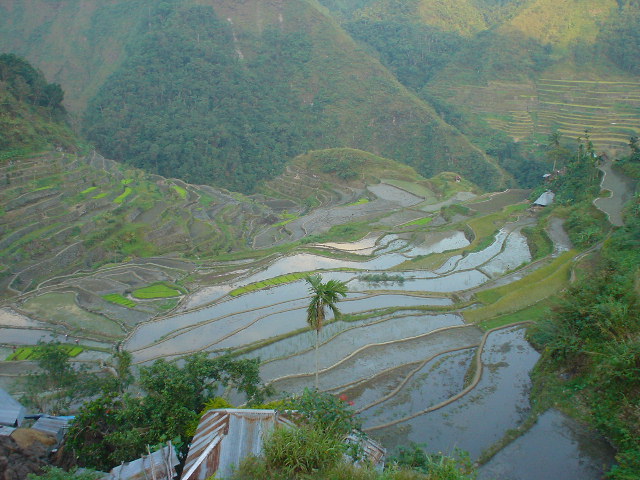
IF THE PHILIPPINE MINISTRY OF TOURISM HAS ANYTHING to do with it, the terraces (picture above) of the Banaue area are the “Eighth Wonder of The World” — well, that’s what they bill them as anyway to any foreigner. They are one of many “eighth wonders” I’d seen in other parts of the globe — the Rat Temple in Bikaner was billed as such, for example — and no one could be for sure if it was a real “eighth wonder,” or if there are even more than seven anyway for that matter. Either way, my first impressions were that they were quite impressive and worthy of their World Heritage UNESCO status.
The terraces date back 2,000 years ago and were built out of necessity. Flat terrain is of course essential in rice production, but it is hard to come by in the mountain regions. Therefore, Asian ingenuity started carving rice terraces into the mountains to establish such flat terrain, resulting in a beautiful and practical engineering marvel still in use today. The terraces today are not as they were 2,000 years ago; they are a continual work-in-progress. Farmers reshape the contours of the terraces with stone and mud based on geological and meteorological factors, all to produce the optimal amount of rice each season.
FORTY MINUTES LATER, we saw what we had come for, the “amphitheater,” the main part of the terraces in the shape of a big venue for a rock concert. In the center of the valley of the amphitheater was the village center of Batad, where the local villagers lived their lives when they weren’t working the terraces.
We checked into the Hillside Inn, not in the center but on the hillside a little higher than the bottom, with a view of the terraces below. It wasn’t luxurious by any means; in fact, it was very similar to a humble little guesthouse I’d frequented on the trekking trail in other developing regions. “This is like one of the places I usually go to,” I told my new-to-backpacking relatives. It was plain and simple, with small rooms separated by thin wooden walls and no electricity. It was run by the local Ifugao people, who spoke their own dialect that none of us spoke. Luckily they also spoke Tagalog and English and JayPee asked around for the Ifugao phrase he was trying to say: “Munhinanga.” Translation: “I’m hungry.”
Food would have to wait though since the sun was setting and we wanted to take advantage of remaining daylight. We trekked down the valley to the center of the village — my uncle and aunt only went half way — down walking paths and along the edges of the terraces where people were working the earth. Most terraces were being prepped with water — each level is filled by an ingenious trickle-down waterfall scheme that begins at the top-most terrace — while some had young rice growing in it already.
In the center of town, it was village life as usual; people sitting around staring at the tourists coming in, and kids playing volleyball near the village church. “Munhinanga,” JayPee said. It was getting darker, so we head back the way we came — uphill that is, which totally winded my basketball playing cousin. At the end back at the lodge, he was totally beat and sweating like a dog.
“Look, you’ve lost two pounds,” I told him.
FOR DINNER WE HAD — drumroll please — rice; garlic fried rice that is, a popular Filipino culinary staple, along with scrambled eggs and bottles of water and Gatorade. Village life came to a calm with the coming of nightfall by around 7 p.m., and I spent the rest of the night writing in my room by candlelight.
The next morning when we checked out, I signed the Hillside Inn’s guestbook with the only comment I could think of: “Very very nice as rice.” If I had remembered wheat‘s little song at the time, I might have put that down. Instead I’ll put it again here for old time’s sake. Sing along!
Planting rice is lots of fun
You must do it in the morning sun
I can’t stand it, I can’t sit
Planting rice is full of sh—La la la la la la la la…
SAVE THE DATE; DAY 503 IS COMING. MARCH 5, 2005, NYC.
DETAILS AND TRAILER COMING SOON…
Next entry: From City Slicker To Backpacker
Previous entry: Spider-Man In The Batcave
Commenting is not available in this channel entry.
Comments for “Nice As Rice”
GREETINGS FROM THE YEAR 2005… See you guys all on the other side…
MORE TO COME as it become available!
Posted by .(JavaScript must be enabled to view this email address) on 12/31 at 03:09 AM
Happy New Year 2005 “The Year of the Rooster” in China.
Posted by .(JavaScript must be enabled to view this email address) on 12/31 at 04:59 AM
HAPPY NEW YEAR ERIK! Re-entry was FANTASTIC! Don’t know how I could have ever left this paradise in the first place! If you believe that, let me also tell you about how the world is flat…
I have just finished labeling all the food in my fridge and set several alarms to go off randomly in the night to keep me feeling like I’m traveling.
Posted by .(JavaScript must be enabled to view this email address) on 12/31 at 05:26 AM
Happy New Year!
I can’t believe TGT2004 is almost over! What will I do without the blog adventures? Can’t wait for the welcome home party though & the trailer. :DPosted by .(JavaScript must be enabled to view this email address) on 12/31 at 12:11 PM
Hey Mr. E- New year greetings. Glad to note that Chrissy is fine. I had sent her an email and yesterday had flutters of anxiety. Have sent you an email. Have a nice trip back…and happy writing (the book)!
Posted by .(JavaScript must be enabled to view this email address) on 12/31 at 12:55 PM
pics got 404 - “walking paths”; “along the edges of the terraces”; and “terraces”
i looked for them, but doesn’t seem that it made the upload.
Posted by .(JavaScript must be enabled to view this email address) on 12/31 at 04:09 PM
Dude, you are definitely going to need a new hat when you get back:-)
Posted by .(JavaScript must be enabled to view this email address) on 12/31 at 04:48 PM
wow, can’t believe it’s coming to an end soon! it’s gone by fast, but i’ve really enjoyed reading “Blog” this last year. thanks a lot for keeping it going, erik.
Posted by Alyson on 12/31 at 07:50 PM
I like the rice paddies - I can see why they’re UNESCO yada yada certified, etc.
So glad you’re getting to hang out with your family - haven’t seen mine in ages!
HAPPY NEW YEAR!!
Posted by .(JavaScript must be enabled to view this email address) on 12/31 at 10:23 PM
MARKYT: Thanks. Pics up now.
Posted by .(JavaScript must be enabled to view this email address) on 12/31 at 10:27 PM
Hi Erik, Did you make it into the Yunnan Province of China? I haven’t been able to find it on your site. Looks like it would have been sometime in late August. Keep up the great writing! - Felix
Posted by Felix on 01/02 at 12:44 AM
FELIX: No Yunnan that I know of… sorry!
Posted by .(JavaScript must be enabled to view this email address) on 01/02 at 12:55 PM
HAPPY NEW YEAR!!! wow, i can’t wait til the trailer is up. man, day 503. march 5 will be here before we even realize it.
Posted by .(JavaScript must be enabled to view this email address) on 01/02 at 06:11 PM
Hey do you have a total count of how many World Heritage UNESCO sites visited on the TGT2004?
BTW, shall we get your NYY hat bronzed when you get home? It’ pretty beat-up, but still hanging in there….
Posted by .(JavaScript must be enabled to view this email address) on 01/02 at 10:42 PM
CHRISTY: Yeah, I was wondering that myself… It’s not like I go planning to see these UNESCO sites… I just go wander and then all of a sudden—POOF—there I am again, at another UNESCO World Heritage site.
Perhaps whoever figures the total count can win a door prize on DAY 503… or at least a beer on me!
Posted by .(JavaScript must be enabled to view this email address) on 01/02 at 11:02 PM
DAY 503 - Prizes to be won….Contest by markyt still to be determined….
Posted by .(JavaScript must be enabled to view this email address) on 01/03 at 01:07 AM
cool.
Posted by .(JavaScript must be enabled to view this email address) on 01/03 at 03:45 PM
SHARE THIS TRAVEL DISPATCH:
Follow The Global Trip on Twitter
Follow The Global Trip in Instagram
Become a TGT Fan on Facebook
Subscribe to the RSS Feed
This blog post is one of over 500 travel dispatches from the trip blog, "The Global Trip 2004: Sixteen Months Around The World (Or Until Money Runs Out, Whichever Comes First)," originally hosted by BootsnAll.com. It chronicled a trip around the world from October 2003 to March 2005, which encompassed travel through thirty-seven countries in North America, South America, Africa, Europe, and Asia. It was this blog that "started it all," where Erik evolved and honed his style of travel blogging — it starts to come into focus around the time he arrives in Africa.
 Praised and recommended by USA Today, RickSteves.com, and readers of BootsnAll and Lonely Planet's Thorn Tree, The Global Trip blog was selected by the editors of PC Magazine for the "Top 100 Sites You Didn't Know You Couldn't Live Without" (in the travel category) in 2005.
Next entry:
From City Slicker To Backpacker
Previous entry:
Spider-Man In The Batcave
THE GLOBAL TRIP GLOSSARY
Confused at some of the jargon that's developed with this blog and its readers over the years? Here's what they mean:
BFFN: acronym for "Best Friend For Now"; a friend made on the road, who will share travel experiences for the time being, only to part ways and lose touch withThe Big Trip: the original sixteen month around-the-world trip that started it all, spanning 37 countries in 5 continents over 503 days (October 2003–March 2005)
NIZ: acronym for "No Internet Zone"; a place where there is little to no Internet access, thus preventing dispatches from being posted.
SBR: acronym for "Silent Blog Reader"; a person who has regularly followed The Global Trip blog for years without ever commenting or making his/her presence known to the rest of the reading community. (Breaking this silence by commenting is encouraged.)
Stupid o'clock: any time of the early morning that you have to wake up to catch a train, bus, plane, or tour. Usually any time before 6 a.m. is automatically “stupid o’clock.”
The Trinidad Show: a nickname of The Global Trip blog, used particularly by travelers that have been written about, who are self-aware that they have become "characters" in a long-running story — like characters in the Jim Carrey movie, The Truman Show.
WHMMR: acronym for "Western Hemisphere Monday Morning Rush"; an unofficial deadline to get new content up by a Monday morning, in time for readers in the western hemisphere (i.e. the majority North American audience) heading back to their computers.
1981ers: people born after 1981. Originally, this was to designate groups of young backpackers fresh out of school, many of which were loud, boorish and/or annoying. However, time has passed and 1981ers have matured and have been quite pleasant to travel with. The term still refers to young annoying backpackers, regardless of year — I guess you could call them "1991ers" in 2013 — young, entitled millennials on the road these days, essentially.
Spelling or grammar error? A picture not loading properly? Help keep this blog as good as it can be by reporting bugs.