Holy Rats and Camel Humps
This blog entry about the events of Friday, November 05, 2004 was originally posted on November 10, 2004.
DAY 384: While Bikaner is home to the beautiful Junagarh Fort, it wasn’t the architecture that brought me there. No, I had come for something much smaller in size than a big impenetrable fortress, and that little something was covered in dark fur and sported a long tail. Thirty kilometers south of Bikaner lies the Karni Mata Temple, known by many simply as the “Rat Temple” for its thousands of sacred rats that run rampantly through the building. According to Hindu lore, a rat was the reincarnation of the nephew of Karni Mata, Bikaner’s patron goddess, and all the male descendants thereafter were also born as rats.
I remembered seeing Karni Mata Temple serve as one of the obstacles the contestants had to overcome in the first season of The Amazing Race — people had to overcome any fears of free-range rodents running at their bare feet to get to the next clue. It was a place that, like so many other places, proclaimed itself as the Eighth Wonder of the World.
AFTER A PUBLIC BUS RIDE THROUGH THE DESERT, I was dropped off in Deshnok, the small desert town where the temple resides amidst the food stalls that sprouted up when the temple became known as a tourist attraction. I paid the camera usage fee, took off my sandals and prepared for the onslaught of sacred rodents.
As a foreigner I wasn’t allowed into the sacred central shrine area, but that didn’t mean I didn’t get my share of rats. Thousands of rats scurried around the temple pavilion, doing what sacred rats reincarnated from holy deities do, i.e. sleeping, kissing, eating or drinking the offerings brought over by worshipers. Others simply honored the holy rats with music. There was a time when such a scene might have freaked me out — believe me there were some jumpy people there — but for some reason it didn’t phase me; over the past year, I’d become desensitized to a lot of things in true experienced globetrotter form. Rats? Rats, schmats. (At least they weren’t snakes.)
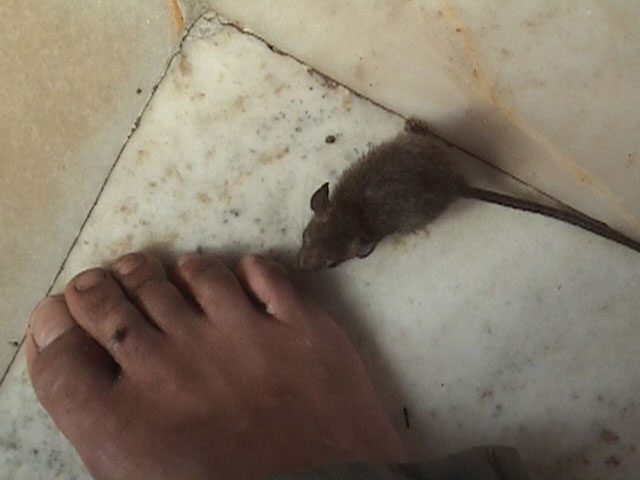
There weren’t really as many rats running around as I thought there would be; I expected it to be one big rat rave, like a big furry moving carpet, but the rats were pretty subdued as rats are, hiding in corners or in the insides of walls — although one curious rate came over to me to nibble on my foot (picture above). I guess that means I was blessed.
THAT AFTERNOON I WENT TO SEE CREATURES of a bigger size, creatures also with four legs, but with big humps on their backs: camels. Seven kilometers out of Bikaner in the middle of the desert, was the Camel Breeding Center, still in operation today since its origins during the days of the ancient Silk Route. An auto-rickshaw driver took me there and waited for me by the entry gate for me to finish. I signed into the logbook and saw the names above mine: “Martina” and “Michael.”
The Austrian couple was there, after recuperating from a night of Michael’s heat-related fever and Martina’s worrying and nursing of him. They invited me to tag along their short guided tour they were on and we saw the things one sees at a camel farm: lots of camels. Camels walking, camels eating, and camels just sort of hanging out in stables — everything but camels actually breeding. The in-ranch Camel Museum explained the different kinds of camels in the region (Jaisalmer, Kachchi and Bikaneri) and the versatility of camel-related products, from utensils to textiles to “decorative” camel fetuses. It didn’t stop there; camels had also been used once to generate electricity and camel milk is of great importance; not only did it produce milk for the desert people, but camel milk was known to aid in the treatment of tuberculosis victims. Camels were bred for all these purposes, but more significantly for camel safaris, the big thing to do in the region if you had the time and money. (Those of you Blogreaders using this Blog for research for your own trip, a camel safari is a “must do;” I was only skipping out on it due to time restrictions and the fact that I’d done one in Morocco already.)
I MET THE AUSTRIANS back in town at a restaurant recommended in my guidebook, one of the few ones that actually served meat, but when we got there, nothing was being served in accordance with the Muslim fasting season of Ramadan, when food was not to be consumed until after sundown. We looked elsewhere in town for a place that was open before sunset and finally found the Suraj Restaurant, serving Hindus not practicing the Muslim custom. Although no meat was served, it was a good place for proper food, particularly the Kashmir Pullav rice dish I ordered with savory spices and fruits, garnished with a silvery substance that looked like aluminum foil (but edible). For the Austrians and I it was a sort of farewell dinner; I’d leave that night on an overnight sleeper bus to Udaipur, while the two would stay another night and leave early the next morning to Jaisalmer for a camel safari.
“May we invite you for dinner?” Michael asked me. I was confused because we had just eaten.
“Treat you to dinner,” his girlfriend corrected his English. “May we treat you to dinner.”
“No, it’s okay, I can pay.”
“No, really. Our treat.”
I gave a respectful hesitant pause before saying, “Yeah, okay, sure.” Turn down a free meal? Shiet, no way! Michael paid the tab and they sent me off on my way. I suppose that’s how Austrians say goodbye.
I BOARDED THE OVERNIGHT SLEEPER BUS of private bus company Nandu Travels — it was the only way to get to Udaipur since there was no direct train. The bus took me southbound, away from the camels and the rats nibbling on my feet.
Next entry: Remembering Bond
Previous entry: Celebrities
Commenting is not available in this channel entry.
Comments for “Holy Rats and Camel Humps”
Cmon, it is mumbai time…...! I want news, I want news of good old Mumbai!
Posted by .(JavaScript must be enabled to view this email address) on 11/09 at 03:27 PM
HAPPY DIWALI EVERYONE! I haven’t really mentioned it in the entries, but it’s really beginning to look a lot like Christmas here, except here the holiday lights and gift exchange all over India is for the Hindu holiday of Diwali, the Festival of Lights, instead.
I’ve been invited to celebrate Diwali in true authentic Indian form with DUSTY’S friend Cuckoo and her family here in the northern suburbs of Bombay where I am writing this on a surprisingly fast dial-up connection.
I’m still a couple of days behind, so bear with me. More to come!
Posted by .(JavaScript must be enabled to view this email address) on 11/09 at 03:27 PM
DUSTY: To sum up really quickly, I think Mumbai is great. It reminds me of Miami in many ways… I’m here at Cuckoo’s in Thane. Happy Diwali!
Posted by .(JavaScript must be enabled to view this email address) on 11/09 at 03:29 PM
so do you think splinter was one of those sacred rats to teach those turtles?
haha….
“hey isn’t that the pizza guy from TMNT2?” said the rat to the other rat after seeing Erik….
Posted by .(JavaScript must be enabled to view this email address) on 11/09 at 05:05 PM
rat1 to rat2: “nah, man .. thats Rufio” ...
Posted by .(JavaScript must be enabled to view this email address) on 11/09 at 05:18 PM
Erik, I realize I don’t know you personally, but have really enjoyed reading your Blog everyday. You have mentioned your interest in travel writing before, and thought this article would interest you.. about the pitfalls of freelancing. I don’t know when you will be able to read it…
http://mediabistro.com/articles/cache/a3169.aspPosted by .(JavaScript must be enabled to view this email address) on 11/09 at 06:22 PM
Snakes… Why’d it have to be snakes.
Posted by .(JavaScript must be enabled to view this email address) on 11/09 at 08:32 PM
Oh wow those are cute rats! Ugh!
Erik….in your bare feet did you step on any rat shiet???
You haven’t mentioned your leg lately…how is it doing?
Liz is still having lots of earthquakes….2 in a row yesterday.
I’ve gotta say I am not impressed by India, but still a very interesting read.Posted by .(JavaScript must be enabled to view this email address) on 11/09 at 10:56 PM
How come those rats are somewhat cute? They look nothing like the huge, scary sewer rats that you see here. Those things are foul. indian rats look like mice almost!
Posted by Liz on 11/09 at 11:08 PM
Those rats don’t compare to the ones here in New Yawk…release one of our rats out there in that temple and it’ll kick all their asses!

Word Life.
Moman!!
Posted by Supreme Moman on 11/10 at 12:23 AM
New York rats might be kicking ass, but they ain’t Holy….
Posted by .(JavaScript must be enabled to view this email address) on 11/10 at 02:22 AM
Rats, snakes and cows all over the place…........not my cup of tea. But, I agree with Rose, still an interesting read as always!
Posted by .(JavaScript must be enabled to view this email address) on 11/10 at 02:45 AM
KIRSTEN: Thanks for the article. Actually MediaBistro is what made me what I am today (whatever that means). It’s because of the travel writing course I took with them that I got my “big break” in New York media… Plus their networking socials aren’t bad either…
Posted by .(JavaScript must be enabled to view this email address) on 11/10 at 03:54 AM
ROSE / JANICE: Interesting reaction; I actually think India is a lot more interesting than what I thought it would be. Most travelers have only told me of all the hassles and touts, etc., but all that aside, you forget that India was once a great empire and has all this history.
Anyway, I’ll be getting to the Octopussy stuff in the next couple of entries…
Posted by .(JavaScript must be enabled to view this email address) on 11/10 at 03:58 AM
LIZ: That’s because they are holy rats.
Another two tremors? Insane! You think the “big one” is at the end of all this?
Posted by .(JavaScript must be enabled to view this email address) on 11/10 at 04:00 AM
ROSE: Yes, that’s a little rat turd on my index toe.
AS FOR MY LEG, it’s healing slowly but surely I think. It’s still there though, which is why I’m probably going to skip out on the Indian beach scene (Goa, Kerala) since I’m not in full beach mode yet. (It should be healed by Thai beach time.)
Posted by .(JavaScript must be enabled to view this email address) on 11/10 at 04:03 AM
BILL: Asps. Very dangerous.
Posted by .(JavaScript must be enabled to view this email address) on 11/10 at 04:05 AM
You go first….
Posted by .(JavaScript must be enabled to view this email address) on 11/10 at 04:49 AM
Erik - I hope it isn’t the big one, but if it is, nothing I can do about it, so why worry? The one on Tuesday morning woke me up (I was wondering why I was suddenly awake a 4am) and I actually didn’t feel the one on Tuesday evening. Must be because of the building I was in - it is one of the few that survived the fire bombing in WWII. Heck, it is one of the few buildings more than 30 years old LOL. I figure the building is indestructible.
Posted by Liz on 11/10 at 05:25 AM
Happy Diwali!! Enjoy the celebrations this weekend!
Posted by .(JavaScript must be enabled to view this email address) on 11/10 at 01:07 PM
YVETTE: Isn’t Diwali like the best holiday in the world?
Actually it sounds like Iraq out here.
Posted by .(JavaScript must be enabled to view this email address) on 11/10 at 01:15 PM
i’d have to say that i had only 1 eye open when clicking on those rat pics.
I HATE RODENTS!!!! AAAAHHHHHHH!!!
Erik: interestingly enuff, this past monday, they had Fear Factor NYC Edition. They ate blended rats and they showed Joe take one and dropping it in the blender and hitting the button. ugh.
Posted by .(JavaScript must be enabled to view this email address) on 11/10 at 01:57 PM
Liz…..what are you gonna do when they demolish your apartment building? (slated to be torn down in the next year!) Will you be able to find another solid building that can handle all these earthquakes????LOL
Posted by .(JavaScript must be enabled to view this email address) on 11/10 at 02:02 PM
AWWWW!!! they’re so cute!!!! i love rats. and mice. and hamsters. and all other rodents. that one that nibbled on your foot was probably wondering if you tasted like chicken. =)
Posted by .(JavaScript must be enabled to view this email address) on 11/10 at 03:29 PM
ALICE: My feet DO taste like chicken! hahaha
Posted by .(JavaScript must be enabled to view this email address) on 11/10 at 05:02 PM
SORRY FOR THE DELAY on the next entries… Like I said, it’s the big Diwali holiday here and I’m all into the pyromaniac festivities…
Posted by .(JavaScript must be enabled to view this email address) on 11/10 at 05:03 PM
ah rats! any wayz, it’s snowing in the mountain and warren miller came out w/ his new movie:
http://www.warrenmiller.com/wmiller/trailer/index.htmllet it snow let it snow let it snow!!!! N

Posted by .(JavaScript must be enabled to view this email address) on 11/10 at 05:19 PM
I’m torn between thinking the rats are cute and disgusting. I think it’s the walking barefoot through rat feces that bothers me. I’ve heard of that temple. I think roaches are worse. At least mice kind of have a personality.
Can’t wait to read about the pyromaniac festivities!
Posted by .(JavaScript must be enabled to view this email address) on 11/10 at 05:45 PM
beware of chocolate sprinkles….they all could just be rat droppings….
Posted by .(JavaScript must be enabled to view this email address) on 11/10 at 05:55 PM
I’m with Sara. I went the what I dubbed The Roach cave in Malaysia. We walked under a low roof literally coverd with thousands roaches just above our heads! It was all I could do not to start screeming and running around in circles!
Posted by .(JavaScript must be enabled to view this email address) on 11/10 at 07:46 PM
The rats are cute. Reminds me of hamsters I had when I was a little kid… I used to pet them and play with them and…
Posted by .(JavaScript must be enabled to view this email address) on 11/11 at 12:27 AM
The pic of the drinking rat is pretty much the only I like of the rats… not a big fan, ew.
Good to know about your leg - thanks… trying to figure out if I can make it out of the country just now… seriously.
Posted by .(JavaScript must be enabled to view this email address) on 11/12 at 06:34 AM
Hi Erik,
the austrian couple from bikaner is writing to you - and my english is not better yet..
we are now in jaisalmer, where we had a really nice camel safari - but as you suspect: i kept on having my problems with the stomach and fiever - not the best thing to ride a camel at high temperatures…
anyway, we are enjoying our trip and wishing you the best
MichaelPosted by .(JavaScript must be enabled to view this email address) on 11/12 at 06:59 AM
Hi Erik,
We just read about us in your bloq! We are at the moment stranded in Jaisalmer where we liked it so much, that we stayed for a week - we wanted to travel on to Jodhpur today but due to the Diwali festival no buses are going today - so having seen all the sights to see we are interenetting. We are still thinking of ways to getting to GOA but havent found a quick way yet. Hope you have a good time!
Posted by .(JavaScript must be enabled to view this email address) on 11/12 at 07:00 AM
MICHAEL/MARTINA: Hey there! I didn’t make it to Goa; I’m on the other side of the country now, all on a whim, so I probably won’t bump into you again… at least not for the time being! Keep in touch!
Posted by .(JavaScript must be enabled to view this email address) on 11/15 at 04:19 AM
hi ,
i also have gone there and looked that there are many mouse who don’t affreid to peoples and runs here and there ..the people know that all the rats are holy at there plaCE ..
narayan singhPosted by rajsamand on 11/16 at 10:08 AM
Before I even started reading I thought: “Rats. Dad would never have made it. He hates rats! Scared to death of ‘em.” Second thought was at least it wasn’t snakes.
Posted by .(JavaScript must be enabled to view this email address) on 11/18 at 08:02 PM
SHARE THIS TRAVEL DISPATCH:
Follow The Global Trip on Twitter
Follow The Global Trip in Instagram
Become a TGT Fan on Facebook
Subscribe to the RSS Feed
This blog post is one of over 500 travel dispatches from the trip blog, "The Global Trip 2004: Sixteen Months Around The World (Or Until Money Runs Out, Whichever Comes First)," originally hosted by BootsnAll.com. It chronicled a trip around the world from October 2003 to March 2005, which encompassed travel through thirty-seven countries in North America, South America, Africa, Europe, and Asia. It was this blog that "started it all," where Erik evolved and honed his style of travel blogging — it starts to come into focus around the time he arrives in Africa.
 Praised and recommended by USA Today, RickSteves.com, and readers of BootsnAll and Lonely Planet's Thorn Tree, The Global Trip blog was selected by the editors of PC Magazine for the "Top 100 Sites You Didn't Know You Couldn't Live Without" (in the travel category) in 2005.
Next entry:
Remembering Bond
Previous entry:
Celebrities
THE GLOBAL TRIP GLOSSARY
Confused at some of the jargon that's developed with this blog and its readers over the years? Here's what they mean:
BFFN: acronym for "Best Friend For Now"; a friend made on the road, who will share travel experiences for the time being, only to part ways and lose touch withThe Big Trip: the original sixteen month around-the-world trip that started it all, spanning 37 countries in 5 continents over 503 days (October 2003–March 2005)
NIZ: acronym for "No Internet Zone"; a place where there is little to no Internet access, thus preventing dispatches from being posted.
SBR: acronym for "Silent Blog Reader"; a person who has regularly followed The Global Trip blog for years without ever commenting or making his/her presence known to the rest of the reading community. (Breaking this silence by commenting is encouraged.)
Stupid o'clock: any time of the early morning that you have to wake up to catch a train, bus, plane, or tour. Usually any time before 6 a.m. is automatically “stupid o’clock.”
The Trinidad Show: a nickname of The Global Trip blog, used particularly by travelers that have been written about, who are self-aware that they have become "characters" in a long-running story — like characters in the Jim Carrey movie, The Truman Show.
WHMMR: acronym for "Western Hemisphere Monday Morning Rush"; an unofficial deadline to get new content up by a Monday morning, in time for readers in the western hemisphere (i.e. the majority North American audience) heading back to their computers.
1981ers: people born after 1981. Originally, this was to designate groups of young backpackers fresh out of school, many of which were loud, boorish and/or annoying. However, time has passed and 1981ers have matured and have been quite pleasant to travel with. The term still refers to young annoying backpackers, regardless of year — I guess you could call them "1991ers" in 2013 — young, entitled millennials on the road these days, essentially.
Spelling or grammar error? A picture not loading properly? Help keep this blog as good as it can be by reporting bugs.