What A Difference A Day Makes
This blog entry about the events of Tuesday, July 13, 2004 was originally posted on July 19, 2004.
DAY 269: July 14th may just be a random summer day to others in the northern hemisphere, but in France it is Bastille Day, the independence day of the French republic, a day of national celebration and, as Let’s Go so eloquently puts it, “a time of glorious firework displays and equally glorious alcohol consumption.” Paris, the governmental center of France had no inhibitions of celebrating the national holiday in a big, big way — so big that the huge Bastille parade on the Avenue des Champs-Elysées altered the normal morning rush hour Metro service.
My big Bastille Day plan had nothing to do with France, but with Russia and China, as I woke up early to get my passport with new Russian visa at the Russian embassy in one part of town in time to rush over to the Chinese consulate in another part. A straightforward plan, but with one possible glitch: I had applied to be in Russia exactly July 30th to August 13th, forgetting that my travel agent reserving train tickets for me couldn’t get me out of Russian and into Mongolia without a night stay over in a town on the way — the direct train must have been full — meaning I’d technically be in Russian until August 14th. Whether or not that one day of being in transit made a difference or not I wasn’t sure. I crossed my fingers and hoped they’d just give me a standard 30-day tourist visa like my Lonely Planet Trans-Siberian Railway guidebook said.
“I NEED TO EXTEND my stay another night,” I asked the hostel’s reception clerk the way I did the morning before with no problems. The Centre International de Paris hostel didn’t take individual reservations and you had to check each morning to see if there was space available for another day.
“We’re full tonight,” she said, explaining that a big school group was arriving later on. “But wait until later to see if someone checks out.” I put my name on the waiting list and prayed I wouldn’t have to sleep out on the street that night (or worse, pay 50 euros for a place to stay). I moved my packed my bags as everyone else was still sleeping, and put my valuables in a locker in case my stay there was over.
Bastille Day festivities closed some roads down, even for pedestrians, and I had to walk around the block just to get to my closest Metro stop. Some Metro stops were closed en route to my transfer point, but it didn’t really affect my commute to the Russian embassy. I transferred at Etoile Charles de Gaulle and got off at the Porte Dauphine stop, at the end of the No. 2 line, the closest stop to the embassy, still about a quarter of a kilometer away on foot. The one advantage to it being Bastille Day was the visa line wasn’t nearly as long as the day before; I simply went to the passport pick-up counter with my receipt and got it in fifteen seconds. Inside my passport, on a visa sticker taking up a full page, the ink from a dot-matrix printer spelled out: “30.07.04/13.08.04.” I went back to the tourist visa line to investigate — this time around I was only fourth in line with no travel agents cutting head with groups of passports.
“Hi, remember me?” I said to the same Russian immigration officer as the day before.
“Yes,” he said in his Russian accent.
“My visa is only until the thirteenth, but my agent couldn’t get a train out of Russian until the fourteenth. Does it matter?”
“Yes, you must have the exact dates, but you can extend your visa in Russia,” he said. “But if you do you will be at the hands of local police and it will be at their discretion. It’s probably better to get it before you enter Russia.”
“What can I do? Can I get a transit visa for that one day?”
“You can’t have two visas at the same time. You will either extend your visa in Russia with local police or apply for a new visa.”
I opted for the safer option. “Um, can I have an application?”
FILLING OUT THE FORM was easy, especially since I had a photocopy of my previous application and just copied it. The tricky part was attaching a passport-sized photo to it — I didn’t have any on me. I thought I could get away with tearing out the black and photo photocopy of my face from a photocopy of my passport, but the immigration officer just rolled his eyes.
“Just get a photo at a machine at the RER station,” he said. “All the RER stations have photo booths.”
With two hours before closing, I ran off.
THE RER, the other commuter train network in Paris extends out to the suburbs where the Metro doesn’t go. Conveniently enough, one of the RER stations was right by the Porte Dauphine Metro stop a quarter kilometer away, so I walked over thinking I could get photos in a snap — but the station didn’t have an automatic photo booth. The ticket desk there told me to go to the next station, so I ran the quarter kilometer back towards the embassy and another quarter kilometer the other way to the next station. Inside was a photo booth. Cool, I’ll take it in a snap and walk back. But the screen of the booth had a message on its screen. “Je ne peux pas faire les photos maintenant.” (“I can’t make photos now.”)
Tapped out of RER stations within walking distance of the embassy, I hopped on a commuter train outbound towards the suburbs with less than two hours to spare. I ran upstairs of the next stop to found a photo booth — but with a taped note on it. “Ne functione pas.” I was really starting to hate Paris.
Fuck! What should I do, what should I do… Go one more stop into the suburbs or back the other way beyond the first RER station I checked? Not much time to think, so I decided to go back towards the city, three stops away in a neighborhood across the Seine. The frequency of RER trains was half of the Metro (if not less) and I paced back and forth like a guy with diarrhea waiting for a public toilet to open up.
On the north side of the Seine I finally lucked out and got my picture taken by a machine. I dashed back off to the embassy with less than an hour before closing time. Lucky for me, there was a pair of scissors and some glue in the security office and in no time I was back in front of the young Russian immigration officer.
“You got the photo?”
“Yeah,” I replied, still catching my breath. “All the photo booths around here were broken.”
The Russian took my documents like he did the day before when it was a lot more crowded — I was just one of five civilians this time — and he went through the mental process over again, flipping through my documents. “It says here the fourteenth,” he pointed out as if we never had a conversation before about my dilemma of extending my visa a day. “You need to have a detailed itinerary for more than two weeks.” He also pointed out the other discrepancy — my host invitation only had me in Russia for three days — which he let slide the day before.
“But I just need the extra day because of the train,” I begged, pointing out that I already had a visa up until the thirteenth. I showed him a printout of an e-mail from my Siberian travel agent in Boston with the confirmed date of the departure on the fourteenth.
“Sorry, anything beyond fifteen days requires a detailed itinerary.”
I caught him on his slip of English (or inability to do math); he said fifteen, not fourteen.
“But it is fifteen days! The thirtieth to the fourteenth is exactly fifteen days.”
The Russian counted out the days on a calendar. “Okay, I’ll give it to you,” he said with his stern Russian accent, “but next time, you should know to have all the documents and details.”
“I know, I know,” I said with relief. “It’s just because of the train situation.” He handwrote “14/8/04” on my host invitation form, initialed it, and told me to go to the other window. That window took my passport and my documents and directed me to another window where I shelled out a whopping 122 euro for one-hour service — sixteen more than what I paid the day before for 24-hour service. The Russians let me wait in the waiting room beyond the 12 o’clock visa office hours to wait for it, and in 60 minutes I had an annulled old visa and a new one on the next page.
As I left the waiting room, I saw on the television that the parade was over. I had missed all the big Bastille Day festivities. It was passed noon so my plan to rush off to the Chinese consulate went bust. Half an hour later, I went back to the hostel to check on the room situation — nothing opened up and I was evicted. I really hated Paris.
AFTER A MUCH NEEDED LUNCH CHILL OUT SESSION at a sidewalk cafe that had 20 minutes of free Wi-Fi internet service, I went off to the affiliated hostel on the other side of town to find a place to crash for the night.
“Hey!” called a familiar face from the other hostel in the Latin Quarter. It was Evan, my Mexican dorm mate from the dorm I just got kicked out from — he had been evicted too and was forced to find another place in town. Luckily for us we had managed to snag the last two male dorm beds in the place. For Evan, moving around would only be temporary; he was waiting for an apartment because he was to live in Paris for a couple of months to study at the legendary Cordon Bleu culinary arts school. We chat for a bit and made tentative plans to meet later that night.
I went for a sightseeing stroll that afternoon, seeing some of the standard sights in the city on the Seine: the outside of the Sorbonne, one of Europe’s oldest universities; the solar-responsive metal iris windows of the Institut de Monde Arabe; Notre Dame and the bateaux mouches cruising up and down the Seine nearby; the crowds lining up for the other big event of the day, France’s opening day for Spiderman 2; and the Quartier Mouffetard, Hemingway’s old neighborhood and home of arguably the city’s best ice cream at the Octave parlor. A scoop of chocolate and sesame made me happy, and Paris started to grow on me again after a crazy morning.
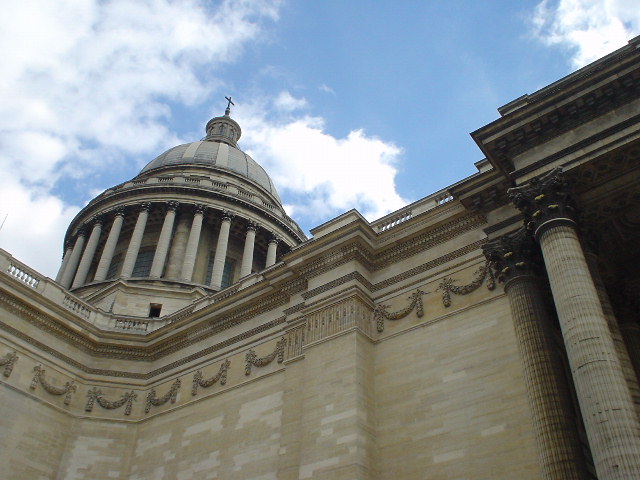
There were a couple of small Bastille Day-related celebrations around town as I wandered. An army band played amidst tanks parked in front of the Pantheon (other picture above), which houses the tombs of some of France’s great heroes, including Victor Hugo, Louis Braille and Voltaire. Another smaller band played in a gazebo in the Jardin de Luxembourg, home of the eponymous palace, trees cut into rectangle shapes, and kids’ little sailboats floating around a fountain.
But surely there was some other big Bastille Day celebration I could witness since I missed the big one that morning dealing with Russian bureaucracy. Yes, there was one place left to see to go out of Bastille Day with a bang.
THE EIFFEL TOWER. The former holder of the title, “world’s tallest structure,” the metal monument was created in 1889 as the centerpiece of the Universal Exposition. Since then, the “300-meter flagpole” (as designer Gustave Eiffel once called it) has become the definitive icon of Paris and all of France for that matter. Every year on July 14th it becomes the centerpiece of a spectacular sound, light and firework show in celebration of French independence.
I was planning to meet up with Evan for the fireworks, thinking I’d just run into him on the Champs de Mars, the park fields underneath the famous tower — until I arrived and saw the mob of people. I gave up on looking for him and snagged a perfect spot for the show, which started at nightfall. Light beams shot out of the tower as fireworks lit up the sky with tremendous booms, all in sync with Oriental-influenced new age music. After the final boom, the tower continued to be lit, with additional sparkily lights like chasers in a Christmas tree. After a crazy, depressing morning over matters of a day in the future, the nighttime sight that day revived the good in Paris for me all over again.
Next entry: Dead End
Previous entry: Paris Lost
Commenting is not available in this channel entry.
Comments for “What A Difference A Day Makes”
first? excellent stuff Erik. damn big school groups! then again, group rates rule.
Posted by .(JavaScript must be enabled to view this email address) on 07/19 at 02:59 PM
don’t you just love free wi-fi spots, even if it’s only for 20 minutes?
ahhh…
Posted by .(JavaScript must be enabled to view this email address) on 07/19 at 03:04 PM
Wow this is a “first” for me!
Posted by .(JavaScript must be enabled to view this email address) on 07/19 at 03:11 PM
Damn…......thought I had it.
Posted by .(JavaScript must be enabled to view this email address) on 07/19 at 03:13 PM
THANKS NEVEN for your pledge! Postcard is on the way!
Posted by .(JavaScript must be enabled to view this email address) on 07/19 at 03:23 PM
When is Lara coming back into the story?
Posted by .(JavaScript must be enabled to view this email address) on 07/19 at 03:59 PM
waiting in line truly suck…but we’re glad you ended your day with a bang!
btw, what did u eat for lunch? salmon?
Posted by .(JavaScript must be enabled to view this email address) on 07/19 at 05:01 PM
That pic of Notre Dame makes it look much bigger - more of what I thought it would be. It’s all about perspective. The Eiffel Tower in Vegas never looks like that - thanks for the picture!
Posted by .(JavaScript must be enabled to view this email address) on 07/19 at 05:21 PM
Yum Yum…you made me hungry. Great lunch, salmon, bread & wine. Perfect! Hope you enjoyed it!
Posted by .(JavaScript must be enabled to view this email address) on 07/19 at 05:34 PM
ERIK: I could have directed you to a hostel for 20 euro a night where an Aussie friend of mine works. Let me know if you still need a place.
Posted by .(JavaScript must be enabled to view this email address) on 07/19 at 06:05 PM
a little birdie told me that ERIK next stops are to (as he is no longer in gey paris):
Berlin, Amsterdam, Luxemborg, (just to name a few)...
so if you have any suggestions for those spots, post at them up at will..
Posted by .(JavaScript must be enabled to view this email address) on 07/19 at 07:07 PM
I’d be jumping over a counter and strangling someone. One of the goals of my RTW is to learn patience… I think I hear my husband laughing hysterically in the background.
I was wondering if you were in Paris during the fireworks - I looked for you on TV LOLPosted by Liz on 07/19 at 07:27 PM
It starts to get dark around 9 there? It starts to get dark around 1 in morning here.
...visas are such a hassle.
Posted by .(JavaScript must be enabled to view this email address) on 07/19 at 08:59 PM
NICOLE (AK): Wow! Sebastian (Morocco) was telling me about some sort of festival around this time in the Yukon, where they watch the sun dip under a mountain but never set and then rise again 20 minutes later… Insane…
BTW, where are you in AK?
Posted by .(JavaScript must be enabled to view this email address) on 07/19 at 09:09 PM
BRENL: Dunno… Perhaps her apperance on “The Trinidad Show” is over; she said her next trip would most likely be Africa, and that “season” of the show is over already…
Posted by .(JavaScript must be enabled to view this email address) on 07/19 at 09:10 PM
BEAR WITH ME… I’m really behind now… I’m almost caught up on paper, so I’m almost there… My last dorm didn’t have convenient electrical outlets, and my laptop battery’s dead…
OH HEY! It’s the 20th of July… It’s been exactly NINE MONTHS since The Trip began…
Posted by .(JavaScript must be enabled to view this email address) on 07/19 at 09:28 PM
Hey E! I don’t know about anyone else but .. I say that was a quick 9 months .. Congrats dude ..
Posted by .(JavaScript must be enabled to view this email address) on 07/19 at 09:45 PM
9 months already? wow. In the words of the french - j’aime le blog!
Posted by .(JavaScript must be enabled to view this email address) on 07/19 at 10:35 PM
Awesome pics of the Eiffel Tower!!!
Posted by .(JavaScript must be enabled to view this email address) on 07/19 at 10:54 PM
Wow time flew. How are your funds Erik? Think you’ll make it to the 16th month?
Posted by .(JavaScript must be enabled to view this email address) on 07/19 at 11:16 PM
Congrats on 9 months!
Posted by Liz on 07/20 at 05:35 AM
Well, the military dad and daughter are out:( They were my favorite, most down-to earth team…figures they wouldn’t last…(plus I think I got a crush on the daughter now, lol…)
Erik-Congrates on the nine months! Jeez, it sure has gone quickly…for me that is, don’t know about you, lol…
-Harry
Posted by .(JavaScript must be enabled to view this email address) on 07/20 at 06:29 AM
HARRY - Marsha (the daughter) was definitely a cutie pie.
Posted by .(JavaScript must be enabled to view this email address) on 07/20 at 06:57 AM
I’m on the Kenai Peninsula.. South of Anchorage…The city of Kenai to be specific.
Yeah, I’ve never heard of that festival but I’m sure its kickin’.
hehe..
I biked 25 miles straight today!! yay for me!
Posted by .(JavaScript must be enabled to view this email address) on 07/20 at 07:21 AM
That’s so lucky you got to be there on bastille day. Or did you plan that?
And thanks for the great tips on what to do in Paris, I’ll be there for my first time next week!Posted by .(JavaScript must be enabled to view this email address) on 07/20 at 08:08 AM
Damn erik! That looked like the perfect save at the end of a horrible day. The fireworks celebration must have been amazing!! Horay for ya! To second Melisa, did you plan to be there to catch the Bastille day celebration? BTW, the solar-responsive metal iris windows of the Institut de Monde Arabe looks damn cool.

Posted by .(JavaScript must be enabled to view this email address) on 07/20 at 08:38 AM
Oh man, I should’ve downloaded AR5 before checking here LOL I have to wait until it comes up on the net cuz I don’t get it here :(
At least the bowling moms are still in!Posted by Liz on 07/20 at 02:46 PM
AR5: I don’t get it - complaining about eating CHOCOLATE? That would be my perfect task! Certainly better than eating live slugs or roasted beetles….....
Posted by .(JavaScript must be enabled to view this email address) on 07/20 at 03:08 PM
Liz- Yikes…sorry for the spoiler, I should have noted it as so.
Posted by .(JavaScript must be enabled to view this email address) on 07/20 at 05:58 PM
“Oh what a difference a day makes… 24 little hours” Who remembers that song from Run Lola Run?!
Congratz Erik! I’m sorry, I don’t usually let the 20th go by unacknowledged but I was hella busy yesterday.
Posted by .(JavaScript must be enabled to view this email address) on 07/20 at 06:17 PM
Harry - no worries
I didn’t expect to download it until tomorrow anyways… and the sucking speed it is downloading at, it probably will be tomorrow by the time it is done!
Just don’t tell me if the bowling moms get eliminated - they are currently my fav team!Posted by Liz on 07/20 at 06:43 PM
Let’s play a game all….where is Erik??? (Like where is Waldo!) Not due to be in Russia until the 30th but not in Paris….uhm LOL
Posted by .(JavaScript must be enabled to view this email address) on 07/20 at 07:40 PM
ROSE: Good suggestion… Yes, Where in the World is Erik Trinidad?
Posted by .(JavaScript must be enabled to view this email address) on 07/20 at 07:45 PM
NO, I DIDN’T PLAN ON BASTILLE DAY… it was just a coincidence…
Posted by .(JavaScript must be enabled to view this email address) on 07/20 at 08:20 PM
Where in the World is Erik Trinidad?
Being promoted to Sleuth by host Greg Lee on Where in the World is Carmen Sandiego, I think I can catch him.
But maybe not if the help of BH’s that will house Erik on the way.
LIZ - If you’re RoboCrook, I’ll definitely catch you!...
Posted by .(JavaScript must be enabled to view this email address) on 07/20 at 08:22 PM
Question from the un-Frenchified: what is the Institut de Monde Arabe? And what exactly do those solar panels do that makes them so special?
MELISA: add a visit to Sant Chapel (spelling?). It’s architecture and stained glass will blow your mind!
Posted by .(JavaScript must be enabled to view this email address) on 07/21 at 12:49 AM
Christy: thanks for the tip, I’ll definantly put that on the list.
Posted by .(JavaScript must be enabled to view this email address) on 07/21 at 09:43 AM
CHRISTY: Institute of the Arab World. Really big deal in Paris… recommended on all the walking tours… unfortunately it was closed so I only got to see it’s famous windows done in modern Arab style… Supposedly the irises of each window close and open depending on the level of sunlight, keeping the indoor ambient light from outside consistent… no computer screen glare!
Posted by .(JavaScript must be enabled to view this email address) on 07/21 at 05:55 PM
Hey Eric,
No passionate kissing with a french girl under the fireworks at the Eiffel Tower?
That would have been the perfect end to the day.
Cheers.
Posted by .(JavaScript must be enabled to view this email address) on 07/23 at 12:41 AM
SHARE THIS TRAVEL DISPATCH:
Follow The Global Trip on Twitter
Follow The Global Trip in Instagram
Become a TGT Fan on Facebook
Subscribe to the RSS Feed
This blog post is one of over 500 travel dispatches from the trip blog, "The Global Trip 2004: Sixteen Months Around The World (Or Until Money Runs Out, Whichever Comes First)," originally hosted by BootsnAll.com. It chronicled a trip around the world from October 2003 to March 2005, which encompassed travel through thirty-seven countries in North America, South America, Africa, Europe, and Asia. It was this blog that "started it all," where Erik evolved and honed his style of travel blogging — it starts to come into focus around the time he arrives in Africa.
 Praised and recommended by USA Today, RickSteves.com, and readers of BootsnAll and Lonely Planet's Thorn Tree, The Global Trip blog was selected by the editors of PC Magazine for the "Top 100 Sites You Didn't Know You Couldn't Live Without" (in the travel category) in 2005.
Next entry:
Dead End
Previous entry:
Paris Lost
THE GLOBAL TRIP GLOSSARY
Confused at some of the jargon that's developed with this blog and its readers over the years? Here's what they mean:
BFFN: acronym for "Best Friend For Now"; a friend made on the road, who will share travel experiences for the time being, only to part ways and lose touch withThe Big Trip: the original sixteen month around-the-world trip that started it all, spanning 37 countries in 5 continents over 503 days (October 2003–March 2005)
NIZ: acronym for "No Internet Zone"; a place where there is little to no Internet access, thus preventing dispatches from being posted.
SBR: acronym for "Silent Blog Reader"; a person who has regularly followed The Global Trip blog for years without ever commenting or making his/her presence known to the rest of the reading community. (Breaking this silence by commenting is encouraged.)
Stupid o'clock: any time of the early morning that you have to wake up to catch a train, bus, plane, or tour. Usually any time before 6 a.m. is automatically “stupid o’clock.”
The Trinidad Show: a nickname of The Global Trip blog, used particularly by travelers that have been written about, who are self-aware that they have become "characters" in a long-running story — like characters in the Jim Carrey movie, The Truman Show.
WHMMR: acronym for "Western Hemisphere Monday Morning Rush"; an unofficial deadline to get new content up by a Monday morning, in time for readers in the western hemisphere (i.e. the majority North American audience) heading back to their computers.
1981ers: people born after 1981. Originally, this was to designate groups of young backpackers fresh out of school, many of which were loud, boorish and/or annoying. However, time has passed and 1981ers have matured and have been quite pleasant to travel with. The term still refers to young annoying backpackers, regardless of year — I guess you could call them "1991ers" in 2013 — young, entitled millennials on the road these days, essentially.
Spelling or grammar error? A picture not loading properly? Help keep this blog as good as it can be by reporting bugs.