We Gonna Rock Down To Electric Avenue
This blog entry about the events of Monday, September 20, 2004 was originally posted on September 27, 2004.
DAY 338: Japanese technology can be seen all over the world, from a mobile phone in a remote town in Africa to a big home theater in Chicago, USA. Chances are that the very computer you are using right now to read this very Blog has some Japanese parts in it, if not all Japanese parts. Japanese technology has put the “modern” in “Modern World” as many everyday indispensable things originate from the electronic über-companies that are based in Japan, particularly Tokyo. In fact, Liz’s apartment was just across the street from the backside of Sony World Headquarters, with a windowless R & D wing guarding so many secret prototypes like a secure fortress — you couldn’t even park you car on the street outside.
Sony’s secret products eventually are made public and leave the factory, along with other hi-tech products produced by the other Japanese electronics companies, for worldwide distribution — as well as in the home country of Japan. In Tokyo, all these electronics can be found in the Akihabara neighborhood, a district full of so many multi-level electronics stores and video arcades that it is also known as “Electric Town.”
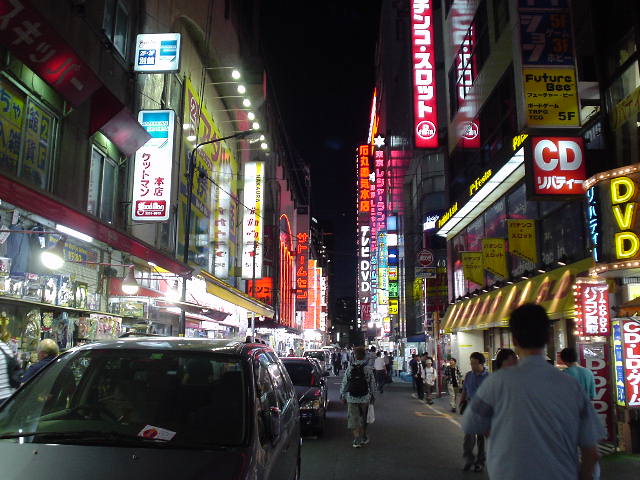
Going to Electric Town was a major culture shock to me, having been in really undeveloped places the past several months — Ethiopia and central China for example — and walking through its canyons of neon lights (picture above) I was reminded of a TV special in the 1970s, Rescue From Gilligan’s Island, where the castaways of the popular syndicated TV series are finally rescued after fifteen years from that uncharted desert isle and must adjust to life back in modern society. I remember the Professor (who never had a real name, am I correct?) was having an especially hard time trying to get back into inventing new things in his lab because he had missed out on so many leaps in technology since he left for that ill-fated three hour tour (three hour tour). Why he had problems I don’t know; the Professor could make radios and metal detectors out of dried up palm leaves and a couple of coconuts.
Anyway, one scene that came to mind was when Gilligan (played by Bob Denver, who will always wear that stupid fisherman’s hat if he wants a steady income) goes to visit the Professor in his lab. The Professor is sitting there in a lab coat, still stumped on ideas, probably due to the lack of coconuts. Gilligan tries to cheer him up by showing him something that had been invented since that the day the tiny ship was lost: a frisbee.
MY METAPHORICAL “FRISBEE” CAME NOT in the form of a flying disc but in the form of a mobile phone. Mobile phone technology had skyrocketed since I left New York in October 2003 and as I walked on through Electric Town I saw just what cell phones in Japan are now capable of. Not only could a cell phone be a low-resolution digital camera, an MP3 player and a PDA, but now it could come with optical zoom, simulated surround sound and videophone technology. One flip phone I saw actually doubled as a camcorder; the top part opened up then swiveled to the side so that you could use it like a traditional camcorder since the lens was mounted on the side of the hinge. Another phone I saw was actually a color television (antenna broadcast only though). My stroll through Electric Town showed me that phones are getting smaller, sleeker and smarter and one day we might push buttons through an easy-to-use interactive menu to order a pizza with mobile internet technology — so that we may never have to actually use the phone function to simply call and order that pizza from an actual person.
ELECTRIC TOWN WASN’T JUST ELECTRONIC STORES but electronic playgrounds with multi-level video arcades from Taito and Sega. Inside were titles of each respective gaming company, both new and old, attracted not only teenage boys and girls, but suited businessmen on their way home from work. Most of them went to play MJ2 — Mahjong 2 — although I had to wonder if they were really there to try their luck at a skill crane where one could win a dress.
After wondering around the video arcades and stores and with items I couldn’t yet afford to buy — but definitely drooled over (hey, I’m a guy) — I met Liz by the train station near a couple of street performers, a girl wailing out Japanese lyrics to the riffs from an electric guitar. Liz and I took a crowded rush-hour train out of Electric Town, sitting next to a middle-age man reading the porn section of a regular Japanese newspaper, and then went out to eat tonkatsu (food breaded and fried Japanese style) for dinner — real food that is, not the convincingly real plastic kind seen in the window of almost every restaurant in Tokyo. (Japan even has technology to make fake food look real.) After dinner we took the train back to the apartment using the train system’s electronic sensor debit cards — cards that will soon be placed in cell phones so that one can just use his/her cell phone to get around.
I may have been thirteen hours ahead in the future of North America’s eastern seaboard, but being in Tokyo felt like I was at least two years ahead. I’m sure if any company from another country tried to surpass the leaps in Japanese technology, they wouldn’t be able to do it. And even if they did, the Japanese would come back and surpass them again anyway — no matter how many coconuts they have.
Next entry: Things to Do When Your Wallet is Missing
Previous entry: Fugu Me
Commenting is not available in this channel entry.
Comments for “We Gonna Rock Down To Electric Avenue”
BEHIND THE SCENES: So, the day I met Sebastian in Marrakesh, Morocco, I got an e-mail from the Wall Street Journal, asking for an interview from me since they were going to do an article about the pros/cons of travel Blogs. I went back and forth with the reporter there via e-mail for months. And, so I’m told the article is out today (9/28) in the WSJ’s Personal Journal section.
Exciting? No. If the article is what they sent me in an e-mail I just got, mention of me and The Blog didn’t make the cut. In fact, out of the 50 or so people interviewed from the industry, only about three people have provided quotes in the final article.
I’m not sure if I’m mentioned in the actual PRINT edition; if you want to look into it, go ahead.
(FYI: This was part of the reason why I was behind on the Blog in Morocco/Europe.)
Despite how you may have interpreted my last rant on my internal Nepal debate, I’m still really 50/50; there are pros and cons either way. The polls are still open.Posted by .(JavaScript must be enabled to view this email address) on 12/31 at 07:00 PM
mmmmmmmmmmm, porn
Posted by .(JavaScript must be enabled to view this email address) on 09/27 at 06:09 AM
first!
My first “first”.
It must be because I too am in Tokyo.
Hey Erik, are you still in Tokyo (Sep 28?), if so, any interest in meeting my girlfriend and I for a drink? We found a great place for Sake.
Isn’t Tokyo amazing?
We’re one month into our RTW trip (Australia & New Zealand before here), if I could plug our megar site http://www.rtw2004.com, you can check it out.
If you are interested, you can email me at .(JavaScript must be enabled to view this email address).
Hope we can meet up—-
John & Melissa
Posted by Szlachta on 09/27 at 06:09 AM
Damn-
You “First” vultures are good—I spent too much time typing my msg.
I must rescind my First.
Posted by Szlachta on 09/27 at 06:12 AM
Hey, porn vulture I can live with, but first vulture? Never!
Posted by .(JavaScript must be enabled to view this email address) on 09/27 at 06:14 AM
GO NEPAL 5; NO NEPAL, 14. The polls are still open.
DAN’s link is quite interesting; the latest posts are from backpackers who just landed in Kathmandu and say everything is fine as long as you avoid the overly American areas. From my experience, the warnings posted by governments are usually an overreaction—there were warnings about going to Tanzania and Sinai; similarly there are warnings in other countries to avoid New York—and usually it’s okay. But there are also warnings (from the backpackers) not to trek solo—not that I would; I’d try and find a group to trek with—that is, if enough people are saying YES to Nepal too and will be there.
Keep in mind that dealing with Maoists on the trails is inevitable and has been for years—and people still go—it’s part of the experience so I’m told. (They usually give you a receipt for the items they take from you so you can claim on insurance.) Also keep in mind that my plan wasn’t to do the popular Annapurna Circuit; I was just going to fly into Kathmandu, acclimate for a day and then fly to Lukla, the closest airport to the base of Everest. I would hike from Lukla to Everest Base Camp, not all the way from Kathmandu.
I’m still 50/50 on Nepal but I’ll stick to my word and really put it in the voters’ hands (without having it ultimately come to only the votes from Florida). Assuming that the results kick Nepal out of the itinerary, I will go straight to India (which is not without it’s current political tension).
Assuming Nepal doesn’t win the election, where should I be for my 30th birthday on October 18? My plan was to ring in the Big Three-Oh at “the base camp of the tallest mountain in the world.” What superlative can top that? (Keep in mind that I’m really “churched out,” “templed out,” “shrined out,” “pagodad out,” “pyramided out,” etc.)
Posted by .(JavaScript must be enabled to view this email address) on 09/27 at 06:14 AM
how about sitting on the beach in Goa?
Posted by .(JavaScript must be enabled to view this email address) on 09/27 at 06:16 AM
SZLACTA: Let’s meet up tonight (28th)... I’ll email you details…
Posted by .(JavaScript must be enabled to view this email address) on 09/27 at 06:16 AM
TJW: Is Goa attached to any superlative?
Posted by .(JavaScript must be enabled to view this email address) on 09/27 at 06:17 AM
it just looks interesting to me. A friend (from India) places it high on his list of places to go.
Also, see the beginning of the Bourne Supremacy. The first 15 mins or so are all in Goa.
Posted by .(JavaScript must be enabled to view this email address) on 09/27 at 06:20 AM
ok ok…
You ONLY live once…
You ONLY turn 30 once…If it’s meant to be, it’s meant to be….I still say feel it out, there might be someone out there (SBR, or anyone else, or maybe even something cool that I don’t even know about (where’s that line from?
 ) that will lead you in our path to the base of the mountain…
but if, not…on the way to dehli, you must stop at pankot palace….and you must take the the LEFT tunnel, the LEFT tunnel…
Posted by .(JavaScript must be enabled to view this email address) on 09/27 at 06:42 AM
MARKYT: It was Will Ferrell in “Old School.”
Posted by .(JavaScript must be enabled to view this email address) on 09/27 at 06:46 AM
Look, birthdays are just an arbitrary thing. Time is a made up concept. Some physicists even argue that it doesn’t exist, unlike mass or distance. They say a more realistic measure would be entropy.
I don?t think you need a superlative experience for your 30th birthday after spending your 29th year like you have. Life?s not about topping your previous experiences, it’s just about growing. Like me, growing thirsty for another beer.
Cheers
Posted by .(JavaScript must be enabled to view this email address) on 09/27 at 06:48 AM
Man you guys are chatty tonight…
Posted by .(JavaScript must be enabled to view this email address) on 09/27 at 07:08 AM
Oh and I vote for Nepal, something good to tell the grand kids, if you make it.
Posted by .(JavaScript must be enabled to view this email address) on 09/27 at 07:12 AM
hah. i like Bill’s attitude. “If you make it.” lol
anyways, you sound like you wanna go to nepal…so i recind my “no” to a “yes”. You can also cross the sea north and head over to South Korea..and if you want to attach a superlative to that, think North Korean Border.
btw, the future is now. i ordered a Papa John’s pizza in Clifton thru the internet. Paid by credit card and recieved a confirmation via email. ah yes, if only Giligan’s Island had broadband they could’ve been stuck on the island with good food.
Posted by .(JavaScript must be enabled to view this email address) on 09/27 at 07:52 AM
btw…thanks for the sneak peak! btw, you do know the mission was to take a pic WITH the hotties right?
Posted by .(JavaScript must be enabled to view this email address) on 09/27 at 07:54 AM
As I’m a diver and have it from a friend, Sri Lanka is a wonderful place… you could maybe go diving in Goa and then get to Sri Lanka and dive there?? Just a thought. You’ve been diving on the East Coast of Africa, so maybe elsewhere? Could be fun…
Also, porn in the newspapers is ODD! Do you have to be of a certain age to buy them? That seems so strange.
Posted by .(JavaScript must be enabled to view this email address) on 09/27 at 08:04 AM
Also - even Toykyo has bad street performers, so no city is exempt from them… wow!
Posted by .(JavaScript must be enabled to view this email address) on 09/27 at 08:07 AM
i’ve got to say that San Francisco has pretty BAD street performers…
Go to Nepal cuz I’m off to Hurricane Country, either wise known as the land where votes don’t count tomorrow…
Posted by .(JavaScript must be enabled to view this email address) on 09/27 at 08:10 AM
And then we’ll take it higher….
Posted by .(JavaScript must be enabled to view this email address) on 09/27 at 08:39 AM
Hey Love Penny, Erik did take a pic WITH the booth bunny! And yeah, Electric town has all the goodies the japanese don’t export out of the country. We won’t see half that tech in the states for another 2 years.
Posted by .(JavaScript must be enabled to view this email address) on 09/27 at 08:48 AM
LOVE PENNY: Yes, ten (plus) photos WITH Japanese hotties… I’m five entries behind on the one that will post them… Stay tuned…
Posted by .(JavaScript must be enabled to view this email address) on 09/27 at 12:53 PM
TJW / NOELLE: Goa was always on my To See list, but not necessarily on Three Oh Day.
NOELLE: Porn in newspapers, Liz tells me, is fairly normal. They also run hard core anime porn and bukkake videos on TV around 10 p.m…
Posted by .(JavaScript must be enabled to view this email address) on 09/27 at 12:57 PM
BILL: So glad you got that… Woh-uh-ohh, we gonna rock down to… Electric Avenue, and then we’ll take it higher…
Posted by .(JavaScript must be enabled to view this email address) on 09/27 at 12:59 PM
GO NEPAL 8; NO NEPAL 12.
LOVEPENNY: Yes, I do feel like going; but am just as wary as all the people voting NO. I can’t tell if the warnings this time are the same “usual” paranoid ones issued every so often for other countries, or if this one is really the “real deal.” Peace Corps and the American Embassy pulled out people out of Kathmandu a couple of weeks ago; then again, they are known to be perhaps overly cautious.
ALSO, going to Nepal cuts into my India/SE Asia time…
Posted by .(JavaScript must be enabled to view this email address) on 09/27 at 01:19 PM
I think if you have any doubts that the warnings are not the usual paranoia….than don’t go. I originally voted yes, but am now recinding my vote to a no.
It is 9:00 am here and I am cursing you for putting that song in my head, I am sure it will be with me ALL day!
Posted by .(JavaScript must be enabled to view this email address) on 09/27 at 04:51 PM
Erik, I think whatever decision you make on Nepal is fine. I’m just worried. But that’s probably why you’re on a trip around the world and I’m not.
Posted by .(JavaScript must be enabled to view this email address) on 09/27 at 04:52 PM
Like you said, the Maoist’s have been part of “the experience” for a couple years now. There haven’t been any serious incidents with tourists being kidnapped or targeted to my knowledge. Not that I’m a commie or anything, but all of the news pouring out of Nepal about evil rebels comes from the govt. of course, and we know that all of that isn’t the clear truth.
I think if you do the obvious and avoid demonstrations, lay low in the capital, and stay with a group, you’ll be fine. You may even have the oppurtunity to talk with a Maoist rebel while trekking and hear their side (someone I’ve spoken with via email did just this).
How about Indonesia? Do you have plans to visit? The warnings to Indo have to be worse than Nepal, but besides a few incidents, it is a safe and welcoming country (outside the capital and northern sumatra).
Good luck with your decision. I’m voting again for YES - Hey, I’m from Florida so I wanna make sure you get my vote

Posted by Dan on 09/27 at 05:00 PM
Dude just “DO It! ” 30 I hear is just downhill after that… besides You don’t want to miss out on this ...
http://news.bbc.co.uk/2/hi/south_asia/3695426.stm
I’m sure you can use your chameleon skills to get around without even being noticed there.Posted by .(JavaScript must be enabled to view this email address) on 09/27 at 05:28 PM
i voted no, but seeing how you really want to go, and how you don’t look like an typical american, and how you wanted to do something “special” for the big 3-0, even though this whole trip is something incredible, then i’ll retract my “no” and give you a “yes”. but make sure you are very careful and you get a receipt for anything they take from you, though i don’t see how that works with the insurance companies.
Posted by .(JavaScript must be enabled to view this email address) on 09/27 at 06:12 PM
just don’t let them take your camera!
Posted by .(JavaScript must be enabled to view this email address) on 09/27 at 06:18 PM
FUGU! let them take your camera…just make sure you get a receipt.
Posted by .(JavaScript must be enabled to view this email address) on 09/27 at 06:27 PM
Old men reading porn…
Posted by .(JavaScript must be enabled to view this email address) on 09/27 at 06:28 PM
I know that the 30th birthday is a big deal. I went to Spain for my 30th. (not as exciting as Nepal but I agree that you gotta do something BIG!) Hey simf2p, it’s not all downhill after that…. I turn 34 in a few months and I’m going on my biggest trip yet backpacking in Asia over Christmas!
Being 30+ is COOL! especially when you look and act young to begin with. (I’m still pretty immature)
Just had to stick up for your “older” readers, haha!
Posted by .(JavaScript must be enabled to view this email address) on 09/27 at 06:38 PM
Oh, and the old guy reading porn in the newspaper is classic! I love it.
Posted by .(JavaScript must be enabled to view this email address) on 09/27 at 06:40 PM
Finally all caught up =) I don’t know if it’s too late to vote but I vote no to Nepal - just from all the links I’ve read. You should spend your 30th at the Taj Mahal =) It’s an amazing place.
Posted by .(JavaScript must be enabled to view this email address) on 09/27 at 07:04 PM
Sara: I actually have 1 1/2 years to go & if it is as exciting as you say then I’m looking forward to it. Down with the 81’rs though ..
Posted by .(JavaScript must be enabled to view this email address) on 09/27 at 07:18 PM
You could always go to Kashmir to see what all the fuss is about. For 30 - you should dive the great barrier reef.
Posted by .(JavaScript must be enabled to view this email address) on 09/27 at 07:36 PM
MOE: GBR, been there, done that. (May 2003) Thanks for the idea though.
Kashmir… I’ll look into it.
LOVEPENNY: That goes for N. Korea too; Skye (Yangshou) said that one company has figured out the loopholes to let American tourists into N. Korea. He told me that you mustn’t stray away from your guide or else he will be shot.Posted by .(JavaScript must be enabled to view this email address) on 09/27 at 07:40 PM
Hey Erik
Have a go in Nepal. It’s supposed to be great. Be careful though.
About N.Korea: I checked a couple of months ago and the tours are still going but are really expensive and strictly monitored. (as Lovepenny said) I haven’t been that far North, but the tour to the DMZ is really good. I know you’re templed out and Korea is yet another land of temples and pagodas. They start looking the same,, and you haven’t been to S.E. Asia yet. You’ll see enough for many lifetimes. I know how you’re feeling.
I’m just outside of Seoul so if you come to Korea you have a place to stay, but if not, have a great time with the rest of your travels.Posted by .(JavaScript must be enabled to view this email address) on 09/27 at 09:57 PM
After careful concideration, I vote HAI! for Nepal. As long as you don’t spend to much time in the capital.
But if Nepal loses the poll, how about Bhutan?
http://www.kingdomofbhutan.com/
Just thought I’d throw that out there.Posted by .(JavaScript must be enabled to view this email address) on 09/27 at 11:43 PM
You’d get the beauty of the Himalayas unmarred by a dicey political situation. And, you could still celebrate the big three-oh among the worlds highest peaks.
Posted by .(JavaScript must be enabled to view this email address) on 09/27 at 11:58 PM
ERIK: When i lived in Japan i remember freaking out over those porn magazines that they sell over there that are read by boys. teenagers and old men. I actually have one at home. Shame on me
Posted by .(JavaScript must be enabled to view this email address) on 09/28 at 01:02 AM
I vote for Bhutan. Great idea Td0t! I was trying to think of somewhere up there that won’t get you killed. The only Hindu state in the world has to be worth something, right? While they may not have access to Everest, they still have some pretty tall stuff.
About Nepal, you don’t want to be the first foriegner that they actaully kill. Its bound to happen at some point. Its not like you were actaully going to summit on Everest, so going to base camp is really just symbolic anyway.
Posted by .(JavaScript must be enabled to view this email address) on 09/28 at 03:00 AM
I was just reading about Bhutan - not to rain on anyone’s parade - but they recommend getting the Visa 90 days before your arrival and no independent travel is allowed… ugh. But, that site does tell you all you need to know…
Posted by .(JavaScript must be enabled to view this email address) on 09/28 at 03:22 AM
Go Nepal.
Posted by .(JavaScript must be enabled to view this email address) on 09/28 at 04:09 AM
Sorry I’m still behind… MY BRAIN IS ABSOLUTELY FRIED; my eyes have been red for about a month now, from the lack of sleep from trying to travel and make a Blog interesting at the same time. Last night I’ve discovered now that there’s a whole big visa to-do for getting into India that is going to be a whole other headache added to the pile. Not to mention the stress that my bank account is rapidly diminishing.
I apologize in advance if the next coming entries aren’t up to par…
Posted by .(JavaScript must be enabled to view this email address) on 09/28 at 05:45 AM
Hey- is my yes to Nepal vote already counted?
Posted by .(JavaScript must be enabled to view this email address) on 09/28 at 06:28 AM
I just voted NO NEPAL in the previous post, but there are some good Pro Nepal arguments in these comments here. So I hereby declare my vote as officially changed to YES NEPAL!. Just take care, find a group to go around with as you get to Kathmandu and yada yada yada.
However, if No Nepal wins, how about starting early with your SE Asia bit and spending the BDay by the tallest twin towers here in Kuala Lumpur?
(still want to know what SBRs stand for, I guess I’m one of them)
Posted by .(JavaScript must be enabled to view this email address) on 09/28 at 06:37 AM
Yo Erik—plan on visitng Yap, Saipan, or any other of the small atolls in Micronesia? It’s a diver’s paradise out there…
Word Life.
Moman!
Posted by Moman on 09/28 at 07:00 AM
Erik - we will read, have no fear. Your posts are always interesting, even when you think they’re boring… reason being that we are armchair/desk/treo travelers - and we love that you are out there inspiring us… have no fear!
Posted by .(JavaScript must be enabled to view this email address) on 09/28 at 08:51 AM
LETS: Silent Blog Reader. I replied in the post where you originally asked me.
Posted by .(JavaScript must be enabled to view this email address) on 09/28 at 10:03 AM
hey Erik - first of all, Noelle is right - your posts ARE always interesting! Secondly, I think you need a vacation! If your eyes have been red for a month and the blog is stressing you out a bit, maybe you can find a little island or town to chill out in. You can tell us about the local characters or just post pictures of your feet on a beach and when you’re ready, go conquer whatever you feel like. It will still be interesting to read about, I promise!
Posted by .(JavaScript must be enabled to view this email address) on 09/28 at 06:41 PM
Erik:
I would like to second Td0t’s HAI! in regards to going to Nepal. HAI! HAI!From the news that I have read on the subject from from bloggers that have recently been there, it sounds like a managable situation for a seasoned traveller like you. Just excercise extra caution.
Its a shame that there’s not a HAI! pronunciacion equivilent in the Spanish launguage, I would love to shout SI! in a normal conversation with the same loud entonation when speaking here in Costa Rica (where I currently live) without getting strange looks from bystanders who think that I have a hearing problem or that I have begun speaking Spanish at a higher VOLUME than the locals, much in the same way that Americans speak when conversing amongst themselves in English (It has been my experience that many non-english speakers percieve that folks from the US practically YELL when speaking to each other in English—I include myself in this group of LOUD TALKERS by the way…guilty as charged).
Also, as one of the bonafied TGT blog addicts, I am one of many who love the daily posts to feed our wanderlust. However, if updating the blog on a daily basis means that you are not getting enough sleep or neglecting a cool experience on the road, please don’t do it. We can wait a couple of days to hear about your latest adventure. Remember above all to enjoy this experience to the fullest with no regrets!
Posted by .(JavaScript must be enabled to view this email address) on 09/29 at 05:56 PM
SHARE THIS TRAVEL DISPATCH:
Follow The Global Trip on Twitter
Follow The Global Trip in Instagram
Become a TGT Fan on Facebook
Subscribe to the RSS Feed
This blog post is one of over 500 travel dispatches from the trip blog, "The Global Trip 2004: Sixteen Months Around The World (Or Until Money Runs Out, Whichever Comes First)," originally hosted by BootsnAll.com. It chronicled a trip around the world from October 2003 to March 2005, which encompassed travel through thirty-seven countries in North America, South America, Africa, Europe, and Asia. It was this blog that "started it all," where Erik evolved and honed his style of travel blogging — it starts to come into focus around the time he arrives in Africa.
 Praised and recommended by USA Today, RickSteves.com, and readers of BootsnAll and Lonely Planet's Thorn Tree, The Global Trip blog was selected by the editors of PC Magazine for the "Top 100 Sites You Didn't Know You Couldn't Live Without" (in the travel category) in 2005.
Next entry:
Things to Do When Your Wallet is Missing
Previous entry:
Fugu Me
THE GLOBAL TRIP GLOSSARY
Confused at some of the jargon that's developed with this blog and its readers over the years? Here's what they mean:
BFFN: acronym for "Best Friend For Now"; a friend made on the road, who will share travel experiences for the time being, only to part ways and lose touch withThe Big Trip: the original sixteen month around-the-world trip that started it all, spanning 37 countries in 5 continents over 503 days (October 2003–March 2005)
NIZ: acronym for "No Internet Zone"; a place where there is little to no Internet access, thus preventing dispatches from being posted.
SBR: acronym for "Silent Blog Reader"; a person who has regularly followed The Global Trip blog for years without ever commenting or making his/her presence known to the rest of the reading community. (Breaking this silence by commenting is encouraged.)
Stupid o'clock: any time of the early morning that you have to wake up to catch a train, bus, plane, or tour. Usually any time before 6 a.m. is automatically “stupid o’clock.”
The Trinidad Show: a nickname of The Global Trip blog, used particularly by travelers that have been written about, who are self-aware that they have become "characters" in a long-running story — like characters in the Jim Carrey movie, The Truman Show.
WHMMR: acronym for "Western Hemisphere Monday Morning Rush"; an unofficial deadline to get new content up by a Monday morning, in time for readers in the western hemisphere (i.e. the majority North American audience) heading back to their computers.
1981ers: people born after 1981. Originally, this was to designate groups of young backpackers fresh out of school, many of which were loud, boorish and/or annoying. However, time has passed and 1981ers have matured and have been quite pleasant to travel with. The term still refers to young annoying backpackers, regardless of year — I guess you could call them "1991ers" in 2013 — young, entitled millennials on the road these days, essentially.
Spelling or grammar error? A picture not loading properly? Help keep this blog as good as it can be by reporting bugs.