Volunteer Work
This blog entry about the events of Thursday, February 03, 2005 was originally posted on February 08, 2005.
DAY 474: “I’m in a Toyota pick-up truck in Thailand!” an excited Noelle said in a Toyota pick-up truck in Thailand. We had just arrived in Krabi’s bus terminal after a two-hour bus transport from Surat Thani — the hub town where the overnight train dropped us off earlier that morning — and were now headed to Krabi Town, the popular resort town where divers, rock climbers, sea kayakers, and plain old sunbathers came in droves — that is, before the catastrophic Asian Tsunami of December 26, 2004.
Not every tourist was as enthusiastic about traveling to Krabi province in southern Thailand as Noelle, not even the little dogs in t-shirts. With the overly dramatic TV news media playing up the drama as usual, many people had canceled their travel plans to the Thai tourist meccas of Phuket and Krabi for fear of disease, the “second wave of death” as CNN put it, or another tsunami. I saw beyond this and my intention to journey to Krabi wasn’t just to do the touristy things, but to find some hands-on volunteer work, like building a house or something, if it was available. The travel agent in Bangkok who sold us our train tickets told us that volunteer work was still needed in Krabi, and I was psyched that being in Krabi would kill three birds with one stone with my limited travel schedule: diving, rock climbing, and volunteer opportunities.
“IS THERE ANY SORT OF VOLUNTEER WORK AROUND?” I asked a guy at the tour office at the Krabi bus terminal.
“That’s finished already. Where were you a month ago?!” he said, but not in a scolding way.
“Uh…” I bashfully stammered. I was sitting on my ass in Manila, Philippines.
The guy told me that most of the repair work had been done already and that the rest of what had to be done was under control. As one Swedish Phuket-based bar owner I met told me, “They work really fast.” Phuket was one of the hardest hit in Thailand from the tsunami, but was up and running to some capacity in just a couple of weeks. “Everything is back to normal,” the Swede told me. “[They just need tourists to come back.]”
As so, the opportunity to do some hands-on volunteer work washed away with the receding tidal wave. “Well, at least you got my money,” I told the guy in Krabi, referring to my donation to UNICEF.
AS MY DUTY AS A “JOURNALIST,” I am happy to report and confirm that the fear of disease in southern Thailand is in fact an unwarranted one. Everything is fine, at least from what I saw in Krabi Town and its “nearby” beaches. I put “nearby” in quotes because after we checked into a guesthouse in the center of town, we discovered that Ao Nang beach was not within walking distance like we thought; it was a 15-minute, 20-baht ride away down the road.
Fifteen minutes and forty baht later, we were in the beach town of Ao Nang where businesses were indeed up and running — and eager for patrons. The Thai people of the region sort of put all their eggs in one basket, becoming completely dependent on visiting foreigners for their livelihoods, and with the tourists at bay, so was the cash flow. Some t-shirt vendors even went as far as to profit off the catastrophic event (much like the t-shirt vendors in New York as early as September 15, 2001). December through April is usually the high tourist season in these parts, but with the remnants of damage still on the shores, tourists in Thailand opted for other beach towns that weren’t affected.
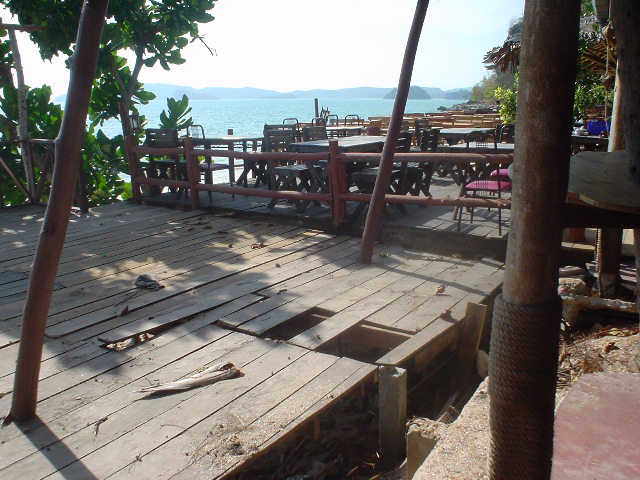
From what we saw that day, just five weeks after the tsunami struck, Ao Nang had bounced back to some capacity. Sure, some of the beachfront restaurants were still in a state of disrepair (picture above), but most were fine — just waiting for people to show up. The row of restaurants on a long deck was practically abandoned — just five patrons for seating of about a hundred — and some places had chairs up in the back since they weren’t being used.
Knowing that the only way to help out in post-tsunami efforts now in the affected regions of Thailand was to simply pump money into it by being a tourist, Noelle and I bought lunch at one of the beachfront restaurants. The chef there proved that Ao Nang was back in the tourist game by cooking us up a delectable curry prawn dish and a pot of spicy crab. “[It’s slow now, huh?]” we asked our waitress.
“Farangs [foreigners] not here,” she said. I asked her about her tsunami experience and with limited English she said that she was there, at a bar at the time, at that it was “scary.” Water came up from under the deck and then up over the side, tossing and turning everything like a big saltwater washing machine. It all happened in a matter of twelve seconds.
WALKING THE BEACHFRONT STRIP OF AO NANG gave both Noelle and I a mixed feeling of emotion. On one hand, we felt sorry of what had happened there, and that the people were still suffering from it in terms of income. On the other hand, it was sort of nice not to have it swarming with loud and obnoxious Western tourists. Walking down the virtual ghost town, I said, “It’s like I own the place.”
To help out some more, we “volunteered” to pump more money into the economy by renting a sea kayak for an hour from an office called “Mr. Kayak.” Mr. Kayak (who was a woman that day) set us up with a two-person vessel, which we used to row — often out of sync — to and from the big limestone cliff formation on the eastern side of the beach. Noelle raved about the schools of jumping fish jumping along side us, while I took pictures of the overhangs. In the distance, we saw that construction was continuing at the far eastern end of the beach; some were building structures bigger and better than before. Soon we were back in town to return the kayak in time for sunset, which we spent swimming and floating in the warmest waters I’ve ever experienced on any beach (that don’t involve volcanic activity).
IT’S NOT JUST THAI BUSINESSES that were affected by the doldrums in tourism; the ex-pat community that had set up business in town to profit from their Western brethren were also suffering. We learned this when we ended up in The Irish Rover, run by (not surprisingly) an Irishman with his Thai wife and family. Said the Irishman, “It’s supposed to be the high season now, but it’s lower than the low season.”
With that said, we helped him and his Thai family out by doing some more “volunteer work,” which I put in quotes because I really mean “drink booze.” Our continued support of post-tsunami relief came in the form of buying beer and many pints of Strongbow English cider, which not only made them happy, but us drunk.
And so, I implore you Blogreaders out there: while your contributions to UNICEF and the Red Cross were in fact beneficial, what the people of Krabi and Phuket really need now is for you to come on over and start drinking beer. Who wants to volunteer?
SAVE THE DATE; DAY 503 IS COMING. MARCH 5, 2005, NYC.
CLICK HERE TO VIEW THE TRAILER.
PLEASE R.S.V.P. WITH YOUR HEADCOUNT BY POSTING A COMMENT HERE.
Next entry: A New Homebase
Previous entry: The Fifth And Final Time
Commenting is not available in this channel entry.
Comments for “Volunteer Work”
Good on you Erik. Volunteer a few beer for me, eh.
Met a guy from New York today, made me think of you. Like you, he was volunteering also, but in Banda Aceh…

See you in Vancouver?
From lovely Lombok, The other Erik
Posted by Erik vK on 02/08 at 12:03 PM
Hey Mr. E
I got your post card today, straight from Camodia. It certainly made my day. Vineet, your pal is definately thrilled with his. No, my dusty shoes are not yet on. Slgging away this month and the first half of March. Then it is freedom (for some time)
Happy writing, once u get back to NYC. Sure hoping for a best seller!Posted by .(JavaScript must be enabled to view this email address) on 02/08 at 12:54 PM
Hope to do my part later this year volunteering !

Posted by .(JavaScript must be enabled to view this email address) on 02/08 at 01:17 PM
someone buy me a ticket and i’ll buy the beer…
Posted by .(JavaScript must be enabled to view this email address) on 02/08 at 01:46 PM
I just went and read your near-fatal experience in Nepal… One word - wow.
I like how you can keep your sense of humor even about that experience.
Posted by .(JavaScript must be enabled to view this email address) on 02/08 at 02:04 PM
The ATL cube farm resident who thought up the melodramatic term “Second wave of death” probably felt pretty good about him or herself. Ironically, that catch phrase may have contributed to a second wave of economic hardship which will certainly take longer than twelve seconds to recede.
I mean… since when is Mark Brunett producing the news?!
Posted by .(JavaScript must be enabled to view this email address) on 02/08 at 02:24 PM
Ooo ooo…pick me pick me! I’ll help “volunteer” all you want. Just have to finish my grad classes first. I want to make to to Day 503, but I have a feeling my research and assignments are going to take over my life. Yuck.
Posted by .(JavaScript must be enabled to view this email address) on 02/08 at 02:56 PM
Yo! I finally got the trailer to work for 503! I have a HUGE grin on my face this is so HOTALICIOUS!
I love the little dog in the t-shirt, like you know, dogs just arent’ DAWGS unless they rock the t-shirt with orange trim. Right?
Posted by .(JavaScript must be enabled to view this email address) on 02/08 at 07:30 PM
Please Please…...someone out there tell me who is the artist of the music from the trailer! I want to buy it.Keep playing it over and over! LOL
Posted by .(JavaScript must be enabled to view this email address) on 02/08 at 08:47 PM
ROSE - The song on the trailer is entitled “Pompeii”. The artist is E S Posthumus. Erik used the same artist for the Would You video as well.
Posted by .(JavaScript must be enabled to view this email address) on 02/08 at 09:15 PM
Thanks markyt! Gonna run out and buy right now! That music is stuck in my head LOL
Posted by .(JavaScript must be enabled to view this email address) on 02/08 at 10:17 PM
Erik,
Great info. you should think about submitting a story to a travel magazine about your stay in the affected areas. Could do a world of good, plus great opp for your writings.
PS - first time poster having enjoyed your blog, if you were wondering “who’s this ass trying to give me advice?”
Posted by .(JavaScript must be enabled to view this email address) on 02/08 at 10:44 PM
Damn, dude! I’d fly over in a heartbeat if I have the time & money. Post Tsunami or not I’ve always wanted to visit Thailand. I had a classmate in highschool who often went back to Phuket to see her family. She would send me postcards of her island when we were still writing each other. The cliffs look magnificent on the cards! I hope someday I’ll get to visit that island.
Posted by ravissant on 02/08 at 11:01 PM
MORE TO COME as it becomes available…
HAPPY CHINESE NEW YEAR!!!
Posted by .(JavaScript must be enabled to view this email address) on 02/09 at 02:02 AM
yes…the year of the cock…i mean rooster
Posted by .(JavaScript must be enabled to view this email address) on 02/09 at 02:05 AM
good to hear the area is pretty much back to normal. i plan on ‘volunteering’ there in the near future.
out of curiousity, do you have a waterproof camera you used to shoot those kayaking photos, or whats your method for making sure your cameras dont get wet?
Posted by .(JavaScript must be enabled to view this email address) on 02/09 at 04:06 AM
I miss Thailand *wail* I’d volunteer in a flash if I could get time off work… er, if I could afford time off work that is. Thailand is awesome.
Posted by Liz on 02/09 at 05:21 AM
MARQUEE: Get the AquaPac clear dry bag; I bought it in Japan, but I’m sure it’s available elsewhere… It makes any camera waterproof up to 10 ft.
Posted by .(JavaScript must be enabled to view this email address) on 02/09 at 08:11 AM
For you scuba divers out there, you can swing some deals about now too - they really need the work!
Posted by .(JavaScript must be enabled to view this email address) on 02/09 at 08:20 AM
I found your website about a month and a half ago when I was doing a search for Balut, of all things. Have been an avid reader since. I’m trying to play catch up though and a bit disappointed that i caught your trip on its tail end!! Your entry for this past New Year’s was my favorite by far. Thoroughly enjoyed your writing about the Philippines. It was interesting reading about some of the same sites I saw when I went there for the first time in 1998 to visit the aunts, uncles and hundreds of cousins I’ve never met before!! Great job to you and your brother for keeping an awesome site. I have an older brother named Eric too!! From the Chi-town, Marky!
Posted by Marky Mark on 02/09 at 08:55 AM
MARKY MARK: Glad you enjoy… now play catch up and start on Day 1 before Day 503!
“It’s such a good vibration… c’mon, c’mon, c’mon…”
Posted by .(JavaScript must be enabled to view this email address) on 02/09 at 12:11 PM
Liz: did you get the AR6 finale yet?
Posted by .(JavaScript must be enabled to view this email address) on 02/09 at 05:44 PM
hey erik
i just wondered, on the bna page you wrote that you saved something like 16000 or 17000 dollars, was that sufficient for your trip, or were heavily relying on the donations ?
if you have some spare time heh do you want to write up some budget list for each country or atleast region, like which regions are insane budget killers which arent aso.
thanks and keep the good work upPosted by .(JavaScript must be enabled to view this email address) on 02/09 at 06:10 PM
Thanks for the postcard!!! It was very exciting to see it sitting on the table amongst various bills.
...but what’s with the NJ postmark dude?

Safe travels…
Posted by .(JavaScript must be enabled to view this email address) on 02/09 at 08:48 PM
SORRY, I’m still behind about five days… but I’m off on a long bus journey to Malaysia now; hopefully I won’t spend most of that time staring out the window so I can catch up!
MORE TO COME AS THE COUNTDOWN TO 503 CONTINUES…
Posted by .(JavaScript must be enabled to view this email address) on 02/10 at 01:06 AM
Hey, check out the pins on the pledge page… Tres cool…
Posted by .(JavaScript must be enabled to view this email address) on 02/10 at 01:16 AM
Hey Erik, thanks for the info on Krabi - I can imagine your positive assessment will help the economy as much as you guys pounding some brewdoggies down there. Been following your trip with interest online, but freakier still, in real life - in Phnom Pehn now, and also heading down to Krabi in a couple of months to climb. Leave a trail of popcorn or tiger balm or something so I can find my way.
Conor
blogs.bootsnall.com/conorPosted by .(JavaScript must be enabled to view this email address) on 02/10 at 06:08 AM
Oh, one other thing (the ‘Volunteer Work’ title reminded me - I was volunteering in Nepal for a few months) - I was a couple of weeks behind you on the Everest Base Camp trek, and Linda, from the Pheriche HRA at 4200 meters used you and your guide as an example of things that can go really wrong at altititude. You gotta think of easier ways to get famous, man…
Conor
blogs.bootsnall.com/conorPosted by .(JavaScript must be enabled to view this email address) on 02/10 at 06:20 AM
it was a really cool trailer… Astig…
Posted by .(JavaScript must be enabled to view this email address) on 02/10 at 08:39 AM
hey man… cool trailer… it reminds me of Spider-Man… ASTIG!!!
Posted by .(JavaScript must be enabled to view this email address) on 02/10 at 08:41 AM
JOEY T: Yeah, it’s the music from the trailer for the first Spider-Man. (That’s when I first heard it.)
Posted by .(JavaScript must be enabled to view this email address) on 02/10 at 11:47 AM
DENNIS: Donations were just pleasant surprises; I depended on my savings mostly. As of late I’m totally dependent on credit, which is why I’m going home sooner than later.
Budget killers (off the top of my head): Brazil (esp. during Carnaval), South Africa (esp. after getting mugged), Tanzania, all of Europe, Russia, Hong Kong (unless you have a place to crash or win big in Macau), Japan (even if you have a place to crash, it’s still crazy expensive—but well worth it!) Everything else you can do on about $15-$20 a day, minus the occasional splurges.
Posted by .(JavaScript must be enabled to view this email address) on 02/10 at 11:56 AM
CONOR: Wow, what did they say about me and Tilak?
I didn’t die, and now I’ve been immortalized in Pheriche! Woohoo!
Posted by .(JavaScript must be enabled to view this email address) on 02/10 at 11:57 AM
GREETINGS FROM PENANG (MALAYSIA)... Yup that means I’m REALLY behind on entries now… Off to the iBook for me now…
MORE TO COME…
Posted by .(JavaScript must be enabled to view this email address) on 02/10 at 11:59 AM
I got your postcard too! Seems like you were just in Cambodia - that was fast! I really wish I could come to your party but I dont’ think I can. I do hope I can meet you someday though - and that you keep your blog on-line for a long time so we can all go back and read it whenever we want.
Posted by .(JavaScript must be enabled to view this email address) on 02/10 at 01:37 PM
Hi Erik!
Posting again here… I just spent an hour reading your Nepal entries. Now I have to go back and try to catch up on your entire trip (I’m seriously considering printing your website off for some bedtime reading)!! You should really put this together into a book or something, I wish I could write like you.Also - someone posted a link to your site on the lonelyplanet forums - looks like your fan base is growing!!
Posted by .(JavaScript must be enabled to view this email address) on 02/10 at 01:43 PM
PS - in agreement with Dennis above - can you start a section on travel tips/budget?? I would love to do a trip like yours, and I’m sure I’m not the only one!!
Posted by .(JavaScript must be enabled to view this email address) on 02/10 at 01:46 PM
Erik,
After many months of silent reading, I just wanted to post to say how great this blog is. I started reading in the fall and have now read the whole thing! There have been some fun reminders of trips I took when I lived in Asia a few years back - and it’s a great break from the daily desk grind now that I have a “real” job. Enjoy Penang!
ColleenPosted by .(JavaScript must be enabled to view this email address) on 02/10 at 01:48 PM
SBRs are posting before it’s too late!
Posted by .(JavaScript must be enabled to view this email address) on 02/10 at 02:04 PM
Hi Erik!
Just stumbled across your blog and it’s great reading, and is really cheering up a crappy Montreal winter.
Anyways, enjoy the remainder of your trip.
Posted by .(JavaScript must be enabled to view this email address) on 02/10 at 05:55 PM
Sure hope those were NOELLE’s feet, and you haven’t started painting YOUR toenails! Great pics!
Posted by .(JavaScript must be enabled to view this email address) on 02/11 at 11:01 PM
Those piggies don’t look like Erik’s? Being the WHITE CHICK that I am…
Posted by .(JavaScript must be enabled to view this email address) on 02/12 at 07:10 AM
SHARE THIS TRAVEL DISPATCH:
Follow The Global Trip on Twitter
Follow The Global Trip in Instagram
Become a TGT Fan on Facebook
Subscribe to the RSS Feed
This blog post is one of over 500 travel dispatches from the trip blog, "The Global Trip 2004: Sixteen Months Around The World (Or Until Money Runs Out, Whichever Comes First)," originally hosted by BootsnAll.com. It chronicled a trip around the world from October 2003 to March 2005, which encompassed travel through thirty-seven countries in North America, South America, Africa, Europe, and Asia. It was this blog that "started it all," where Erik evolved and honed his style of travel blogging — it starts to come into focus around the time he arrives in Africa.
 Praised and recommended by USA Today, RickSteves.com, and readers of BootsnAll and Lonely Planet's Thorn Tree, The Global Trip blog was selected by the editors of PC Magazine for the "Top 100 Sites You Didn't Know You Couldn't Live Without" (in the travel category) in 2005.
Next entry:
A New Homebase
Previous entry:
The Fifth And Final Time
THE GLOBAL TRIP GLOSSARY
Confused at some of the jargon that's developed with this blog and its readers over the years? Here's what they mean:
BFFN: acronym for "Best Friend For Now"; a friend made on the road, who will share travel experiences for the time being, only to part ways and lose touch withThe Big Trip: the original sixteen month around-the-world trip that started it all, spanning 37 countries in 5 continents over 503 days (October 2003–March 2005)
NIZ: acronym for "No Internet Zone"; a place where there is little to no Internet access, thus preventing dispatches from being posted.
SBR: acronym for "Silent Blog Reader"; a person who has regularly followed The Global Trip blog for years without ever commenting or making his/her presence known to the rest of the reading community. (Breaking this silence by commenting is encouraged.)
Stupid o'clock: any time of the early morning that you have to wake up to catch a train, bus, plane, or tour. Usually any time before 6 a.m. is automatically “stupid o’clock.”
The Trinidad Show: a nickname of The Global Trip blog, used particularly by travelers that have been written about, who are self-aware that they have become "characters" in a long-running story — like characters in the Jim Carrey movie, The Truman Show.
WHMMR: acronym for "Western Hemisphere Monday Morning Rush"; an unofficial deadline to get new content up by a Monday morning, in time for readers in the western hemisphere (i.e. the majority North American audience) heading back to their computers.
1981ers: people born after 1981. Originally, this was to designate groups of young backpackers fresh out of school, many of which were loud, boorish and/or annoying. However, time has passed and 1981ers have matured and have been quite pleasant to travel with. The term still refers to young annoying backpackers, regardless of year — I guess you could call them "1991ers" in 2013 — young, entitled millennials on the road these days, essentially.
Spelling or grammar error? A picture not loading properly? Help keep this blog as good as it can be by reporting bugs.