Things to Do When Your Wallet is Missing
This blog entry about the events of Tuesday, September 21, 2004 was originally posted on September 28, 2004.
DAY 339: People came from the left, right, north, south, east, west, northwest and north north west. Everywhere I turned there was another person speeding along on two legs trying to get somewhere. I stood in the middle of the random chaos and just observed with no rush of my own, spinning around and shooting them all with my camera. From above it probably looked like a game of Asteroids or something.
I was at Tokyo’s Shinjuku Station, arguably the busiest in the world, a place I went at Liz’s suggestion to experience the concentrated one-hour Japanese morning rush, much more hectic that afternoon rush, which was spread out over four hours. Commuters poured in from different train lines, kept orderly by red stick-toting, white glove-wearing conductors on the platforms, as they went to their offices in the Skyscraper District or to the nearby architectural marvel, the Tokyo Metropolitan Government Building — the other thing I went to see that morning.
I HAD HEARD SOMEWHERE that Japan is so crime-free that if you were to leave your wallet out somewhere, you could go back an hour later and it’d still be there with all its contents, because it’s not in the Japanese upbringing to take it — in fact, most people would go out of their way to give it back to you. As an experiment I bought a second wallet at the 100 Yen Store (A Dollar Store) — where I resisted as much as I could to jokingly ask the cashier “How much is this?” — and filled it up with a frequent flyer card, a passport photo of myself, one US dollar and 2000 yen (about $20). Liz had a mid-day break from her job as a corporate trainer and English teacher and met me at the Excelsior Coffee shop near the Tamachi station on the JR line.
“Okay,” I whispered. “The wallet is on my chair. I’m just going to leave it there.” After a couple of coffees, we just got up and left like normal people.
I figured if the wallet would still be there an hour later, why not a whole day? And so my plans for the day were to do things to kill time before I went back to the cafe that night to see if my wallet was still there with the $22 worth in items.
LIZ HAD SOME TIME TO KILL before her next training appointment and came with me to the Edo-Tokyo Museum, established in 1993 to “preserve the historical heritage of Edo-Tokyo” (according to their pamphlet). Nearby, we watched a couple of juggling buskers that impressed me by rolling a square tea box around the top of a spinning umbrella, amongst other feats. “Arigato Gozaimaaasu!” they’d say after every feat.
Up the curvaceous escalator that didn’t stop when it leveled off mid-way, Liz and I entered the museum. The fairly large exhibition hall, right next to the Sumo stadium went through a chronological history from the ancient feudal days of Edo to the modern post-WWII days of Mega-Tokyo, using small models and life-sized reconstructions of buildings and moving shrines.
“Wow look at her [big] shoes,” I said, referring to a statue of a Kabuki theater actress.
“Uh, that would be a guy,” Liz corrected me. She went off back to the office, leaving me to my own devices — with a bunch of much bigger guys.
RIGHT NEXT TO THE EDO-TOKYO MUSEUM was something larger than life. Larger than my life at least. It was the Ryogoku, the big Tokyo sumo arena, and it was just my luck that the big Grand Tournament in Tokyo coincided with my travels. You really have to a sport like sumo wrestling; I mean, what other sport does training actually involve the possibility of eating two pizza pies, a whole chicken and a gallon of gravy with pats of rich creamy butter on top — all before filling up on bread before the main course arrives.
I wasn’t a Sumo wrestler myself, but before making my entrance into the arena, I decided to bulk up to get into the mood. Right across the street there was just the place to do so.
“This one or this one?” the cashier asked me, pointing to two different options on the menu on the counter.
“This one,” I said, pointing to the one with the bigger red box. “Super-size me.”
SUMO WRESTLING IS NOT JUST AN EXCUSE to get men who could never land a basketball marketing deal a chance to shine under arena spotlights. Japan’s national sport is actually rooted in Shinto Buddhism, when the sport was actually a ceremonial ritual to appease the gods for a good harvest each year. The excitement of it transcended religion though and became an entertaining spectator sport of fat guys slapping each other silly and get their revenge for being teased as “the fat kid” as a child — to other guys who probably had the same experience. Nowadays, professional sumo wrestling involves a league that travels from city to city in Japan where the best, brightest and heaviest rikishis (wrestlers) compete for the title of Musashifuji (grand champion).
I had a general unreserved-seat pass, which meant that I could sit anywhere there was an empty seat in the nosebleed section — while others that played more for reserved nosebleed seats officially had to stay in the same seat, even if it was bad. I got to the arena before seats filled up though, giving me time to see the gigantic warriors enter the arena gates to a crowd of spectators cheering them on. Alone or in small groups at a time, they came in their kimonos and wooden slippers like gladiators the shapes of panda bears draped in silk. Underneath the glamour, sumo wrestlers were just regular guys though; before the tournament, I had seen them around just running errands, some even on bicycle.
Early afternoon was for bouts of the Juryo wrestlers, the first division which not many people cared about. For me it was exciting anyway being my first live sumo experience — and the fact that I could sneak down closer to the dohyo (ring) for a while to watch the matches.
The object of the game is simple: when the match starts you are to use all your body weight to attack the other guy and either knock him down (without falling yourself), or out of the boundaries of the inner circle of the ring. If you are lucky your opponent will fall off the dohyo and embarrass himself even more than the fact that he is wearing nothing more than a big baby diaper.
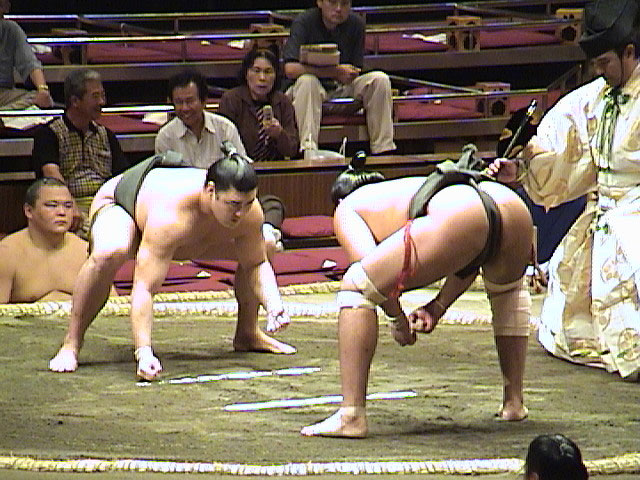
A typical match went like this:
The guys size each other up (picture above) by staring at each other and then slapping their own asses.
The guys decide they aren’t ready and go into the corner to stretch some more. There is more slapping of the asses.
The guys go back and size each other up again (after another couple of ass slaps), this time stretching their legs out and stomping their feet like they’re doing a very bad line dance.
The guys go back to their corner to stretch and then back to starting position, this time spreading ceremonial salt on the floor.
Go time! The guys are released towards each other and either start a really rapid bitch-slapping contest, or grab each other in tight wrestling holds — sometimes for four or five minutes — trying to shove the other down. This second choice wouldn’t be recommended for non-sumo wrestlers, especially for someone like Calista Flockhart. Can you imagine someone like Calista Flockhart in a sumo match? She’d be knocked over like a toothpick by a bowling ball. Anyway, the match ends when one of the guys is knocked over or outside the inner circle. In the event of that might be a draw, the gyojis (referees) gather in the circle to determine the winner of the match.
A winner is declared by the gyoji who announces the winner by “knighting” him with a ceremonial fan. The winner has a smug look on his face like he is “the man.” He leaves the ring and pats himself on the ass.
After a while the matches got a bit repetitive — except for the “interludes” placed in the day-long “ceremony,” including the prancing of sponsors around the ring, the introduction of new wrestlers, and the going to the bathroom because of all the beer I had. In the later part of the day when the Yokozuna wrestlers (grand champions) entered the ring, things got a little interesting. The crowd really fired it up in the arena to cheer on their favorite wrestlers, much like in WWE but without the signs and foam (middle) fingers. One wrestler, who I take it was the public favorite, had a sort of catch gimmick like a WWE wrestler: when he spread the ceremonial salt on the ring, he’d throw a whole pile out, making the crowd go wild.
At the end of the last series of matches, a winner was declared, who performed the yumitori-shiki, the winner’s ceremonial dance with a big bow to show off his victory and to wish the audience to come the next day for more.
IT WAS DARK BY THE TIME I left the sumo matches (and the monk outside) and I immediately went back to the Excelsior Cafe near the Tamachi station to see if my wallet was still there with all the money. The seat I sat in was occupied with no trace of the wallet, so I went to the cashier.
“Saifu o nakushimashita,” I said with help from my phrasebook. The girl gave me a confused look. “Uh, my wallet. I lost it.”
“What color?”
“Blue.”
She pulled it out of a drawer and all the money was inside too. In the end, it wasn’t such an interesting experiment at all — I should have known nothing would have been missing. I went on my way to explore Shinjuku at night and then to Liz’s place, with my wallet in my back pocket not only holding my money, but keeping my ass protected from any surprise sumo ass-slaps — well, on one cheek at least.
Next entry: See No Common Sense
Previous entry: We Gonna Rock Down To Electric Avenue
Commenting is not available in this channel entry.
Comments for “Things to Do When Your Wallet is Missing”
GO NEPAL 13, NO NEPAL 13.
Posted by .(JavaScript must be enabled to view this email address) on 09/28 at 10:06 AM
It’s a tie! And someone bad intentionned could easily manipulate you by posting comments and casting votes with various different fake usernames ... (**evil grin**)...
Interesting experiment with the wallet… I wonder how long it took for someone to act on taking to the cashier to keep it. You should do it again, in a place where you can observe from a distance.
Posted by .(JavaScript must be enabled to view this email address) on 09/28 at 11:36 AM
I was actually going to ask you about crime, but you beat me to it! That bicycle looks like it has a flat tire in the back…
How’s the weather over there? I have a friend who is out in the country someplace (can’t quite figure out where) teaching English and she’s been in quite a few typhoons since she arrived there in July. Just wondering…
And Shinjuku is super sensory overloading!!
Awesome building pics, and the commuter pics are fun too!! Thanks!Posted by .(JavaScript must be enabled to view this email address) on 09/28 at 05:14 PM
wow..dood. i am really warming up to japan. Once again, thanks for the great pics. Love the random pics that show the japanese daily lifestyle like the escalator and the monk in the city.
Posted by .(JavaScript must be enabled to view this email address) on 09/28 at 05:29 PM
Are you sure you counted my Floridian “Yes” vote?

Posted by Dan on 09/28 at 05:34 PM
when in doubt, go for it
Posted by .(JavaScript must be enabled to view this email address) on 09/28 at 06:08 PM
ERIK: When i lived in Japan the same thing happened. I lost a jacket at a local bath and went back a week later and they still had it waiting for me.
Posted by .(JavaScript must be enabled to view this email address) on 09/28 at 06:48 PM
NOELLE: Currently in Tokyo, “Typhoon 21” is coming in… They number the typhoons by season instead of naming them like in the States…
Posted by .(JavaScript must be enabled to view this email address) on 09/28 at 06:50 PM
That esclator that continues during the flat part is a great idea… The George Papidou cultural centre in Paris should look into that.
As for Nepal… Asking for our input is great, but ultimately you should decide if the risk is worth it.
Posted by .(JavaScript must be enabled to view this email address) on 09/28 at 06:56 PM
Love the wallet experiment. I wonder where kitchen stadium is, from “Iron Chef”? It would be funny to see an Iron Chef showdown.
Posted by .(JavaScript must be enabled to view this email address) on 09/28 at 06:56 PM
The typhoons do have names - Japan just calls them by numbers. This one is typhoon Meari. Asian states take turns naming them but I don’t know in which order. This is the 8th one to actually hit Japan, most of them just go up the Japan Sea side and hit Taiwan instead
Posted by Liz on 09/28 at 06:59 PM
There’s some good news for you Janice!
BTW: Where has Janice been?
Posted by .(JavaScript must be enabled to view this email address) on 09/28 at 07:05 PM
TD0T: re: Nepal. My thoughts exactly. At this point, it’s virtual tie, but I’ve just discovered a perfect compromise under my sleeve… Stay tuned.
Posted by .(JavaScript must be enabled to view this email address) on 09/28 at 07:26 PM
it is so good to see that honesty is still around. good for japan! that gives me another reason to want to go there, besides all the cute stuff and anime. =)
Posted by .(JavaScript must be enabled to view this email address) on 09/28 at 07:29 PM
ALICE: I used to think that the cutesy anime drawings were just in the cartoons, but most of the public signs have them; it’s everywhere! Plus there are unique electronic chimes at each train station; every time I stand on a platform, I feel like I’m getting a “power up” or an extra life.
Posted by .(JavaScript must be enabled to view this email address) on 09/28 at 07:38 PM
man, why can’t we have cute stuff here in the u.s. too? i would like cute animals and characters on my food packages, and household items, and public signs, and utility bills. at least you get a slight smile outta paying the bills every month. i should move to japan!
Posted by .(JavaScript must be enabled to view this email address) on 09/28 at 07:46 PM
I’m in favor of those Japanese school girl uniforms finding a wider audience among adult women also! Is that wrong?
Posted by .(JavaScript must be enabled to view this email address) on 09/28 at 09:13 PM
tjw: you got my vote if you run for prezident. (^_^)
Posted by .(JavaScript must be enabled to view this email address) on 09/28 at 09:54 PM
Hey Erik: hell, was I laughing out loud over your description of the sumo match.. Not laughing over all the rituals, because I’ve seen them on TV and I understand the rituals - just the way you were describing reminded me a little of Stifler - the dude with no internal sensor and no internal monologue - “Dude.. why does he keep slapping his ass?” and totally miss all of the other symbolisms..
Maybe since Japan doesn’t have NFL style football, this is the way their athletes get their ass-slapping in??
Posted by .(JavaScript must be enabled to view this email address) on 09/28 at 10:17 PM
The Wall Street Journal can suck it! Of course they HAD to point out the “corporate” blogging travel sites…
SUCKERS…whatever… BH’s Rule!
Posted by .(JavaScript must be enabled to view this email address) on 09/28 at 10:37 PM
HERE, HERE!
Posted by .(JavaScript must be enabled to view this email address) on 09/28 at 11:12 PM
Hey Erik. if you have trouble sleeping in Japan get one of these -
http://www.thecouriermail.news.com.au
/common/story_page/0,5936,10917596
%5E10369,00.html[THIS LINK HAS BEEN SPLIT IN THREE TO RESOLVE FORMATTING ISSUES.]
Posted by .(JavaScript must be enabled to view this email address) on 09/29 at 12:02 AM
TDOT - Janice threw her back out so is around but not able to check the blog as far as I know.

Posted by Liz on 09/29 at 04:26 AM
Do you think those man-shaped pillows come with a snoring mechanism? If that’s the case - forget it!!! Or I could conveniently forget to put batteries in…..........
Posted by .(JavaScript must be enabled to view this email address) on 09/29 at 08:07 AM
Intereesting about the typhoons - do they produce the same devastation as hurricanes? I would think that there would be more about them, if they did… and, apparently the hurricans go in cycles - there will be quite a few per year for the next 30 or so years… is that the case for the typhoons too? Or does anyone know? Just wondering…
Posted by .(JavaScript must be enabled to view this email address) on 09/29 at 06:04 PM
Man, I just had to slap my own ass after reading that entry—I think those sumos may be on to something there…
Posted by .(JavaScript must be enabled to view this email address) on 09/29 at 06:19 PM
Noelle - the typhoons produce a lot of damage in Okinawa and the southern island of Kyushu in Japan. Several people have died this year and there has been a lot of flooding. They seem to hit China and Taiwan with more force than they do here - not sure if that is stronger buildings or what.
There have been more typhoons this year than normal - and they started a lot earlier. I suspect it isn’t in the news because typhoons are a normal part of September here, the damage isn’t to Tokyo, and the major news channels tend to be culturally-centric and only report major disasters around the world that affect the North American audience.
For instance, it took four days for the English news to report a mushroom cloud in North Korea that they at first suspected to be nuclear. Luckily it wasn’t. Being in the fallout area, I would have liked to have known that pretty much the day it happened. (For those of you who don’t know about this, it happened two weeks ago).
Anyway, back to the topic (rant finished!) - I suspect typhoons also go in cycles as do hurricanes. I mean, really they are all the same thing (hurricanes, cyclones and typhoons) - they just have different names depending on what ocean they came from, right?
Posted by Liz on 09/30 at 04:20 AM
You learn something new every day… I will have to research more…
Posted by .(JavaScript must be enabled to view this email address) on 10/01 at 03:13 AM
I stumbled on your journal entry, and I don’t know if it’s because it’s 1:30 AM EST, or if you’re just hilarious, but either way I’m laughing my ass off from your description of the men slapping their own asses. Thank you for a late night laugh. I shall watch your blog for more entertainment
As to your request for updates on the US… nothing new here! Here in Florida we got a nice cleansing courtesy of mother nature, leaving a few hundred thousand homes demolished, etc. I live in a protective bubble fortunately, so I watched the festivities without any harm being done to myself.Anyway, write me if you’d like!
-Vanessa
Posted by .(JavaScript must be enabled to view this email address) on 10/12 at 09:23 AM
SHARE THIS TRAVEL DISPATCH:
Follow The Global Trip on Twitter
Follow The Global Trip in Instagram
Become a TGT Fan on Facebook
Subscribe to the RSS Feed
This blog post is one of over 500 travel dispatches from the trip blog, "The Global Trip 2004: Sixteen Months Around The World (Or Until Money Runs Out, Whichever Comes First)," originally hosted by BootsnAll.com. It chronicled a trip around the world from October 2003 to March 2005, which encompassed travel through thirty-seven countries in North America, South America, Africa, Europe, and Asia. It was this blog that "started it all," where Erik evolved and honed his style of travel blogging — it starts to come into focus around the time he arrives in Africa.
 Praised and recommended by USA Today, RickSteves.com, and readers of BootsnAll and Lonely Planet's Thorn Tree, The Global Trip blog was selected by the editors of PC Magazine for the "Top 100 Sites You Didn't Know You Couldn't Live Without" (in the travel category) in 2005.
Next entry:
See No Common Sense
Previous entry:
We Gonna Rock Down To Electric Avenue
THE GLOBAL TRIP GLOSSARY
Confused at some of the jargon that's developed with this blog and its readers over the years? Here's what they mean:
BFFN: acronym for "Best Friend For Now"; a friend made on the road, who will share travel experiences for the time being, only to part ways and lose touch withThe Big Trip: the original sixteen month around-the-world trip that started it all, spanning 37 countries in 5 continents over 503 days (October 2003–March 2005)
NIZ: acronym for "No Internet Zone"; a place where there is little to no Internet access, thus preventing dispatches from being posted.
SBR: acronym for "Silent Blog Reader"; a person who has regularly followed The Global Trip blog for years without ever commenting or making his/her presence known to the rest of the reading community. (Breaking this silence by commenting is encouraged.)
Stupid o'clock: any time of the early morning that you have to wake up to catch a train, bus, plane, or tour. Usually any time before 6 a.m. is automatically “stupid o’clock.”
The Trinidad Show: a nickname of The Global Trip blog, used particularly by travelers that have been written about, who are self-aware that they have become "characters" in a long-running story — like characters in the Jim Carrey movie, The Truman Show.
WHMMR: acronym for "Western Hemisphere Monday Morning Rush"; an unofficial deadline to get new content up by a Monday morning, in time for readers in the western hemisphere (i.e. the majority North American audience) heading back to their computers.
1981ers: people born after 1981. Originally, this was to designate groups of young backpackers fresh out of school, many of which were loud, boorish and/or annoying. However, time has passed and 1981ers have matured and have been quite pleasant to travel with. The term still refers to young annoying backpackers, regardless of year — I guess you could call them "1991ers" in 2013 — young, entitled millennials on the road these days, essentially.
Spelling or grammar error? A picture not loading properly? Help keep this blog as good as it can be by reporting bugs.