The Universal Language Of Beer
This blog entry about the events of Tuesday, March 30, 2004 was originally posted on April 01, 2004.
DAY 164: I’ve discovered that waiting around for my safari to start in Windhoek during the rainy season for a couple of days isn’t so bad — there’s always beer.
Just outside Windhoek are the Namibian Breweries, the fairly new beer-making factory built in 1987. This newer brewery replaces the former one in town and produces ten beers — including Windhoek Lager, Windhoek Special and Tafel Lager — all under strict German purity standards, using ingredients imported from Germany. With these strict German beer-making laws in place, Namibian Breweries also produces the German Beck’s and the Dutch Heineken. They also produce and bottle schnapps, tonics and beverages of Pepsico.
MY TRANSPORT, ORGANIZED BY OUTSIDE ADVENTURES, was driven by Ephram, a middle-aged Windhoek native who sometimes referred to himself in the third person. He told me about the segregated times in Namibia’s past — before a black man could go on such a tour of a brewery.
“It was terrible,” he said. “Luckily, Ephram was not shot.”
During the turbulent years, Ephram was a sort of modern day male Rosa Parks, entering “whites only” establishments, knowing that men are men and money is money, no matter what colors they are.
“I tell them, if the whites use different money than the black people, then fine, but the black people use the same money as the whites.” The money, he continued, was produced and printed by blacks and even the buildings of the establishments were constructed all by blacks — so why wouldn’t they be allowed to use them?
Things have changed in Windhoek since then — although a lot of prejudice still exists today in one way or another. At any rate, Ephram’s anecdotes and history lesson passed the time until we arrived at the parking lot of the beer plant.
THE NAMIBIAN BREWERIES PLANT was a beautifully landscaped factory on the outside, with freshly cut lawns and gardens. Inside the modern office building, which was as sterile as a hospital, I was greeted by Loureen the Namibian Breweries tour guide. I thought it was just going to be the two of us until we were joined by a big school group of about twenty late-teens and a teacher.
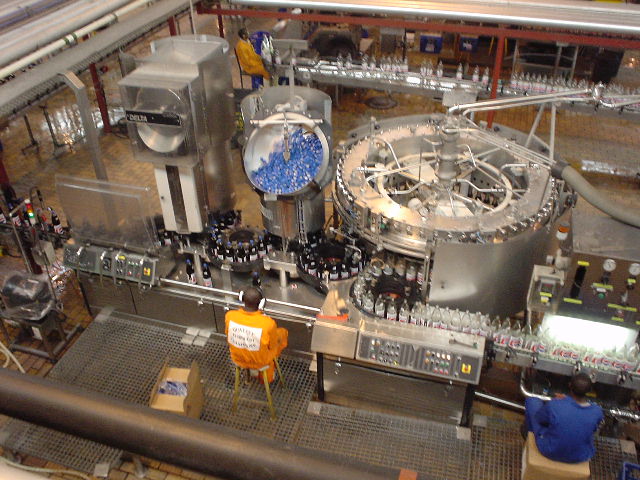
Loureen led us around the plant, from the big mixing tanks and hoses to the filtration room to the big fermentation silos outside. From there, we saw the motorized assembly line (picture above) where beverages were bottled by machines like in the introduction to Laverne & Shirley — if it wasn’t so much security, I would have tried to stick a glove on a bottle.
I was sort of the outsider of the group since everyone else spoke to each other in either Afrikaans or some other tribal dialect. I figured they might have taken me for a lone Japanese tourist since I didn’t say much and just shot away with my little Japanese digital camera. One girl was suspicious of me and asked if I was one of the tour guides or on tour like they were. I told her I was just a tourist.
WHILE THE PROCESSES OF BEER-MAKING ARE INTERESTING, they are not more interesting than the processes of beer-drinking. When the factory tour ended, Loureen brought us to the bierkeller, the company bar, which was out of place in the modern building; it had an old-fashioned wooden German motif. Loureen transformed from tour guide to bartender so that we could sample the fruits of the breweries’ labor. While the students gathered around the bar, Loureen asked me first what I wanted to try.
“Well, what do you recommend?” I asked, revealing my American accent to the class. Eyes lit up. “I’ve tried the Windhoek and the Tafel, what else is there?”
“I can give you the Hansa draught.”
“Sure.”
“A big glass or a small one?”
“Uh,” I started, feigning the hesitation. “A big one.”
“A big one!” I heard from across the bar. One of the African guys was in full agreement with me. His mates smiled. As I sat at the end of the bar like Norm Peterson on Cheers with my big glass of Hansa draught, the curiosities of the others grew.
“Where are you from?” the professor asked me for the class.
“New York,” I answered.
The class was in awe. One guy — a really effeminate one — introduced himself as a singer and dancer as if I was some big New York talent scout. (There was nothing I could do for him, although if you are reading this Blog Mr. Simon Cowell, come on down.)
BEER IS A GREAT ICE BREAKER because the more we “sampled” drinks, the more we broke down the cold barriers of prejudice. I thought they might have mistook me for Japanese, but in fact, some of them thought I was one of the locals in the “coloureds” race. I thought they were so young they were probably underage high school students, but they were actually college students of legal drinking age.
Eventually everyone got a taster — and by taster I mean a full-sized drink in the first of several rounds of beer — on class time too nonetheless! While I sampled different beers (Windhoek Special is my favorite, with Hansa draught in a close second) I chatted with Tulongwe, Lizel and some other Namibian girls who told me the whole story of the class. Although each of them had come from different areas of Namibia, Angola and Zambia, they were all students in an international university based out of Windhoek to learn the business of tourism. Tourism in Namibia, like in most developing nations, is a major industry that brings millions of needed foreign money into the country. Being in the program had its perks, one of them being field trips to Cape Town, France, Germany and local breweries. (It was Lizel’s brilliant idea to go to the brewery for “research.”)
“We should do this more often,” Tulongwe said to her classmates. I was told this was the first time the class actually went out together in a social way. Beer not only broke the ice for me to meet the class, it also brought them together amongst themselves.
“ANYTHING MORE?” Loureen asked me from behind the bar.
“Everything more!”
She served me another “taster.”
In the end, what had started out as a somewhat boring tour about tanks and fermentation turned out to be the start of new friendships. The secret? Beer! Lizel invited me to their class’ benefit party that Friday — inconveniently when I would be on safari already. We swapped e-mails and cell phone numbers and I told them I’d contact them the following week when I got back to Windhoek to see if anything was going on. Perhaps it’d be the next time they’d hang out socially again. Perhaps it was just another excuse to drink more beer.
Ephram came to pick me up so I bid farewell to my new Namibian, Angolan and Zambian friends at the bar. Ephram drove me back to the backpackers where I stumbled back through the gate. Needless to say, I was pretty drunk from all the “tasting” — and all before noon too.
THE REST OF THE DAY I watched some more videos and partook in the nighttime braai of kudu steaks and boerewors (sausage). I’d go into detail about it, but I don’t quite remember for some reason…
Next entry: Making Tracks
Previous entry: The New Lost American Generation
Commenting is not available in this channel entry.
Comments for “The Universal Language Of Beer”
NAVID: Dude, thanks for the donation! Postcard to come!
Posted by .(JavaScript must be enabled to view this email address) on 03/31 at 04:34 PM
SIM: Thanks for the donation! I don’t believe I have your snail mail address though… Send it telepathically (or just e-mail it).
Posted by .(JavaScript must be enabled to view this email address) on 03/31 at 04:35 PM
ALL: As if being in the LVIZ for a week was bad, I’m headed off to the NIZ for 7-8 days, on safari of the southern parts of Namibia—in desktop wallpaper land, so stay tuned!
To combat the NIZ blues, here’s the hefty PDF file of the journal of my last safari in Africa in 2000:
http://www.eeyartee.com/journeys/africa/africa.pdf
It was my journal through Botswana’s Okavango Delta and Chobe National Park, en route to Victoria Falls on the Zambia/Zimbabwe border—my first big independent trip abroad, and the trip that infected me with the travel bug!
If you have the means and the time, go ahead and read it. I apologize about the writing style—it was mainly written just for me with no intention of an audience. The pictures are pretty good though.
FYI: My “Disbelief of Wonder” story in “Hyenas Laughed at Me…” (now available at bookstores everywhere) was from an incident on this 2000 trip.
BLOG YOU LATER!
Posted by .(JavaScript must be enabled to view this email address) on 03/31 at 04:43 PM
Erik: I’ll enjoy the journal while sipping on my new GlobalTrip mug, thanks & I’ll email you my address since I haven’t yet graduated from Jedi training. Keep it real & Keep it FUNdaMENTAL !!!
Posted by .(JavaScript must be enabled to view this email address) on 03/31 at 04:56 PM
ERIK: the new BnAll logo looks good up there!
Posted by .(JavaScript must be enabled to view this email address) on 03/31 at 05:22 PM
erik: you should introduce the “red devil” or do you think the worlds not quite ready for it? all you need is a good bartender and a tina
 ... SURE DO like red devils!
Posted by .(JavaScript must be enabled to view this email address) on 03/31 at 05:59 PM
Oh oh oh, not a NIZ :( 8 days you say!!! I’m already feeling the withdrawal. Your mission should be to get some kick ass photos that beat the Bolivian salt flats ones

Posted by Liz on 03/31 at 08:23 PM
It’s going to be difficult to beat the salt flat pictures… but I say go for it! Have fun, don’t be a typical American tourist and stick your hand out the window for the lions (they did that on my mom’s REI safari - she was dumbfounded!) - we want you to keep your limbs, so you can write the blog!
Posted by .(JavaScript must be enabled to view this email address) on 03/31 at 08:48 PM
Perception is a funny thing.
When I was traveling in France (winter 2002) I was most commonly perceived as an American. Whether I was speaking French or English, they concluded that my accent was surely not African.
Correct me if I’m wrong but… I assume that Europeans perceive young black guys (without African accents) as coming from one of two places: the UK, or more commonly the USA.
The very nice Lady of the “mom & pop” hotel I stayed in said to me in French “It’s nice to see that the young Americans are learning French!” Her smile and the look in her eye expressed her contentment… So, I smiled and said “Yes, it is!”
Posted by .(JavaScript must be enabled to view this email address) on 04/01 at 12:39 AM
See?! Beer heals all wounds?
“The Universal Language of Beer” - put that on an official Global Trip? Cafe Press Beer Stein and I’ll buy two!Posted by dunlavey on 04/01 at 12:46 AM
jet blue free wifi baby!
Posted by .(JavaScript must be enabled to view this email address) on 04/01 at 06:32 AM
The best line I know of about alchohol as a social lubricant comes from Ogden Nash:
Candy is dandy
But liquor is quicker.Posted by .(JavaScript must be enabled to view this email address) on 04/03 at 02:47 PM
NIZ is good when you’re in NIZ yourself for a couple days…nothing to catch up on!
Posted by .(JavaScript must be enabled to view this email address) on 04/04 at 08:05 PM
Something I’ve been saving for an NIZ day?
http://x-entertainment.com/articles/0873/
Gimme a pizza wit’ nuthin’!Posted by dunlavey on 04/04 at 11:38 PM
Where’d you go Markyt?
Posted by .(JavaScript must be enabled to view this email address) on 04/06 at 12:06 AM
DUNLAVEY - thanks! I love that commercial!
TD0T - At DisneyWorld for work, but I did get to “travel the world” at Epcot, getting FUNdaMENTAL in each country, ultimately causing a rawkus in Japan…
Posted by .(JavaScript must be enabled to view this email address) on 04/06 at 02:06 AM
HEY GANG… I’m back from the NIZ with all my limbs intact. As I write this, I am still covered in sand—behind my ears, in my ears, in my pockets, etc. Will explain soon…
I will catch up on Blog duties in the next two days, and upload the stories as they come available. There’s some new desktop wallpaper photos on the way too, some in beautiful hi-res!
Posted by .(JavaScript must be enabled to view this email address) on 04/07 at 06:53 PM
BRENDA: Thanks for the donation! Look out for a postcard, coming soon… Swakopmund wasn’t a big souvenir town like I had thought; so I didn’t send the first round just yet… The first Africa round might come from Malawi…
Posted by .(JavaScript must be enabled to view this email address) on 04/07 at 06:55 PM
MARKYT: I once watched my brother inlaw get funDUHmental in EPCOT sampling the world’s beers. He also tried on the appropriate hats/headgear from each country. Too bad I was laughing too hard to take photos. As we went along he got more and more “duh”. By the time we hit the British pub, he was a mere puddle of beer-swilling happiness. BTW, he didn’t care for the Japanese beer.
Back from the NIZ, eh?! It’s about damn time!
Posted by .(JavaScript must be enabled to view this email address) on 04/08 at 12:26 AM
CHRISTY - yeah…the epcot beer tour is tons of fun….and yes saki in japan is an acquired taste…it ain’t for everyone, but definitely for me!
ERIK - got the package, still haven’t checked the disk cuz i’m a slacker…will check this weekend and let you know….
Posted by .(JavaScript must be enabled to view this email address) on 04/08 at 02:41 PM
HEY GANG - Erik is in NIZ with no money!
Apparently, Visa is everywhere you want to be, and not as priceless as Mastercard.
We’ll be working through this issue and hopefully be back up and running in a jiffy…
Posted by .(JavaScript must be enabled to view this email address) on 04/10 at 04:14 AM
Leora es hermana de mi amiga y vecina Aviva. Soy Argentina y vivo en Rochester, Ny. Felicitaciones por tu viaje!!!!!! Vi las fotos que tomaste de Argentina y reflejan a mi pais!
Bye!Posted by .(JavaScript must be enabled to view this email address) on 04/10 at 04:40 AM
Hurry! I’ve got the NIZ blues.
Posted by .(JavaScript must be enabled to view this email address) on 04/11 at 01:20 AM
cure to NIZ blues is a nice bottle of vino…
Posted by .(JavaScript must be enabled to view this email address) on 04/11 at 01:54 AM
ERIK: whooo you’re back. i was kicked out of my tech class twice due to checking for updates.
ALL: i’m going to hawaii soon, can frommers recommend places to go? please email me. uhm, not just places to get drunk. thanks!
Posted by hanalei on 04/11 at 03:17 PM
WOOHOO!
hurry up and post!
I can’t take it any longer, need my daily fix!Posted by .(JavaScript must be enabled to view this email address) on 04/11 at 05:08 PM
I have really become a “blog hog” - I’m going through withdrawl!
Posted by .(JavaScript must be enabled to view this email address) on 04/11 at 05:43 PM
I’m in the final stages total blog withdrawal! I need a fix…
The only thing keeping me from a total breakdown is the fact that there is 2 weeks left until I leave for the white sand beaches of sunny Bali!!!!
Posted by .(JavaScript must be enabled to view this email address) on 04/11 at 06:52 PM
yeh dude, I’ve got the shakes here.
Hanalei: I got a few things for you to do while your there!:
Go snorkling in Hanauma Bay, Windsurfing near Daimond Head, Boogie Boarding near China Man’s Hat, Surfing at Kaena Point, Body surfing at Sandy’s Beach, Rock jumping at Waimea Beach! .. & don’t miss the local dishes !!: Mix-plates at INA’a s BBQ & the local Saimin (spam included!)
hope that helpedPosted by .(JavaScript must be enabled to view this email address) on 04/11 at 06:53 PM
REAL DEAL on this latest NIZ - So on Saturday afternoon, I get an email on my phone from some stranger with a Zambian email address saying:
“Hi, Please call Erik in Zambia at 260 3 324229. Zambia is nine hours ahead, try calling 10pm NYC Time. He’s fine by the way.”
So what am I supposed to think? Ransom e-mail? Do I get to go to Zambia and break Erik out? If so, who’s coming with me?....
ANYHOW…
So I call that number up that night and talk to Erik (which is the number to a hostel in Livingstone, Zambia). Basically, the banks are closed, and Visa is only accepted and not Mastercard. The only Visa with Erik has no pin and was stopped because of the unexpected transaction he was trying to make overseas.
So basically he has no money to go online to blog for all our enjoyment, but should be up and running soon (I think…I believe in Zambia, Easter Monday is observed, so the banks were closed today)....
Posted by .(JavaScript must be enabled to view this email address) on 04/11 at 08:15 PM
hey Markyt .. dude .. that was lame .. tell us the truth .. Erik’s been captured by the local tribe who will be boiling him alive for stew later ... unless he reveals to them all the secrets to that mysterious COKE bottle that fell from the sky ...
Posted by .(JavaScript must be enabled to view this email address) on 04/11 at 08:39 PM
ok yeah. it was lame…
but it is a lesson to all: visa IS more places than mastercard…
to all you RTWers: be sure to tell your CC companies before leaving that you’ll be travelling around the world, so they can expect a possible purchase overseas that is not fraudulent…and get a pin number just in case…cuz the gods must be crazy…
Posted by .(JavaScript must be enabled to view this email address) on 04/11 at 09:12 PM
tsk tsk…everyone knows American Express Blue is the only way to go. Heck…you can prolly even sell the card for a few bucks. Oooh…its translucent! Gimme 500 rupees!
Posted by .(JavaScript must be enabled to view this email address) on 04/11 at 09:23 PM
So Erik hasn’t been eating by the last remaining Zambian canibalistic tribe? That’s a relief!
Posted by .(JavaScript must be enabled to view this email address) on 04/12 at 12:00 AM
Whilst we endure this prolonged NIZ…
Can anyone recommend a good book? It doesn’t necessarily have to be travel related.
Posted by .(JavaScript must be enabled to view this email address) on 04/12 at 12:03 AM
I know it’s been out for a while, but if you haven’t read “The DaVinci Code” I would recommend it. It’s pretty good - and the last book I read. In December.
Posted by .(JavaScript must be enabled to view this email address) on 04/12 at 12:07 AM
Also, can anyone tell me where to support the trip? I can’t find the link on theglobaltrip.com and don’t have the energy to look it up in an old comment list - help, por favor!
Posted by .(JavaScript must be enabled to view this email address) on 04/12 at 12:10 AM
TD0T - what are you into?
the Dan Brown books are good thrillers: Angels & Demons, Da Vinci Code, Digital Fortress
the Paulo Coehlo books are good (spiritual/inspiring): The Alchemist, The Valkyries
the Eoin Colfer books are good (hi-tech/fantasy): entire Artemis Fowl triology
the Lonely Planet phrase books are funny: all languages
Posted by .(JavaScript must be enabled to view this email address) on 04/12 at 12:13 AM
NOELLE - The Global Trip pledge drive:
http://www.cafeshops.com/theglobaltrip_p
Posted by .(JavaScript must be enabled to view this email address) on 04/12 at 12:14 AM
Markyt - Thanks. I’ll do it on Thursday, when I have money again!
Td0t - a book that I really enjoyed that was a very speedy read is “Einstein’s Dreams.” Very surreal, “written” around the time that Einstein was coming up with the theory of relativity and it’s the dreams he had during that time. Great read - and very quick too.
Posted by .(JavaScript must be enabled to view this email address) on 04/12 at 07:43 AM
I’m alive!
Details and entries coming soon…
Posted by .(JavaScript must be enabled to view this email address) on 04/12 at 09:18 AM
MARKYT: Thanks for the call… Did you check the photo CD yet? ‘Cuz I need to clear off my hard drive once you tell me the photos are okay…
Posted by .(JavaScript must be enabled to view this email address) on 04/12 at 09:20 AM
SOL: Hola y bienvenidos a La Beca del Blog!
Posted by .(JavaScript must be enabled to view this email address) on 04/12 at 09:30 AM
NOELLE: If you haven’t found the pledge drive link immediately, it’s on the pull down menu on upper left… check out the other things on there too if you’ve missed them…
Posted by .(JavaScript must be enabled to view this email address) on 04/12 at 09:35 AM
Erik: Great News! Shea and Allison had a beautiful baby girl this past sunday!!!
7lb 2oz @ 7:03 am. Welcom Riley Kornblum and congratulations to the proud new parents.
Posted by .(JavaScript must be enabled to view this email address) on 04/12 at 12:17 PM
Td0t: not sure what you’re into..but i’ve recommended George R.R. Martin’s A Song of Fire and ICe series to a few peeps and they love it. The first book is called A Game Of Thrones. Check it out.
Posted by .(JavaScript must be enabled to view this email address) on 04/12 at 12:27 PM
ERIK - Photo Archive works fine…you may delete off your HD…Will back up CD on my firewire drive…
Posted by .(JavaScript must be enabled to view this email address) on 04/12 at 01:17 PM
Erik - apologies - sometimes I think I’m blonde. The link is right there!
Thanks to you and Markyt.Posted by .(JavaScript must be enabled to view this email address) on 04/12 at 03:02 PM
hey erik. this is unreal. you must be loving this backpacking. thnx to ur photography skills, i see it’s beautiful over there.
i met your aunt today, leoni brady i think her name is. she’s a very patient lady. hi to her. ;]
im majoring in information technology, and seeing that you have backpacked the world at 29 after a few years in the field is encouraging.
well, good luck to you and be safe erik.-Paul
Posted by .(JavaScript must be enabled to view this email address) on 04/14 at 05:06 AM
PAUL: Hey there, thanks and welcome to The Fellowship of The Blog!
Posted by .(JavaScript must be enabled to view this email address) on 04/14 at 08:54 AM
SHARE THIS TRAVEL DISPATCH:
Follow The Global Trip on Twitter
Follow The Global Trip in Instagram
Become a TGT Fan on Facebook
Subscribe to the RSS Feed
This blog post is one of over 500 travel dispatches from the trip blog, "The Global Trip 2004: Sixteen Months Around The World (Or Until Money Runs Out, Whichever Comes First)," originally hosted by BootsnAll.com. It chronicled a trip around the world from October 2003 to March 2005, which encompassed travel through thirty-seven countries in North America, South America, Africa, Europe, and Asia. It was this blog that "started it all," where Erik evolved and honed his style of travel blogging — it starts to come into focus around the time he arrives in Africa.
 Praised and recommended by USA Today, RickSteves.com, and readers of BootsnAll and Lonely Planet's Thorn Tree, The Global Trip blog was selected by the editors of PC Magazine for the "Top 100 Sites You Didn't Know You Couldn't Live Without" (in the travel category) in 2005.
Next entry:
Making Tracks
Previous entry:
The New Lost American Generation
THE GLOBAL TRIP GLOSSARY
Confused at some of the jargon that's developed with this blog and its readers over the years? Here's what they mean:
BFFN: acronym for "Best Friend For Now"; a friend made on the road, who will share travel experiences for the time being, only to part ways and lose touch withThe Big Trip: the original sixteen month around-the-world trip that started it all, spanning 37 countries in 5 continents over 503 days (October 2003–March 2005)
NIZ: acronym for "No Internet Zone"; a place where there is little to no Internet access, thus preventing dispatches from being posted.
SBR: acronym for "Silent Blog Reader"; a person who has regularly followed The Global Trip blog for years without ever commenting or making his/her presence known to the rest of the reading community. (Breaking this silence by commenting is encouraged.)
Stupid o'clock: any time of the early morning that you have to wake up to catch a train, bus, plane, or tour. Usually any time before 6 a.m. is automatically “stupid o’clock.”
The Trinidad Show: a nickname of The Global Trip blog, used particularly by travelers that have been written about, who are self-aware that they have become "characters" in a long-running story — like characters in the Jim Carrey movie, The Truman Show.
WHMMR: acronym for "Western Hemisphere Monday Morning Rush"; an unofficial deadline to get new content up by a Monday morning, in time for readers in the western hemisphere (i.e. the majority North American audience) heading back to their computers.
1981ers: people born after 1981. Originally, this was to designate groups of young backpackers fresh out of school, many of which were loud, boorish and/or annoying. However, time has passed and 1981ers have matured and have been quite pleasant to travel with. The term still refers to young annoying backpackers, regardless of year — I guess you could call them "1991ers" in 2013 — young, entitled millennials on the road these days, essentially.
Spelling or grammar error? A picture not loading properly? Help keep this blog as good as it can be by reporting bugs.