The New Lost American Generation
This blog entry about the events of Monday, March 29, 2004 was originally posted on March 30, 2004.
DAY 163: “So what brings you here?” my American dormmate Hunter asked me at the outdoor table as we were eating the breakfasts we prepared ourselves. I started telling him the usual spiel about may lay off the summer before.
“Let me guess,” he continued. “You got laid off from a dot com which allows you to take an indeterminable amount of time off, and you figure it’s cheaper to be in Namibia than look for work back home. And you’ve managed to save enough money to be here for a while.”
I smiled. Hunter had it right on the money. “Yeah.”
“Just like the last Americans I met.”
“Yeah, there are a lot of us out here.”
ALTHOUGH I’M A LATE BLOOMER BY TWO YEARS — I was laid off in 2003 while most of the dot comers were laid off in 2001 — I’m still part of a lost generation of former internet twenty- and thirty-somethings wandering the world without full-time work, seeing how long a little savings and a severance package goes. Most of the AmericanS I’ve met on the road are in the same boat as I am, taking a year or so off from the corporate world, a world of Microsoft Outlook and chain e-mail forwards. Perhaps the American Generation-X was eased into this technological life, growing up with Atari 2600s and Commodore 64s. (Remember LOAD"SPACETAXI”,8,1 ?)
Only time will tell whether or not this new lost generation of traveling former American dot comers will be written in the history books like Ernest Hemingway’s Lost Generation of the 1920s, but, at the time of this writing, I must say it’s all been a trip so far.
Now not every American backpacking the world comes from Silicon Valley or Silicon Alley. Hunter the San Franciscan, like San Diego Sean in Cape Town, had just finished his term in the Peace Corps in Zambia (Sean was in Romania) and was wandering around Africa to prolong his unwanted return back to “American normalcy” without any plans of what to do exactly after re-entry. Living in Zambia for two years, he was far removed from the advancements in Western technology and laughed when I complained that the dial-up connection in the backpackers was too slow. I eventually adjusted to the “slow connection” — typing up my last story secretly in my dorm so I could just upload it in one shot — until “slow” came to a halt when the power went out in Windhoek for about half an hour.
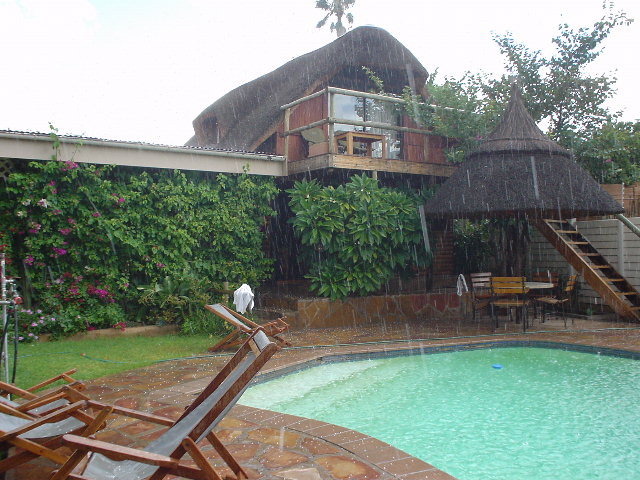
The power went out mid-day during a pretty heavy hail and rain storm (picture above), the same kind of rainy season storm that put a damper on any of the outdoorsy day trips I tried to organized out of the city that day: either a cave expedition through the bat- and scorpion-infested Arnhem Cave (Namibia’s largest), which was closed due to flooding; or a mountain bike game drive through the nearby Daan Viljoen Game Park, which was too muddy.
Instead, it was another day in the Chameleon Backpackers’ lounge watching videos with others also trying to keep dry — The Ninth Gate, The Professional, Twelve Monkeys and two Time/Life wildlife safari videos. I also read a chapter in Zadie Smith’s White Teeth, which I bought in town the day before. The sun finally came out in the late afternoon, and I inquired about things to do in Windhoek — but as Morne at the bar put it, “There’s not much to do here, man.” Two other locals agreed; it was more or less just a town to get stuff before moving on to the countryside. (I still had two more days to go before my safari.)
THAT NIGHT AT THE POOLSIDE BAR, I befriended Michael, yet another one of The New Lost American Generation of former dot comers, from Chicago. Burnt out from working crazy IT contracts for CBS and AT&T Wireless’ mLife campaign, he took an indefinite leave of absence (it had just been over a year when I met him) to go to developing nations to attend and facilitate programmer workshops so that less-technological countries — like Namibia with its dial-up connections (even in internet cafes) — could play a little catch up to the modern Western world. He was at the end of his stay in Africa and was also trying to postpone the inevitable re-entry to the job that he technically never quit.
Rosa, the native Namibian tending bar, and I were chatting about the usual things you talk about at a backpackers bar, travel and life goals amongst them. She told me she had been working at Chameleon for the past two years — maintaining the hostel, bookkeeping, tending bar, etc. — but was certain that she wouldn’t want to be there forever like her co-worker Sam, who was going on five years.
“What would you want to do?” I asked.
“My dream,” she said in her African accent, as I waited for her to finish the sentence with something lofty in my mind, “is to work on computers.”
Confused, I asked, “Like programming and stuff?”
“No, just to set up accommodations and reservations and things like that.” She told me she wanted to work in an office.
Perhaps Rosa was part of an unwritten lost generation of Africans that wanted the exact opposite of The New Lost American Generation. As the saying goes, “The grass is always greener on the other side” — especially when it had been raining so much that day I stayed indoors.
Next entry: The Universal Language Of Beer
Previous entry: Influencing Windhoek
Commenting is not available in this channel entry.
Comments for “The New Lost American Generation”
I’m number 1!
BTW - I’m relieved you’re ok after being mugged by knifepoint and that you’re outta S.A.
Posted by .(JavaScript must be enabled to view this email address) on 03/30 at 12:57 PM
HAHA How ironic.
Posted by .(JavaScript must be enabled to view this email address) on 03/30 at 01:23 PM
hey erik, do you get a lot of crap for being american while you’re abroad? or do they still think you’re mexican? i’m pretty curious… (about treatment of americans…not whether you are mexican or not.)

Posted by hanalei on 03/30 at 01:51 PM
Atari2600 RULEZ!
Posted by .(JavaScript must be enabled to view this email address) on 03/30 at 02:07 PM
are you a mexiCAN or a mexiCAN’t?
Posted by .(JavaScript must be enabled to view this email address) on 03/30 at 02:33 PM
that commodore64 prompt line brought back some good memories! my favorite game was labyrinth….man that kicked ass!
Posted by .(JavaScript must be enabled to view this email address) on 03/30 at 03:44 PM
YO ERIK: So WHEAT and I were stopped and this time frisked by New York’s Finest tonite…..again we fit the “description” of people that someone just called the cops about…
Although this encounter was “nicer” than that last one we all had, fuck that….
they kept on saying, “so is there anything you are carrying that you shouldn’t be carrying?”
ummm…..no dick….are they doing they’re job, or being dicks, any thoughts anyone? this happened on 9th in between 41st and 40th right behind port authority…
Posted by .(JavaScript must be enabled to view this email address) on 03/30 at 10:25 PM
That sucks Markyt! WTF!!!
how could someone “dream” of office work?! I guess the grass IS always greener.
Still though… it seems like an odd thing to “dream” about.
Posted by .(JavaScript must be enabled to view this email address) on 03/31 at 12:05 AM
FUNDAMENTAL!!!!!
Posted by .(JavaScript must be enabled to view this email address) on 03/31 at 02:28 AM
TD0T - so does a profile wear a peacoat and walks with his hands in his pocket?? FUCK THAT…WHAT fuck da police…..
Posted by .(JavaScript must be enabled to view this email address) on 03/31 at 02:29 AM
markyt- i’m sorry that you were frisked. maybe racial profiling wouldn’t be so bad for you if po-po’s were hot, jessica rabbit type she-cops. then a grand time would be had by all.
but then that goes into the whole gender politics/objectification discussion. but still, i hold the above true.
Posted by hanalei on 03/31 at 02:09 PM
“...in between 41st and 40th right behind port authority…”
hmm…what were you doing behind port authority? Was this at 2 am in the morning? Knowing Wheat, i betcha you had it coming.
j/k…but that is some f’kd up shit.
Posted by .(JavaScript must be enabled to view this email address) on 03/31 at 03:50 PM
SHIT, MarkyT… that’s is f’d up. On Sept. 13th, 2001, an NYPD cop stopped me from entering a barricade south of 14th Street—and let a shadier looking white guy passed. Racial profiling? Hmmm…
Funny me being Filipino-American abroad… in South America I was mistaken for Brazilian, Peruvian, Colombian, Ecuadorean, Bolivian…
In South Africa and Namibia, people mistake me for one of the “coloureds.” (It happened again on Day 164 and Day 165.)
Only when I speak do I reveal I am from the USA.
HANALEI: As for Americans abroad… what can I say… what more of an adventure is it to be American abroad with everything that is going on!
Seriously, there is definitely anti-American sentiment out there… in Rio de Janiero, there were anti-USA bumper stickers around (even in the tour agency that set up my Carnaval parade).
It’s interesting watching the news out here—news that is NOT controled by politically-influenced corporations. While American news portrays sympathetic stories about the latest violence in Iraq, BBC World always takes the angle of Americans and their greed for oil. (In fact, sometimes, they don’t even refer to W. as “President Bush” but just “Mr. Bush.)
Meeting American backpackers is an interesting experience since we’re all in the fraction of a percentage of the population—only 8% of the American population has a valid passport, let alone long-term travellers. Something that’s stuck out in my head in one conversation with one was, “Man, if only the Americans back home could come out here and see how badly portrayed we are to other countries, then maybe they’d vote differently.”
Posted by .(JavaScript must be enabled to view this email address) on 03/31 at 04:30 PM
LP: it happened at 7pm….and yeah it must have been wheat that pissed someone off….hahahahah…
Posted by .(JavaScript must be enabled to view this email address) on 03/31 at 05:11 PM
SHARE THIS TRAVEL DISPATCH:
Follow The Global Trip on Twitter
Follow The Global Trip in Instagram
Become a TGT Fan on Facebook
Subscribe to the RSS Feed
This blog post is one of over 500 travel dispatches from the trip blog, "The Global Trip 2004: Sixteen Months Around The World (Or Until Money Runs Out, Whichever Comes First)," originally hosted by BootsnAll.com. It chronicled a trip around the world from October 2003 to March 2005, which encompassed travel through thirty-seven countries in North America, South America, Africa, Europe, and Asia. It was this blog that "started it all," where Erik evolved and honed his style of travel blogging — it starts to come into focus around the time he arrives in Africa.
 Praised and recommended by USA Today, RickSteves.com, and readers of BootsnAll and Lonely Planet's Thorn Tree, The Global Trip blog was selected by the editors of PC Magazine for the "Top 100 Sites You Didn't Know You Couldn't Live Without" (in the travel category) in 2005.
Next entry:
The Universal Language Of Beer
Previous entry:
Influencing Windhoek
THE GLOBAL TRIP GLOSSARY
Confused at some of the jargon that's developed with this blog and its readers over the years? Here's what they mean:
BFFN: acronym for "Best Friend For Now"; a friend made on the road, who will share travel experiences for the time being, only to part ways and lose touch withThe Big Trip: the original sixteen month around-the-world trip that started it all, spanning 37 countries in 5 continents over 503 days (October 2003–March 2005)
NIZ: acronym for "No Internet Zone"; a place where there is little to no Internet access, thus preventing dispatches from being posted.
SBR: acronym for "Silent Blog Reader"; a person who has regularly followed The Global Trip blog for years without ever commenting or making his/her presence known to the rest of the reading community. (Breaking this silence by commenting is encouraged.)
Stupid o'clock: any time of the early morning that you have to wake up to catch a train, bus, plane, or tour. Usually any time before 6 a.m. is automatically “stupid o’clock.”
The Trinidad Show: a nickname of The Global Trip blog, used particularly by travelers that have been written about, who are self-aware that they have become "characters" in a long-running story — like characters in the Jim Carrey movie, The Truman Show.
WHMMR: acronym for "Western Hemisphere Monday Morning Rush"; an unofficial deadline to get new content up by a Monday morning, in time for readers in the western hemisphere (i.e. the majority North American audience) heading back to their computers.
1981ers: people born after 1981. Originally, this was to designate groups of young backpackers fresh out of school, many of which were loud, boorish and/or annoying. However, time has passed and 1981ers have matured and have been quite pleasant to travel with. The term still refers to young annoying backpackers, regardless of year — I guess you could call them "1991ers" in 2013 — young, entitled millennials on the road these days, essentially.
Spelling or grammar error? A picture not loading properly? Help keep this blog as good as it can be by reporting bugs.