The Farmer That Found A Warrior Within
This blog entry about the events of Saturday, August 28, 2004 was originally posted on September 01, 2004.
DAY 315: In 1974, a group of peasant farmers in a remote countryside of the Shaanxi province were digging up a well. Instead of water, they stumbled upon something else: without aiming to do so, they had found one of the greatest archaeological sites of the 20th century, Emperor Qin Shi Huang’s army of The Terracotta Warriors.
The Terracotta Warriors, an army of an estimated 8,000 life-sized statue warriors made of terracotta clay, were created under order of the eccentric Emperor Qin Shi Huang of the ancient Qin dynasty (who has also been credited with creating the first sections of The Great Wall). The purpose of this clay army was simply to guard his tomb after death from invaders, so that perhaps he might have a good night’s sleep — permanently. The Terracotta Warriors, and the tomb they “swore” to protect, went hidden underground for millennia until that one day in ‘74 when the farmers found it by accident. Little did they know at the time that their discovery would spawn an army of kitschy souvenir vendors thirty years later selling replicas of the Terracotta Warriors in different sizes.
VISITING THE ARMY OF TERRACOTTA WARRIORS, 28 km. east of Xi’an’s city center in the suburbs, is arguably the reason for a tourist to visit Xi’an. I had signed up to see them, as well as some little added extras, on a tour set up by the travel agency in the hostel. With me were a Swiss couple, the Dutch couple that I had met the day before at the train station, an Australian college student named Mike and three guys traveling China after an international relations conference in Shanghai: Stewart from Scotland, Ben from Australia and Santiago from Ecuador. We were led by our lovely librarian and part-time tour guide Zhou, who spoke into the microphone using broken but decent English to tell us historical information en route to the dig site.
Our first “bonus” site was a terracotta factory, where artisans hand-crafted different functional and non-functional items, the most non-functional being the kitschy replicas of the terracotta statues for vendors to sell on the street — although the factory also sold them in their showroom. The terracotta statue showroom was just one of many other showrooms selling many different goods to tourists under the guise as a “factory.”
“Hmmm, this factory looks a lot like a souvenir gift shop,” I said.
“Hmmm, I wonder why they brought us here,” Stewart said.
The only redeeming value of this “factory” (for me at least) was the ultra-kitschy Terracotta Warrior costume for an ultra-kitschy photo of myself.
WE SPENT THE NEXT HOUR at another site on the way to the site of The Terracotta Warriors, the small, but decent collection of the Lintong Museum, housed in a building with a guardian lion statue who probably didn’t guard much since he was permanently scratching himself. Inside the museum was not only a display of some Buddhist relics, but a comprehensive exhibition of artifacts from the Qin dynasty to the Ming dynasty, covering centuries of history in the Xi’an region. Zhou walked us around the displays and explained some history to us — something she thought I was most interested in — including the gruesome corporal punishment of the short-lived Qin dynasty. The violent punishments of the penal laws ultimately led to the end of the dynasty when farmers in the Farmer Revolution took over the land and overthrew the government with more peaceful laws.
After a delicious lunch of Shaanxi Chinese cuisine at a restaurant on the way, we finally arrived at the site of The Terracotta Warriors, a very developed tourist complex that was something out of Disneyland or something, just without the dress up characters — it was hard to believe that the excavation was still in progress. Zhou led us into the “park” and pointed out the different hangars and buildings where the three main excavation pits were, before walking us to the theater with the introductory historical re-enactment film.
“If you’re lucky, the farmer will be there,” she said. She was referring to Yang Yen Pei, the last remaining farmer in the group that discovered The Terracotta Warriors in 1974 who was strong enough not to be bedridden. (Only one other remained in the entire group of farmers.)
Yang’s reason to be at the “Terracotta Park” was for one reason: to pose as a celebrity and sign autographs in coffee table books about the archaeological find he discovered by accident. The old man in his seventies was indeed there, at a table near a stack of books, looking quite tired of sitting at the same damn desk everyday to deal with dumb tourists. He didn’t do it for the fame though; he did it for money. A book cost 120 yuan and an autograph another 50.
We walked over as a group to the desk to see him up close. I was somewhat excited to meet the man himself and was about to extend my hand for a handshake — but he started picking his nose before I did and I retracted before I even extended. I wondered if he was picking his nose that day in 1974.
Ben was feeling the celebrity vibe in him and didn’t want to let the opportunity pass him by, fee or no fee. He bought a book and an autograph, and posed for a photo with his friend Stewart, who didn’t mind shaking the old man’s nose-picking hand. Stewart and Ben posed with Yang for Santiago to take the photo; I seized the opportunity to take a photo of them too with my little spy camera. When Santiago was focusing, I whipped out my little spy camera out of my pocket pretty obviously and snapped a photo for myself. Yang saw what I was doing and immediately got angry at me for “stealing” a photo without paying.
“You have to pay ten yuan,” a woman told me.
“But I’m with them.”
“Ten yuan.”
Zhou interjected and then reiterated the rule to me. “If you want to take a picture with him, you have to pay ten yuan. Do you want to take a picture with him?”
“Uh, I just took one.”
“They said it’s ten yuan to take a picture with him.”
“But I don’t want a picture with him, I just took it because we’re all in the same group.” It was my alibi and I was sticking to it — I didn’t know at the time that Ben had paid the extra 10 yuan in addition to the 170 he spent already.
“Did you take the photo already?” Zhou asked me.
“Yeah.”
“Let’s go then!” We snuck away before Yang and his underlings chased me down.
THE INTRODUCTORY MOVIE WAS REALLY DATED; it seemed like it had been made in the 1970s, with what sounded like a mono soundtrack and a film reel in desperate need of a restoration. The good thing was that it was presented in a 360° surrounding screen format — just like they do at Disneyland. The re-enactment was somewhat cheesy, but at least the Yang the old man had a cameo in the background when a guy playing him dug up the warriors.
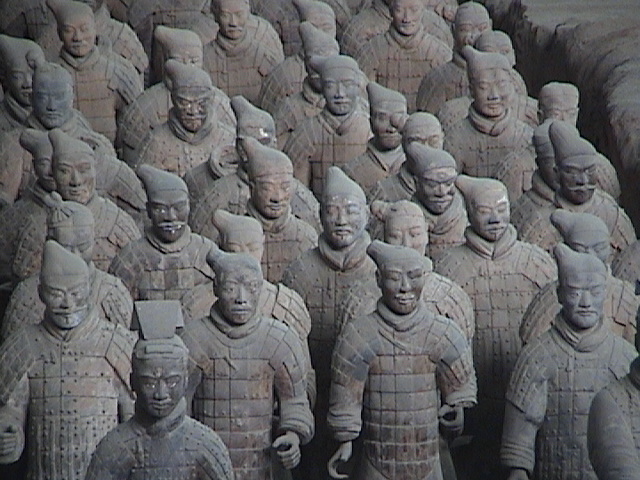
We all split up and wandered the “park” at our leisure in the manner Zhou suggested: Pit 1, the biggest, most impressive pit of the Terracotta Warriors (picture above), then Pit 3, with broken bits of warriors, then Pit 2, a site of the excavation in progress, and finally the museum of the Bronze Chariots, found in Qin Shi Huang’s tomb.
Pit 1 was the definitive site you might have seen in a history book. Protected by what looked like the roof of an airplane hangar, over a thousand Terracotta Warriors and their Terracotta Horses stood frozen in rows ready to attack — although most of them looked like they wanted to do the dance “The Robot” instead. Each one was sculpted as a real warrior, complete with the uniform denoting its rank in the army. Even the faces were individually crafted, modeled after the actual soldier it was trying to depict.
Pit 3 was just like it had been described to us; a smaller pit with incomplete warriors and broken pieces of the clay army, and Pit 2 was a huge area of clay where more warriors were supposedly hidden underneath. The excavation was on-going — although we wondered just when archaeologists got to work on it with all the tourists around taking photos at the indoor exhibition of the different types of warriors found in the army: the Kneeling Archer, the Standing Archer, the Mid-Ranking Officer and the High-Ranking Officer.
“JUST LOOK AT THE ANGER IN HIS FACE!” Ben pointed out, looking at their digital photo of Yang the old nose-picking farmer. Santiago too captured the moment digitally of the little incident I caused earlier that afternoon.
“Now that’s worth ten yuan right there,” Stewart said.
I took out my camera and we compared. They were both similar, truly capturing the emotion in Yang’s face. “I think I felt him clench his fist tighter when you took the picture,” Stewart told me.
“I think I almost killed him,” I joked. We had all left the premises before Yang had time to track us down — although I’m sure if he had a really good American lawyer, he might be able to get back at me through legal channels.
SPEAKING OF LAWYERS, I met two that night. Over early evening drinks I met Todd, a Canadian from Nova Scotia working in Hong Kong who believed that there were only two true world cities, New York and London. (Paris is on a tier below New York and London, because, as international as it is, it’s still pretty French-centric.) Later on that night in the rock bar in the basement of the hostel — where Santiago and Ben jammed with the local Chinese rock band with vocals and drums — I met Michael, a retired lawyer of the United Nations in the world city New York. In between lawyers I met a teacher and a student in the hostel restaurant in the back, open to locals as well. It was there I stumbled upon 39-year-old magazine entrepreneur David and his 27-year-old English tutor Hana, who was so excited that I turned up out of nowhere because now her pupil could practice English with a true English-speaker. In the end, it was beer that eased the practice conversations, which eased my wallet that night because David paid for my dinner and my drinks in return the favor of my “tutoring.”
Perhaps I should have just offered Yang a beer when he got pissed off at me earlier that day and shook his hand in apology, although I’d probably have to look out for which had he was picking his nose with first.
Next entry: Big Wild Goose Chase
Previous entry: He Said, She Said in Xi’an
Commenting is not available in this channel entry.
Comments for “The Farmer That Found A Warrior Within”
HEY ALL… There you go, four more in a row without commerical interruption!
I’m off in the NIZ (No Internet Zone) for the next 4-5 days, as I cruise along the scenic Yangtze River’s Three Rivers Gorge before it’s too late—the entire thing will be submerged underwater when a dam reaches completion in 2006.
Stay tuned!
Posted by .(JavaScript must be enabled to view this email address) on 08/31 at 05:41 PM
so much for a “spy camera”! or you have to work on your 007 skills! looking forward to your return. be safe

NPosted by .(JavaScript must be enabled to view this email address) on 08/31 at 06:07 PM
dude! warriors doing the robot!! now that is awesome
some shaolin pop-lock moves
Posted by .(JavaScript must be enabled to view this email address) on 08/31 at 06:18 PM
I’ve wanted to visit the site since I saw a small display dedicated to the terracotta warriors in the Pacific Mall; located in a Chinese area just outside Toronto.
Posted by .(JavaScript must be enabled to view this email address) on 08/31 at 07:56 PM
Again, fantastic pic’s…it makes me wonder, what did they hold in all their hands? They definately held something. Erik, did they tell you if they held anything?
Will look forward to your return!
Posted by .(JavaScript must be enabled to view this email address) on 09/01 at 04:50 AM
such amazing craftsmanship!
Posted by .(JavaScript must be enabled to view this email address) on 09/01 at 09:27 AM
ERIK - So I thought I deleted the last comment spams, but it doesn’t look like it. Walk me through next time around.
Posted by .(JavaScript must be enabled to view this email address) on 09/02 at 01:27 AM
ok, nevermind…looks like it did work!
Posted by .(JavaScript must be enabled to view this email address) on 09/02 at 01:28 AM
did it work?
Posted by .(JavaScript must be enabled to view this email address) on 09/02 at 05:16 PM
“ultra-kitschy”... catchy!
That food looked very yummy. I’ve got a stupid question: I’m chop-stick-deficient to say the least. I would even call my attempts “spazy”. Have you even SEEN a fork since your arrival in China?
SUPER jealous! I can’t believe all you’ve seen in just the short time you’ve been in China so far. The *Warriors*??? Holy crap!
I’ve been so impressed with the sights, and so extremely happy you’ve shared it with us. This is definitely me living vicariously through you! Thankyou, thankyou, thankyou, thankyou….
Posted by .(JavaScript must be enabled to view this email address) on 09/02 at 07:44 PM
You always seem to get caught taking photos when you’re not supposed to, eh Erik?

BTW—I may be back in Oz in Jan/Feb of 2005! I’ll keep you posted.
Word Life.
Moman!!
Posted by Moman on 09/03 at 05:09 AM
AR5 - whazzup with you guys? No AR5 comments this week? Well, I’ll start (if you haven’t seen it yet, don’t read - and get BitTorrent and download the episode from http://www.suprnova.org)
Those water slides in Dubai - I’m there! Hiroshi (my husband) is not. He’s convinced it is death on a slide. Doesn’t like roller coasters either, party pooper. Dubai looks cool though. Definitely want to go to that flower market in in India - wow! Too bad no one picked that option on the detour.
And what was up with the FF? Has there ever been anything so extreme before? Of the episodes I’ve seen (not many mind you) it always seem they just need to go somewhere and do some minor task. Shaving your head is a bit much. Although, I’d do it. Especially at the moment - my long hair is driving me buggy in the summer heat!
Posted by Liz on 09/03 at 06:31 AM
Liz: AR5…the FF…I would have done it. It’s just hair, and really Brandon would be cute with a shaved head! Just think the shaved heads could have worked to their advantage….someone would probably think they were sick. Let me know when you get to Dubai on your trip and I’ll fly over and do the slide with you….looks like fun! LOL
Posted by .(JavaScript must be enabled to view this email address) on 09/03 at 06:56 PM
HELP! Where are the pics of the salt fields in South America? I remember one entry is titled “Dali World” or something like that…........but I can’t find them. What country? What month? If anyone could direct me to them I would appreciate it! Want to show them to someone. Thanx!
(P.S. Still a few days behind. Been busy reading my Lonely Planet for Taiwan!)Posted by .(JavaScript must be enabled to view this email address) on 09/03 at 10:52 PM
Janice: You’re going to Taiwan!! I loved it there, and I’m planing to make the move next August.
The salt flats are Bolivia. I think this is the entry you’re looking for:
http://theglobaltrip.dreamhosters.com/images/blogs/tgt2/001356.shtmlPosted by .(JavaScript must be enabled to view this email address) on 09/04 at 02:06 AM
I love the pic of you as a terra cotta warrior. So cute!
Posted by .(JavaScript must be enabled to view this email address) on 09/04 at 07:58 AM
ROSE: Some of them held wooden staffs and spears I believe. Also most of them used to be fully-painted in lifelike colors, but those paints didn’t survive…
Posted by .(JavaScript must be enabled to view this email address) on 09/04 at 10:36 AM
CHRISTY: No, I have not seen one piece of Western silverware since I’ve been here—spoons are the nice Chinese ones. If you plan on coming over, get the practicing with them thar chopsticks!
Posted by .(JavaScript must be enabled to view this email address) on 09/04 at 10:38 AM
E:LISA: If you think me as a Terracotta warrior is cute, you should see me as a nutsack!
(That’s not a joke.):
http://www.theglobaltrip.com/videos
Posted by .(JavaScript must be enabled to view this email address) on 09/04 at 10:41 AM
GREETINGS FROM WUHAN! Get this, not only am I really behind, but I’m in a NCHUZ (no camera hook up zone)... Sorry, new entries will have to wait.
CHOOSE MY OWN ADVENTURE: Get this, Hong Kong, although a part of China since its return from the British in 1997, STILL requires a visa to get in and out, like it’s still a separate country…
THIS HAS CHANGED MY PLANS A BIT, and I’d like some feedback. Originally, I was going to go from the southern city of Guilin to Hong Kong, meet up with Aviva (EL ZEE’s SBR sister) who has a place for me to crash and then head up to Shanghai to see the city for a couple of days before taking the boat to Japan to see LIZ. BUT I can’t without a hassle because once I enter HK, I will have technically left China and need another visa to get to Shanghai.
In the end, it boils down to Hong Kong or Shanghai.
From Guilin, should I: go to Hong Kong, which is really close by (compared to Shanghai, which I’d probably have to fly to); or go to Shanghai?
Hong Kong’s option: I have a place to crash, I have established contacts there. But I wouldn’t go to Shanghai at all and would most likely spend the money to FLY to Tokyo instead of taking the boat.
Shanghai’s option: I get more bang for my buck with the single-entry Chinese visa I already have, plus I get to see Shanghai (everyone raves about it)... plus a boat to Japan is only $200, as opposed to a pricier flight. However, to get there in reasonable time to the boat ticket requires me to fly in from Guilin anyway, and there is no place to crash.
As I’m told from someone who’s been to both places, both are big comparable cosmopolitan cities, Hong Kong the classic British colony with Chinese flair; and Shanghai, the soon-to-be showcase city of China’s post-modern architecture.
HELP!
Posted by .(JavaScript must be enabled to view this email address) on 09/04 at 10:55 AM
AVIVA: How long am I allowed to impose?
Posted by .(JavaScript must be enabled to view this email address) on 09/04 at 11:07 AM
Impose as long as you need to…I still don’t know anyone in HK yet, so it will be awesome to have someone to talk to/sightsee with (if you don’t mind me tagging along sometimes)...but I also understand if you choose Shanghai… difficult choice to make. Aviva
Posted by .(JavaScript must be enabled to view this email address) on 09/04 at 12:28 PM
Erik, stop being a wuss, you can get a new China (PR) visa in a few hours in HK, you’ll need one passport photo:
Forever Bright(!) LimitedRoom 707, New Mandarin Plaza
Tower B, Science Museum Rd. Tsim Sha Tsuiplus there’s a cool place to eat thee, called the House of Bento (in the KFC) until they get your visa
you won’t need a visa to the HK SAR but I hope you know that…
and please don’t change your RMBs into HK$in TST unless you want to get seriously ripped off….Posted by .(JavaScript must be enabled to view this email address) on 09/04 at 02:16 PM
f. man
are you in Wuhan? can’t wait to see your comments about the Detroit of China….
I hear it’s reallllllly beautiful there….Posted by .(JavaScript must be enabled to view this email address) on 09/04 at 02:21 PM
HK it…
Posted by .(JavaScript must be enabled to view this email address) on 09/04 at 05:16 PM
“choose your own adventure” I used to have those books as a kid - I forgot all about them!
I’ll enjoy reading about either way you go.
Posted by .(JavaScript must be enabled to view this email address) on 09/04 at 08:55 PM
Td0t: Thanx for the pic info! Yes, I’m applying in Taiwan right now and ready to go as soon as I get a job!
Posted by .(JavaScript must be enabled to view this email address) on 09/05 at 04:23 AM
AVIVA: You had me at “impose as long as you need to.”
Right now I’m leaning towards HK since I’m down south already…
F.LEVENTE: Yeah, I know I can get the Chinese visa in HK, but with time restraints, it boiled down to HK or Shanghai; it’s also a money thing too… Where are you exactly? Feel like appearing on The Blog?
Posted by .(JavaScript must be enabled to view this email address) on 09/05 at 05:40 AM
Hi Erik,
I think HK is the better choice, there are more to see and it’s a unique place, if you are interested I can get you a list of how-to-do-it cheap…
SH is more like wide highways, skyscrapers the Chinese style.
at the moment we live in a crappy industrial place between Macau and Guangzhou, I doubt if you are interested in it we have an apartment in Guangzhou from the 15th. by the way, where you are welcome if you are stuck here.HK-Tokyo is quite expensive unless you have your RTW ticket (It’s about 5000 HK$)
what’s your route to HK? if you have to change in GZ we can meet you there to help you get around, it’s not a friendly place to arrive…:)Posted by .(JavaScript must be enabled to view this email address) on 09/05 at 05:56 AM
about the money thing: you can easily get a job at a language school now in SH for even 2 weeks, get free logding , etc and make about 6000 RMB in 14 days, just an idea…
Posted by .(JavaScript must be enabled to view this email address) on 09/05 at 06:00 AM
F.LEVENTE: An agent quoted me 2300 RMB from HK to Tokyo… was he pulling my leg?
Posted by .(JavaScript must be enabled to view this email address) on 09/05 at 06:07 AM
if it’s not the good old bait and switch please let us blogreaders know about that agent! seriously…
Posted by .(JavaScript must be enabled to view this email address) on 09/05 at 07:01 AM
rebuild
Posted by .(JavaScript must be enabled to view this email address) on 09/08 at 10:15 PM
Those warriors are awesome. And I like the pic of you as a warrior - awesome…
Are those big mounds going to be unearthed as well? How far away from the statues could you get?Posted by .(JavaScript must be enabled to view this email address) on 09/10 at 12:16 PM
SHARE THIS TRAVEL DISPATCH:
Follow The Global Trip on Twitter
Follow The Global Trip in Instagram
Become a TGT Fan on Facebook
Subscribe to the RSS Feed
This blog post is one of over 500 travel dispatches from the trip blog, "The Global Trip 2004: Sixteen Months Around The World (Or Until Money Runs Out, Whichever Comes First)," originally hosted by BootsnAll.com. It chronicled a trip around the world from October 2003 to March 2005, which encompassed travel through thirty-seven countries in North America, South America, Africa, Europe, and Asia. It was this blog that "started it all," where Erik evolved and honed his style of travel blogging — it starts to come into focus around the time he arrives in Africa.
 Praised and recommended by USA Today, RickSteves.com, and readers of BootsnAll and Lonely Planet's Thorn Tree, The Global Trip blog was selected by the editors of PC Magazine for the "Top 100 Sites You Didn't Know You Couldn't Live Without" (in the travel category) in 2005.
Next entry:
Big Wild Goose Chase
Previous entry:
He Said, She Said in Xi’an
THE GLOBAL TRIP GLOSSARY
Confused at some of the jargon that's developed with this blog and its readers over the years? Here's what they mean:
BFFN: acronym for "Best Friend For Now"; a friend made on the road, who will share travel experiences for the time being, only to part ways and lose touch withThe Big Trip: the original sixteen month around-the-world trip that started it all, spanning 37 countries in 5 continents over 503 days (October 2003–March 2005)
NIZ: acronym for "No Internet Zone"; a place where there is little to no Internet access, thus preventing dispatches from being posted.
SBR: acronym for "Silent Blog Reader"; a person who has regularly followed The Global Trip blog for years without ever commenting or making his/her presence known to the rest of the reading community. (Breaking this silence by commenting is encouraged.)
Stupid o'clock: any time of the early morning that you have to wake up to catch a train, bus, plane, or tour. Usually any time before 6 a.m. is automatically “stupid o’clock.”
The Trinidad Show: a nickname of The Global Trip blog, used particularly by travelers that have been written about, who are self-aware that they have become "characters" in a long-running story — like characters in the Jim Carrey movie, The Truman Show.
WHMMR: acronym for "Western Hemisphere Monday Morning Rush"; an unofficial deadline to get new content up by a Monday morning, in time for readers in the western hemisphere (i.e. the majority North American audience) heading back to their computers.
1981ers: people born after 1981. Originally, this was to designate groups of young backpackers fresh out of school, many of which were loud, boorish and/or annoying. However, time has passed and 1981ers have matured and have been quite pleasant to travel with. The term still refers to young annoying backpackers, regardless of year — I guess you could call them "1991ers" in 2013 — young, entitled millennials on the road these days, essentially.
Spelling or grammar error? A picture not loading properly? Help keep this blog as good as it can be by reporting bugs.