The Fantastic Wall
This blog entry about the events of Sunday, August 22, 2004 was originally posted on August 28, 2004.
DAY 309: I remember watching a television special as a kid in the 1980s when hotshot magician David Copperfield performed a “magic” illusion in which he walked through The Great Wall of China. Actually, from what I recall, you never really saw him pass through The Wall; on both sides of The Wall he put up a backlit translucent screen so that you only saw a silhouette of David Copperfield go in one end and out the other. The end result, as mysteriously executed as it was, was pretty lame.
Nowadays, David Copperfield’s lame television magic specials have been replaced by David Blaine’s lame tests of endurance, but The Great Wall remains. If you live in America, no doubt you are within close vicinity of a Chinese food take-out place bearing the same name. But I’m not talking about that Great Wall — as greasily good the chicken with broccoli may be — I’m talking about The Great Wall, the 4,464 mile-long wall constructed in northern China in sections over time from 3rd century B.C.E. to 17th A.D. by the various emperors — most constructed in the later years by the Ming Dynasty. It’s been said this wall, long enough to link New York to L.A., is so tremendous that it is the only man made object viewable from outer space — although I’m told that when China’s first astronaut went up, he was an embarrassment to his country when he said that he couldn’t seem to find it.
“Beijing, we have a problem.”
THERE ARE SEVERAL SITES TO VISIT THE GREAT WALL from Beijing, the closest (and therefore most crowded with tourists) being Badaling, not to be confused with Badabing (the strip club on The Sopranos). For a more intimate experience with The Wall, one mustn’t need to resort to heavy petting at Badaling, but simply journey farther out from the city to the “Wild Wall” as Lonely Planet calls it, sections where The Wall is lonely and unrestored from the times it had been breached by incoming warriors. The Hostelling International hostels in Beijing couldn’t make it any easier (and cost effective) to go to the Wild Wall beyond Badaling, three hours north of Beijing by car to Jinshanling. From Jinshanling, we’d hike 10 km. east on top of The Wall to the town of Simatai for a ride home.
Sitting in the transport mini-van at 7:00 a.m. were a drowsy group of people — I was happy to see I wasn’t the only one who had only slept four hours after going out the night before. Actually, a trio from France was the only energetic ones, but they got nixed from the transport because no one had jotted down their transportation reservation from the day before, and our car was full.
With me on the ride through Beijing’s Monday morning rush hour were: Ed and Will, two farmboy brothers from the UK; Amit, a Cambridge scholar from the UK who had just graduated and had just completed a stint teaching English in southern China; Monique, on vacation leave from her post in the Dutch Army; two other guys whose names I forgot; and driver Joseph who was a master at the wheel, weaving in and out of traffic as good as the next guy. We arrived at the village of Jinshaling around ten, where I immediately rushed to the nearest toilet from holding my bladder in for the entire ride.
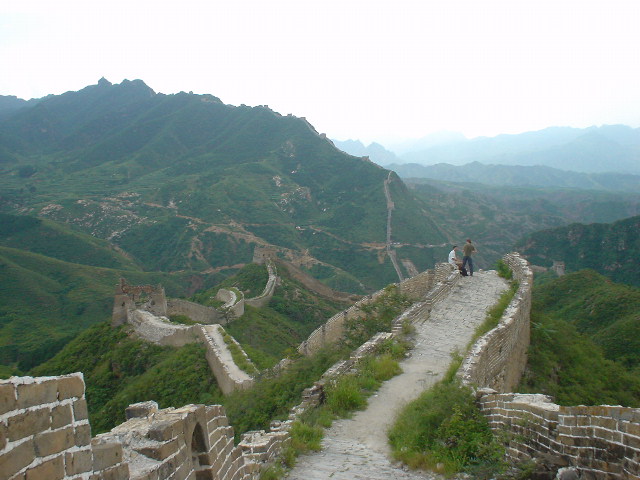
Relieved, I joined the others, including just two other van-loads of people, up through the village and along the dirt path up the mountain to one of the entrances of The Great Wall. Not only where we in awe that we were actually in the front of one of the Seven Wonders of The World, but the surrounding rolling green mountains were also just breathtaking — or maybe we just had to catch our breaths from the steep hike uphill. Once on top of The Wall at our first of twenty-seven watchtowers we’d pass through, we took a moment to just let the moment process in our minds. For me, it was the big finale of my trip of on the Trans-Siberian/Trans-Mongolian Railways, which started upon gazing at St. Basil’s Cathedral in Moscow’s Red Square.
“No wonder they called it The Great Wall,” Ed said.
“It’s not just The Wall, the scenery is amazing,” Monique said.
“I don’t think they should have called it The Great Wall, they should have called it The Fantastic Wall,” Ed said. “This pretty much whips The Forbidden City’s ass.”
While the section around Jinshaling was restored, it wasn’t a walk in the park. “I thought when we were coming up the hill that at least that was the worst of it,” Amit said, “Until this.” He was referring to the fact that we weren’t at a flat section of The Wall one could simply rollerblade on. The Wall followed the undulating nature of the mountains, going up and down, up and down, sometimes so steep that tall steps had to be built to ascend.
WE STARTED ON OUR 10-KILOMETER TREK on The Wall — which seemed a lot longer since for the first half there were more uphills than downhills — just like the ancient trader caravans did between Europe and Asia. Going up the steep inclines was like being on a StairMaster that wouldn’t stop. The Great Wall was built to discourage nomadic barbarians from attacking from the north? I thought. These inclines are steep enough to discourage the people defending The Wall from going anywhere.
Our group split up naturally, the way big hiking groups do when everyone has a different pace. I spent most of the day with my new friend Amit, who was just as much of a shutterbug as I was, if not more. Unlike the madness I had heard about at crowded Badaling, for most of the time, it was just us two stragglers in the back with our cameras. We weren’t completely alone though; each hiker was followed by one or two touts trying to sell postcards, books or drinks. At one point, Amit did the polite British thing to do: kindly telling the two women they were wasting their time and energy hiking along with us because we weren’t going to buy anything. Monique once got rid of her tout simply by faking her out with a false step forward and then back — the woman got the hint and left her alone. Two other Dutchmen we met actually bought water from their two girl touts — that wouldn’t stop laughing in the tower they were stationed in for I don’t know why — provided that we could take a picture with them. It didn’t matter if we got rid of a tout because another one waiting down the line would start following. I’m sure not even David Copperfield could have made them disappear.
The farther we got from Jinshaling, the more The Great Wall was more in ruins — the wall itself and its watchtowers as well. I noticed that a lot of the sections that were more beat up were at points where The Wall was lower or on a lower mountain — an easier place to breach in wartime — although some bricks were simply taken by locals over time to build their houses. Not every section was weak; as history had it, one guy in charge of construction of one section of The Great Wall was really anal about it, making sure everything was exact. His production schedule was way behind everyone else’s and so he was killed — but in the end, it was his section that was one of the strongest sections of the entire span.
“DO YOU WANT A BEER?” Amit asked me. I had a bit of a cold but accepted his offer. I mean, when else would I drink a beer on The Great Wall? We toasted our cans after making a short video on Amit’s camera and shared some cold ones on a Wonder of The World before continuing on. We met up with Monique and hiked together, all adamant to stay on The Great Wall (picture above), even on the destroyed sections that the touts said were too dangerous to go over — sections that were too narrow or had too high of a drop. Near the end of our hike we had no choice to stray off as the trail led off The Wall and down to a suspension footbridge over a gorge. At the other end, we had finally reached the end of our once-in-a-lifetime hike on The Great Wall, so great that I agreed with Ed — it might as well be called “The Fantastic Wall.”
The fastest way to get to the meeting point in the village of Simatai down the mountain and across a dam was via a zipline — lo and behold, one was available to us for a small fee. One by one we strapped into a harness that took us over the dam to the other side where our van was waiting for us. Joseph the driver took us back to Beijing during rush hour — there was more traffic the closer we got to the city, but most of us were too exhausted and just fell asleep not to notice.
“IT’S FUNNY, THIS IS JUST A RESTAURANT HERE,” I told Ed at just-a-restaurant back in Beijing after we all had freshened up and regrouped for a dinner out together.
“Yeah, we’re here going out for Chinese,” he said.
“It’s not Chinese food here in China, it’s just food,” I said. “These people aren’t going out for Chinese, they’re just eating out.”
The restaurant, whose name was written in Chinese, was “authentic” — locals ate there and the menu had no pictures or English, forcing us to pronounce words or point to dishes in our phrasebook. I sat between Ed and his brother Will at the table, which had been set up for us near the window to attract other foreigners in, even by shifting around patrons who were already eating to other tables. (It worked.) We shared a bunch of dishes and bottles of beer and hungrily ate like we had just scaled The Great Wall. It was a real feast, and all at the cost of about $1.50 (USD) each. At that price, I’m sure even if the restaurant’s name was named after The Great Wall like a place that might be near you, I’d definitely call it The Fantastic Wall too.
Next entry: No Common Denominator
Previous entry: Forbidden No More
Commenting is not available in this channel entry.
Comments for “The Fantastic Wall”
ohhhh super super super jealous. The Wall pics rock! I’ve never seen an un-touristed shot of it. Very, very amazing!
Posted by Liz on 08/27 at 05:21 PM
The Wall and Ziplining…so schweet!!
So I think the only way I’m gonna make it to Beijing is for the 2008 Olympics….
who wants to coach me in the trampoline??
Posted by .(JavaScript must be enabled to view this email address) on 08/27 at 05:44 PM
Erik I have to say, China has moved up on my list of places I have to see! I just finished reading November 2003 and thought the Galapagos Island pictures were amazing….can’t wait to see what happens next!
Posted by .(JavaScript must be enabled to view this email address) on 08/27 at 06:16 PM
Wow…loved the pic’s. Such fabulous opportunities you have! You must be in good shape after that walk/climb! I don’t think I could of walked/climbed that far..but I sure would do the zipline! Reminded me of AR. Hey Erik, I see you finally got a haircut! You had the q-tip head in previous pic’s.
Posted by .(JavaScript must be enabled to view this email address) on 08/27 at 07:32 PM
The picture of you and the Great Wall is incredible - shows the insignificance of people in the grand scheme. Your pics are so fun! I’m glad you had a fellow shutterbug to keep you company.
How long was that zipline? That looks like a crazy long trip… and now I’m HUNGRY!Posted by .(JavaScript must be enabled to view this email address) on 08/28 at 04:40 AM
This place was really beautiful…
If you want to (and if you return it after use) I can express post to you our LP China guidebook.
By the way you’ll hate it in Southern China, the rains have arrived, it’s been raining for days now and it looks like it will until October. Been really sunny until a few days ago…
good luck and careful with those divey diners up there
Posted by .(JavaScript must be enabled to view this email address) on 08/28 at 05:44 AM
i’m finally up to date!! yay!! got the link to your blog from a forum on the lonely planet site. interesting.. considering how much you bag them
 anyway, the blog it awesome. i’ve been constantly reading it for about 4 days straigt. its nice to finally read entries that aren’t months old.
china sounds awesome. keep up the great writing!Posted by .(JavaScript must be enabled to view this email address) on 08/28 at 06:51 AM
KERRYN: Hello and welcome! Yeah, funny about all the LP slamming… maybe now they’ll update their books…
Posted by .(JavaScript must be enabled to view this email address) on 08/28 at 12:52 PM
I so remember the David Copperfield ‘trick’ in the Great Wall too!!! That, along with playing Nintendo and guiding Bart Simpson through his skate along the wall, are what I know of the Wall. I hope I will get to see it for real once.
Posted by .(JavaScript must be enabled to view this email address) on 08/29 at 07:52 AM
Hey Erik. I found out about the Blog through a buddy of mine. Not sure how he stumbled on it, but he knows I love to travel and thought I might like it. And I do. It is the perfect way to break up the day at my corporate job. Ok time to catch up, remember your only in Africa in my readings. Talk 2 u soon
Posted by Dhaval on 08/29 at 06:04 PM
Out of all the amazing once in a lifetime experiences on GT2 so far, the Fantastic Wall is at the top of my list!!
Markyt: Maybe you should consider basketball instead.
Posted by .(JavaScript must be enabled to view this email address) on 08/29 at 06:45 PM
TDOT - what and play for a bronze medal winning team?? LOL
Maybe i’ll traing for speed walking!
Posted by .(JavaScript must be enabled to view this email address) on 08/29 at 07:19 PM
Great work buddy! So you’re in the land of Shaolin. Keep the stories comin’!
Word Life.
Moman!!
Posted by Moman on 08/29 at 10:14 PM
sure is an AMAZING wall! love the pictures
looking forward to more n Posted by .(JavaScript must be enabled to view this email address) on 08/30 at 12:04 AM
Markyt, you’re just what they need to turn around for 2008!
Posted by .(JavaScript must be enabled to view this email address) on 08/30 at 05:17 AM
MOMAN: I missed Shaolin actually, I’m more south now… I’m debating whether or not I should head back or go to HK…
Posted by .(JavaScript must be enabled to view this email address) on 08/30 at 05:13 PM
What were the basketball standings in the end?
Posted by .(JavaScript must be enabled to view this email address) on 08/30 at 06:11 PM
BBALL - Gold for Argentina, Silver for Italy, Bronze for USA
Posted by .(JavaScript must be enabled to view this email address) on 08/30 at 06:38 PM
Hey Erik! Still catching up. Great pics - I hope to see The Great Wall one day =)
Posted by .(JavaScript must be enabled to view this email address) on 08/30 at 11:24 PM
markyt: yeah, what was up with the trampoline competition? I had NO idea.
Great pics Erik. Knew that zipline had your name written all over it! You’re so much more adventurous than me. And in WAY better shape! I had a friend who went to that same stretch of Wall, and she loved it! So uncrowded. If you had gone where everyone else went no way would your pics have come out so awesome. Its really impressive—wo, understatement! I particularly love the looooong shots of the Wall going on over hill after hill. One’s my new desktop photo!
Posted by .(JavaScript must be enabled to view this email address) on 09/01 at 12:32 AM
SHARE THIS TRAVEL DISPATCH:
Follow The Global Trip on Twitter
Follow The Global Trip in Instagram
Become a TGT Fan on Facebook
Subscribe to the RSS Feed
This blog post is one of over 500 travel dispatches from the trip blog, "The Global Trip 2004: Sixteen Months Around The World (Or Until Money Runs Out, Whichever Comes First)," originally hosted by BootsnAll.com. It chronicled a trip around the world from October 2003 to March 2005, which encompassed travel through thirty-seven countries in North America, South America, Africa, Europe, and Asia. It was this blog that "started it all," where Erik evolved and honed his style of travel blogging — it starts to come into focus around the time he arrives in Africa.
 Praised and recommended by USA Today, RickSteves.com, and readers of BootsnAll and Lonely Planet's Thorn Tree, The Global Trip blog was selected by the editors of PC Magazine for the "Top 100 Sites You Didn't Know You Couldn't Live Without" (in the travel category) in 2005.
Next entry:
No Common Denominator
Previous entry:
Forbidden No More
THE GLOBAL TRIP GLOSSARY
Confused at some of the jargon that's developed with this blog and its readers over the years? Here's what they mean:
BFFN: acronym for "Best Friend For Now"; a friend made on the road, who will share travel experiences for the time being, only to part ways and lose touch withThe Big Trip: the original sixteen month around-the-world trip that started it all, spanning 37 countries in 5 continents over 503 days (October 2003–March 2005)
NIZ: acronym for "No Internet Zone"; a place where there is little to no Internet access, thus preventing dispatches from being posted.
SBR: acronym for "Silent Blog Reader"; a person who has regularly followed The Global Trip blog for years without ever commenting or making his/her presence known to the rest of the reading community. (Breaking this silence by commenting is encouraged.)
Stupid o'clock: any time of the early morning that you have to wake up to catch a train, bus, plane, or tour. Usually any time before 6 a.m. is automatically “stupid o’clock.”
The Trinidad Show: a nickname of The Global Trip blog, used particularly by travelers that have been written about, who are self-aware that they have become "characters" in a long-running story — like characters in the Jim Carrey movie, The Truman Show.
WHMMR: acronym for "Western Hemisphere Monday Morning Rush"; an unofficial deadline to get new content up by a Monday morning, in time for readers in the western hemisphere (i.e. the majority North American audience) heading back to their computers.
1981ers: people born after 1981. Originally, this was to designate groups of young backpackers fresh out of school, many of which were loud, boorish and/or annoying. However, time has passed and 1981ers have matured and have been quite pleasant to travel with. The term still refers to young annoying backpackers, regardless of year — I guess you could call them "1991ers" in 2013 — young, entitled millennials on the road these days, essentially.
Spelling or grammar error? A picture not loading properly? Help keep this blog as good as it can be by reporting bugs.