The Canadian Identity
This blog entry about the events of Friday, February 25, 2005 was originally posted on March 07, 2005.
DAY 496: According to a factoid I read, the border between the U.S.A. and Canada is the world’s largest undefended border, at about 5,500 miles long. This is because Canada, at least to the American majority, is no real threat, almost a counterpart of America anyway — it’s been called by some, “America’s Little Brother” and “America’s Biggest Suburb.” To quote a line from the song “Blame Canada” from the movie South Park: Bigger, Longer, and Uncut, “They’re not even a real country anyway.”
Canadians of course hate this; they struggle to find their own identity to separate themselves from those crass Americans, even if it’s by the simple attachment of a Canadian flag patch on a backpack while traveling, the superimposition of a Canadian maple leaf on familiar American logos, or just by the simple adding of the word “eh” at the end of most spoken sentences. Canadians probably want to stand out with their own identity because foreigners often confuse them for Americans — a nationality that in this day and age doesn’t seem to get good press internationally — and would rather retain the friendly “good guy” image they’ve seemed to acquire over the years. This wholesome image of Canada is exemplified in what I think has become my favorite piece of Canadian paraphernalia, the new five-dollar bill. While other currencies show images of historical figures or buildings, the back of Canada’s blue five-dollar note is a happy wholesome image of kids playing in the snow — my favorite one is the innocent-looking kid in the corner sledding down a hill. Aww… who could hate a nationality with a wholesome image like that?
THE WHOLESOME IMAGE OF CANADA could have been thrown right out the window if you saw the aftermath of Aviv, Adam, and David Sebastian’s “Spring Fling” college party; their apartment was pretty trashed when we got up that morning. Visiting friend Mike was passed out on the couch, bottles and plastic cups were everywhere, and the kitchen floor was a bit sticky. We did the American and Canadian teamwork thing — I was on vacuum detail and even got rid of carpet stains with stain remover and a little elbow grease. By late morning the place was back to the normal college apartment (with the obligatory M.C. Escher poster on the wall), and my day to explore the Canadian identity began.
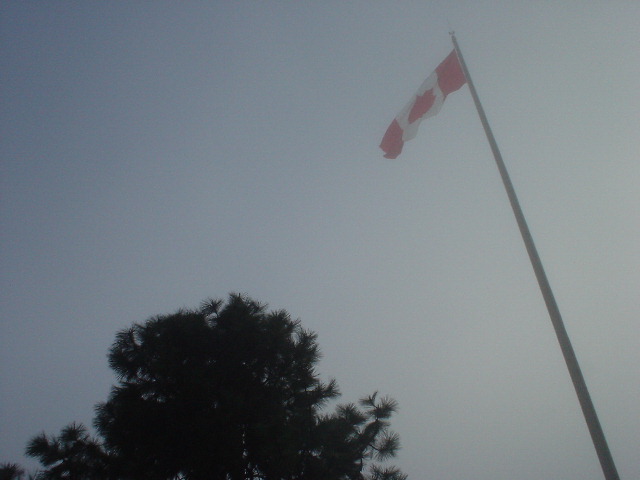
Sebastian, who only revealed to me the night before that his real name was Dave, led me on a casual bike tour around the hippie-turned-yuppie neighborhood of Kitsilano near UBC where they lived, to give me a sense of the Vancouverite vibe. This vibe apparently involves a lot of rain; like San Francisco, USA, Vancouver is mostly covered in fog and rain clouds, so much that some call the city “Raincouver.” The damp weather didn’t stop Vancouverites from playing outside. In the fog, people were still running, cycling, playing croquet and bocce, and even beach volleyball, all under a Canadian flag proudly waving high above in the misty air (picture above).
“What’s the history of Vancouver in fifty words or less?” I asked David Sebastian when we rode by some historical and significant totem pole. He didn’t really know — most people don’t know jack about the history of where they came from — but I looked it up briefly in the Lonely Planet book they had in the house. To make a long story short, Vancouver was founded by some guy named George Vancouver and the rest is history.
We biked around Kitsilano and up to the marina at Granville Island — “Tourist central [of shops and cafes]” as David Sebastian put it — where he left me so that he could go off on a “date,” which I put in quotes because it was one of the on-going jokes in the house; anytime someone had a meeting with any girl for any reason (no matter how insignificant), it was automatically called a “date” and she was automatically your “girlfriend.” This attributed to one distinct characteristic of the Canadian identity: sense of humor. Canadian’s have a great sense of humor; let us not forget that Canada’s greatest export to the States is the comedian, including Michael J. Fox, Mike Myers, Tom Green, Howie Mandel, Alex Trebek (his moustache was kind of funny-looking), and the entire cast of Degrassi Junior High. My theory on why so many entertaining people come out of Canada is because there is an underlying inferior complex living under the shadow of America, and that drives people to excel or prove themselves. (The same goes for the many celebrity entertainers coming out of New Jersey, living with the inferiority complex of living in the shadows of New York.)
Granville Island wasn’t so great that day; sure there were some street performers, but it was raining most of the time; I wandered a bit and then ended up at an indoor cafe to work on my iBook and my “iClamp” — a big hit with the guys at the house. The rain let up by sundown, and I rode round again, over the Granville Bridge and into central Vancouver. I ended up checking-out the local Chapters bookstore (Canada’s Barnes & Noble) where I saw something I hadn’t seen thus far on the road: the Hyenas… travel humor anthology book I’m in; I hadn’t seen it anywhere because I think the San Francisco-based publisher only distributed “domestically” — which of course included Canada because, hell, they have a similar sense of humor and “they’re not even a real country anyway.”
Ha ha, that of course is a joke to all you Canadians out there, you guys and gals and your sense of humor — I love it.
THAT EVENING, I rode back to the house in Kits to continue the search for the Canadian identity — but not with Canadians Aviv, David Sebastian, Adam or Mike (an excellent vegetarian chef by the way). I had plans with yet another Canadian, The Other Erik who I met in Boracay, Philippines, who had just arrived back in Vancouver after his extensive travels through southeast Asia. He told me to meet up with him at what he called “Vancouver’s best Irish pub, The Blarney Stone” in the Gastown district of central Vancouver. I was supposed to meet him around ten or so, but I was so caught up in conversation with my temporary Canadian housemates, I didn’t leave the house until ten. None of them would join me, not even Sebastian — er, I mean Dave — for he would take a bus only up to a certain stop and then get off and bike over to another party he had obligations to go to.
To get to our first bus, we rode on bikes to the main stop seven blocks away from the house. Sebastian took his bike and I rode another that was on loan from a friend.
“[Can Erik take that bike?]” David Sebastian asked Aviv.
“Well, it’s not really mine to lend out,” he said.
“It’ll be fine.” I supposed that was the case. I mean, it was wholesome Canada after all, with happy kids sledding down snowy hills on their five-dollar bill. I locked the borrowed bike at the bus stop — front wheel and frame — while David Sebastian put his on the bus bike rack (most buses in Vancouver have them). David Sebastian got off at my halfway point while I rode all the way downtown using a borrowed UBC student bus pass with the photo believably scratched out of recognition. (Unfortunately, I lost that card in the events of the night.)
GASTOWN, NEAR CHINATOWN, shows off the seedier side of Vancouver and the fog blowing through the night under the street lamps only added to its underworld charm. I was told by some Vancouverites that it boasted North America’s highest concentration of IV drug users, most of which I saw wandering the streets begging for change. I was told that methadone clinics in the district were open late on paydays because of the increased business.
Gastown was as “empty” as the rest of Vancouver, except for the big groups standing and waiting outside the many clubs, bars, and pubs, apparently for no reason but to build hype for the on-goings inside; many of the places were not full at all and just wanted to have the image of being popular. These lines were prime targets for the beggars of course, calling “Hey man, could you spare a quarter for coffee?” or as in one beggar’s case, singing for his keep with a song about “Britney Spears and her twat.”
The Other Erik was nowhere to be seen on the hour-long line outside The Blarney Stone. I had no choice but to wait for him there because without a phone, I had no way to contact him or vice versa. I figured he had wisely gotten there early with his entourage and was one of the people inside, but when I finally got in passed midnight he was nowhere to be found. To be fair, it was hard him with the sea of people, like trying to find Waldo in a candy cane factory. I never did find him or his Canadian friends that night, and there went my chances of further experiencing the Canadian identity. Later on I learned he had tried to reach me to tell me he had gone to another place because his friends didn’t feel like waiting.
The night wasn’t a bust though; while waiting on line I befriended a group of students, not from UBC, but from an international school teaching English to foreigners: a Japanese girl, an Argentine guy, a Brazilian girl and a half Finn/half Swiss girl. The Japanese and Argentine got tired of waiting around after some time, leaving me with Mayra, the Brazilian from Sao Paolo, and Riikka, the half Finn/half Swiss. It was with them I partied the night, drinking pitchers of cheap beer, dancing, and doing the Irish jig to the Irish rock musical stylings of the live band.
We partied until we were kicked out at the 2 a.m. closing time and then split a cab out to Kits where we all lived with host families. I was dropped off not at the house but at the bus stop so that I could pick up the bike I left there — or so I thought.
“UH, I HAVE GOOD NEWS AND BAD NEWS,” I said to David Sebastian in his dark bedroom where I had a floor mattress set up for me. “Do you want the good news or bad news first?”
“Uh, take your pick.”
“Well the good news is I got a girl’s phone number.”
“Alright.”
“The bad news is the bike isn’t really there any more.”
Sebastian — I mean Dave — was sort of in shock but not so surprised. “Bikes still get stolen around here.”
Bikes still get stolen around here? I thought. What about the wholesome Canadian good guy image? What about the happy little kid sledding on the five-dollar bill?!
I walked back to the bus stop at 3:30 a.m. to see if I had missed anything, but the only thing remaining at the bike rack was another bike that had been there before — unlocked. We considered stealing that one to replace the one we lost, but after careful thought out analysis, we came to the far-fetched but conceivable conclusion that it was a decoy set up by the cops that had a tracer on it.
“[Why would they break the lock of that bike and not just take the unlocked bike?]” I asked.
“Don’t worry about it,” the laid back David Sebastian said — another characteristic of the Canadian identity. “There’s nothing we can really do. It’s just money.” He was pleased in a way because now he’d have the excuse to go out on a “bike-shopping date” with the girl whose bike it was.
AT THE END OF THE DAY, I realized I hadn’t gotten as much insight into the Canadian identity as I wanted to, if there was even any one to be found during my day at all. While I saw that there’s a side to Canada that is seedy and one that is funny, I spent the night in the company of the Japanese, Argentine, Brazilian, and Finnish/Swiss — at an Irish bar with an Irish band in a neighborhood next to Chinatown, no less. While we’re on the subject of other nationalities, I’ll point out now that on the other pieces of Canadian money (that don’t have happy little kids on them), there is still an image of Queen of England — a remnant of the Canadian history of being under the rule of England as a commonwealth.
Wait, hold on. A country formerly under British rule? A nation now a melting pot of other nationalities, taking in the tired, the poor, the huddled masses yearning to breathe free? All of this is starting to sound a little familiar… Hmm… almost as if… the Canadian identity was kind of… American... eh?
Next entry: The Ultimate College Experience
Previous entry: Our Greatest Ally
Commenting is not available in this channel entry.
Comments for “The Canadian Identity”
1st!
haha:)
(i’m jealous)
Posted by .(JavaScript must be enabled to view this email address) on 03/07 at 09:45 PM
THE FINAL ENTRIES will be posted as soon as I can get them written; I’m just getting off my DAY 503 high now… (3 days after)
MORE TO COME….
Posted by .(JavaScript must be enabled to view this email address) on 03/07 at 09:46 PM
Oh Erik,,
You missed out on some of the great comedians coming from our neck of the woods. John Candy, Jim Carrey, and Martin Short are all from Ontario.
What would ‘Saturday Night Live’ and ‘In Living Colour’ been without those Canucks?
And Baywatch would have been a serious flop without Vancouver Island born Pamela Anderson.
We export a lot more than just lumber, eh?Posted by .(JavaScript must be enabled to view this email address) on 03/07 at 10:13 PM
I’ve been dropping in silently for a while—it’s been fun and just like everyone else here, I will miss it. My husband and I are currently on our own RTW trip (http://www.meganandmichael.com/travelogue), and have at times used your blog to do a little research before arriving in a destination. Other times I’ve read your updates after the fact and found that we had coincidently been to the same places (like finding the best Banana Lassis at Shankara Vegis in Agra, India). Congratulations on an excellent travelogue! It’s clear that you’ve put a lot of time and effort into it, and also clear from all the comments how much your audience appreciates it, including us. Thanks!
Posted by Megan on 03/07 at 10:17 PM
so like 500 bucks in canada is like what 5 US dollars or something? hahaha…
i always here from my canadian co-worker, “things are done different up here”....well ain’t that the truth….
Posted by .(JavaScript must be enabled to view this email address) on 03/07 at 10:41 PM
I, for one, being a born and bred Washingtonian, think that BC in particular is a suburb of Seattle - I used to go drinking in Gastown (although I didn’t know the name of the place) when I was of age in Canada, but not in the US. Good times…
Posted by .(JavaScript must be enabled to view this email address) on 03/07 at 11:07 PM
Markyt: At today’s rate of exchange $500 US dollars = $595 CDN. Your money goes a lot further but of course we lose when it’s the other way around. $500 CDN = $384 US
Just a little FYI…...........Posted by .(JavaScript must be enabled to view this email address) on 03/07 at 11:27 PM
ok i meant that the other way around…5 USD is like 500 CAN….must be that TDOT virus going around….
Posted by .(JavaScript must be enabled to view this email address) on 03/08 at 12:50 AM
ERIK: how’s it feel to be back “home-home” with this winter snow storm and all and just in general? as opposed to “home sick”, are you “travel sick” at all or glad to just be back in your home w/o having to catch a bus, plane, train, etc…?
i know i hated it today. it took me 5 hours to get home!!!
Posted by .(JavaScript must be enabled to view this email address) on 03/08 at 02:27 AM
Beware Blog Readers: The Td0t Virus might be contagious!
Posted by .(JavaScript must be enabled to view this email address) on 03/08 at 02:35 AM
Nice work Erik. So many “dates”....
Posted by .(JavaScript must be enabled to view this email address) on 03/08 at 02:54 AM
Glad to hear you had a decent time; again sorry we didn’t connect.
Insightful tidbits on the Canadian psyche…
Poor TdOt. I feel that someone should stick up for the poor bugger, and I guess that will have to be me! In Canada a ‘snowboarding accident’ is a very valid excuse for missing any occasion; weddings, graduations, funerals - even parties located in the tropical climes of southern North America. Poor TdOt. Eh?
Posted by .(JavaScript must be enabled to view this email address) on 03/08 at 04:03 AM
a new job for Erik?
http://www.pilotguides.com/company/jobs.php
Posted by Alyson on 03/08 at 04:43 AM
chio chio…503 was the best.
if slainte only had skol.Posted by .(JavaScript must be enabled to view this email address) on 03/08 at 11:02 AM
CALL FOR PHOTOS!!! Please send me your D503 picts to my email address…
Posted by .(JavaScript must be enabled to view this email address) on 03/08 at 12:00 PM
Our money may be pretty…..but it aint worth shit!
Our beer on the other hand…..
Posted by .(JavaScript must be enabled to view this email address) on 03/08 at 12:17 PM
Cold enough for ‘ya back home Erik?! I slid all the way to work today, fun stuff!
Sorry I didn’t make it on Sat. But welcome back home! Glad there’s still some posts coming! I think I’m gonna have serious TGT withdrawal soon after.
Posted by .(JavaScript must be enabled to view this email address) on 03/08 at 12:20 PM
Now I have that “Blame Canada” song in my head. Damn you Erik TGT!
Posted by .(JavaScript must be enabled to view this email address) on 03/08 at 01:24 PM
Wow… I’ve really fallen from grace. In a matter of days I went from being an ambassador of a generation to the virus toting monkey from outbreak! It?s a good thing my friendly west coast counterpart stuck up for me.
Posted by .(JavaScript must be enabled to view this email address) on 03/08 at 01:42 PM
Top Ten Reasons Everybody’s Always Picking on Canada=
http://www.csittl.com/old/03list67.htmlTop Ten Ways to Improve Canada=
http://www.csittl.com/old/00list100.htmlPosted by .(JavaScript must be enabled to view this email address) on 03/08 at 02:17 PM
It’s easy to fall from grace - getting back up is the hard part…
Ali - that 2nd list is great!
Posted by .(JavaScript must be enabled to view this email address) on 03/08 at 05:06 PM
Noelle: Any suggestions?
Posted by .(JavaScript must be enabled to view this email address) on 03/08 at 07:17 PM
Watch out and be carefull on those Canadian roads they are very icy. If you aren’t careful, you might get hit by spinners(literally) who speed on the roads then hit their brakes and spin on the ice. I saw a spinner on our street this morning!
Posted by .(JavaScript must be enabled to view this email address) on 03/08 at 07:37 PM
psst Td0t… You can redeem yourself Friday, 3/11 @ Zen & get well soon.
BTW E, had fun on D503, wish I brought my camera. It was great to see you again! I had a million & one questions I wanted to ask but my mind was drawing blanks when I saw you. lol So what ever happened to Bali?
Posted by .(JavaScript must be enabled to view this email address) on 03/08 at 08:41 PM
RINA: Bali? I don’t know. I had a free place to crash there too. The advanced announcement of DAY 503 put a cap on my travels—but that was actually a good thing since I would have been really in the red.
Posted by .(JavaScript must be enabled to view this email address) on 03/08 at 08:48 PM
wow, these last few entries are really dragging out the inevitable…. it’s over, it’s really over. I may actually have to WORK at the office. Say it isn’t so Erik!
Posted by .(JavaScript must be enabled to view this email address) on 03/08 at 09:50 PM
THE FELLOWSHIP OF THE BLOG: Don’t fret; I haven’t forgotten to finish off the entries… I’ve just been swamped with work left and right and other matters to “get my life back.”
STAY TUNED!!!
Posted by .(JavaScript must be enabled to view this email address) on 03/08 at 09:51 PM
Erik TGT - we were really worried - not. Even though you’re trying to get back to “real life,” you wouldn’t leave us hangin’ like that, would you?
I just saw a “GO CANADA” commercial touting all of our neighbor to the North’s best qualities - its soundtrack was Celine Dion. I guess someone is trying to market the great white North!
Posted by .(JavaScript must be enabled to view this email address) on 03/09 at 04:24 AM
SHARE THIS TRAVEL DISPATCH:
Follow The Global Trip on Twitter
Follow The Global Trip in Instagram
Become a TGT Fan on Facebook
Subscribe to the RSS Feed
This blog post is one of over 500 travel dispatches from the trip blog, "The Global Trip 2004: Sixteen Months Around The World (Or Until Money Runs Out, Whichever Comes First)," originally hosted by BootsnAll.com. It chronicled a trip around the world from October 2003 to March 2005, which encompassed travel through thirty-seven countries in North America, South America, Africa, Europe, and Asia. It was this blog that "started it all," where Erik evolved and honed his style of travel blogging — it starts to come into focus around the time he arrives in Africa.
 Praised and recommended by USA Today, RickSteves.com, and readers of BootsnAll and Lonely Planet's Thorn Tree, The Global Trip blog was selected by the editors of PC Magazine for the "Top 100 Sites You Didn't Know You Couldn't Live Without" (in the travel category) in 2005.
Next entry:
The Ultimate College Experience
Previous entry:
Our Greatest Ally
THE GLOBAL TRIP GLOSSARY
Confused at some of the jargon that's developed with this blog and its readers over the years? Here's what they mean:
BFFN: acronym for "Best Friend For Now"; a friend made on the road, who will share travel experiences for the time being, only to part ways and lose touch withThe Big Trip: the original sixteen month around-the-world trip that started it all, spanning 37 countries in 5 continents over 503 days (October 2003–March 2005)
NIZ: acronym for "No Internet Zone"; a place where there is little to no Internet access, thus preventing dispatches from being posted.
SBR: acronym for "Silent Blog Reader"; a person who has regularly followed The Global Trip blog for years without ever commenting or making his/her presence known to the rest of the reading community. (Breaking this silence by commenting is encouraged.)
Stupid o'clock: any time of the early morning that you have to wake up to catch a train, bus, plane, or tour. Usually any time before 6 a.m. is automatically “stupid o’clock.”
The Trinidad Show: a nickname of The Global Trip blog, used particularly by travelers that have been written about, who are self-aware that they have become "characters" in a long-running story — like characters in the Jim Carrey movie, The Truman Show.
WHMMR: acronym for "Western Hemisphere Monday Morning Rush"; an unofficial deadline to get new content up by a Monday morning, in time for readers in the western hemisphere (i.e. the majority North American audience) heading back to their computers.
1981ers: people born after 1981. Originally, this was to designate groups of young backpackers fresh out of school, many of which were loud, boorish and/or annoying. However, time has passed and 1981ers have matured and have been quite pleasant to travel with. The term still refers to young annoying backpackers, regardless of year — I guess you could call them "1991ers" in 2013 — young, entitled millennials on the road these days, essentially.
Spelling or grammar error? A picture not loading properly? Help keep this blog as good as it can be by reporting bugs.