Taken For A Ride
This blog entry about the events of Thursday, June 03, 2004 was originally posted on June 05, 2004.
DAY 229: Blogreader and former “The Trinidad Show” cast member (Ecuador) Navid was in good spirits on Yahoo! Messenger when I logged onto my daily morning internet session to upload Blog entries. Having been to Egypt before, he gave me suggestions on what I should see in my limited 12-day stint in the country of the former ancient civilization: Luxor, Aswan, Dahab and other historical sites. It was good guidance for when I would leave Cairo and explore Egypt on my own.
It was Friday, the holy day in Muslim culture, and most of Cairo was shut down. In and around Tahrir Square, the usual traffic jams were replaced with almost empty streets. I figured if one place would be open, it’d be the places of tourism draw, and no where in Cairo is that draw bigger than the Pyramids of Giza, not too far away across the River Nile.
WITH THE INDEPENDENT TRAVEL SPIRIT that I had when traveling with Navid through Ecuador, I decided to forego a taxi or day tour service to Giza and take the public 355 (or 357) bus since it picked up passengers not too far away from my hotel, behind the Egyptian Museum. However, I waited and waited and waited. Buses went by with Arabic numerals I couldn’t understand, but I was convinced that the 355 or 357 would be marked in Western numbers since I had seen a “357” bus the night before. I waited about an hour with no luck. Perhaps it was because of the Friday holyday?
I was about to go over to the side street to hop in a taxi when one stopped right in front of me. “Are you going to Giza?” the taxi driver asked me. He probably figured I was waiting for the 355 that was never to come.
“Yes. How much?”
“Ten pounds,” he told me. It was half of the normal E£20 to E£25 from every other cab driver, and he told me why. “I live in Giza. I just want to go home.”
“Alright.” I hopped in the front seat.
The taxi driver’s name was Amma and he was in a good mood. I figured he was just happy to be off duty and to be headed home after a long day. “You’re done working for the day?” I asked him.
“Yes, I am going home. You know why?”
“Why?”
“Tonight, my wife is going to have baby!”
“Oh wow.”
He was bursting with happiness about his upcoming child (his first) and shared his enthusiasm with me. “When you bye bye Cairo?” he asked in broken English.
“Not tomorrow, the next day.”
“You, after tomorrow, bye bye Cairo. Me, after tomorrow, BABY!” He was all smiles and it was infectious.
We made our way down the highway that hugged the Nile and then cross over on a southern bridge towards the touristy neighborhood of Giza. “Other taxi drivers charge twenty, twenty five, but Amma only charge ten because he is going home to Giza because his wife is going to have baby!” He started honking the horn in glee. A guy on the street tried to flag him down, but he waved his hand as a No. “Sorry, Amma is going home to have baby!” He grabbed my hand to honk the horn.
“You tell your mother and father that Amma is good driver!”
“Okay!” I honked the horn again. His enthusiasm as an upcoming father filled me with a celebratory spirit too.
“You, bye bye Cairo. Me, baby!”
When we drove down the exit ramp, Amma told me that he’d like to buy me a tea with his friend really quickly on the way to the pyramids. According to him, his hospitality towards me would give him good luck towards his new child. I accepted. We drove to a small street off the main one and parked the car; I was on guard in case it was a trap, and wary of the tea being tainted or something. But everything was fine.
Or was it?
The teahouse was actually one of the many perfume stores in the area. Amma and I sat at a booth in the corner and ordered the teas. His friend Ababa came from prayer service to greet us shortly afterwards. I thought it was be a joyous occasion of three guys celebrating a new child, but then Ababa started bringing out perfume samples.
Great, here we go.
Ababa had me smell an assortment of scents, from the famed essence of lotus plant to “Egyptian Viagra.” All very nice, but I wasn’t interested. “No thanks, I’ll just have the tea.”
“But I’m giving you a good price! Fifty piastres per gram. You know usually it’s two pounds!”
“It’s true, it’s true. I know. I am from Giza,” Amma said.
“You know if you come in here without him, I charge four or five times more?” went Ababa’s argument. “But you are friend of Amma, so I give you a deal.”
“Uh, that’s okay. I’m fine. I don’t have the room.”
“What you mean no room? They are so small!”
“Do you have anything smaller then?”
Ababa had his worker bring out three empty smaller bottles in a gift case. “Here, these are smaller. I give you three bottles for price of two. Good deal, okay?” He started pouring some essence into one of them.
“No, wait, I don’t want three. I don’t want any of them.”
“You don’t want Egyptian Viagra? It’s for the ladies! Or how about essence of lotus? You know you can’t get that anywhere but Egypt. Not in Philippines or Israel or Italy.” I had told both of them that I was from the Philippines.
“He is telling truth. I know! I am from Giza!” Amma said, sipping his tea.
“Okay, okay, that’s nice, but I don’t want it.”
“But you asked for smaller, and I bring you smaller. Look, I sell you three but you only pay for two. See? One, two. This one free. Okay, deal.”
“No, no.”
Great, I thought. I think I just fell for one of the biggest scams in the book — or rather not in the book because my Lonely Planet Shoestring guide was so painfully inadequate. It was becoming clear to me that I probably would never get to leave the store without buying anything; I was at the whim of a taxi driver, away from the pyramids in a store I didn’t want to be in, with an aggressive and pushy salesman, in a neighborhood I wasn’t familiar with so that I couldn’t just leave without getting lost. Yup, I’d call that a big scam.
“If I buy something, I only want one,” I said.
Ababa got all defensive and almost a little angry. “Why do you only want one? I’m giving you deal for two. Look eighty pounds for two. That’s forty, forty and you get one free.”
“It is true! I am from Giza, I know!” Amma said. Okay Amma, I get it, you probably-not-having-baby-tonight motherfucker.
“I don’t have the room. Really, I only want one.” I pointed to the essence of lotus and he poured it from the big bottle into the smaller one. Then he poured some Egyptian Viagra in another.
“No, wait, I said I only want one.”
“You are getting a good deal! Eighty for two! Do you know how much I would charge you if you were American? Two hundred or even two fifty!” (Funny, huh?)
“Really I don’t have the room. Just one.”
It went back and forth: my argument for “just one” (ugh, one up from “none”); Ababa’s argument that the bottles were so small and that I was getting a good deal because I came in with his friend; and Amma continuing to tell me that “he knows, he knows, because he is from Giza!” To keep the “friend” story going, Amma and Ababa would exchange words in Arabic and them come back with fake deals like there was some hard negotiations. When I settled on just getting a small bottle of lotus essence for E£50, Amma pulled me aside to tell me something in “private” ten feet away from Ababa. “Okay, since you are my friend, I convince him to give you second bottle for only twenty.”
“No, really, I only have room for the one.”
“Okay, I tried, but you don’t want a good deal. It’s up to you,” was the gist of his emotional blackmail scam. But I didn’t fall for it; at least not as much as I already had been up to that point.
In the end, I didn’t even finish my tea, nor did Amma. In fact, Ababa never had a tea himself for the supposed “baby toast,” nor did Amma pay any money to anyone, providing the loophole that he was to buy me something for his supposed baby’s good luck.
I HOPPED INTO THE TAXI with a small bottle of lotus essence and fifty pounds less, feeling pretty dumb. I even felt more dumb when I paid the ten for the ride to the pyramids when we arrived. “Good luck with your baby tonight,” I wished him to see if he’d react appropriately.
“Thank you. You tell your mother and father than Amma is good taxi driver!”
Yeah, right. Mom, Dad… if you ever come to Cairo, avoid that man at all costs; he’s a total con artist. I know, I know, he is from Giza.
THE PYRAMIDS OF GIZA are one of the Seven Wonders of the World. Photos of he geometrically-simple, yet elaborate tombs of great pharaohs have stirred emotion and imagination in the minds of many people throughout the world for ages. However, what these photos never depict is that right across the street from the Great Sphinx and the Pyramids lies a Pizza Hut and a KFC.
I was happy to be within the compounds of the Great Sphinx and Pyramids, thinking that it being a tourism place I’d been within a contained area away from scammers like Amma and Ababa. Boy, was I wrong. While there was an entry gate into the perimeter, there was no such barrier for desperate Egyptians looking for a way to exploit tourists. While most tourists were on package tours following a guide holding up a flag, I was alone, hoping to tour the pyramids independently with a Pocket PC guide voiced by Stephen Hawkings like I had received in the Egyptian Museum the day before. No such digital guide existed, nor did any official human guide. Once inside, if you were on your own, you were on your own. Like the Egyptian Museum, there was a shortage of signage and labels for everything, and without a guide, I really didn’t know exactly what I was looking at.
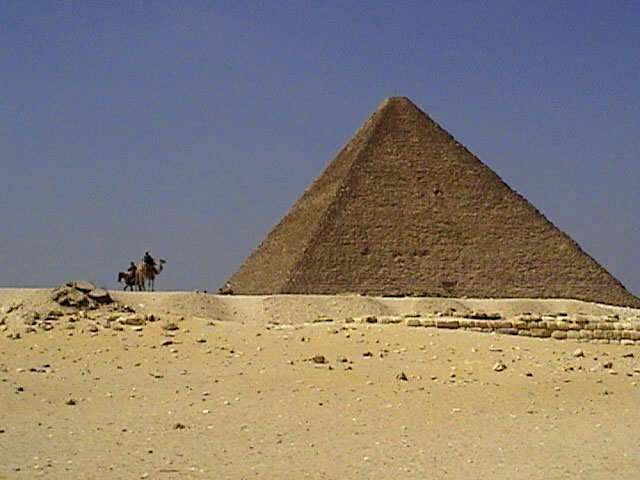
There were some freelance guides leading clients on camels and horses out in the nearby desert and I went to check one of them out on the left side from the sphinx; it wasn’t hard to do because one of the camel drivers came to me and put a turban over my head. After what I had been through with the taxi, I would have been turned off, but I was genuinely interested in a camel ride (picture above) anyway. It was Egypt and the Sahara after all.
“How much is the tour?”
“One hundred, but for you eighty.”
“Oh, I don’t know if I can afford that.”
“I know you don’t have a lot of money, you are not American. The Americans, I charge two hundred or two fifty!” (Funny, huh?)
I asked him about the tour, where we would go, for how long and if he was a good enough guide to tell me all the historical facts about the sites since apparently there were no boards posted up with explanations or labels. He insured me everything would be fine, and for the “cheap” price of E£80. For some reason, I felt eighty seemed reasonable; I anticipated it being a hundred Egyptian pounds.
“Okay, let’s go.” I hopped on the saddle over the camel’s single hump, behind the guide and we started the trek through the desert. I had my video camera out to shoot the scenery from the side; the front was obstructed by my guide’s back.
“Do you want to ride by yourself?”
“Yeah, that would be good if I can.” I figured he’d get off and walk along the side, but then he passed me off to a younger guy on a horse. “Okay, you go with him, he is your guide.”
“And does he know all the history? It’s very important to me. I’m a writer.”
“No problem. He knows it all.”
“Hello,” he said to me, proving that he actually did speak English.
“Okay.”
“You pay me the money now. Eighty a animal.”
I gave him eighty pounds.
“No, eighty per animal. Eighty… eighty,” he said pointing to the camel and then the horse.
“Oh, no no. I can’t afford another eighty. Let’s just do it they way it was going to be. You get back on the camel.”
“But you said you want to ride alone!”
“No, it’s okay, if it’s going to be eighty more. Let’s just do it they way before you brought me to this guy.”
“Okay, I give you deal. Forty for the horse.”
Ugh, it was getting tiring. Doing things in Egypt independently was probably costing me more than if I had just booked a tour. “Fine. As long as the guide is good and can tell me all the history.”
“Don’t worry, he’s good. He speaks English.”
And so, with me on the hump of a camel — whose name was “Mickey Mouse” — and my new guide on the back of a horse, we rode into the desert.
“SO WHAT PHARAOH BUILT THESE?” I asked my “informative” “guide” Isham as we bobbed up and down the Saharan sands around the pyramids.
He looked at me like I was making up words. “Pharaoh?”
An Egyptian asking me what a “pharaoh” was? What, was he kidding? Every ten-year-old back in The States knows what a pharaoh is. And this guy was my guide?
“Pharaoh. Don’t you know? King.”
“Oh, king! Cheops, that is Chephren, and that is Mycerinus. Do you know how many pyramids there are?”
“Nine, three big ones and six small ones.”
“Ah, you know.”
“So when where these pyramids built?” I asked Isham.
“They are made of limestone.”
“No, when. What year?”
“Limestone.”
What Isham lacked in brain he made up for in not much else. He was a good guy I suppose, always offering to take a photo of me with my camera, although the first time he tried to be funny when I handed him my camcorder. “Okay, bye now,” he joked with my camera in his hand.
We journeyed to the prime vantage spots for photos in and around the pyramids of Cheops, Chephren and Mycerinus — of course, I didn’t know which one was which. “If you want, you can go in that pyramid, but there is nothing to see,” Isham told me. “Tourists pay twenty to go into a room, but there are no statues, it’s just a room.” He was telling me it was up to me if I wanted to go, but his advice was it was a waste of money. “We go to that one [a smaller one] and you can climb it with a watchman. He’ll take you up for good pictures and then into the tomb to see the statues.”
“But you just said there are no statues in the tombs.”
“There is in the small one. The watchman will show you.”
“And how much is the watchman?”
“Nothing, you just give him tip. Whatever you decide.”
Of course.
“What do you want?” Isham asked me.
“Uh… let’s go closer and then I’ll decide.”
“Okay.” Isham, the horse, Mickey Mouse the Camel and I went over to one of the small pyramids. The “watchman” came to me. He told me that he could take me up to the top for a photo opp (“Very good pictures from there, see everything, all pyramids”) and then into the tomb.
“Only fifty pounds,” he quoted me.
“But this guy said it was free!”
The “watchman” thought for a moment and then asked me if I had some sunblock lotion. Granted, it was pretty hot out there under the Sahara sun. I took the bottle out of my bag and have him a dab.
“No, the bottle and I bring you for free.”
“Nah, that’s okay, I don’t want to climb it anymore.” Was climbing even a permitted option? No one else was climbing up the side of a pyramid, big or small.
“You give me cream and I bring you for free.”
“No thanks. I’ll just ride the camel. I like riding the camel.”
He asked for a little more lotion (“I have skin problems”) and I gave him another dab to get rid of him. Isham led the horse and camel around the small pyramid (of which I didn’t know the name of). “Okay, for free you can climb up here,” he told me, like he was doing me a favor. “You climb up for good picture. You give me the camera and I take it.”
Uh, yeah right. I go up, away from my camera so that you can be alone with it, on a horse no less, while I’m twenty steps up away? I don’t think so.
“Nah, really. I don’t want to climb the pyramid anymore. I like riding the camel.”
“Okay. As long as you are happy. Are you happy?”
“Sure, I just like riding the camel. When else will I ride a camel?”
Isham took me and the camel to a spot in the desert where others were gathered, including a handful of tourists. It was the prime location for a classic shot of the pyramids into one frame. Nearby where two vendors trying to make a buck; one chotchskie vendor that I ignored, and a cold soft drink vendor, which enticed me. “How much for the Mirinda [orange soda]?”
“Five pounds.”
Before I could decide whether or not I wanted to pay that much, he opened the bottle and shoved it into my hand. Oh well, I’m in the middle of the desert and I’m thirsty. The syrupy orange liquid went down my throat.
“Okay, one hundred pounds.”
“You said five.”
He smiled like he was just joking. Ha, ha. “Ten.”
“You said five.”
“No, it’s ten!”
I pulled out a five and gave it to him. Luck was on my side (I suppose) but it was one of the rare occasions I actually had the exact amount with no need for change from a larger bill (that I usually never get back).
“Ten. Five more.” He waited for me to pull out another bill but I wouldn’t budge.
“You said it was five! It would be different if you said ten to begin with, then maybe I’d give you ten. But you said five. That’s it.”
Another tourist on a horse rode into the area and he turned his attention to her and left me alone. All of this happened in front of Egyptian policemen too — they were stationed all around the area, but weren’t providing any sort of peace or justice as far as I was concerned.
“Okay, we go around and to the sphinx,” Isham told me.
“Okay.”
“Are you happy?”
No response. But I kept my spirits up and enjoyed the ride.
A COUPLE OF MORE PHOTOS AND DIGITAL CLIPS LATER, we were back at the entry gate for me to dismount. Here comes the tip bit, I thought. I figured I’d give him twenty or maybe thirty, then he argued that people usually give him up to one hundred.
“One hundred? That’s more than the camel ride!”
“But that’s for the animal. What about for me?”
Ugh. It was tiring. I had nothing smaller than a fifty and of course I didn’t get any change back. Isham took it and rode off into the sunset as I wondered if “Isham” translated to “I scam.”
THE REST OF THE AFTERNOON, I wandered the area, walking around the pyramids, and I still didn’t know what I was looking at. Other camel touts tried to sell me a ride, but I insisted that I had been taken for a ride already. (Taken for a ride, many times that day.) I walked passed one guy and declined him and he tried to play the friend bit. “Son, come here. Take this for good luck.” Good luck? I’d heard this line before.
The perimeter closed at 5 p.m. and I left. The only refuge I could figure to go to to avoid the aggressive and clever touts was the KFC. God bless Colonel Sanders.
Navid told me that morning that the nightly Sound and Light show at the pyramids was worth seeing, so I decided not to go back into the city and hang out to check it out. Tickets and seating wasn’t available until 8:00 so I had about three hours to kill — I spent them quietly in a nearby internet cafe across the street from the pyramids. At my chair was a computer screen and to my left, out the window, stood the pyramids at dusk like it was no big deal.
I arrived fifteen minutes before 8:00 to get a ticket at the designated light show seating area, but like the movie theater experience the night before, seating didn’t begin until the announced time. I had time to kill again and I was going to take refuge in the KFC again, but next door to it was a nice looking cafe with a roof terrace. Figuring I couldn’t run off to Colonel Sanders every time I was in need, I looked at the cafe.
“Come in. Very good view.”
And it was. From the roof terrace you could see it all, the sphinx, the pyramids, the Sahara as the backdrop — all without a backward KFC or Pizza Hut logo to obstruct the view. The waiter there asked me if I was staying for the show; the norm was that people usually saw the show from there with dinner for E£60-65 instead of paying the E£40 for the official seats (E£35 more for video rights). Sounded like a good deal, and it was — others paid the 65 while I only paid 60.
An impressive synchronized light show illuminated the pyramids in different primary colors to an outdated sixties-esque orchestral soundtrack, while an outdated sixties-esque narrator explained the history of the pyramids, just within earshot of the restaurant terrace. There were only about ten of us in total on the terrace for dinner, and I sat next to a table of three older tourists traveling on a tour. It was their last night in Egypt and the Sound and Light show was their big send off. They had been on tour for two weeks and saw all the main sites.
I befriended the woman from Miami Beach sitting next to me and she shared her enthusiasm of how Egypt was all a dream for her until she actually got there; it was all “amazing” for her; all that ancient architecture, and above all, all that history.
“In the beginning there were so many facts about this pharaoh and that one, and dates, and wars and it was like an overload of information! So much history! After a while you hear it all and slowly it starts to process and make sense,” was the jist of her raves.
“I’m surprised that there isn’t much explanation or any signs at any of the sites,” I told her. “Usually I can do things independently.”
“You really need to get a guide. Our guide has been great! He’s an archaeologist and is studying anthropology.”
I couldn’t help but be a bit jealous. Archaeologist as a guide? Wow. My guide didn’t even know what a goddam pharaoh was.
AS I RODE BACK INTO TOWN with a much friendlier and less shady taxi driver that gave me Arabic lessons, I realized that perhaps a guided tour was in order, especially with my limited time in Egypt. As they say, time is money, and in my case, I didn’t have much of either — but I’m sure Amma’s “baby” did.
Next entry: Dates in Egypt
Previous entry: Then and Now
Commenting is not available in this channel entry.
Comments for “Taken For A Ride”
HEY GANG… sit tight as I go “on tour” of the southern sites. I’m guessing there will be internet access in the touristy areas, but I’m not sure how much time I’ll have for Blogging as I’m on a tight schedule.
Then again, with only five colors (at the time of writing), I’m not sure if many of you care…
Posted by .(JavaScript must be enabled to view this email address) on 06/05 at 10:15 AM
BLOGREADERS - that’s an obvious cry for support!!!!
i’m not sending a new spy cam and some inspiration books to erik for my health….
Posted by .(JavaScript must be enabled to view this email address) on 06/05 at 03:19 PM
Im sorry that I don’t have time to read the new entry’s. I have to catch an early bus to the Kansai Airport and my pack looks like a Tsunami passed through it.
But Ill have broadband at my friend’s house in Taipei so Ill catch up tomorrow.
ERIK: I don’t know what kind of support you need, but you know I got your back! Japan isn’ that expensive when you’re crashing on various futons across Honshu like I’ve been doing.
MARKYT: I think its Newark, but Im not sure and I have no time to look.
Posted by .(JavaScript must be enabled to view this email address) on 06/05 at 05:44 PM
The pics still look awesome!
Posted by .(JavaScript must be enabled to view this email address) on 06/05 at 06:20 PM
NEVEN / AMIRA: Hey, I met up with Hesham last night… Good guy… We went out for sheesha and drinks at a couple of spots ‘round town… Thanks for the contact! (Details to come in the next entry…)
Posted by .(JavaScript must be enabled to view this email address) on 06/05 at 06:26 PM
TDOT - It’s Newark. My friend has been doing it every month…
Posted by .(JavaScript must be enabled to view this email address) on 06/05 at 08:38 PM
that really sucks that everyone wants to rip off americans…. from now on i am from canada, eh.
Posted by .(JavaScript must be enabled to view this email address) on 06/05 at 10:14 PM
Mom was stationed in Libya and went to see the Pyramids FIFTY YEARS AGO, and her recollection of the “touts” sounds almost IDENTICAL to yours!!
The light and sound show, huh? So, did you see an impeccibly dressed British guy in an ice cream suit, or better yet, this really, really big guy with a giant set of metal teeth?
TWH
Posted by .(JavaScript must be enabled to view this email address) on 06/06 at 12:15 AM
Hang in there Erik! My morning pre-work procrastination session would not be the same without a daily dose of the FELLOWSHIP OF THE BLOG.
Mental note. If and when in Egypt…gotta go with a guided tour.
FELLOW SILENT BLOG READERS: Lets all give Erik a shout out of support!
Posted by .(JavaScript must be enabled to view this email address) on 06/06 at 12:28 AM
Hey Erik, the next time someone says to you “I give you a deal, I charge Americans this much or that much (usually double)”, you should just ask them straight out - “Why do you charge an American that much?”
I know your attempts to put them on the spot and be accountable for the prices they quote you aren’t working out, but it would be interesting to hear what any answer might be.
And trust me, as a Canadian, we would still get charged almost the same - it’s the “North-American-got-money-out-the-wazoo-to-spend-on-holiday-and-cheesy-tours” appearance that we show to them. Saying you’re Canadian might get a person less hostile attitude, but it still gets you the “sucker” stamp on the forehead…Posted by .(JavaScript must be enabled to view this email address) on 06/06 at 02:44 AM
E, don’t get too down about the “run around” things would be so much crazier if you were not melanin enhanced. One of the best things about being brown while traveling (BWT) is that locals are a bit more open to you. Yeah, you’ve been kicked in the nads a couple of times, but you have had access to people & places that some people will never have.
The bridge across our blessings is often built over the river of sacrifice.
Posted by .(JavaScript must be enabled to view this email address) on 06/06 at 07:06 AM
Now my dreams of taking the touristy package cruise up the Nile doesn’t sound like such a sell-out move. Glad to hear the details, much as some may suck. Too bad you were solo on this day. You tend to get hassled less when you’re with a group.
I had to check the currency conversion on Egyptian pounds to USDs. Sounds like you still spent under $50 between all the scams, eating, and getting back to town. I know you’re on a budget, but you probably still made out OK. Now you also have the added bonus that on your next bumpy bus ride, your bottle of perfume may bust open and make all your gear smell like lotus blossoms. That ought to make you very popular!
Keep up the BLOG. It’s my reason for going online! Need it to live… it’s an addiction.
BTW, some Prenhall news… Gill got a new job, is going over to BigColor as their new IT hotshot. Here’s the best part… that’s where Lorraine works! Can you just hear her now, “GILL!” and giggling with joy!
Posted by .(JavaScript must be enabled to view this email address) on 06/06 at 07:29 AM
THANKS FOR THE SUPPORT GUYS… seriously! Some days this travel and blogging thing feels like a tiring, underpaid job… In fact, it is! hahaha… Anyway, I’m in Aswan right now, as part of my tour… although so far, I haven’t had to follow any tour company flags just yet!
DARCY: Sometimes people don’t know the difference between Canada and the US… they think Canada is just another state, and assume, “American.”
SCOTT: Therefore, the Canada thing might not work! Not even with a Canadian flag patch on your backpack!
Posted by .(JavaScript must be enabled to view this email address) on 06/06 at 12:41 PM
TOM (TWH): I didn’t bring the tuxedo on this trip, so no James Bond references…
See you in Spain!
Posted by .(JavaScript must be enabled to view this email address) on 06/06 at 12:47 PM
ok there goes my canada plan…. i guess i can always say i am from the phillipines since it seems no one over there ever heard of it. hell, i can just make up some random word and tell them it was a former soviet republic.
Posted by .(JavaScript must be enabled to view this email address) on 06/06 at 04:08 PM
Hey Erik, it’s been a long while. I have a lot of catching up to do. I lost track after Cape town. Anyways, I was just checking in.
BTW my favorite color = deep red.Posted by .(JavaScript must be enabled to view this email address) on 06/06 at 05:02 PM
RINA: Wow, Cape Town was AGES ago… Anyway, how goes the planning?
Posted by .(JavaScript must be enabled to view this email address) on 06/06 at 05:44 PM
SCOTT: You can always say what Fred (Ethiopia) tells people. “I am from the moon.”
Posted by .(JavaScript must be enabled to view this email address) on 06/06 at 05:47 PM
Hi Eric, I’m Nevin’s friend writing from NYC. Originally from Egypt.
I’m glad you did get in touch with Hesham. I hope you had a good experience. I will try to read about this later.
I read about your experience at the Pyramids and in Giza, I hope that you looked at it as an adventure to see the other side of Civilization more than a scam. I totally understand how you feel. this is how I felt when I went back to Egypt after 3 years in NY City. There is a big gap in the Society. And when you deal with the public is kinda crazy ...Why??1- Most of the Egyptians that you will meet working in these jobs (a new graduate tour guide- a cap driver making $50 or so a month to pay back his taxi which must have coast him fortune- a bazaar sales man working on commission) is suffering from poverty and not a well educated class most of the time-NOT AN EXCUSE FOR NONETHICAL BEHAVIOR- but when you live in poverty for long you tend to be aggressive to make money. and actually tourism had made some people greedier why… Look at your average tourist (European or American??) like the guy said if you were American I would charge you more??? Why// because $1.00 is $6-7 Egyptian money. So, majority of tourists they calculate in their own currency_even I did that when I went back home- .
So, if they were offered a tour to see the pyramid for 80.00 LE with dinner which is about $10.00 it sounded cheap. So they tip every body around extra… if something costs a $1 they gave $5 for the people. which made the hungry people -knowing they can hustle some money- try to make a fast living.
AND THIS WHY MAYE BE THEY GAVE YOU UNGRATEFUL ATTITUDE….2-No System is established in Egypt by the ministry of Tourism or the government to control and educate the public about tourism.
Also, I want you to know that Egyptian tend to use humor a lot -sometimes it’s not necessary- and they think it’s funny. they can’t help it it’s a cultural thing they understand it but even I-as an Egyptian- don’t sometimes. So, take this in consideration when dealing with people. I know it’s not funny when they act like they are going to steal your Camera. but actually they do assume that you will think this is funny.
And from reading your story. It could have been a bad nasty scam, or also misunderstanding of cultural behavior. the cap driver maybe is having a baby and he thought to make some money of you in his way to his wife and his way is still wrong… Tour guides, taxi drivers, etc they make a commission of bringing tourists to bazaars. and they get their commission any how even if you don’t buy something… So, when you get to the bazaar it’s the sales man job to try to sell you..usually tour guides inform their group about this, to expect and tell them how to deal with it in advance. I used tell my groups if you were pushed to buy something to firmly say NO. and face any situation with sense of humor and don’t take street people seriously. and trust that NO BODY EVER GOING TO HARM YOU…NEVER, ACTUALLY EVEN THIS PERSON THAT TRY MAYEBE TO SCAM YOU. IF YOU TOLD HIM THAT YOU LOST YOUR MONEY AND YOU DON’T HAVE A PLACE TO STAY, HE MIGHT OFFER YOU A PLACE IN HIS HOME TO STAY THE NIGHT…..
I’m trying to give you an inside of what’s really happening ... an average egyptian makes $30-$80 a month. So, a tourist is a bag of gold walking around… but underneath their needs for money there is a sweet, naive, generous, spontaneous and funny(not all the time) nature. I hope you come across it before you leave. and I think you are right a paid tour is the best thing. You save money and time ..
I hope you will come a cross better experiences and adventures in this coming couple days I think you traveling the world is a great adventure and I’m sure many people may wish to do it but not everybody can sometimes.Posted by Amira on 06/06 at 07:37 PM
I know it happens everywhere, but that “charge americans more” business really sucks. It just makes me want to stay away. This post kind of stressed me out just reading it - with all the scams. That’s why you are a good writer, Erik, you make us feel exactly how annoyed you are when they try to scam you like that!
I’m so much more apt to tip well when I’m not being conned. And I hate having to take a tour just to keep from being treated like that. But it turns out the touristy-tour may have been a good idea. “special price for you!” I bet that gets so old after awhile. But that’s the way the world works, I guess… Oh well, won’t stop me from travelling. Amira, your post really did shed some light on it, though. Thanks!Posted by .(JavaScript must be enabled to view this email address) on 06/06 at 08:06 PM
the sphinx pic is awesome dude .. “this is true I am NOT from Giza” hahaha
Posted by .(JavaScript must be enabled to view this email address) on 06/06 at 08:47 PM
correct me if i’m wrong, but wouldnt it make more sense to con the europeans since the dollar has been sliding against the euro?
Posted by .(JavaScript must be enabled to view this email address) on 06/06 at 09:16 PM
Hey Erik FYI: http://www.msnbc.msn.com/id/5158063/
careful man ..Posted by .(JavaScript must be enabled to view this email address) on 06/06 at 10:15 PM
SCOTT - sure does make sense…but scamming an American is much better when it comes down to it…
scamming an american is like being george mcfly and punching out biff in back to the future…
or being little mac from nintendo’s mike tyson’s punch out and knocking out tyson in the end…
or being robin hood taking from the rich and giving to the poor (yourself)...
Posted by .(JavaScript must be enabled to view this email address) on 06/06 at 10:18 PM
markyt,
or like being lambda lambda lambda and kicking some alpha beta ass!Posted by .(JavaScript must be enabled to view this email address) on 06/06 at 10:50 PM
apologies E, but i’m about caught up on enteries.
ERIK: sorry to hear that you got scammed. at least you got some liquid viagree for the ladies. chio nob to that. btw…someone else realized their “dream”. shiet. skol skol skol.
MARKYT: you are von kaiser and i am little mac. scamming an american is like taking photographic advantage of a friend passed out in a restaurant bathroom in rio de janeiro.
Posted by .(JavaScript must be enabled to view this email address) on 06/06 at 10:56 PM
SCOTT - hell yeah…NERDS RULE!!!
PAUL - good one buddy….but again…nothing is better than getting wasted and yakking in WHEAT’s car for an entire ride home….
Posted by .(JavaScript must be enabled to view this email address) on 06/06 at 11:01 PM
hey erik this is the cool amusement park i mentioned to you. you should check it out if you are in switzerland
http://www.mysterypark.ch/index.html?&page_id=4&node=1&level=0&l=1Posted by .(JavaScript must be enabled to view this email address) on 06/06 at 11:34 PM
AMIRA: thanks for your insights. It’s easy to just expect you’re being victimized for greed. It’s equally easy to not understand what the local guy may be going through just to make a living.
It gets worse when it happens a few times in the same day, you just feel like everyone’s out to get you. Turns out they’re all just looking to make a living. Yeah the unethical behaviour just feeds the problem, but in the end, it’s a few bucks and if you’re lucky you can all laugh about it.
Posted by .(JavaScript must be enabled to view this email address) on 06/07 at 12:54 AM
you WERE taken for a ride whether you liked it or not :( hang in there… but Hey, it makes for a great story, you just cannot make that $hit up! N
 btw, it’s 98 degrees in Colorado! HOT-HOT-HOT…
 as a side note: don’t forget to wear your sunscreen! keep it on at all times, reapply every 2 hours. That goes for everyone, esp. you white folks

Posted by .(JavaScript must be enabled to view this email address) on 06/07 at 02:22 AM
I figure when DH and I start our RTW were going to get scammed everywhere. I’m Canadian (which is the same as an American to most people) and my husband is Japanese.
I think the Japanese may have it worse than Americans do though. Basically many of them don’t have an idea of what is a reasonable value (because everything is just so much cheaper than at home). And if they do, very often they don’t have the language ability to negotiate, so they just pay the extra to avoid dealing with it. Americans almost always argue the price
I think the locals are just being smart. Yes, it isn’t fair to overcharge one nationality. But to get the most money for the least amount of work, you’re going to target the wealthiest group that you can. If you can target three wealthy tourists and get the same money as targetting 6 less wealthy ones, well who can blame them?
This is not to say that different pricing is fair, but I think it is understandable. I imagine there is a lot of jealousy/anger if you only make $50 a month and see tourists regularly blow that amount in one afternoon. If I were in that situation, I think I’d definitely make some plans to get part of that action. A couple bucks to an American (or Canadian, Australian, or Japanese) is nothing, but to an Egyptian it would be a whole day’s wages.
I agree with Sara, I’m much more apt to tip when I’m not being scammed. But I assume that their system works, otherwise there wouldn’t be so many of them doing it. I’m sure there are thousands of gullible tourists.
My point (finally!) is I don’t think they are only targetting Americans. This happens everywhere, and the scam artists and touts just target the wealthiest people… whatever country they come from. The line “I would have charged an Amerian…” may also have been a line to emphasize what a great “deal” they were giving you, rather than telling you that they try to rip Americans off. Who knows.
Posted by Liz on 06/07 at 04:52 AM
hay…you don’t have to be in a foreign country to scam americans…..that’s what that thing the world wide web is for…
Posted by .(JavaScript must be enabled to view this email address) on 06/07 at 07:55 AM
ERIK: I assume you’ve heard by now, Ronald Reagan bought the farm. Poor bugger. 1000s of folks are strolling past his casket in California. They’re shipping him to DC next so 1000s more can do the same. Friday’s to be a Nat’l day of mourning… no mail, etc.
Posted by .(JavaScript must be enabled to view this email address) on 06/08 at 12:32 AM
Dang dude,
Sorry you got scammed. It happens to everyone backpacking—inlcuding myself. All I could really do is laugh it off in the end. Just take it in as an experience you’ll never forget.
Geez man, I forgot to tell you when we were IM’ing each other that I know peeps in Eygpt too!! He’s an archietect, living in the southern part of the country. Funny dude he is, I’ll try and dig up his info for you…
In the meantime keep up the good work!!
Word Life.
Moman!!
Posted by .(JavaScript must be enabled to view this email address) on 06/08 at 07:19 AM
I agree with Liz!
Since I’m black, most Asians conclude that I must be from Africa because black people don’t live anywhere else. But despite being from Africa, I must still be rich because I managed to make it all the way to their country and I have a digital camara. Therefore, I still get ripped off!
It’s a harsh world, and being a Canadian (perceived as an African) doesn’t help.
Posted by .(JavaScript must be enabled to view this email address) on 06/08 at 07:32 AM
I agree with Liz!
Since I’m black, most Asians conclude that I must be from Africa because black people don’t live anywhere else. But despite being from Africa, I must still be rich because I managed to make it all the way to their country and I have a digital camara. Therefore, I still get ripped off!
It’s a harsh world, and being a Canadian (perceived as an African) doesn’t help.
Posted by .(JavaScript must be enabled to view this email address) on 06/08 at 07:32 AM
I am Black too! African American though.
The massai people called us ololan (swahili sp??) which could have meant you stupid @$$ foreigners but they told us we were like turtles carrying our homes on our backs. They called us “people with luggage looking for trouble”!!! Right after that someone asked how many cows my father required for my hand in marriage. Flattering but since my parents live on a .25 lot in the ‘burbs I had to decline to comply with city ordinances and health & sanitation departments. Damn, I should’ve gotten that proposal in writing!
Posted by .(JavaScript must be enabled to view this email address) on 06/08 at 09:16 AM
lol funchilde!
I guess we really do look like turtles carrying our homes on our backs!
Posted by .(JavaScript must be enabled to view this email address) on 06/08 at 01:31 PM
To All:
Just saw the best movie of the year this week (Twillite Samurai).. If you haven’t seen it yet I highly recommend it .. for those that have, kompai!Posted by .(JavaScript must be enabled to view this email address) on 06/08 at 04:05 PM
No mail on Friday? Man, that’s stinky. For him? Man…
This list of comments had TONS of info on it - and all has good points in it.
Good luck - I think I would have signed off and headed for home already - no patience. But then again, you’re MUCH better at this traveling thing than I am.
Keep it up, I need to keep up with my procrastination!!
SAVED! is hilarious - saw it last night - gotta have a sense of humor around Christianity, though. Fun times…
Posted by .(JavaScript must be enabled to view this email address) on 06/08 at 09:00 PM
Erik: Sorry about your crummy experience….but dood, you rode a camel around Giza! How freakin sweet was that! And you had KFC right outside the pyramids. The last time i had KFC, it was in front of a pawn shop in Clifton, NJ. Keep it coming.
Posted by .(JavaScript must be enabled to view this email address) on 06/09 at 12:53 AM
Hey Bloggers,
This will be my final entry from Asia. Im currently enjoying the unlimited free internet iMacs set up at gate 65.
No more timezone advantage LP. We’ll be back on even ground in the good old EDT!
Posted by .(JavaScript must be enabled to view this email address) on 06/09 at 10:50 AM
Td0t: heh..like i needed an advantage! HAH! Have a safe flight.
Posted by .(JavaScript must be enabled to view this email address) on 06/09 at 12:03 PM
WHOA… now THAT’s what I call Blog comments! (For full effect, say that sentence with the inflections of Wil Smith.)
I’m in Luxor now… just got here after a relaxing felucca ride… I know I’ll have to catch you up on all this… The tour is sort of a rush, but at least I’m seeing all the main sites hassle free (well, sort of.)
I’m glad this entry spawned a whole forum about Western tourists in other developing nations…. Let it be known that while most people I’ve met on the road are concerned with “only paying as much as it should,” I am not of this school; Yes, I know that most people are poorer and depend on tips; usually my attitude on giving a little cash away is “Hey, what’s another dollar, they need it more than I do.” I just don’t like the shadiness of it all and—no offense to you Egyptians—I just haven’t seen as much aggression of it as I’ve seen in this country so far… (That’s not to say that I haven’t met some really nice people too though!)
Wish I could comment on every one of yours, but I’m off on a tour in about an hour and I’m dire need of the three Sh’s right now: a shit, shower and a shave!
BTW… wow, I’m so out of touch with American pop culture… what the hell is SuperSize Me? If it’s anti-McD’s, I’m not sure I want to see it out here; as I’ve said before McD’s is my “American Embassy” where I can always revert to a place like home. (On related note, boy, do I miss IHOP.)
Posted by .(JavaScript must be enabled to view this email address) on 06/09 at 03:05 PM
-
it is a funny movie. and it hasn’t stopped me from eating fast food either. in fact, after watching the movie, we went across the street to a krispy kreme and had a donut. though, feeling guilty after that, we had a “healthier” dinner at minado’s. even though it was a buffet, at least it was a seafood/veggie buffet. =P
Posted by .(JavaScript must be enabled to view this email address) on 06/09 at 05:27 PM
Hi Erik,
Be very careful in Egypt, it’s not really a good place to be on your own, join a tour group. Take care!
Bien
Posted by .(JavaScript must be enabled to view this email address) on 06/09 at 10:22 PM
erik, are the pyramids bigger than you imagined?
Posted by .(JavaScript must be enabled to view this email address) on 06/09 at 11:31 PM
ERIK - out here in minnesota…actually went to the mall of america…i feel soooo “american” now…hahahaha…that shit still has nothing on jersey malls!...
anyhow…what you’re missing in pop culture is the MTV Movie Awards hosted by Lindsay Lohan tonite…
oh…since no one said it… maybe 6/9…
oh yeah…did you know…ronald reagan died?????? the funeral this friday…
any how…back to nyc, then off to sf…
any one in SF wanna beer? i’m in town sunday to tuesday nite!...
Posted by .(JavaScript must be enabled to view this email address) on 06/10 at 01:22 AM
oh yeah erik, the pistons are going to win the nba championship!!!!
Posted by .(JavaScript must be enabled to view this email address) on 06/10 at 06:06 AM
OH NO, not Ronald Reagan… former [star of “Bedtime for Bonzo!”]
I think I’m more sad about Ray Charles!
Posted by .(JavaScript must be enabled to view this email address) on 06/10 at 02:59 PM
any cab drivers mackin on u yet???
i know markyt said it already but, lindsey lohan is hosting mtv video awards…i just felt i had to stress that.
Posted by .(JavaScript must be enabled to view this email address) on 06/10 at 07:58 PM
Didn’t the MTV Movie Awards air last night? Oh yeah, never mind - MTV repeats EVERYTHING nowadays…
were they good?
Posted by .(JavaScript must be enabled to view this email address) on 06/11 at 05:09 AM
ERIK and other Amazing Racers - AR5 is starting up in the coming weeks!
I caught a little of the preview from CBS morning show and it’s starting out on some pier in Santa Monica and lets just say in that initial run people are already tripping and falling over..
Oh, and it’s a first for a little person to make the show…so we’ll see how this all turns out!!
Posted by .(JavaScript must be enabled to view this email address) on 06/11 at 06:35 AM
oh…here’s that link:
http://www.cbs.com/primetime/amazing_race5/
July 6th, AR5 begins….
Posted by .(JavaScript must be enabled to view this email address) on 06/11 at 06:40 AM
^^
On that note…I’m coming out of the shadows to give Erik some much deserved blog love. Not to go all name-dropper on y’all, but this is Chris from the Amazing Race 4 (of Amanda and..). Don’t worry, even the die-hard TAR fans have no idea who the fuck we are.Anyways, just wanted to say that I stumbled upon the site a few weeks ago and have been trying to catch up (I’m so screwed, I’m only at December). And that, what you’re doing Erik, is so much fucking cooler than being on the Race. I’m honestly quite jealous (scammings, Man of War stingings, muggings, El Gripe-ings, and all). So keep hammering out those entries for all us tied-down wanks who are living vicariously through you. They’re absolute comedy gold. And if some publisher doesn’t give you a travel writing job after this is over, they are all totally blazing the crack pipe.
Be safe.
PS: TAR5 will be hitting several locations/cities that you rolled through. So Blog Followers, keep your eyes out for that.
Posted by Chris on 06/11 at 11:16 AM
CHRIS (OF AMANDA AND…): Thanks man! I always knew that The Amazing Race and The Global Trip would cross paths at some point… I actually applied with WHEAT to be on TAR4, but perhaps you and Amanda took our spot…
TAR FANS: Here are videos that me and WHEAT made for our application:
http://www.eeyartee.com/inprogress/ar_video.mov
http://www.eeyartee.com/inprogress/real_ar_video.mov
(We ended up sending in the 2nd one, thinking that the first one only made me look like I should be on the CREW of the show, not the CAST.)
Posted by .(JavaScript must be enabled to view this email address) on 06/11 at 12:08 PM
HEY ALL… hang tight, I’m planning on doing some catch up today… hopefully more entries within 24 hours of this comment posting…
MARKYT: Just finished The Da Vinci Code… It’s a good one.P.S. Find Robert Langdon
Posted by .(JavaScript must be enabled to view this email address) on 06/11 at 12:11 PM
wow…i haven’t seen that video in ages…
if there if the filming is up to par for a reality show, i’ll take a new job!...
anyhow…the real AR video outtakes are even funnier cuz of course drinks were involved…
Posted by .(JavaScript must be enabled to view this email address) on 06/11 at 03:47 PM
SHARE THIS TRAVEL DISPATCH:
Follow The Global Trip on Twitter
Follow The Global Trip in Instagram
Become a TGT Fan on Facebook
Subscribe to the RSS Feed
This blog post is one of over 500 travel dispatches from the trip blog, "The Global Trip 2004: Sixteen Months Around The World (Or Until Money Runs Out, Whichever Comes First)," originally hosted by BootsnAll.com. It chronicled a trip around the world from October 2003 to March 2005, which encompassed travel through thirty-seven countries in North America, South America, Africa, Europe, and Asia. It was this blog that "started it all," where Erik evolved and honed his style of travel blogging — it starts to come into focus around the time he arrives in Africa.
 Praised and recommended by USA Today, RickSteves.com, and readers of BootsnAll and Lonely Planet's Thorn Tree, The Global Trip blog was selected by the editors of PC Magazine for the "Top 100 Sites You Didn't Know You Couldn't Live Without" (in the travel category) in 2005.
Next entry:
Dates in Egypt
Previous entry:
Then and Now
THE GLOBAL TRIP GLOSSARY
Confused at some of the jargon that's developed with this blog and its readers over the years? Here's what they mean:
BFFN: acronym for "Best Friend For Now"; a friend made on the road, who will share travel experiences for the time being, only to part ways and lose touch withThe Big Trip: the original sixteen month around-the-world trip that started it all, spanning 37 countries in 5 continents over 503 days (October 2003–March 2005)
NIZ: acronym for "No Internet Zone"; a place where there is little to no Internet access, thus preventing dispatches from being posted.
SBR: acronym for "Silent Blog Reader"; a person who has regularly followed The Global Trip blog for years without ever commenting or making his/her presence known to the rest of the reading community. (Breaking this silence by commenting is encouraged.)
Stupid o'clock: any time of the early morning that you have to wake up to catch a train, bus, plane, or tour. Usually any time before 6 a.m. is automatically “stupid o’clock.”
The Trinidad Show: a nickname of The Global Trip blog, used particularly by travelers that have been written about, who are self-aware that they have become "characters" in a long-running story — like characters in the Jim Carrey movie, The Truman Show.
WHMMR: acronym for "Western Hemisphere Monday Morning Rush"; an unofficial deadline to get new content up by a Monday morning, in time for readers in the western hemisphere (i.e. the majority North American audience) heading back to their computers.
1981ers: people born after 1981. Originally, this was to designate groups of young backpackers fresh out of school, many of which were loud, boorish and/or annoying. However, time has passed and 1981ers have matured and have been quite pleasant to travel with. The term still refers to young annoying backpackers, regardless of year — I guess you could call them "1991ers" in 2013 — young, entitled millennials on the road these days, essentially.
Spelling or grammar error? A picture not loading properly? Help keep this blog as good as it can be by reporting bugs.