Sweet, Sour and Sandy
This blog entry about the events of Friday, December 19, 2003 was originally posted on December 20, 2003.
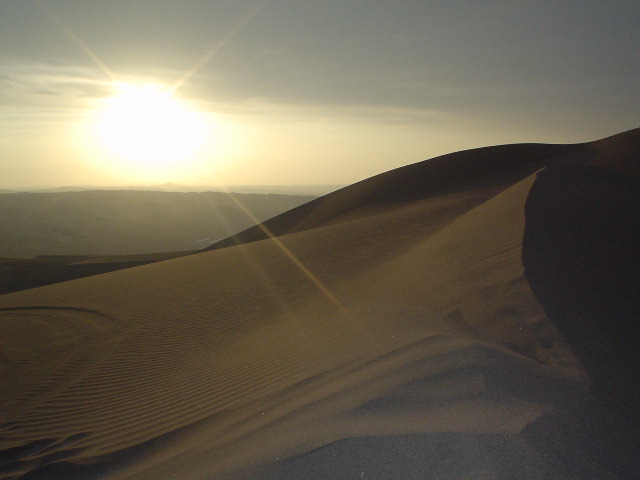
DAY 62: Ica, capital city of the department of the same name, is known for two things: its massive and dramatic surrounding sand dunes (picture below), and its pisco brandy and wine-producing vineyards. The easiest way to see them both is with a city tour. At just ten dollars, the tour wasn’t a bad deal considering the amount of free booze samples you get. And what’s not to like about free booze?
My tour guide Fernando picked me up in an unmarked sedan. He was a nice fortysomething man who didn’t speak any English — the majority of tourists were Peruvian anyway. We picked up the three other tourists at their hotels: Luis, a Peruvian living and working in Mexico City, and Elena and Mauricio, a young couple from Cuzco. Fernando took us around the highlights of the city, first to the church of Señor de Luren with its classical architecture and moreno-toned Christ. Despite the fact that Luis was native to Peru, he must have been excited to be back because he was taking pictures left and right, many of which I took for him so he could be in it.
Fernando took us to two nearby vineyards, El Catedor and the Italian-founded Vista Alegre. Both had displays of old-fashioned grape presses which were replaced by modern equipment. Juices of grapes were fermented in ceramic pots or oak barrels to produce a number of fine red and white wines, many of which were very sweet, like desert wines. In addition to the various wines, they also produced cognacs, vermouth and the famous regional white grape brandy, pisco. Pisco is often mixed with sour mix to make the ever-popular “pisco sour” cocktail.
Needless to say, the wine and pisco tastings were the best — and blurriest — parts of the two tours.
THE LAST STOP OF THE CITY TOUR was Huaca China, a natural oasis-turned-resort in the middle of the surrounding desert. Huaca China used to be the vacation destination for heads of state and men of power, but over the years it felt into despair — only to be overridden by backpackers and sandboard bums. I was surprised to see the number of gringos there because Huaca China — nor sandboarding for that matter — was mentioned in my Lonely Planet “Shoestring” guide.
Luis and I wandered around the lake, watching the paddleboats and swimmers inside. Massive sand dunes the size of mountains surrounded us and with the presence of desert palms, I felt I might have been in the Sahara.
Fernando’s city tour ended there, but rather than go back with the rest, I hung around for a bit of sandboarding.
I HAVE BEEN AN AVID SNOWBOARDER for the past five years, and having been away from snow in the summer of the southern hemisphere, this was where I’d get my fix. While most of the sandboard bums just rented a board for five bucks and hiked up the dunes for an hour only to come down in a minute, I paid the twenty bucks for a sand buggy to pick me up and bring me to the top after every run.
People who drive sand buggies aren’t called “drivers” in Huaca China. They are called “pilots.” I didn’t understand this until my pilot Mitchell, a Chilean living in Peru, got behind the wheel. With just miles upon miles of sand with nothing to crash into, Mitchell took the buggy about 60 miles per hour up and down the massive dunes. Like a rally sport driver, he swerved around deep ditches and floored it down jaw-dropping hills that must have been 75°, if not more. To describe the experience as a “roller coaster” would be both cliché and an understatement. A snappy metaphor doesn’t come to mind, but I suppose it was like being in a NASA training simulator — not that I’ve ever been — where they spin you and contort your body really fast just to see what the limits of human endurance are. There should have been a warning sign that read “Do not go on this ride if you have heart conditions, are pregnant or have a will to live.” I was strapped in with a shoulder belt, which was absolutely necessary since I might have flown up and out of the car when it caught a little air.
And if driving ridiculously fast up and down a sea of sand wasn’t enough of a heartstopper, Mitchell would race up a dune and stop short right at the edge of a peak.
“[You sandboard?]” I asked him.
“[No, that’s for crazy people.]”
Riight.
ACCOMPANYING ME ON THE SLOPES was Andres, a Colombian on vacation from his job in San Antonio, Texas. He wasn’t as experienced in boarding as I was, so we did a couple of practice runs on a “bunny slope” — which was about as gentle the bunny boiling in Fatal Attraction. Mitchell picked us up and brought up to the top each time, and over time, Andres got the hang of it.
Sandboarding is similar to snowboarding in that you have to have a certain amount of lunacy to do it. Sandboards are similar in design to snowboards, except the bindings are made of velcro straps that hug your boots. Sand, although more forgiving on impact, doesn’t pack or move like snow does, making it difficult to carve left and right — doing so would only make you lose momentum and stop. With this said, sandboarding is a major balancing act where you must balance your body with your will to live — or rather, the will not to ingest sand.
Mitchell (center) drove us through his big play sandbox to bigger and bigger dunes to surf down, each time meeting us at the bottom for a convenient lift back up. I shot down like a rocket on each mound, happy that being away from home didn’t prevent me from going riding. Andres wiped out a couple of times, and had to stop once to empty all the sand that had filled his pockets.
Our pilot drove us to a peak so we could watch the sunset. The sun glowed a creamy orange and transformed the sky into other colors of the rainbow sherbet spectrum. As we blazed a dusty trail back into town, I felt the whole experience ranked in one of the top things I’ve done in South American thus far.
BACK IN HUACA CHINA, Andres and I bought Mitchell a beer at the nearby outdoor bar, adjacent to a popular hostel. There I met two Brits, Matt and Ellen, who had just arrived in Ica that day and had heard nothing but raves about the sand buggy/boarding experience. I added to that hype.
Until I got a taxi back into the city, I drank and chatted with the Brits and the local bartender Lalo, who made us various drinks with pisco in them — one of which was called the “Huaca fucking China.” Although it wasn’t free like the taste samples that morning, it was the perfect drink after a great fucking day.
Next entry: NAZCAR
Previous entry: A Pair of Turtles
Commenting is not available in this channel entry.
Comments for “Sweet, Sour and Sandy”
some man SHOT some guy in the willowbrook mall @ SPENCERS!!!! How funny is that?!
...it’s beginning to look a lot like christmas!
Posted by .(JavaScript must be enabled to view this email address) on 12/31 at 07:00 PM
Computer whoas over for now… check out these pictures!
Posted by .(JavaScript must be enabled to view this email address) on 12/20 at 04:36 PM
Thanks for the Punta Sal and Miraflores seaside pics! Brought back great memories!
One word for your sandboarding pics: AWESOME!
Posted by .(JavaScript must be enabled to view this email address) on 12/20 at 05:08 PM
Hey, we got together at Casa Yacat last night for our annual xmas gathering. I think it was the kids, b/c we didn’t play a single xbox game. Can you believe that? And amongst all the tired (we all ate too much) farewells, we forgot to grab a group shot for you just to show you our sorry looking mugs up here in the states. I also left Robo2 at home.
Liked the Sheloab scene in ROTK. The movie had its moments (Sheloab, the pan views of Gondor) but it fell short b/c it definitely needed a fourth movie (or a 4.5 hour runtime) to properly tell everything.
Posted by .(JavaScript must be enabled to view this email address) on 12/20 at 05:15 PM
E. Thanks for drunk messaging me last night! For everyone that wants to know what Erik is like when drunk and grumpy on Pisco… here’s a little transcript.
E. - f#
Posted by .(JavaScript must be enabled to view this email address) on 12/20 at 06:34 PM
AWESOME PICS!!!
Posted by .(JavaScript must be enabled to view this email address) on 12/20 at 07:25 PM
sun glowed creamy orange is new desktop….
umm…what size is that board? looks mad short…..are those burton bindings? hahaha….
Posted by .(JavaScript must be enabled to view this email address) on 12/20 at 08:47 PM
Hey, I forgot to post a picture…it’s up now under “swerved around deep ditches.”
Posted by .(JavaScript must be enabled to view this email address) on 12/20 at 09:10 PM
Duaine: What can I say, it was Pisco Country…
Posted by .(JavaScript must be enabled to view this email address) on 12/20 at 09:33 PM
wahaha, that was about what erik sounded like when i was iming him. but our conversation was more of him saying, “ah, fuck, esfjfklrthighk” , “i can’t get this to , sjroptkladndg work”. maybe that was when his face hit the keyboard. =)
Posted by .(JavaScript must be enabled to view this email address) on 12/20 at 09:48 PM
Alice: Yes, when I’m drunk and I can’t get things to work on a computer, I turn into Don Music from Sesame Street.
Posted by .(JavaScript must be enabled to view this email address) on 12/20 at 09:52 PM
Don Music…LOL….isn’t he the same muppet shape and size and look as Guy Smiley?
Posted by .(JavaScript must be enabled to view this email address) on 12/20 at 11:51 PM
wow. great pics!
...and we did play a game or two. New Amped 2 rocks hard….too bad there’s no sandboarding modes.
Posted by .(JavaScript must be enabled to view this email address) on 12/21 at 12:12 AM
Glad to hear you had a great time this day. So you’re homesick-for-Christmas message the other day got me thinking, and if everyone will indulge me in this particularly sappy moment, I will share with you a song I wrote just for Erik.
Read along to the tune of the 12 days of Christmas….
On the 1st day of Christmas my pal Erik sent to me: another great BLOG entry.
On the 2nd day of Christmas my pal Erik sent to me: two butterfly grubs, and another great BLOG entry.
On the 3rd day of Christmas my pal Erik sent to me: three thieving monkeys, two butterfly grubs, and another great BLOG entry.
On the 4th day of Christmas my pal Erik sent to me: four land iguanas, three thieving monkeys, two butterfly grubs, and another great BLOG entry.
On the 5th day of Christmas my pal Erik sent to me: five Blue-footed boobies (he he); four land iguanas, three thieving monkeys, two butterfly grubs, and another great BLOG entry.
On the 6th day of Christmas my pal Erik sent to me: six savvy tour guides, five Blue-footed boobies (he he); four land iguanas, three thieving monkeys, two butterfly grubs, and another great BLOG entry.
On the 7th day of Christmas my pal Erik sent to me: seven machetes slashing, six savvy tour guides, five Blue-footed boobies (he he); four land iguanas, three thieving monkeys, two butterfly grubs, and another great BLOG entry.
On the 8th day of Christmas my pal Erik sent to me: eight bartenders pouring, seven machetes slashing, six savvy tour guides, five Blue-footed boobies (he he); four land iguanas, three thieving monkeys, two butterfly grubs, and another great BLOG entry.
On the 9th day of Christmas my pal Erik sent to me: nine jellies swimming, eight bartenders pouring, seven machetes slashing, six savvy tour guides, five Blue-footed boobies (he he); four land iguanas, three thieving monkeys, two butterfly grubs, and another great BLOG entry.
On the 10th day of Christmas my pal Erik sent to me: ten banana bunches, nine jellies swimming, eight bartenders pouring, seven machetes slashing, six savvy tour guides, five Blue-footed boobies (he he); four land iguanas, three thieving monkeys, two butterfly grubs, and another great BLOG entry.
On the 11th day of Christmas my pal Erik sent to me: eleven postcards pending, ten bananas bunches, nine jellies swimming, eight bartenders pouring, seven machetes slashing, six savvy tour guides, five Blue-footed boobies (he he); four land iguanas, three thieving monkeys, two butterfly grubs, and another great BLOG entry.
On the 12th day of Christmas my pal Erik sent to me: twelve tourist-topped trains, eleven postcards pending, ten bananas bunches, nine jellies swimming, eight bartenders pouring, seven machetes slashing, six savvy tour guides, five Blue-footed boobies (he he); four land iguanas, three thieving monkeys, two butterfly grubs, and another great BLOG entry.
Whew!
Posted by .(JavaScript must be enabled to view this email address) on 12/21 at 03:03 AM
Awesome pics dude…after coming in from cold ass crummy weather up here in New Yawk, I’m glad there is someone out there enjoying what the world has to offer!! Word up!!
Keep livin’ large….
Posted by .(JavaScript must be enabled to view this email address) on 12/21 at 03:05 AM
Sandboarding looks amazing! I can’t wait to hit the slopes here though…
Christy: Wicked song! Very creative!
Posted by .(JavaScript must be enabled to view this email address) on 12/21 at 03:48 AM
dood. sorry about the spek party diss. blame j2x for not having wifi.
(^_^)
Posted by .(JavaScript must be enabled to view this email address) on 12/21 at 03:36 PM
CHRISTY: Amazing song… I see PH is keeping you really busy this holiday season…
Anyone else? New commentators perhaps?

Posted by .(JavaScript must be enabled to view this email address) on 12/21 at 04:34 PM
I’m home for the holidays, and it’s great to be away from the office!
Incidentally, how much sand did you get in your pockets, shoes, etc….?
Posted by .(JavaScript must be enabled to view this email address) on 12/21 at 05:06 PM
AWESOME!!! I’m so excited for you that you got to go “snow"boarding!!!! that’s going to be my NEXT vacation spot
 i’ve been out of the loop for a week while i’ve been in NYC. but will catch up, hope all is well and keep the sunset pictures coming!
 Posted by .(JavaScript must be enabled to view this email address) on 12/21 at 05:18 PM
Christy: Pockets were fine…but when I took off my boots I poured out enough to make a small sand castle.
Posted by .(JavaScript must be enabled to view this email address) on 12/21 at 05:29 PM
Christy: great song!
Erik: You have a head start with sandboarding, I’m scared. I’m going to go rolling down the dune! (or pull a Dave and Gary)
Posted by .(JavaScript must be enabled to view this email address) on 12/22 at 01:40 PM
nikkiJ: shot at spencers?? niiice…i can only imagine what item they were fighting over??
Posted by .(JavaScript must be enabled to view this email address) on 12/22 at 01:43 PM
wow eric, those pics remind me of the alchemist..
keep it up santiago!
Posted by .(JavaScript must be enabled to view this email address) on 01/12 at 02:15 AM
SHARE THIS TRAVEL DISPATCH:
Follow The Global Trip on Twitter
Follow The Global Trip in Instagram
Become a TGT Fan on Facebook
Subscribe to the RSS Feed
This blog post is one of over 500 travel dispatches from the trip blog, "The Global Trip 2004: Sixteen Months Around The World (Or Until Money Runs Out, Whichever Comes First)," originally hosted by BootsnAll.com. It chronicled a trip around the world from October 2003 to March 2005, which encompassed travel through thirty-seven countries in North America, South America, Africa, Europe, and Asia. It was this blog that "started it all," where Erik evolved and honed his style of travel blogging — it starts to come into focus around the time he arrives in Africa.
 Praised and recommended by USA Today, RickSteves.com, and readers of BootsnAll and Lonely Planet's Thorn Tree, The Global Trip blog was selected by the editors of PC Magazine for the "Top 100 Sites You Didn't Know You Couldn't Live Without" (in the travel category) in 2005.
Next entry:
NAZCAR
Previous entry:
A Pair of Turtles
THE GLOBAL TRIP GLOSSARY
Confused at some of the jargon that's developed with this blog and its readers over the years? Here's what they mean:
BFFN: acronym for "Best Friend For Now"; a friend made on the road, who will share travel experiences for the time being, only to part ways and lose touch withThe Big Trip: the original sixteen month around-the-world trip that started it all, spanning 37 countries in 5 continents over 503 days (October 2003–March 2005)
NIZ: acronym for "No Internet Zone"; a place where there is little to no Internet access, thus preventing dispatches from being posted.
SBR: acronym for "Silent Blog Reader"; a person who has regularly followed The Global Trip blog for years without ever commenting or making his/her presence known to the rest of the reading community. (Breaking this silence by commenting is encouraged.)
Stupid o'clock: any time of the early morning that you have to wake up to catch a train, bus, plane, or tour. Usually any time before 6 a.m. is automatically “stupid o’clock.”
The Trinidad Show: a nickname of The Global Trip blog, used particularly by travelers that have been written about, who are self-aware that they have become "characters" in a long-running story — like characters in the Jim Carrey movie, The Truman Show.
WHMMR: acronym for "Western Hemisphere Monday Morning Rush"; an unofficial deadline to get new content up by a Monday morning, in time for readers in the western hemisphere (i.e. the majority North American audience) heading back to their computers.
1981ers: people born after 1981. Originally, this was to designate groups of young backpackers fresh out of school, many of which were loud, boorish and/or annoying. However, time has passed and 1981ers have matured and have been quite pleasant to travel with. The term still refers to young annoying backpackers, regardless of year — I guess you could call them "1991ers" in 2013 — young, entitled millennials on the road these days, essentially.
Spelling or grammar error? A picture not loading properly? Help keep this blog as good as it can be by reporting bugs.