Speculations and Interpretations
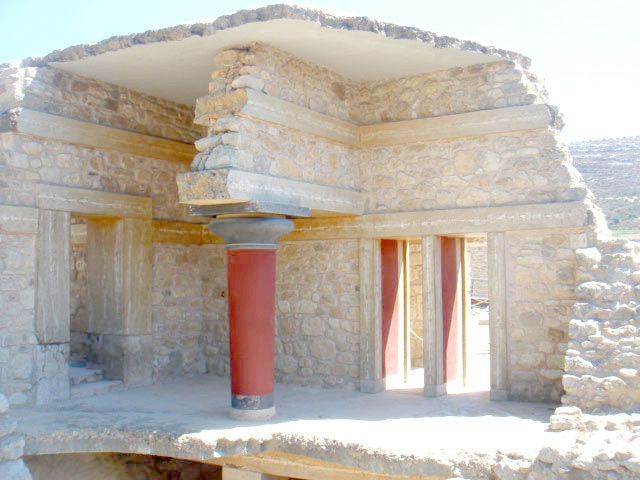
This blog entry about the events of Sunday, September 03, 2006 was originally posted on September 05, 2006.
DAY 10: Archaeology is not an exactly science; it does not deal in time schedules. However, there is a fine line between science and speculation, and when you’re dealing with the ruins of something wiped out hundreds of years ago, it could go either way. This is such the case with the Temple of Knossos, the greatest archaeological find of the Minoan civilization — and home of the Minotaur in the labyrinth legend — a half hour bus ride from Iraklion.
During the hey day of archaeology in the early 20th century, the British “discovered” the ruins of Knossos on the island of Crete, and for 43 years excavated and restored it under their lead archaeologist, Sir Arthur Evans. However, Evans sort of guessed his way around Knossos, so blatantly to the point that every guidebook and informational sign prefaces all facts with “according to Evans…” For example, in this one famous fresco found on the site, Evans had only fragments of the entire piece (lower right of photo) but simply drew in the rest from his imagination. This is like getting 20 pieces of a 500-piece jigsaw puzzle and drawing in the rest without ever having seen the box with the final picture on it.
RICH THE ONE-i’D CYCLOPS met me at the Iraklion bus terminal so we could take the shuttle bus to Knossos together. He was playing hooky from his medical device conference since the topic of the day — tension-free vaginal tape of all things — had nothing to do with the product he had worked on. Besides, it was a beautiful day and back home it was a day off anyway, Labor Day. We waited a good forty minutes at the cafe by the entrance of Knossos for the official English-speaking tour guide to amass a big enough cost-effective tour group, but there were very few native English-speaking tourists around — Greece is rampant with mostly Italian, French, and Germans.
Rich The One-i’d Cyclops and I just went on our own, powered by two guidebooks. “[It’s a shame about the tour,]” Rich said. “[But whatever they say,] it’s all just speculation anyway.”
Speculation is right. Picture the jigsaw metaphor I used for the fresco, and make it much bigger and three-dimensional. Evans took a look at the ruins that remained and drew an illustration of what Knossos was before its fall. The museum in town even recreated a scale model of Evan’s vision, which looks like a pretty bad ass Lincoln Log cabin if you ask me. To give Evans credit, there were definite fragments of the temple remains that did suggest a continuity in the palace as a whole. The red pillars (picture above) for example were everywhere — whether they were all red is speculation.
Rich The One-i’d Cyclops and I wandered around Knossos amongst the other tourists, all mindful that the restoration of the ruins before us was merely an interpretation. “I don’t know if they’re restoring or painting on rocks,” Rich said when we saw a couple of archaeologists working on the site.
There wasn’t much to Knossos — particularly after seeing how awesome it might have been in its glory days — and going around took only about an hour, from its outsides to the few areas of interior that were closed off to be “imaginably restored.” You could see that the former passageways were probably very narrow, with right angles and low ceilings, which is why it was dubbed the “labyrinth” in Greek mythology.
“A guy probably saw all this and just said, ‘It’s like a labyrinth,’” Rich said, citing the legend of the Minotaur. “I heard that the Minotaur was just some family member that was [hideous], which kind of makes the slaying of the Minotaur kind of sad.” Concurrently, Knossos’ maze of mud, stones, and bricks reminded him of the video game God Of War. “I feel like smashing one of the vases.”
The throne room was the big crowd-pleaser of the Knossos, a room fully-restored and painted to Evan’s vision, complete with the placement of fake furniture and fake frescoes painted on the walls. It was with that that we concluded our trip to the former Minoan palace. “It’s all a big fraud,” I said. “It’s all just pieces brought over from the U.K.”
“It’s really just an Irish castle,” Rich joked. Despite the controversy on the authenticity of the Knossos site, Rich was happy to see it instead of being at his conference. “It’s better than listening to a lecture on tension-free vaginal tape.”
AFTER A GREEK BANANA SODA (I chose it for the monkey), and a lunch of Feta in the Oven, cuttlefish, and delicious grilled octopus tentacles, Rich The One-i’d Cyclops and I parted ways rather abruptly since we both had buses going to two different destinations. I was headed for the western part of Crete, to the city of Hania, where I’d spend the night and arrange a trek to the famous Samaria Gorge the following day.
Hania was another Venetian port city with a protective fortification protecting the harbor, although its allure to tourism was far greater than Iraklion. Like Venice, Italy, it seemed to be a place that was once great but had now only existed for the sake of honeymoon vacations, a place that Las Vegas might want to recreate with their own speculations and interpretations. I arrived just in time for sunset, when fishermen were trying to catch fish with bread from the Venetian walls. Boats came in from sea using the Venetian lighthouse as their beacon as the sun sank and the moon rose.
I was sort of turned off by Hania’s ultra-touristy scene of tourist cafe after tourist cafe and vendors everywhere along the marina, and rented a studio apartment with a kitchenette and a terrace overlooking a small, quiet alleyway a block away from all the action. It was in this alley that I dined on a Cretan stifado stew of lamb, beef, and rabbit home-cooked by Anna of the Taverna Apovrado. Afterwards I found a local dive bar, the Kafe Kriti, where two Greek guys played traditional music when they weren’t busy serving ouzo and snacks in between songs. Definitely the coolest place I’d been in Greece so far, this kitschy bar of random tchotchkes that collectively reminded me of a VFW hall was a local’s favorite — as well as of the few tourists that showed up to get away from the glitzier clubs by the marina. At one point, a dance circle sprouted with cheers of “OHPAA!” as I sat and watched while drinking my glasses of ouzo.
This is awesome, I thought. Much better than listening to a lecture on tension-free vaginal tape anyway.
Next entry: The Beaten Path
Previous entry: Wandering Without The Cyclops
Commenting is not available in this channel entry.
Comments for “Speculations and Interpretations”
TWO MORE FOR YOU… I’m all caught up according to my schedule, until I
far behind again in the next 12 hours… I’ll keep them coming, they way
I always have…Posted by Erik TGT
<http://www.blogger.com/profile/05087591227757317086>
First!
Great stuff so far, Erik. It’s giving me a jonesing to go traveling in
that part of the world again. We’re planning about a week and a half in
Nov thru SE Asia, tho, and that will tide us over in the meantime, I
suppose.Posted by Dave and Melody on 09/05 at 01:38 PM
Erik, great entry! Fake artifacts, vaginal tape, red columns, grilled
octopus tentacles, cool apts, kitschy bars???this entry has it all! Great
pics too! You should have asked the two musicians if they could play YMCA…Posted by Dan 3 on 09/05 at 04:44 PM
HELLO ALL… I’m back in Iraklion (Crete), my overnight layover before
The Wanderings of Trinideus take me to Santorini. I’m just briefly
checking in—more entries to come tomorrow. Right now I’m hungry and I
need some chicken gyro in me.AS ALWAYS, COMMENTS WELCOMED AND APPRECIATED. For those who are new to
this blog, most of the people commenting I’ve never actually met, so
don’t be shy and stop being an SBR (Silent Blog Reader).DAN3: YMCA! Almost forgot about that entry! Glad to know there’s a
follow out there, somewhere…Posted by Erik TGT
i think alot of those ruins can be repaired with the use of good ole
trusty tension-free vaginal tape…at the least if you apply it and pull it off, it won’t hurt…
Posted by markyt on 09/05 at 11:04 PM
so do you work at digitas? i cannot remember. i was in the city over the
weekend and was going to leave you a note at your desk… but decided
against it…Posted by civil013
Great pictures and it looks like you are having great weather also!
Enjoyed reading this entry. You make us feel like we could be there!
What’s with all the french fries? RosePosted by Anonymous on 09/06 at 03:47 AM
Some of those pictures just blew me away. Never been to Europe and now
I’m getting the itch to go travelling!Posted by Janice on 09/06 at 05:30 AM
Love the sunset pics! Udz and I have to make our way to Greece one day!!
YvettePosted by Anonymous on 09/07 at 05:57 PM