Sensory Overload
This blog entry about the events of Saturday, September 25, 2004 was originally posted on October 03, 2004.
DAY 343: I am probably a bit biased when I say this, but I think my generation, the generation whose childhood took place in the 1980s, is the best generation. It was in the 80s that the video game revolution began, when an Atari 2600 or ColecoVision was on the top of every boy’s Christmas list, when visions of sugarplum game cartridges danced in our heads. Yes, you can blame us for being that first generation that would rather play video games than do a boring thing like reading or taking out the garbage. Why do anything else when you could switch your switchbox on the back of the TV from “TV” to “GAME CONSOLE” and play a game like Atari’s Combat, where you could fire a non-descript looking shape that was supposed to be a tank with such a force that it knocked the other non-descript shape all the way to the other side of the screen?
Video games, one of the biggest exports out of Japan, have come along way since the days of Combat and Donkey Kong; nowadays, video game tanks actually look like tanks and Donkey Kong has a family of his own. Video games get more sophisticated each year and every fall the latest ones are showcased at the Tokyo Game Show, the world’s largest video game expo. Liz didn’t think I’d be interested in such an event when her friend Cal told her it was going on that weekend, but Cal knew very well that I was in the target demographic for it: young, male and jaded from reality. When he showed me the article of the expo in the local newspaper, my eyes lit up with the same excitement of first finding the hidden Warp Zone at the end of Super Mario Bros. Level 1-2.
I immediately sent an e-mail to my friend and Blogreader LovePenny; I knew for a fact that he would share my enthusiasm of going to Tokyo Game Show 2004. I mean, the guy lives and breathes video games. When his daughter Penny was born (the namesake of his Blog handle), he joked that she would just run around in dirty diapers because all his money would still go towards his hobby of video games. A frequent poster on video game bulletin boards, he knew the workings of a video game expo and sent me on a mission since he could not be in Tokyo himself:
“Take at least 10 pictures WITH the Game Hotties (the japanese chicks!)!!!!”
A TRAIN TOOK LIZ AND ME to the convention center in nearby Chiba, just a bit farther out of the city center than Tokyo Disneyland. We met Cal at a coffee shop and then followed the crowd of teenagers and young adults — not exclusively male and not exclusively Japanese — to the ticket line. Neither Liz or Cal were really up-to-date on the latest video games and so I played guide as best I could, geeking them out with trivia like a 3-D rendering engine that uses bump mapping uses less polygons than one without bump mapping, so less math is involved. (If you are confused as to what that means, ask resident Blog video game nerd LovePenny.)
“My friend has sent me on a mission,” I told Cal. “To take a photo with at least then Japanese models.”
“Models?” he questioned, confused at the ambiguity in language.
“As in women.”
“Oh, you’ll probably get that in the first fifteen minutes.” Cal, who worked in the tech sector, was no stranger to the strategies companies used at trade shows to entice the public — more specifically the use of sexy women in front of their booths, also known as “booth bunnies.” In the first couple of minutes after entering the first exhibition hall, we already had two photos down: one with (1) an SNK girl and (2) a girl selling toys and accessories.
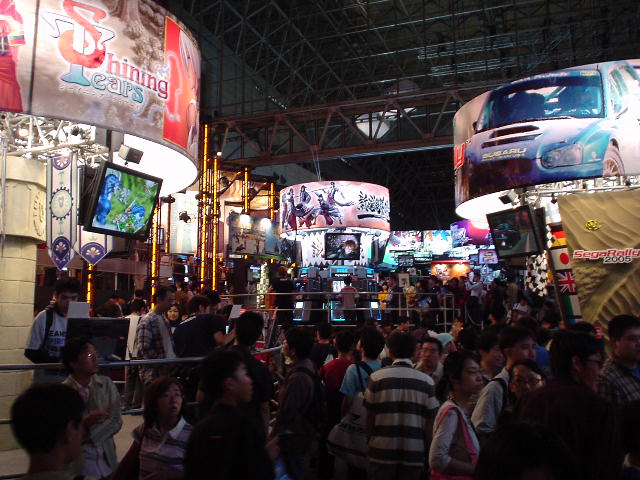
If you’re not familiar with the tech expo, it is not just a bunch of generic-looking booths and tables that might be mistaken for a real estate convention or community bake sale. No, companies spend millions on trade shows, each building a huge pavilion with flashy lights, big TV monitors and often a stage for presentations. Each company tries to outdo the other, and the end result is an all out sensory overload that makes you feel like you are in some sort of giant pinball machine (picture above).
VIDEO GAME ENTHUSIASTS (a.k.a. “gamers”) came from every direction, searching for the latest in video games for computers, mobile phones and game consoles, which they all knew by their acronyms: RE4, MGS3, GT4 to name a few. Companies hyped them up with music and sometimes free giveaways — one company even had dancers performing to a loud taiko drum performance — and of course, booth bunnies like the ones at (3) KDDI, (4) Atari’s Driver 3, and (5) Koei. Booths for driving games like Need for Speed 2: Underground treated their showcase like it was at an import car show, having their booth bunnies sprawled out on a car instead of passing out flyers. Nothing else mattered when a new model came out to pose — (A) one from Wayi literally stopped the flow of traffic since every drooling guy with a camera walking by couldn’t help but stop to point and shoot.
The horniness at the expo translated to the virtual world too. A couple of years back, Tecmo released Dead or Alive for Microsoft’s X-BOX, a traditional one-on-one fighting game. While the fighting in DOA was fast and furious, many gamers responded mainly to the female fighters in the game, particularly the way they were rendered in the bust region. These voluptuous virtual women became such a hit with horny teens that the producers of DOA took them and put them in a different gaming environment altogether to show off their curves and bump maps: beach volleyball! The women of DOA were put in bikinis and swimsuits so that owners of the X-BOX could put them in different outfits and wack a volleyball back and forth. (That’s not all they were wacking.) Perhaps these virtual babes were on X-BOX in lieu of X-BOX’s real babes; pictures with X-BOX’s booth bunnies were denied every time I asked. (Microsoft bitches!)
Models, like the ones for (B) Taito and (C) Konami weren’t the only ones dress for the occasion; many attendees dressed up as their favorite video game character, revealing yet another subculture within the already outrageous culture of young fashion rebels. “I can’t tell if they’re dressed up as a character or if they normally dress like that,” Liz said.
“I would have expected the [exhibitors] to dress up but not the attendees,” Cal added.
With so many games to choose from, there were many outfits going around, some familiar, some not. “Hey, I actually know who that is!” Cal exclaimed. The girl in blue was just one of a group of people who had collectively worn different outfits for a big group photo of Japanese video game heroes.
Another group in costume that was more recognizable was a team of people promoting the latest Star Wars games by LucasArts: one dressed as C3PO next to an R2-D2 unit and a bunch of Stormtroopers. One by one, people in the crowd were allowed to pose with them, and eventually it was our turn. I stood next to C3PO, the droid I grew up with in my childhood, and put my arm around his shoulder like we were old pals — but C3PO got all defensive and shoved me aside. What? C3PO? C’mon now, after all the love I’ve given you all these years? A Stormtrooper noticed the commotion and restrained me from C3PO, who stood there all pompous-like, waddling in his standard droid pose with his arms out, all high on fame like I was beneath him. We posed anyway, with the group from that galaxy far, far away, but if you’ll notice in the photo, the Stormtrooper held a grip on me in case I “assaulted” C3PO again. (C3PO, you bastard!)
THE THREE OF US WANDERED THE CROWDED EXPO, taking more photos with booth bunnies — (6) Game Excite, (7) Taito, (8) Rumble Roses, (9) Gung Ho Online — trying out this game and that game for Playstation 2 and X-BOX, and watching others play not only with game controllers but with their entire bodies to show off motion sensor devices that are now coming from the arcades and into the home. In one of these motion sensor games you had to throw virtual jam at dancing fish, while at the same time be beware of the attacking toast man. How’s that for Japanese pop culture?
I thought everything we had seen in the first hall was a sensory overload until we entered the Sony-dominated second hall, with perhaps twice as many people, bigger booths with bigger screens and more sounds — so much that Liz had reached her threshold.
“I’m going to have to take a time out,” she told Cal and me. She went off to find a quiet place on the side where other attendees were sitting on the floor from exhaustion.
The big showcase game in the second hall was one I was really looking forward to playing after seeing its “E3 2004 Trailer”: Metal Gear Solid 3: Snake Eater (also with its own (10) MG3S booth bunny), the latest in a franchise that combined dramatic storylines with action, strategy and espionage, created by not only a team of programmers and electronic artists and a military advisor, but with a title sequence designer and score composer from the Hollywood movie biz. As much as I wanted to try it out, the crowd for it was so big the waiting time to get on a station to play it was over an hour (like most games at the expo) and I just didn’t have the patience. Instead I used my time more constructively and by that I mean take more pictures with booth bunnies (even though I had already reached LovePenny‘s quota): (11) Electronic Arts, (12) Namco and (13) Hudson.
I finally made it out to arguably the highlight of the show, the pavilion for Sony’s new portable gaming unit, the PSP. Trying it out was easier than trying out MGS3 because not only were there multiple stations to play, but Sony’s booth bunnies went around with PSPs strapped to their belts for people to try them out. I played a fighter game on one while admiring the PSP’s sleek design, hi-res graphics and stereo sound. Unlike the snobby bitches at Microsoft’s X-BOX booth, (14) the Sony PSP booth bunny was more than willing to pose with me, even with the PSP unit despite the signs posted all over that photos of products were forbidden.
AFTER THE SENSORY OVERLOAD OF JAPANESE ELECTRONIC POP CULTURE (and even more photos with (15) booth bunnies that I’m not sure what game or company they represented (although (16) one was an “actual booth bunny” [said Cal]), it was fitting that I found the perfect refuge from such a chaotic scene: the quiet insides of a capsule in a Japanese capsule hotel since Liz had to go out of town that night to meet her husband Hiroshi at her in-law’s. I lay my head to rest in my own little pod that night (which was roomier than expected), secluded from the flashy graphics and loud sounds of video games, as visions of sugarplum booth bunnies danced in my head.
Next entry: Searching For Godzilla
Previous entry: Goldilocks and The Three Bowls
Commenting is not available in this channel entry.
Comments for “Sensory Overload”
I’VE CONVENIENTLY NUMBERED AND LETTERED THE BOOTH BUNNIES so you guys can go ahead and rate them if you want. Pick your favorite or individually rate them by number on a scale of 1-10 if you wish…
Posted by .(JavaScript must be enabled to view this email address) on 10/03 at 08:47 AM
First! 3rd time in a row!! Woohoo!!!
Hey! All the boothbunny shots aren’t uploaded yet! Curses! I’m too early!!! :(.......
LovePenny must be green with envy!!!
Erik, I was wondering when you’d get a capsule shot! Finally! yay!
Posted by .(JavaScript must be enabled to view this email address) on 10/03 at 09:06 AM
Oh, re: the xbox bunnies.. damn you microsoft!!!
Posted by .(JavaScript must be enabled to view this email address) on 10/03 at 09:07 AM
bootbunnies pictures link not working!
Posted by .(JavaScript must be enabled to view this email address) on 10/03 at 10:14 AM
WTF: I SWORE I uploaded the bunny picts at Liz’s before I left Tokyo… Grrr… Hopefully I can find a way to upload them before the Monday morning rush…
Posted by .(JavaScript must be enabled to view this email address) on 10/03 at 04:35 PM
CRISIS AVERTED! The booth bunny picts are now up online…
Posted by .(JavaScript must be enabled to view this email address) on 10/03 at 04:51 PM
GREETINGS FROM HIROSHIMA… more to come…
Posted by .(JavaScript must be enabled to view this email address) on 10/03 at 05:05 PM
I have to say this enrty ranks up there as one of my favorites ... #12 ( Namco ) diffinitey my choice for Miss Globaltrip 2004 ..
Posted by .(JavaScript must be enabled to view this email address) on 10/03 at 05:16 PM
woohoo! finally…. (^_^)
i knew 10 pics w/ booth bunnies was too easy…but since it was your first game con, i didn’t wanna raise the bar too high. Great shots and the PSP is gonna be the final nail on the coffin for Nintendo. Where Nintendo dominated the gaming portables w/ its GameBoys…now comes Big Bad Sony w/ its high-end portable…and it plays video and music!
I agree w/ Sim…#12 is cute but #7 taito takes the cake for Ms. Globaltrip 2004.
Posted by .(JavaScript must be enabled to view this email address) on 10/03 at 06:10 PM
i think Erik misquoted me. I said that we were gonna save our money by not buying diapers and letting the lil’ one run around w/ no diapers on.
But after peeing on the floor twice, diapers = best invention since sliced bread!
Posted by .(JavaScript must be enabled to view this email address) on 10/03 at 06:15 PM
wow, awesome!!! i am so jealous. i would have loved to be there. and with all the hot looking bunnies. i vote for number 12. she is cute, though seems plastic-doll like. maybe it was just the glare on her costume. the capsules look fun. were they expensive? can a person get away with visiting japan on a tight budget and sleeping in those things for a week? and lovepenny, you could have saved money for games and not buy diapers if you just bring home all the spec sheets they print here from work and wrap them about penny. or layer it on the floors for the piddle protection. god knows we have enough wasted paper here.
Posted by .(JavaScript must be enabled to view this email address) on 10/03 at 08:21 PM
Why is it that they mostly have bleached hair?? Very strange… but, interesting. The Taito girls are wearing barely anything - funny… I’d be with Liz, though, taking a time out… overload…
The capsule hotel is very curious… and interesting. How do you take a bunch of stuff with you? Neat, though. Reminds me of the space ship in THE FIFTH ELEMENT - neato!
Posted by .(JavaScript must be enabled to view this email address) on 10/03 at 08:50 PM
#12 is the tops - although the Microsoft bunnies buns get my vote.
Posted by Dan on 10/03 at 10:22 PM
Wooo Hoooo!!! GT4!!!!
Oh, and (7) Taito is smokin’
I was always confused by Love Penny’s handle. See, you guys (and gals) need Bio’s so us SBR’s can see who’s talkin here.
Posted by .(JavaScript must be enabled to view this email address) on 10/04 at 01:05 AM
tjw: you aern’t so much of an SBR anymore now are you? Jackass. ha
Oh, and I gotta wait till I get home to view the beauties, as I don’t want anyone to think I’m surfing soft porn here at the terminal at school.Posted by .(JavaScript must be enabled to view this email address) on 10/04 at 01:21 AM
Bill: NICE
Posted by .(JavaScript must be enabled to view this email address) on 10/04 at 01:45 AM
I second Dan’s Xbox Booth Bunny Buns!! Now say that a few times fast!
Posted by .(JavaScript must be enabled to view this email address) on 10/04 at 02:38 AM
RE: CAPSULE HOTELS… They are amongst the cheapest options to crash for a night in Japan at about $30/night—you buy the ticket from a vending machine and hand it to reception to get the key.
The showers are all on one floor, along with the lockers, where you keep all your stuff, away from the capsule hall. It is customary to go to the capsule hall with nothing but your key and your little smock thing (that blue thing I’m wearing).
Capsule hotels are a male-only domain—Liz could go no further than reception when she helped me check in. I first thought were for businessmen, but Liz and Hiroshi say its mostly for drunk guys who’ve missed the train home—the subway closes at 10pm and the JR trains close at midnight!
No matter, each capsule runs anime porn (Milk Girls) and live action porn on two different stations, in between the serene scenery channel…
Posted by .(JavaScript must be enabled to view this email address) on 10/04 at 02:52 AM
I agree with voters for #12 and #7, but think I’m partial to #4, the Driv3r girl—I think I have a solo picture on my hard drive that does her more justice…
p.s. I say again (with fists raised): DAMN YOU C3PO! DAMN YOU TO HELL!!!!
Posted by .(JavaScript must be enabled to view this email address) on 10/04 at 02:55 AM
LOVEPENNY: Maybe THATs why Nintendo DS had no major presence at TGS2004. The TV ads are cool though; but they never show the actual product… Its just a white background space with a NinDS far away, and a woman in a red dress walks along and stumbles upon it and gasps in curiosity. CUT.
Posted by .(JavaScript must be enabled to view this email address) on 10/04 at 02:58 AM
I still have yet to type up the new batch, so go ahead and continue rating the booth bunnies…
Posted by .(JavaScript must be enabled to view this email address) on 10/04 at 03:02 AM
Noelle - Japanese women hate having black hair. They want to look western, so they die it, usually to a chestnut brown shade. Before I came to Japan, I always died my hair because I thought it was boring. Turns out, in Japan, women pay hundreds of bucks a month for my colour!
Interestingly, dying your hair causes some issues when getting a job. Here you need to attach a picture to your resume, so many will die their hair back to black for the job application and interview.
After they get the job, it is perfectly acceptable for women to die their hair brown. Men, however, are often told by their bosses to go home and not come back until their hair is black again! This is changing, but I always thought it was a weird double standard.
Posted by Liz on 10/04 at 04:12 AM
Tough chioce…#12
Posted by .(JavaScript must be enabled to view this email address) on 10/04 at 04:14 AM
Tough choice…#12
Posted by .(JavaScript must be enabled to view this email address) on 10/04 at 04:15 AM
I’m going with erik on #4. The Driv3r girl has a genuinely cute smile! Traffic stopper comes in a close second.. too bad she has no booth to merit her a “numbered” booth bunny.
Posted by .(JavaScript must be enabled to view this email address) on 10/04 at 05:06 AM
Alright I’m gonna also say 12 Namco, wow…..
New wallpaper (i superimposed my head on Erik’s body too)[Not really].
Posted by .(JavaScript must be enabled to view this email address) on 10/04 at 05:10 AM
wanna hear about Hiroshima!!!
Posted by .(JavaScript must be enabled to view this email address) on 10/04 at 05:12 AM
erik,
less temples and more chicks=much better entry!!
Posted by .(JavaScript must be enabled to view this email address) on 10/04 at 04:32 PM
NOELLE: Thanks for the donation! I just heard you sent a check!
Posted by .(JavaScript must be enabled to view this email address) on 10/04 at 05:41 PM
OK, I’ll get in on the game. I vote for #1 but I do like #3’s outfit. It’s kind of retro. But then again, I’m not a guy so what do I know?
Posted by .(JavaScript must be enabled to view this email address) on 10/04 at 06:28 PM
12 is the big winner…
Posted by .(JavaScript must be enabled to view this email address) on 10/04 at 07:12 PM
I’m gonna be a rebel and vote for #14 - I like real girls much better than hoed-up models. Plus she’s got a PSP!
Posted by dunlavey on 10/04 at 09:06 PM
i agree with DUNLAVEY - #14…then again, i’m a girl…i just don’t see what’s so attractive about ho-ey types…don’t they just look “dirty”? i don’t know, that’s just me.
ERIK: they don’t have capsules for females at all???
on a sidenote: I wish I had JET BLACK hair!
Posted by .(JavaScript must be enabled to view this email address) on 10/04 at 09:45 PM
isn’t this so typical of MEN. its bad enough that you guys would rather pick a night of playing time crisis or even worse, parappa the rapper..over a nice romantic candlelit dinner with your special someone….but now u have to go so low and rank the freakin girls who promote the games???? wtf?? that’s not cool. that’s not keeping it real. u…u think marcello will like me in one of those outfits? uhoh, i can hear terence telling me to sheddup…
wheat
my vote is for (A) from Wayi. she makes me wanna line dance
Posted by .(JavaScript must be enabled to view this email address) on 10/04 at 10:29 PM
woman, you need to lean back
Posted by .(JavaScript must be enabled to view this email address) on 10/04 at 10:34 PM
YEAAAAAAAAAAH!!!!
Posted by .(JavaScript must be enabled to view this email address) on 10/04 at 10:35 PM
WHEAT - ROFL…
Posted by .(JavaScript must be enabled to view this email address) on 10/05 at 01:54 AM
I too wish I had JET BLACK hair. Or else blonde with millions of dollars of highlights… but then again, we always want what we can’t have…
Liz - thanks for the info - so neato to have an insider’s perspective.
Yes, Erik - I sent a check… don’t need any more STUFF…
Posted by .(JavaScript must be enabled to view this email address) on 10/05 at 04:35 AM
i dunno why they would want to dye their hair blond. i think unnatural blonds look bad. and besides, if you are going to dye your hair, go for a kickass color. like electric blue. i wish i had electric blue hair. unfortunately, i don’t think that would go well here at work. brunettes are hot. angelina jolie is hot. the chick from lacuna coil is hot. gwen stefani is the only exception of a hot fake blond. gillian anderson was hot as a fake redhead. and jessica alba is hot. well, maybe not in that stupid honey movie. but she looks good for fantasic four. and ayumi hamasaki is hot. too bad she has the weird fake blond hair.
Posted by .(JavaScript must be enabled to view this email address) on 10/05 at 06:16 PM
Alice - I totally agree with electric blue!! I’ve always wanted to die my hair electric blue, but, you know, work can be picky about those things…
Posted by Liz on 10/06 at 06:42 PM
=), see. liz and i should start an union for workers with electric blue hair!!! we’ll get them to accept that our hair color wouldn’t affect our ability to be productive!!
Posted by .(JavaScript must be enabled to view this email address) on 10/06 at 08:24 PM
SHARE THIS TRAVEL DISPATCH:
Follow The Global Trip on Twitter
Follow The Global Trip in Instagram
Become a TGT Fan on Facebook
Subscribe to the RSS Feed
This blog post is one of over 500 travel dispatches from the trip blog, "The Global Trip 2004: Sixteen Months Around The World (Or Until Money Runs Out, Whichever Comes First)," originally hosted by BootsnAll.com. It chronicled a trip around the world from October 2003 to March 2005, which encompassed travel through thirty-seven countries in North America, South America, Africa, Europe, and Asia. It was this blog that "started it all," where Erik evolved and honed his style of travel blogging — it starts to come into focus around the time he arrives in Africa.
 Praised and recommended by USA Today, RickSteves.com, and readers of BootsnAll and Lonely Planet's Thorn Tree, The Global Trip blog was selected by the editors of PC Magazine for the "Top 100 Sites You Didn't Know You Couldn't Live Without" (in the travel category) in 2005.
Next entry:
Searching For Godzilla
Previous entry:
Goldilocks and The Three Bowls
THE GLOBAL TRIP GLOSSARY
Confused at some of the jargon that's developed with this blog and its readers over the years? Here's what they mean:
BFFN: acronym for "Best Friend For Now"; a friend made on the road, who will share travel experiences for the time being, only to part ways and lose touch withThe Big Trip: the original sixteen month around-the-world trip that started it all, spanning 37 countries in 5 continents over 503 days (October 2003–March 2005)
NIZ: acronym for "No Internet Zone"; a place where there is little to no Internet access, thus preventing dispatches from being posted.
SBR: acronym for "Silent Blog Reader"; a person who has regularly followed The Global Trip blog for years without ever commenting or making his/her presence known to the rest of the reading community. (Breaking this silence by commenting is encouraged.)
Stupid o'clock: any time of the early morning that you have to wake up to catch a train, bus, plane, or tour. Usually any time before 6 a.m. is automatically “stupid o’clock.”
The Trinidad Show: a nickname of The Global Trip blog, used particularly by travelers that have been written about, who are self-aware that they have become "characters" in a long-running story — like characters in the Jim Carrey movie, The Truman Show.
WHMMR: acronym for "Western Hemisphere Monday Morning Rush"; an unofficial deadline to get new content up by a Monday morning, in time for readers in the western hemisphere (i.e. the majority North American audience) heading back to their computers.
1981ers: people born after 1981. Originally, this was to designate groups of young backpackers fresh out of school, many of which were loud, boorish and/or annoying. However, time has passed and 1981ers have matured and have been quite pleasant to travel with. The term still refers to young annoying backpackers, regardless of year — I guess you could call them "1991ers" in 2013 — young, entitled millennials on the road these days, essentially.
Spelling or grammar error? A picture not loading properly? Help keep this blog as good as it can be by reporting bugs.