Searching For Godzilla
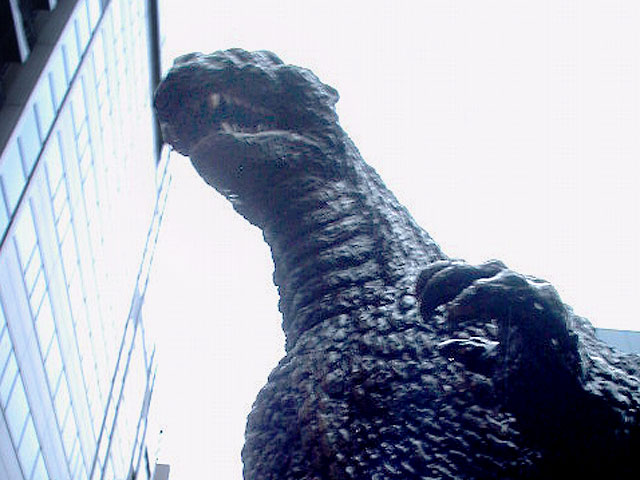
This blog entry about the events of Sunday, September 26, 2004 was originally posted on October 05, 2004.
DAY 344: I never really realized how much Japanese pop culture had become world pop culture until I got to Japan. From video games to anime films, Japan has contributed many things to international pop culture, and none is bigger (at least in size) than the big monster known as Godzilla.
Godzilla has come a long way since that 1954 black and white original film starring Raymond Burr. Over the years (particularly in those drug-inducing sixties and seventies), the Godzilla universe has expanded to include the five-headed dragon Ghidora, the giant pterodactyl Rodan, the robotic Mecha-Godzilla and those two little Japanese girls that sing to summon Mothra. The Japanese Godzilla phenomenon has become so big it spawned many homages in American pop culture, like the “Mecha-Streisand” episode of South Park and the overly hyped 1998 Hollywood movie from the producers of Independence Day. The Hollywood remake flopped, leaving public opinion to believe that Godzilla movies are best left to the Japanese. Japan still makes Godzilla movies today, the latest (at the time of writing) being Final Wars to come out December 2004.
THE GINZA DISTRICT OF TOKYO is where people with money come to shop; Ginza’s Hamuri-dori is like New York’s Fifth Avenue, Paris’ Champs des Elys?es. Those without a big fashion budget might come to Ginza for Kabuki Theater or the Imperial Palace or to see the latest gadgets at the Sony Showcase Gallery (which includes a look at Sony’s upmarket “Qualia” brand, not yet available in North America). But I came for another reason altogether: to find Godzilla.
Liz told me that there existed a Godzilla statue somewhere in Ginza, but it was “small” and “disappointing” (even though she hadn’t seen it herself). This was most likely the case because it was never mentioned in a guidebook or any local tourist map — you just had to know where it was. It didn’t stop me from pursuing it though, even with the rain coming down from the gray skies.
I walked to the first street map I found on a sidewalk when I exited from the JR stop near Ginza. I looked all over for an icon or label, thinking the statue would at least be some local pop culture shrine or something noted on the map, but there was nothing. The map directed me to an information stand down the block but when I walked over, it was just another street map, also with no sign of Godzilla.
There was a cop nearby and I asked him a question using the extent of my Japanese: “Godzilla wa doko?” (“Where is Godzilla?”)
“Oh, Gojira?” He led me into a police booth to show me on a schematic of the city and gave me directions in simple single English words: here, two, JR track, left, Gojira. I got the gist of it.
I followed the cop’s directions and walked through the rain. According to what I think he told me, I was to go two traffic lights from the overpassing rail tracks and make a left. As I walked down the sidewalk, I felt closer and closer to the legendary movie monster and heard the foreboding music of drums and brass in my head — and yet a nearby directional sign with points of interest still gave no mention of him. The cop’s directions led me to the entrance of Hibiya Park so I figured the statue was in there. I continued to search under the rain, passed ponds and fountains, but was still turning up blanks.
No, not a decorated monolith from the Vikings, I want Godzilla! Where is he? I wish there was some way to just summon him, but he always just sort of shows up conveniently to save the day when other monsters attack. Looking at the park map I saw no signs of the statue, but luckily I managed to stumble upon a park rangers’ office.
“Uh Gojira wa doko?” Funny how with no context that comes out of nowhere, but they all seemed to get it.
“Gojira? Oh…” The ranger went to pull out a map he had and showed me. He even photocopied the map, enlarging the section I needed and drew on it. He showed me a route out of the park and down the block, around the corner to a rectangle that I figured was a small plaza or something. “Gojira, here. Across Imperial Hotel.”
Raindrops kept falling on the umbrella I borrowed from Liz as I ventured on. This search for Godzilla is turning into a wild goose chase. But I felt the presence of Godzilla again, with the drums and brass in my head. I found the Imperial Hotel and the rectangle across the street from it, but it wasn’t a plaza like I had thought but a building. On the sidewalk of the building was the statue of a human figure and I thought maybe the Godzilla one would be nearby. I walked around the entire thing but found nothing more, so I walked inside.
“Gojira wa doko?”
“Godzilla?” He spoke English. He knew exactly where the statue was, at a forecourt of the building behind the one we were in. Upon walking out of the lobby I realized just why he had to know the location of the statue; I was in the Toho Building, offices of Toho Pictures, the production company that produced and owned the rights to Godzilla.
The drums and brass filled my inner ears again. I was close. I could even imagine the sounds of distant, thunderous footsteps and Godzilla’s classic shrieks fill the air. Down the block, behind a wall fountain that I had walked by before, there he was immortalized in bronze, textured skin, teeth, scales and all. The statue was a lot bigger than I expected — Liz said it’d only be about two fee tall — which was a pleasant surprise. It was nowhere as big as the real Godzilla in the movies, not even the size of his poor excuse of a son (as seen in Monster Island). However, with a little tweaking of camera positions, he still could appear larger than life (picture above) from front and behind.
Standing out in the rain got to be a bit much for me so I left Godzilla there in that plaza in peace, knowing very well that no matter how big he may have been immortalized in bronze, he was still the big badass movie monster to me.
I MET LIZ BACK at her apartment, who had come home with a new face for me to meet: her husband Hiroshi, who had come back from his mother’s to handle some family matters. The three of us went out to dinner at a kaiten-zushi, one of those restaurants where different kinds of sushi go around and around on a conveyor belt for people sitting at a bar or at a table can choose each freely according to his/her taste and appetite. At the end, the server simply counts your plates (each priced according to color) and figures out the bill.
I had been to a place like this many times before in the States, but this one had items I had not tried, like: daigaku imo (honeyed potatoes), salmon roe wrapped in salmon, seaweed with sweet seaweed jam, hatched roe, (imitation) shark fin and (real) crab claw. The wildest thing that night was the raw shrimp Liz and Hiroshi special-ordered — so raw they were still moving. The chef took two feisty shrimps, cut their heads off to fry separately, then peeled and de-veined the bodies. He put the two tails on the beds of rice like any other kind of sushi, only this kind was still moving. Hiroshi took it like a man and ate the semi-squirming shrimp tail in one bite, while Liz was a little freaked out about her moving food.
“Cut the [end of the tail] off!” she asked her husband. The end we noticed, seemed to be the feistiest, still twitching its semi-live muscle. There aren’t exactly any knives at the table in a Japanese restaurant so he tried using his chopsticks — in doing so the tail jumped off the bed of rice and onto the plate, causing Liz to flinch in nervous laughter. In the end he managed to take the tail end off. Liz quickly popped the shrimp in her mouth and didn’t look back.
WE HAD A LOT OF SUSHI that night (not all of it still half-alive) and in the end we had a tower of empty plates the size of a building — the size of a building if you put it in the scale of that Godzilla statue of course.
Next entry: School Day
Previous entry: Sensory Overload
Commenting is not available in this channel entry.
Comments for “Searching For Godzilla”
Yeah, that shrimp was freaky. It was alive for like 10 minutes without its head!
Godzilla just goes to show - don’t believe everything you hear. A friend who visited it before said it was stupid and very small. I’ll have to check it out myself next time I’m in Ginza.Posted by Liz on 10/05 at 05:05 AM
What’s up with the hatched roe!? Looks like Medusa’s head!
Posted by .(JavaScript must be enabled to view this email address) on 10/05 at 05:14 AM
Excellent! Does Toho give tours of their studios? I have an old book at home that I kept from the library that described how they made those.
(By the way, you misspelled Rodan, and King Ghidra!!)!!
Keep livin’ large!!
Word Life.
Moman!!
Posted by Moman on 10/05 at 07:02 AM
There are several of those sushi items that I couldn’t fathom eating… like the hatched roe - ucky!!
But, the Godzilla pics were fun. I would actually relish walking around in the rain about now… it’s getting cooler in LA, and I want real FALL weather, with rain… for anyone who’s keeping track at home.
 Just a small rant…
Posted by .(JavaScript must be enabled to view this email address) on 10/05 at 09:53 AM
i’ll just have the tempura please…
Posted by .(JavaScript must be enabled to view this email address) on 10/05 at 06:10 PM
oh, is the hatched roe raw? i had it cooked before, sometimes stirfried into scrambled eggs. pretty good. though it is weird when there are hundreds of little eyes looking at you from your scrambled egg.
Posted by .(JavaScript must be enabled to view this email address) on 10/05 at 06:28 PM
GREETINGS FROM BACK IN TOKYO… we just had an earthquake rated 5.8 on the Richter… hoowah!
RE: hatched roe; Hiroshi and Liz say it was steamed—otherwise it’d be moving. Liz says they’re great on salad.
MOMAN: Thanks for the corrections…Posted by .(JavaScript must be enabled to view this email address) on 10/05 at 07:23 PM
you made me hungry….sushi anyone?
Posted by .(JavaScript must be enabled to view this email address) on 10/05 at 07:28 PM
GodZilla looks menacing in the rain
Posted by .(JavaScript must be enabled to view this email address) on 10/05 at 07:56 PM
Wow… According to the bulletin boards, the new Godzilla movie will feature Japanese Godzilla vs. the 1998 American version of Godzilla…
Posted by .(JavaScript must be enabled to view this email address) on 10/05 at 08:32 PM
MOMAN: It’s “Ghidora”...
re: Toho tours… not that I know of—if so they’re be lines out the door.
Posted by .(JavaScript must be enabled to view this email address) on 10/05 at 08:38 PM
I am finally caught up!!! After a lot of determination and wasting of corporate time I am up to speed. Thought I’d speak up. Have fun ET.
Posted by .(JavaScript must be enabled to view this email address) on 10/05 at 09:10 PM
DHAVAL: Great job! I should get my own ass in gear; the entries are actually about a week behind from where I am now…
Posted by .(JavaScript must be enabled to view this email address) on 10/05 at 09:21 PM
For all you IMers:
http://campjinx.pictureshowfilms.com/bls/leonard/im_fight.html
Enjoy!
Posted by .(JavaScript must be enabled to view this email address) on 10/06 at 12:39 AM
Hi Erik, I just finished reading your last three entries, as always they are great. Yesterday I got your postcard, and also I bought the book you told me that has a story written by you, and I received it yesterday too. Saludos, y muchas gracias por la postal, esta muy bonita.
Posted by .(JavaScript must be enabled to view this email address) on 10/06 at 03:35 AM
Markyt - BRILLIANT - that had me in stitches and now it’s going to go everywhere…
I don’t care if the hatched roe were in eggs, on salads or what - EW!
Posted by .(JavaScript must be enabled to view this email address) on 10/06 at 03:47 AM
ARABELA: Thanks… enjoy the book too!
Posted by .(JavaScript must be enabled to view this email address) on 10/06 at 05:21 AM
Yo! Thanks for the Gojira pics! Awesome.. if only you could’ve cropped a car under the big lizard’s feet
I love the shot of the imperial palace.. very moody and serene.
ps. Is Rodan pronouced Radon in Japan? I watched an original japanese dvd once and the actors all called my favorite winged pterasour from monster island “Radon! Radon!”
Posted by .(JavaScript must be enabled to view this email address) on 10/06 at 10:00 AM
My husband says “rah-dohn” is the Japanese pronunciation
Posted by Liz on 10/06 at 06:46 PM
I went to a similar sushi joint in Nagoya, but there was no Moving shrimp or hatched roe.
But, I did eat a particularly undelectable cut of cuttlefish.
Posted by .(JavaScript must be enabled to view this email address) on 10/06 at 10:53 PM
SHARE THIS TRAVEL DISPATCH:
Follow The Global Trip on Twitter
Follow The Global Trip in Instagram
Become a TGT Fan on Facebook
Subscribe to the RSS Feed
This blog post is one of over 500 travel dispatches from the trip blog, "The Global Trip 2004: Sixteen Months Around The World (Or Until Money Runs Out, Whichever Comes First)," originally hosted by BootsnAll.com. It chronicled a trip around the world from October 2003 to March 2005, which encompassed travel through thirty-seven countries in North America, South America, Africa, Europe, and Asia. It was this blog that "started it all," where Erik evolved and honed his style of travel blogging — it starts to come into focus around the time he arrives in Africa.
 Praised and recommended by USA Today, RickSteves.com, and readers of BootsnAll and Lonely Planet's Thorn Tree, The Global Trip blog was selected by the editors of PC Magazine for the "Top 100 Sites You Didn't Know You Couldn't Live Without" (in the travel category) in 2005.
Next entry:
School Day
Previous entry:
Sensory Overload
THE GLOBAL TRIP GLOSSARY
Confused at some of the jargon that's developed with this blog and its readers over the years? Here's what they mean:
BFFN: acronym for "Best Friend For Now"; a friend made on the road, who will share travel experiences for the time being, only to part ways and lose touch withThe Big Trip: the original sixteen month around-the-world trip that started it all, spanning 37 countries in 5 continents over 503 days (October 2003–March 2005)
NIZ: acronym for "No Internet Zone"; a place where there is little to no Internet access, thus preventing dispatches from being posted.
SBR: acronym for "Silent Blog Reader"; a person who has regularly followed The Global Trip blog for years without ever commenting or making his/her presence known to the rest of the reading community. (Breaking this silence by commenting is encouraged.)
Stupid o'clock: any time of the early morning that you have to wake up to catch a train, bus, plane, or tour. Usually any time before 6 a.m. is automatically “stupid o’clock.”
The Trinidad Show: a nickname of The Global Trip blog, used particularly by travelers that have been written about, who are self-aware that they have become "characters" in a long-running story — like characters in the Jim Carrey movie, The Truman Show.
WHMMR: acronym for "Western Hemisphere Monday Morning Rush"; an unofficial deadline to get new content up by a Monday morning, in time for readers in the western hemisphere (i.e. the majority North American audience) heading back to their computers.
1981ers: people born after 1981. Originally, this was to designate groups of young backpackers fresh out of school, many of which were loud, boorish and/or annoying. However, time has passed and 1981ers have matured and have been quite pleasant to travel with. The term still refers to young annoying backpackers, regardless of year — I guess you could call them "1991ers" in 2013 — young, entitled millennials on the road these days, essentially.
Spelling or grammar error? A picture not loading properly? Help keep this blog as good as it can be by reporting bugs.