Searching For Einstein
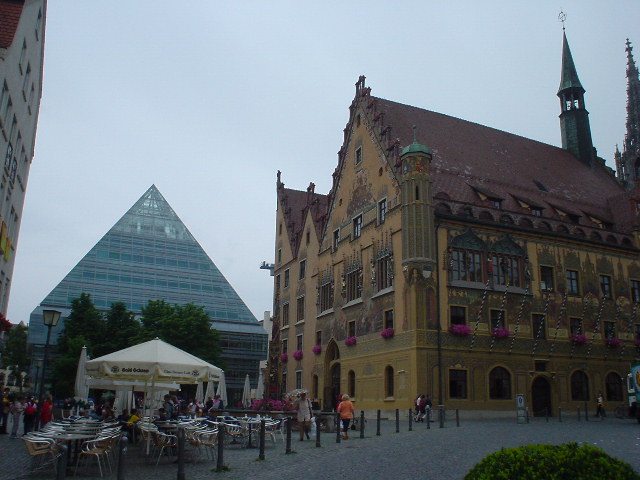
This blog entry about the events of Sunday, July 25, 2004 was originally posted on August 02, 2004.
DAY 281: In 1879, one of the most influential scientists in history was born. Known for his famous Theory of Relativity and his out-of-control, just-got-out-of-bed hair, Albert Einstein was born in the southwestern German city of Ulm on the Danube River. Although Einstein left Ulm and moved to Munich and then Switzerland and ultimately to the United States where he died in Princeton, New Jersey, his hometown had no qualms in celebrating its claims that the genius was born within their city limits. If not for the birth of Einstein in Ulm, sarcastic people around the world might not have had the expression, “Smooth move, Einstein.”
You would think that a city with such bragging rights — on the famous Danube no less — would be more of a tourist destination. However, Ulm wasn’t even in the index of my Let’s Go Western Europe 2004 guidebook, and I’ve heard that little to no attention is given to it in other guides. Luckily my second cousin Tony (who is more of an uncle-type to me) knew of it, as he frequented the city often being only about an hour away from Filderstadt and Stuttgart. He and wife Ursula (who is a German aunt-type to me), both retired, decided to take me to Einstein’s hometown and environs for the day. The night before, they had showed me a coffee table book about Ulm, complete with many pictures, and my goal for the trip to Ulm was to see the subject of one of them: a statue of Einstein’s head, based on the famous silly photo of him sticking his tongue out.
After cruising down the autobahn — slowing down at all the numerous radar/camera devices to regulate speed (Tony knew of all of them) — we arrived at the not-so-famous city in the German state of Baden-Württemberg. A quiet little city of old southern German architecture and sausages, we walked through the streets, passed the city hall and new library (picture above) and down the park along the Danube — despite the name of the famous waltz “Blue Danube,” by Johann Strauss, it was pretty brown. Across a bridge over the Danube, the boundary line between two states, we quickly stepped in New Ulm in the state of Bavaria before walking back to the “old” one.
THE YEAR 2004 MARKS 125 YEARS since Einstein’s birth and Ulm’s stadthaus (town house) exhibition hall presented a comprehensive exhibition on the life of their superstar. That was all nice and all (and in German), but I really just wanted to see the statue I’d seen in the coffee table book. In front of the stadthaus was another sculpture that also played on Einstein and his protruding tongue, but it wasn’t the one I had seen.
Tony nor Ursula (nor their offspring) hadn’t seen the statue, which surprised me because the photo in the book made it seem like it would be fairly famous locally. In fact, Ulm postcards even sported a photo of the statue.
The three of us were on a mission, and Ursula took charge by asking the folks at the Einstein exhibit on where to find it. They gave us vague directions and a direction to walk in, but found nothing but the Einstein Haus, a special school for genius wannabes. The statue wasn’t in the Einstein Haus plaza — the “E = MC Square” as I like to call it — so we asked for directions again. The latest led us out of the city center and into the residential area — but the statue we found there wasn’t of Einstein at all.
“I don’t think that’s Einstein,” I said.
“I told you no one would know where it is,” Tony said. “It’s difficult to find. That’s typical of Einstein.”
Ursula asked for directions in her native German to a resident walking her dog. She didn’t know exactly where it was either — and she lived in Ulm too. Is it really that hard to find? I didn’t want it to be such a pain. I thought it would obvious, but I guess not. We asked another guy on the street who gave us another general direction but nothing specific. Finally we arrived at the Zeughaus, a secluded government building, where Tony and Ursula had walked by many times. However, it was my curiosity to look around the statue. Lo and behold, Einstein and his tongue were only visible if you stood at the front door of the building looking outwards — casual passers-by of the Zeughaus wouldn’t see it unless they knew of its existence. I guess, as Einstein put it, it’s all relative.
I REALLY QUESTION WHY ULM isn’t more popular; not only does it boast being a scenic town on the Danube and the birthplace of Einstein, it also holds the world’s tallest cathedral. More noteworthy than that is that it holds the Museum der Brotkulture — that’s right, “Museum of Bread Culture,” an entire museum dedicated to the history and culture of bread. At Ursula’s suggestion, we went to visit the not-so-famous but impressive museum. I thought it would be like a bakery or something, but it was more or less a museum museum, with paintings and glass displays. As boring as it may sound, the museum was actually pretty interesting; they managed to get their point across to me: bread, in one form or another, has been an important symbolic food source in most civilizations and religions for millennia, from breads of ancient Egypt, to communion hosts in Christianity, to the promise of bread in Nazi propaganda posters. Afterwards, Tony and I went out for doner kebabs in a fairly upscale place (compared to the scummier places I’d seen throughout Germany), which served up sliced meats on really good bread.
WHILE THE “BLUE DANUBE” WASN’T EXACTLY BLUE, a body of water in the old Danube valley was — so blue it was named Der Blautopf, or “Blue Pot.” Der Blautopf, a pond 65 ft. deep, lies in the small town of Blaubernen, the place where Orsel grew up, the town where she met Tony. Perhaps it was Der Blautopf‘s romantic charm back in the 1960s that did the trick (nowadays it’s a locally-popular tourist stop) with its picturesque water wheel and ultra blue water water caused naturally simply by the depth of the water. I suppose we found two things in our excursion that day: Einstein and the blue Danube.
HANS-GEORG WAS HOME FROM WORK by the time we got back to Filderstadt. We made reservations for a court in the local tennis club for an hour of tennis and after our work out, Hans-Georg volunteered to cut my hair. It wasn’t exactly as long as Einstein’s, but bothering me nonetheless. How Einstein could keep his hair all wild I don’t know (although it totally works for him), but perhaps it was intentional when creating all those theories. Now that’s genius.
Next entry: Palace Pictures
Previous entry: What’s A Motto With You?
Commenting is not available in this channel entry.
Comments for “Searching For Einstein”
Sorry this one isn’t up to par; I’ve racked my brain trying to think of a better ending, but have no time for it!
Posted by .(JavaScript must be enabled to view this email address) on 08/02 at 10:51 AM
PRENTICE HALL FOLK THAT HATE THEIR JOBS: You may (or may not) appreciate that photo of the sower and the Nazi emblem…
Posted by .(JavaScript must be enabled to view this email address) on 08/02 at 10:52 AM
HEY ALL… That’s all for now; I’m off on a train through Siberia now… I wouldn’t be surprised if there will be internet in the middle of the tundra (they had it in the Amazon, remember?), so don’t be surprised if you see an entry pop up in the next coming days.
The first leg of the train journey is about 22 hours, so I’m in the NIZ at least for a day… Blog you later!
Posted by .(JavaScript must be enabled to view this email address) on 08/02 at 10:53 AM
What quaint little towns! Oh, I wanna be there! Not here in the literally concrete jungle - sure feels like one anyway. I love quaint architecture… that’s what I want to do in Europe, just wander around looking at cute houses and shops.
Posted by Liz on 08/02 at 03:29 PM
I’m with you Liz - love those quaint little towns. I don’t just want to visit -I want to live there! I have to decide where I want to teach English and this is making it difficult! I have to make up my mind in the next few weeks…........any other TESOL people out there with some recommendations?
Posted by .(JavaScript must be enabled to view this email address) on 08/02 at 04:27 PM
I guess the Museum der Brotkulture is not very Atkins friendly, huh?
Posted by .(JavaScript must be enabled to view this email address) on 08/02 at 05:23 PM
Here’s the secret scoop on Jan (who is my aunt).... Jan has dreamed of teaching English and going abroad for years. I might get in trouble for saying her age (but I’m 31 so that should give you a ballpark) but she has just finished her job, has signed up for a TESOL course and is going to teach overseas! I think that is awesome and incredibly brave! So just wanted to share it with everyone, and to give her a pat on the back for going after her dreams.
Please give her great recommendations on where to go so the rest of the family can have a super fab vacation when we go to visit her LOL
Jan - hope you don’t mind me giving out the personal details, but what you are doing is truly inspiring

Posted by Liz on 08/02 at 05:27 PM
JANICE: I took a TESOL class and I’m hoping to settle in Taipei for a year or so… I would love to learn Mandarin.
Posted by .(JavaScript must be enabled to view this email address) on 08/02 at 05:28 PM
Congratulations Jan! I wish you all the best in the pursuit of your dream.
Posted by .(JavaScript must be enabled to view this email address) on 08/02 at 06:32 PM
Jan, I’m with you.
Why not try different countries for a year each. start with germany, then south america (peru, bolivia, brazil,etc), then japan, china..
I am so happy for you. follow your dreams, sometimes it happens early in life, sometimes later but never stop dreaming.. Go fo it…Posted by .(JavaScript must be enabled to view this email address) on 08/03 at 01:30 AM
Really beautiful towns and countryside. I’m glad we got to tag along in Lux & Germany.
That sculpture of Einstein was a bit strange, huh? Looks like he’s coming out of a snail’s shell—I wonder why? It’s fun, and a scavenger hunt is always a good way to see a town.
JANICE: I’m impressed! See the world and teach—sounds like plan. Good luck! Of all the places I’ve been, I love Italy best. You sure can’t go wrong with the food! I have a friend in Ireland whose gone to Barcelona to teach English (with an Irish accent) for just the summer. Perhaps you can hit a couple of countries in a single year!
Posted by .(JavaScript must be enabled to view this email address) on 08/03 at 02:44 AM
BTW, caught that Nazi poster / Simon & Schuster (old PH) logo connection right away. Hmmm. Sowing the seeds of hatred perhaps?
Posted by .(JavaScript must be enabled to view this email address) on 08/03 at 02:53 AM
Wow - thanks guys for all your support and good wishes. I’ll keep you posted where I end up and of course I’ll still be following Erik (on my new laptop) and maybe meeting up with him somewhere - you never know! The course starts tomorrow and I can’t wait to get going!
Posted by .(JavaScript must be enabled to view this email address) on 08/03 at 05:19 AM
Erik: This week’s episode of AR5 finished at the pyramids in Egypt. I realized why I enjoy your blog so much: we saw teams at the pyramids and the Sphynx but all the while I was looking for the Pizza Hut and KFC across the road. Of course they didn’t show that. TV sensationalizes everything. If it wasn’t for this blog I would never have known to look for them. You give us the real life version!
Posted by .(JavaScript must be enabled to view this email address) on 08/03 at 06:58 AM
Alice: I was thinking the same thing!! BTW, good luck from me too!!
-HarryPosted by .(JavaScript must be enabled to view this email address) on 08/03 at 08:06 AM
Sorry, should have been ‘Janice: ‘

Posted by .(JavaScript must be enabled to view this email address) on 08/03 at 08:07 AM
AR5! The twins really need to go! That’s about it!
Posted by .(JavaScript must be enabled to view this email address) on 08/03 at 01:58 PM
Harry: Great minds think alike!
Markyt: Yes, I agree about the twins. Also Charla & Myrna managed to do well without p***ing anyone off!Posted by .(JavaScript must be enabled to view this email address) on 08/03 at 02:09 PM
Arghh!!! I’m in AR5 agony… it still isn’t up on any download sites!! *cry*
Posted by Liz on 08/03 at 04:55 PM
some NIZ entertainment - 80s music quiz:
http://www.yetanotherdot.com/asp/80s.html
not sure if you’ve all seen this or can relate, but give it a shot!
i’m a “pop junkie” hahahah
Posted by .(JavaScript must be enabled to view this email address) on 08/03 at 06:51 PM
ayo! sausages!!!! i hate u.. why must u explore the world…. im sittin on my ass in front of my comp…
droolin at every destination u describe…pece dude
Posted by .(JavaScript must be enabled to view this email address) on 08/03 at 07:42 PM
mark is a feg wit a small cack -=9
Posted by .(JavaScript must be enabled to view this email address) on 08/03 at 07:44 PM
Why would Colin and Christy use a Fast Forward when they were at least 12 hours a head of the other teams?
Posted by .(JavaScript must be enabled to view this email address) on 08/03 at 09:10 PM
TDOT - cuz they are stupid!
Is Chip’s niceness in this last episode, gonna hurt them or help them?
Posted by .(JavaScript must be enabled to view this email address) on 08/03 at 10:24 PM
For TAR 5, try http://www.televisionwithoutpity.com
I love their recaps and the forums are really good.Posted by .(JavaScript must be enabled to view this email address) on 08/03 at 11:02 PM
mmmmm….kebabs…
Posted by .(JavaScript must be enabled to view this email address) on 08/04 at 12:03 AM
yo E - if there is someone really annoying on the train and loud in russia…just say this
“Zacroy svoy peesavati rot, sooka”
well…maybe you shouldn’t hahahha
Posted by .(JavaScript must be enabled to view this email address) on 08/04 at 12:40 AM
STEPHANIE: re: 80’s test, 97 pts, 15 min time limit.. how did you do?
Posted by .(JavaScript must be enabled to view this email address) on 08/04 at 04:03 AM
- Without really ruining anything for Liz this time…Why is it that the two people that probably have it the best in real life are doing so well in the race anyway…figures…!
Erik: ...Is it cold yet??
I was just thinking, with all the people your meeting, and all the extra experience, you can probably do Global Trip 3 for even longer and cheaper! (Guess your not thinking that far yet tho, lol.)...but seriously…can I come….lol
Stay safe!
-HarryPosted by .(JavaScript must be enabled to view this email address) on 08/04 at 04:59 AM
HARRY - if you notice Erik’s pattern he planned to be in the hemisphere that has the warmer climate than the other….
what a smart guy huh?
Posted by .(JavaScript must be enabled to view this email address) on 08/04 at 05:15 AM
Pure Genious! I wouldda probably been freezing my butt off!
Posted by .(JavaScript must be enabled to view this email address) on 08/04 at 09:50 AM
GREETINGS FROM YEKATERINBURG (formerly Sverdlosk during USSR times)! Technically I’m not in Siberia yet… I’m in the city in the Ural Mountains, the natural boundary at the end of Europe and the beginning of Asia (Siberia)... The city is pretty big (Russia’s third largest) and it’s not cold at all… nice, warm, sunny weather…
My first train ride wasn’t 22 hours like I said, it was actually 30 (I calculated wrong)—I was on that train through two time zones in one shot. I am currently 10 ahead of NYC…
I’m caught up to Moscow on paper, but I have yet to type it up and upload… Stay tuned!
JANICE: You go, girl!
Posted by .(JavaScript must be enabled to view this email address) on 08/04 at 03:45 PM
YEKATERINBURG - now say that 3 times fast…
Posted by .(JavaScript must be enabled to view this email address) on 08/04 at 05:46 PM
DARCY: i don’t remember my score or time, but my results come back w/a pic stating “pop junkie”. not bad for someone who wasn’t a teeny-bopper yet in the 80s. what was your JPG image?
Posted by .(JavaScript must be enabled to view this email address) on 08/04 at 05:52 PM
OK, the blog appeared in my dream last night. Maybe this means I need another vacation? I spend too much time in the internet at work? Erik, you were a really nice guy in the dream (you were only in it for a few minutes, though - it was more like MY blog!) and you were wearing a crazy suede purple outfit. Does this have something to do with Prince touring?
It was a fun dream, though. How about that - the blog made it’s way into my subconsciousness! haha.Looking forward to reading about Siberia - 30 hours on a train sounds painful, though. If you get cold, maybe you can find a purple suede outfit in Russia.
Posted by .(JavaScript must be enabled to view this email address) on 08/04 at 06:19 PM
AR5- phew! Thank goodness for non-elimination rounds! I was really worried that the moms were out. Go moms go!
Colin and Christy - hello????? Hmm, no one seems to be home. Use the FF when you are behind. Geesh.
How come Charla always has to do the challenges? Has Mirna done any of them? Or does she just whine and yell “Charla, run!” every 5 seconds?Posted by Liz on 08/04 at 07:05 PM
I got killed on the 80s test because I can’t spell/type. Doh! Only 59 pts… and because 80’s is pop to me, not metal. :/
Posted by Liz on 08/04 at 07:31 PM
I like challenges so I had to try the 80’s music quiz thinking I would do ok because I had to listen to all those songs coming from my 3 kids bedrooms in that decade. Wrong! (Score: 14.75) I must have blanked most of them out. Or I was drowning out their music with the BeeGee’s and Barry Manilow…...........eeek! (FYI: My taste has evolved since then.)
Posted by .(JavaScript must be enabled to view this email address) on 08/04 at 08:48 PM
lol Janice! I can just tell you’re one of those “Cool Moms!”
Posted by .(JavaScript must be enabled to view this email address) on 08/04 at 08:51 PM
Erik,
How hard would it be to do a blog like this, maybe not as detailed and nice, if you did not have a laptop with you? Would it be feasible to just use internet cafes and such?Posted by .(JavaScript must be enabled to view this email address) on 08/04 at 08:52 PM
LIZ - charla has done every single road bloack/challenge….will she ever do one….the magic 8 points to “not likely”...
KIRSTEN - I think you can get around maintaining a TEXT blog travelling around the world hitting up cafe to cafe is most definitely doable…but you’re gonna wanna have to do…
it also depends on you…most NERDs, like myself, don’t handwrite anything anymore…so if you can keep a good journal, and then gather your ideas for what you wanna write you can be all set…
the laptop aides Erik with time to sort out pics, back up everything, and organize, so when he does finally hit up an internet cafe, he can upload them up…
just my thoughts….doesn’t hurt to have some production help too..
Posted by .(JavaScript must be enabled to view this email address) on 08/04 at 09:08 PM
SIM/LP - where you at? haven’t seen you on here in awhile?
Posted by .(JavaScript must be enabled to view this email address) on 08/04 at 09:10 PM
Markyt & BH’s : my bad the lure of the SBR’s to the darkside was just too great! Indulgence of the blog without any vocal payment but no longer .. must fight the darkside!!! ..
btw dude, How the hell are Mirna & Charla still in it? This AR5 sucks! AR2 was the best!
Posted by .(JavaScript must be enabled to view this email address) on 08/04 at 11:35 PM
SIM - would you rather be programming or posting comments on the Blog?
hahaha….mirna and charla will be on for a bit if they keep their games up….
Posted by .(JavaScript must be enabled to view this email address) on 08/05 at 12:08 AM
Td0t: Gee thanks! (Blushing)
Posted by .(JavaScript must be enabled to view this email address) on 08/05 at 06:48 AM
Did you see the preview for next week? Colin flies off the handle when Mirna steals his cab.
What I want to know is how Mirna caught up with them.
Posted by .(JavaScript must be enabled to view this email address) on 08/05 at 05:02 PM
TDOT - I’m guessing there had to be a transportation departure time that allowed them to catch up…
Hence a WASTED fast forward for the idiots named as Colin and Christie…
Posted by .(JavaScript must be enabled to view this email address) on 08/05 at 06:02 PM
I’m really board and I don’t leave for another 3h.
Who wants to speculate on the next destination? My guess is an African country, like Kenya or something.
Posted by .(JavaScript must be enabled to view this email address) on 08/05 at 09:06 PM
STEPHANIE: I scored a 31.75. Does that make me an 80s geek?! Good fun, but short lived…
WHERE IS ERIK?
Posted by .(JavaScript must be enabled to view this email address) on 08/05 at 09:09 PM
ERIK is in idunnohiswhereabouts…
All I know is that his Visa in Russia is only good till the 14th….
Posted by .(JavaScript must be enabled to view this email address) on 08/05 at 09:30 PM
Another what if ? game ....
hmm… maybe a little too much vodka with the locals and ended up on a flight to M.I.R…Posted by .(JavaScript must be enabled to view this email address) on 08/05 at 09:53 PM
AR5- I’m not sure about wasted fast forwards. If you were paying attention, they said that there were only 2 in the whole race this season. So the odds of even having the opportunity to use another one are slim.
Posted by .(JavaScript must be enabled to view this email address) on 08/05 at 10:30 PM
SIM: Not without $20,000,000
Posted by .(JavaScript must be enabled to view this email address) on 08/05 at 10:33 PM
MIR might be difficult, seeing as how it burned up in the atmosphere a few years back.
More likely, Erik decided to try NOT bribing a police officer, and is now being interrogated as a suspected American spy.
Posted by .(JavaScript must be enabled to view this email address) on 08/06 at 02:17 AM
Well, I think that Yekaterinburg is near the warmth of the Black Sea, perhaps Erik felt the pull of the warm city called Sochi. And is now in Sochi sitting in a cafe having coffee. Afterwards, he’ll be approached by the Russian mafia to become a mule.
How’s that?
Posted by .(JavaScript must be enabled to view this email address) on 08/06 at 04:25 AM
What are the chances he’s hung over on Vodka…just hope he’s not passed out by a park again…
Posted by Harry on 08/06 at 05:09 AM
I think he’s near Lake Baikal. During a walk in the woods he was one of the few people in recent times to actually see a Siberian tiger. Since they are almost extinct, it is very difficult for even the tigers to find each other. This tiger was female, and upon seeing Erik, the tigress thought “male creature - could be a mate”. He is now being pursued relentlessly through the forests by a tireless tigress in heat.
Or he got attacked by a moose.
Or the train broke down somewhere in Mongolia and everyone is now waiting for the next train to pass by and rescue them, which should be in about two days.
Posted by Liz on 08/06 at 05:26 AM
Searching for Einstein? Searching for Erik! I think we should send out a search team. Maybe he would respond to one of those big dogs with a barrel of whiskey around his neck. Erik, where are you?
Posted by .(JavaScript must be enabled to view this email address) on 08/07 at 01:21 AM
KIRSTEN: It would be impossible… In the beginning (previous entries), the entries weren’t as involved, but all the later ones (January on) are totally laptop dependent…
Posted by .(JavaScript must be enabled to view this email address) on 08/07 at 01:08 PM
I noticed that sower/nazi resemblance also, very weird.
Posted by .(JavaScript must be enabled to view this email address) on 08/09 at 12:03 AM
SHARE THIS TRAVEL DISPATCH:
Follow The Global Trip on Twitter
Follow The Global Trip in Instagram
Become a TGT Fan on Facebook
Subscribe to the RSS Feed
This blog post is one of over 500 travel dispatches from the trip blog, "The Global Trip 2004: Sixteen Months Around The World (Or Until Money Runs Out, Whichever Comes First)," originally hosted by BootsnAll.com. It chronicled a trip around the world from October 2003 to March 2005, which encompassed travel through thirty-seven countries in North America, South America, Africa, Europe, and Asia. It was this blog that "started it all," where Erik evolved and honed his style of travel blogging — it starts to come into focus around the time he arrives in Africa.
 Praised and recommended by USA Today, RickSteves.com, and readers of BootsnAll and Lonely Planet's Thorn Tree, The Global Trip blog was selected by the editors of PC Magazine for the "Top 100 Sites You Didn't Know You Couldn't Live Without" (in the travel category) in 2005.
Next entry:
Palace Pictures
Previous entry:
What’s A Motto With You?
THE GLOBAL TRIP GLOSSARY
Confused at some of the jargon that's developed with this blog and its readers over the years? Here's what they mean:
BFFN: acronym for "Best Friend For Now"; a friend made on the road, who will share travel experiences for the time being, only to part ways and lose touch withThe Big Trip: the original sixteen month around-the-world trip that started it all, spanning 37 countries in 5 continents over 503 days (October 2003–March 2005)
NIZ: acronym for "No Internet Zone"; a place where there is little to no Internet access, thus preventing dispatches from being posted.
SBR: acronym for "Silent Blog Reader"; a person who has regularly followed The Global Trip blog for years without ever commenting or making his/her presence known to the rest of the reading community. (Breaking this silence by commenting is encouraged.)
Stupid o'clock: any time of the early morning that you have to wake up to catch a train, bus, plane, or tour. Usually any time before 6 a.m. is automatically “stupid o’clock.”
The Trinidad Show: a nickname of The Global Trip blog, used particularly by travelers that have been written about, who are self-aware that they have become "characters" in a long-running story — like characters in the Jim Carrey movie, The Truman Show.
WHMMR: acronym for "Western Hemisphere Monday Morning Rush"; an unofficial deadline to get new content up by a Monday morning, in time for readers in the western hemisphere (i.e. the majority North American audience) heading back to their computers.
1981ers: people born after 1981. Originally, this was to designate groups of young backpackers fresh out of school, many of which were loud, boorish and/or annoying. However, time has passed and 1981ers have matured and have been quite pleasant to travel with. The term still refers to young annoying backpackers, regardless of year — I guess you could call them "1991ers" in 2013 — young, entitled millennials on the road these days, essentially.
Spelling or grammar error? A picture not loading properly? Help keep this blog as good as it can be by reporting bugs.