Rock The Kasbah
This blog entry about the events of Saturday, June 19, 2004 was originally posted on June 22, 2004.
DAY 245: “It’s amazing there are no French people,” Australian Lucy said. She was referring to the fourteen people that had amassed into a small minibus tour group with the Imagine Le Voyage budget tour company based in Marrakesh. Despite the fact that a huge majority of the tourists in Morocco were from France, we were a rainbow coalition, all English-speaking, from other nations: Lucy and Steve from Australia, Russ from the UK, Maider and Serbio from Spain, Miguel from Portugal, Mazza from Japan, Kim from South Korea, Tina and Hendrik from Sweden, Coral and Waddah from California, USA, Canadian Sebastian and me.
“It’s like the United Nations in a minivan,” I said.
Driver Hassan (from Morocco) took us south out of Marrakesh through the Moroccan country side, up and down the winding roads of the High Atlas Mountains, stopping once at a cafe with a view of the valley for photo opps, tea, coffee and small talk with the new faces of the group. Englishman Russ and I sat at a table on the terrace, contemplating our refreshment options for the next two nights away from the tourist-catering mecca of Marrakesh. “Do you think we’ll be able to get some whiskey?” he asked me.
“Maybe we’ll stop somewhere.”
“Beer would be fine too,” he said. “I’m from England.”
The debate was spawned by the fact that in Morocco, a predominantly Muslim country, most people didn’t drink. Breweries existed primarily to cater to the foreigners within the country borders. “I’m sure there’ll be a place on the way,” I tried to assure the forty-something-old Englishman.
We continued on our way through the countryside but stopped again shortly thereafter due to the all-too-familiar occurrence of a vehicle breakdown. People suspected the carburetor because the tail pipe suddenly exhaled as much smoke as out of the mouth of a Parisian chain smoker. Hassan pulled over the minibus conveniently in the village of Taddert (convenient for the shop owners of Taddert), a chilled out strip of cafes and shops for us to wander and keep us entertained while Hassan fixed the car. I partook in the local Pom’s apple soda (my new simple pleasure). Kim took photos, Coral browsed through trinket stores, Sebastian made Laughing Cow cheese sandwiches and Russ sat at another cafe to pass the time — he still found no signs of whiskey or beer.
“YOU WANT A BRACELET?” a young vendor asked Sebastian at another High Atlas mountain lookout point. We had started to suspect Hassan was stopping not-so-coincidentally at vendor areas so his friends and/or relatives could make a couple of dirham off his tour groups.
“How much?” Sebastian asked.
“Twenty.”
“Twenty? Oh, twenty cookies?” he said, holding a bag of cookies he bought in Taddert.
“No, twenty dirhams.”
“Twenty cookies? Okay.”
“No, twenty dirhams!”
“I give you cookies, you give me the bracelet.”
The kid wasn’t too amused and moved on.
Through the mountains and into the valley we rode in our just-fixed minibus to Aït Benhadou, one of the best-preserved kasbahs in the region with a population of just five families. Aside from being protected by UNESCO, most of its preservation funding came from Hollywood as it served as the location for the filming of Lawrence of Arabia, Jesus of Nazareth and more recently, Gladiator. Nearby was the desert where scenes of 1999’s The Mummy was shot, as well as the big movie production studio lot that catered to Hollywood’s needs on the other side of the Atlantic.
Hassan dropped us off outside the kasbah, leaving us to be guided by a guy in traditional garb of the regionally nomadic Berber people — who just so happened to be listening to a mini-disc player underneath. With headphones out, he led us into a house and around the kasbah. Spaniard Serbia walked in the footstep of Russell Crowe’s “Spaniard” character in Gladiator, although he and his girlfriend Maider would tell you they were really from the Basque country.
“IF YOU GO TO THE SUPERMARKET, can you bring back a couple of beers?” Russ asked Sebastian at the rooftop dining table at a restaurant in the town of Ouarzazate. Sebastian was toying with the idea of saving some money by skipping out on a sit-down restaurant meal, but discovering the supermarket was a kilometer and a half across town, decided to stay and “be sociable.” After dining on traditional Moroccan tajines, couscous and harira soup — and no beer — we continued our journey to a land where Russ still had the hope of a couple of cold ones.
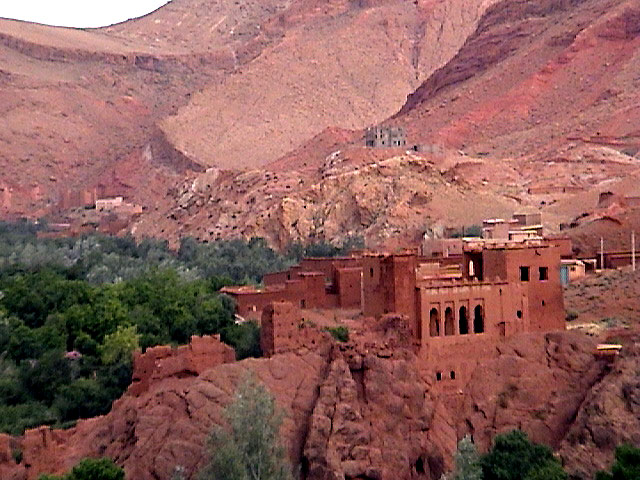
“ALRIGHT, LET’S GO ROCK THE KASBAH,” I told Sebastian as we started westbound from Ouarzazate through the Dades Valley, the valley between the High Atlas mountains to the north and the Jbel Saghro range to the south. The oasis of this valley provided for farming in an otherwise arid region, resulting in many fortified houses, or kasbahs (picture above) to be built for people to live in — thus giving the route the nickname the “Valley of A Thousand Kasbahs.” We stopped not at every kasbah, but every so often for a “photo stop,” which I put in quotes because Sebastian and I thought that a “photo stop” was just a stop anywhere along the way when Hassan wanted a “smoking break.” As Hassan puffed away, it was sometimes hard for us to take photos of the women carrying bails of hay on their backs; they’d always make a fuss if we pointed a camera, so we’d have to take pictures from afar or from behind.
The Dades Valley led to the Dades Gorge, an area that initially didn’t look fit for postcard pictures. Heavy Caterpillar construction vehicles rocked the kasbahs with their vibrations, and it looked more like a big quarry.
“There are no tourists around,” Serbio noticed.
“Looks like we’re being driven to work as slaves,” Portuguese Miguel said.
Luckily for us, our minibus made its way through the construction quarry and on the other end it turned out to be a bit more conducive for photos. During another one of Hassan’s “smoking breaks,” we marveled at the jagged rock formations jutting out of the earth like massive and sharp orange incisors. At the base of the gorge was our accommodation for the night, Le Vieux Chateau, a relatively fancy place for a budget backpacker — although no one was complaining.
“Nice, I never stayed in a place like this,” young Japanese Mazza said, smiling with enthusiasm. “Usually I’m in a youth hostel.”
“This is swank,” my minibus seatmate-turned-roommate Sebastian said. However, being a swanky hotel with a view of the Dades River was nothing special if it didn’t have one thing.
“Do you have beer?” Russ asked someone at the hotel.
“Yes.”
Russ dramatically grabbed me by the shoulders with uttermost excitement. “You hear that? They have beer!”
Dinner in the dining hall was equally impressive as we feasted on harira, chicken, vegetables, couscous and beer as some local guys donned Berber clothes and played the bongos for us. Dusk morphed into night and with only the illumination of a crescent moon, the sky was dark enough for an awesome stellar display above.
“Welcome to the observatory,” Miguel greeted me when I arrived on the roof terrace. After a long and tiring 12-hour day on the road — including a breakdown and numerous “photo stops” — a peaceful night on the roof of a “swank” hotel under the stars was just what we needed. More importantly for Russ, we were in a place were beer was readily available.
Hey, for full effect, read this entry again while listening to this.
Next entry: Carpets and Camels
Previous entry: Splish, Splash, He Gave Me A Bath
Commenting is not available in this channel entry.
Comments for “Rock The Kasbah”
HEY ALL… that’s all I had time to upload for now… I’m still about two days behind, but I’m off to do an overnight trek to North Africa’s highest peak today with Sebastian…
I’ll return.. stay tuned!
Posted by .(JavaScript must be enabled to view this email address) on 06/22 at 01:33 PM
Thanks for the song link LOL… saved me from figuring out if I brought my Clash tape with me from Canada (I don’t think I did). Man, this song brings back teeny-bop memories.
Posted by Liz on 06/22 at 04:03 PM
“Dusk morphed into night and with only the illumination of a crescent moon, the sky was dark enough for an awesome stellar display above.”
Nice one!
I think WHEAT is rocking the casbah in AC….hahaha
Posted by .(JavaScript must be enabled to view this email address) on 06/22 at 04:39 PM
UMMMM>...... beeeeeeerrrrrrrr! there’s nothing like satisfying your craving! have fun climbing the mountain!
Posted by .(JavaScript must be enabled to view this email address) on 06/22 at 05:44 PM
I really want to go to morROCKo! Unfortunately, I’d probably also be antsy for beer just like the British guy…
Posted by .(JavaScript must be enabled to view this email address) on 06/22 at 06:17 PM
Wow - those rocks are awesome - and to spend the night someplace close to them - that is awesome!!
Have fun - can’t wait for more fantabulous pictures!
Posted by .(JavaScript must be enabled to view this email address) on 06/22 at 06:18 PM
also Erik - it’s early, early but I’m going to Thailand and Vietnam (still deciding between Laos or Cambodia too) in Late December/early January for 3 weeks. I’m definitely going to do some sort of trek in there. Not sure if the Trinidad show will be there or not, but just in case!
Posted by .(JavaScript must be enabled to view this email address) on 06/22 at 06:21 PM
Sara: If you are planning a trek in Chiang Mai, Thailand let me know and I’ll pass you some info. I just did a 3 day and it was one of the best expriences of my life!
Erik: That places is hooked up! I love the pic of jagged mountain face!
Posted by .(JavaScript must be enabled to view this email address) on 06/23 at 07:57 AM
Sara: If you are planning a trek in Chiang Mai, Thailand let me know and I’ll pass you some info. I just did a 3 day and it was one of the best expriences of my life!
Erik: That places is hooked up! I love the pic of jagged mountain face!
Posted by .(JavaScript must be enabled to view this email address) on 06/23 at 07:57 AM
td0t - Thanks! I was thinking about going near Chaing Mai. A trek to the hillside villages, etc. When the time gets a little closer, I’ll definitely e-mail you with my questions! I read this blog almost every day so I know where to find you.
Posted by .(JavaScript must be enabled to view this email address) on 06/23 at 05:42 PM
ERIK: awesome pictures and thanks for the song link
MARKYT: Good Luck, rock the casbah.
Posted by .(JavaScript must be enabled to view this email address) on 06/23 at 10:02 PM
SARA: Slight possibility of Trinidad Show appearing there around that time… I’ll be in the Philippines for X-mas/New Years and will be in the area… Not sure yet what I’ll do before or after that, but it will most likely be in SE Asia somewhere…
Posted by .(JavaScript must be enabled to view this email address) on 06/23 at 10:50 PM
I must confess I have been a silent Blog reader - busy reading and catching up (mostly at work…ssshh). Whew! I did it! Been hooked since Malawi and intrigued by the fact that I had just finished reading The Alchemist. (Russell Crowe recommended it on a recent Oprah show.) I also know a lady who started an orphanage in Malawi a few years ago and I want to go there as a volunteer some day. Love your writing style - history with interjections of modernisms (is that a word?). I am in Windsor, Ontario, Canada - Liz is my niece and her mom, Rose is my sister. I’ve also recommended your Blog to my kids. So now you got the whole fan-damily hooked! Looking forward to more of your adventures. (P.S. Fav colour is green - a little late but what the heck.)
Posted by .(JavaScript must be enabled to view this email address) on 06/24 at 03:09 AM
Good tune, the perfect way to read BLOG comments! Good stuff.
I thought Gladiator filmed in that area, very cool. Tho, Russell Crowe could be my Maximus anywhere. I think I’m going home now, putting that DVD in, cranking the surround sound and escaping NJ for the evening.
Good thing you’re behind, I finally caught up! Keep ‘em coming bud.
Posted by .(JavaScript must be enabled to view this email address) on 06/24 at 03:18 AM
JANICE: Hey there… welcome aboard… thanks for breaking the silence!
Posted by .(JavaScript must be enabled to view this email address) on 06/24 at 02:10 PM
SHARE THIS TRAVEL DISPATCH:
Follow The Global Trip on Twitter
Follow The Global Trip in Instagram
Become a TGT Fan on Facebook
Subscribe to the RSS Feed
This blog post is one of over 500 travel dispatches from the trip blog, "The Global Trip 2004: Sixteen Months Around The World (Or Until Money Runs Out, Whichever Comes First)," originally hosted by BootsnAll.com. It chronicled a trip around the world from October 2003 to March 2005, which encompassed travel through thirty-seven countries in North America, South America, Africa, Europe, and Asia. It was this blog that "started it all," where Erik evolved and honed his style of travel blogging — it starts to come into focus around the time he arrives in Africa.
 Praised and recommended by USA Today, RickSteves.com, and readers of BootsnAll and Lonely Planet's Thorn Tree, The Global Trip blog was selected by the editors of PC Magazine for the "Top 100 Sites You Didn't Know You Couldn't Live Without" (in the travel category) in 2005.
Next entry:
Carpets and Camels
Previous entry:
Splish, Splash, He Gave Me A Bath
THE GLOBAL TRIP GLOSSARY
Confused at some of the jargon that's developed with this blog and its readers over the years? Here's what they mean:
BFFN: acronym for "Best Friend For Now"; a friend made on the road, who will share travel experiences for the time being, only to part ways and lose touch withThe Big Trip: the original sixteen month around-the-world trip that started it all, spanning 37 countries in 5 continents over 503 days (October 2003–March 2005)
NIZ: acronym for "No Internet Zone"; a place where there is little to no Internet access, thus preventing dispatches from being posted.
SBR: acronym for "Silent Blog Reader"; a person who has regularly followed The Global Trip blog for years without ever commenting or making his/her presence known to the rest of the reading community. (Breaking this silence by commenting is encouraged.)
Stupid o'clock: any time of the early morning that you have to wake up to catch a train, bus, plane, or tour. Usually any time before 6 a.m. is automatically “stupid o’clock.”
The Trinidad Show: a nickname of The Global Trip blog, used particularly by travelers that have been written about, who are self-aware that they have become "characters" in a long-running story — like characters in the Jim Carrey movie, The Truman Show.
WHMMR: acronym for "Western Hemisphere Monday Morning Rush"; an unofficial deadline to get new content up by a Monday morning, in time for readers in the western hemisphere (i.e. the majority North American audience) heading back to their computers.
1981ers: people born after 1981. Originally, this was to designate groups of young backpackers fresh out of school, many of which were loud, boorish and/or annoying. However, time has passed and 1981ers have matured and have been quite pleasant to travel with. The term still refers to young annoying backpackers, regardless of year — I guess you could call them "1991ers" in 2013 — young, entitled millennials on the road these days, essentially.
Spelling or grammar error? A picture not loading properly? Help keep this blog as good as it can be by reporting bugs.