Recipes
This blog entry about the events of Friday, November 26, 2004 was originally posted on November 30, 2004.
DAY 405: I grew up with a love of cooking. I remember using a Sesame Street cookbook and making banana bread one day that pleased the family and since then I’ve like to cook since, up through my young adulthood when I got my own apartment. When I got a Showtime Rotisserie as a housewarming gift, I swear I made a whole chicken every other day; it’s so easy when you can “set it and forget it.”
After a while the novelty of making a rotisserie-style chicken went away like a passing fad and the Showtime Rotisserie oven joined my pile of old kitchen gadgets advertised on infomercials, right next to the George Foreman Grill. Not only that, but my passion for cooking faded away too since I lived in a fairly trendy metro New York neighborhood on the Hudson where many delicious and reasonably priced foods were readily available. Why cook when I could have someone else do it for me, with Chinese, Japanese, Moroccan, French, Italian, Jamaican, Cuban, Polish, Indian, American, Thai, Fusion and other ethnic cuisines all within walking distance?
“How can you afford to eat out all the time?” people would ask me.
“I don’t keep food in the house,” I’d tell them, before breaking down the details of everything, factoring the throwing away of leftovers you don’t want after eating it three days in a row and the cost of ingredients for one person, etc. My bachelor pad’s refrigerator often only had a jar of olives, a chunk of cheese, a bottle of mustard, and beer. Ramen noodles were in the cupboard.
This isn’t to say I didn’t completely lose an interest in cooking; it was just time- and cost-effective to go out, especially since eating out was essential to networking in the freelance game. Cooking was, and will always will be, a fun thing and rewarding thing for me to do.
ONE OF THE BIG TO-DO’S IN CHIANG MAI is to take a cooking course at one of the dozens of cooking schools in town aimed at tourists. Mama at the Chiang Mai Guesthouse suggested the Classic Home Cooking school, run by her sister. She said that it was superior to other schools because for a cheaper price, you could actually choose six dishes and a curry paste to make individually, instead of having specific dishes mandated to you and the entire group.
Elise joined Lot and me in our one-day course, which started at 9:00. We were picked up in a truck with six others from other guesthouses and were driven to the local market to meet our teacher. Our teacher was a guy named Meow — “like the cat,” he said — and he was a jovial Thai man who first had us choose our dishes. Based on the dishes we gave him, the staff went out and bought the ingredients while Meow gave us a tour of the market. He showed us the different Asian vegetables and fruits, the meats (chicken, beef, pork, etc.), the seafood (including live eels), the congealed lumps of chicken blood, and the fish-filled vats producing the salty and pungent-smelling Asian fish sauce. A local woman demonstrated the coconut milk- and coconut cream-making process using what Meow called a “squish machine.”
“Is that chicken blood?” someone asked, pointing to what looked like it.
“No,” Meow said, chuckling as if to imply what was said was totally silly. “That’s pork blood!”
A ten-minute drive later we arrived at our classroom, a big clean house with just a big kitchen and nothing else. Inside were prep tables, gas ranges, a dining table and the proverbial kitchen sink. We put our aprons on with the other Dutch, Czech and British students (including new friend, Briton Wendy) and got right to it, slicing and dicing the pre-determined ration of ingredients placed at each of our chopping stations, based on what we said we wanted to make. Meow stood at front as teacher, explaining the different vegetables and chilies. I was in the small majority that was going to make green curry paste (Nam Prik Gaeng Kiaw Wan), while others made red, yellow, matsaman and jungle curries. I chopped all my ingredients and place them in a stone mortar to be pounded with a stone pestle, the Thai way: while sitting on the floor.
“Can you imagine seeing this on a cooking show?” I told Elise. “This is the part when we sit on the floor.”
The curry paste each of made was used to make curry dishes at our individual range stations. We mixed the paste and our other chopped ingredients into sizzling woks at medium heat while Meow went around and added in the other ingredients — soybean oil, coconut milk, lime juice, fish sauce, sugar — with measurements he knew to do without measuring utensils. Although he explained what each thing was, it was hard to remember what it was or how much he put afterwards, but in the end I was rewarded with a nice bowl of Gaeng Keaw Wan Gai (Green Curry with Chicken), worthy enough to be served in a Thai restaurant. It was put on the shelf to eat later; the next dish was to be prepared straight away.
“BEWARE OF MY SHOVEL!” Elise said, holding up her metal cooking spatula. The cooking assistants had given us metal utensils instead of wood for our next dish as we were, as TV chef Emeril Lagasse would say, “kicking it up a notch.” My next dish, Stir-Fried Chicken with Hot Basil Leaves and Chilies (Pad Krapao Gai) would kick it up a notch in the spicy category too, with more small Thai chilies — “dynamite chilies” as Meow called them — crushed and put into the mix. Chilies were the only ingredient I really had the control over; as before, everything else was just handed to me in pre-determined proportional amounts, the way you see on cooking shows on TV. “I love how we’re just given the things here,” Lot said.
“Yeah, we’re looking how to cook with three assistants,” I said.
I stir-fried up my chopped ingredients with the additional sauces Meow put in my wok and in no time I had a promising and presentable platter of Pad Krapao Gai fit to serve the king of Thailand. We all had fun making the dishes too — cooking is all about fun — and it was a good time.
WE PREPARED TWO MORE DISHES before we could actually sit down and eat albeit the many tasters we had at our range stations. I chopped up more pre-determined ingredients simply handed to me, stuck them in the wok, stirred them around with the additional ingredients Meow put in for me, and soon I had a nice steaming bowl of Tom Kha Gai (Galangal Chicken and Coconut Soup) and the ever-popular standard, Pad Thai noodle dish, the one dish that I’ve noticed newbies to Thai cuisine often start with.
“If someone says to add more soy sauce or oyster sauce to the Pad Thai, you should get rid of him,” Meow said. “The only sauce in Pad Thai should be tamarind!” Spoken like a true culinary master.
We finally got to sit down and eat our culinary creations after the fourth dish. With the exception of the noodle dishes, everything had gone cold already, but still tasty nonetheless. We all got sleepy with full stomachs afterwards, but head back to the old chopping boards to go at it again.
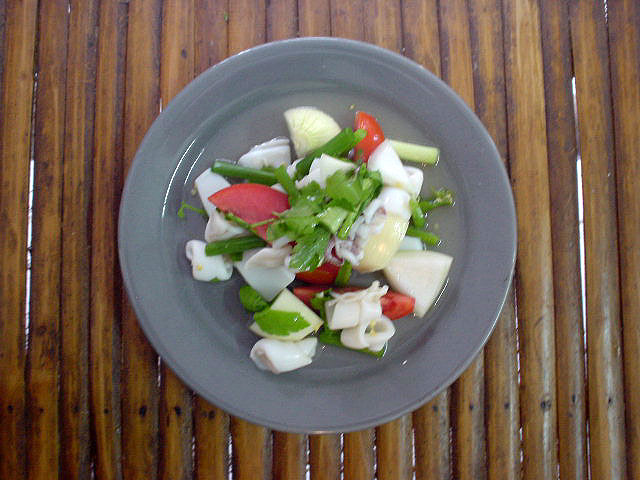
Next up was our choice of salad dishes, and for some reason I was in a crowd that really didn’t embrace the taste or texture of squid as much as me. I was the oddball when I decided to make Yam Pla Mueg (Spicy Squid Salad) while everyone else made chicken, beef or vegetarian salads. All eyes were on me, “that guy who’s actually making squid,” and I got a round of applause after the quick in and out of stir-frying the seafood pieces — one must be careful not to undercook or overcook squid; there is a perfect medium that a chef must achieve. I placed the spicy seafood salad on the plate in a nice presentation. “It’s all about presentation!” Miro the Czech guy said (picture above).
As much as I love squid (yes, even the tentacles), I couldn’t really eat what I just made because I miscalculated the chili-to-other ingredient proportions and ended up with YOW! Pla Mueg (Atomic Squid Salad).
For dessert, Lot and I were in a small envied group that prepared Khanom Gluay (Steamed Banana Cake) with a different teacher, a young Thai woman named Riam. She showed us how to core bananas (the center of the small Thai bananas is too hard for mashing) and mix it in with flour, sugar and coconut into a paste. The paste was plopped into the center of banana leaves and folded into cute little bulbs, which were placed in a steamer for 10-15 minutes. The sweet smell of coconut and banana escaped the steam trays and filled the room, enticing the others making other dishes. In the end, the Steamed Banana Cake Team shared our bounty with the others who reciprocated with their dishes. It was my American Thanksgiving, two days after the fact.
Class was concluded after that, and we were all proud recipients of cookbooks and one-day cooking course diplomas, which Lot, Elise, Wendy and I proudly showed off. Before graduation was over, I made sure I snapped a photo with my mentors Meow and Riam, even though I came away not really knowing how to cook Thai food unless I had the help of three assistants measuring out the right proportions for me. I suppose one day when I get back home in America I’ll invest the time and make some Thai food from scratch, but then again, I might just go out for it; one thing they never tell you on TV cooking shows or in the class I took is that unless you have assistants or an automatic dishwasher, there’s always a big pile of dirty dishes waiting for you once you’re done cooking.
RECIPE FOR CHAOS: Take one thousand rice paper lanterns, hundreds of floating flower boats and stir in a whole bunch of firecrackers and other pyrotechnics. Add fire and bring to a high heat.
Soon after cooking class was our pre-trek briefing with others back at the guesthouse, and after that meeting, our little clique was enlarged by two people: Hans, a Dutchman traveling through southeast Asia, most recently with Claire, the baby of the group at 21, an outdoorsy-type originally from Manchester, UK. Hans, Claire, Lot, Elise and I head out to the Tha Pae Gate, the former big entrance into old city, now the center stage of the Yi Peng celebrations. It was there that Elise and I introduced the two newbies the custom of rice paper lantern launching, this time performing the traditional writing of wishes on the side before setting the core on fire. Elise wished for happiness, peace and sex; Claire, money, happiness, sex; me, “health, happiness, peace, prosperity… and sex.” Before Elise set her lantern core on fire, she added the word “wisdom.”
“What do you want wisdom for?” Claire joked.
“Wisdom? You don’t need a thing like wisdom,” I added.
“What? Wisdom to get sex!”
She stood on the queue to have the Thai firestarter guy set the core on fire as she held it and soon it was up and away, symbolizing the drifting away of her troubles and the bringing of good fortune. Claire’s, Hans’ and my lanterns followed, and they joined the hundreds of others that lit up and sparkled in the sky under the full moon. We didn’t know exactly for how long they’d fly or how far they’d go, but supposedly after two hours the paper would burn out and then presumably the wire ring would fall to the ground. I imagine there was a whole bunch of metal rings somewhere off in the jungles of north Vietnam.
IT WAS THE MAIN DAY OF THE FESTIVAL, the day a big parade strolled through the city as a part PR stunt for companies, part Thai cultural show. Floats were followed by group processions and marching bands, one of which played the theme to James Bond amongst other things. We watched the whole thing atop the old fortification wall over beers and conversation. A big flashy boat float came through with Thai men pretending to row it forward.
“WOOOO!!!” we cheered to the stoic, stone-faced guys. No response. When Claire ran off to the shop to get something, a local woman grabbed her by the arm and scolded her, “You know you can be a bit more respectful when you’re upstairs!”
We eventually walked the parade route faster than the floats and caught up to the flashy rowboat. The guy we cheered on noticed us and stared at us with a death look.
THE PARADE ENDED BACK AT THE NAWARAT BRIDGE, and the pyromania was ten times crazier than it was the night before. I thought the Hindu holiday of Diwali in India was a pyromaniac’s paradise, but this was insane. Not only were fiery lanterns being launched left and right, but so were proper fireworks — many of which were launched not upward but sideways. Launching flower floaters into the Ping River was like going into a battlezone, dodging flares and explosions, all to plant the flower into the river and send it off.
“It’s a warzone!” Claire said. “I don’t like this at all.” She perpetually had her fingers in her ears the entire time we were there. We bumped into Luke and Nick, two guys we met at the trek briefing, and they told us that they held up a paper lantern as it was being lit — all the while little Thai boys lit and threw firecrackers at their feet to make them dance.
After a flare came sparking down on us — singeing my hair and Claire’s arm — enough was enough and we just called it a night and went our own ways. The pyromaniac festivities of the Yi Peng Festival continued all night with the high heat of a warzone and didn’t simmer down until morning.
Next entry: Facing Fears On The Non-Tourist Trek
Previous entry: Sunshine On A Rainy Day
Commenting is not available in this channel entry.
Comments for “Recipes”
Yeah, I’d cook a lot more often if I had three assistants ...
Posted by Liz on 11/30 at 12:45 PM
Showtime Rotisserie ...... Set it and Forget it!
Posted by .(JavaScript must be enabled to view this email address) on 11/30 at 02:21 PM
man, i would love those recipes, they look delish
 How many parades is that? I?m a sucker for a parade. As for news in the Rocky Mountains, some of the resorts got 2 ft of snow over the long weekend, unfortunately I didn?t get to snowboard in any of it but perhaps this weekend! Enjoy the rest of your week
 Posted by .(JavaScript must be enabled to view this email address) on 11/30 at 02:29 PM
OK Now I can’t wait to get to Chiang Mai! 18 more days! I may go to that exact cooking school, only I’m going to make the RED curry! (I like squid too.) And now I’m in the know about the banana cake, haha. YUM
Posted by .(JavaScript must be enabled to view this email address) on 11/30 at 03:47 PM
Maybe “WOOOO!!!” means something different in Thai?
Posted by .(JavaScript must be enabled to view this email address) on 11/30 at 04:32 PM
nice. those lanterns look damn cool…especially when they’re up in the air.
Whats your Pad Thai recipe? everytime i make it, it doesn’t taste like Pad thai…
Posted by .(JavaScript must be enabled to view this email address) on 11/30 at 07:10 PM
Erik: You always seem to land in the right spot with the perfect group of people on the right day to have a wicked festival experience!!
Posted by .(JavaScript must be enabled to view this email address) on 11/30 at 07:48 PM
The food does look yummy. You’ve gotta give Udz some Thai cooking lessons when you get back =)
Posted by .(JavaScript must be enabled to view this email address) on 11/30 at 07:59 PM
with the costs of the ingredients you can get thai food for cheaper and delivered to your door

fire fire!
Posted by .(JavaScript must be enabled to view this email address) on 11/30 at 10:19 PM
“with the costs of the ingredients you can get thai food for cheaper and delivered to your door
”And that’s the triple truth, Ruth.
Posted by .(JavaScript must be enabled to view this email address) on 12/01 at 11:58 AM
NIKKIJ: Snowboard season already? And I’m “stuck” here in balmy tropical weather!

Hopefully I’ll make my way out to Whistler before heading home… (Nudge, nudge to all you Vancouverite readers out there!)
Posted by .(JavaScript must be enabled to view this email address) on 12/01 at 12:04 PM
LOVEPENNY: I’ll be sending the Thai cookbook of all the recipes in my next package back home… MARKYT can relay it to you when he receives it.
Three cooking assistants not included.
Posted by .(JavaScript must be enabled to view this email address) on 12/01 at 12:08 PM
I’M BEHIND AGAIN, but you know me; I’ll catch up soon. I had an action-packed daytrip today with Lot, Claire and Hans; I hope to get caught up tonight and tomorrow morning with one or two more entries before taking the slow boat to Laos…
Posted by .(JavaScript must be enabled to view this email address) on 12/01 at 12:10 PM
JEN102 / WHEAT (and other NJ readers): Hey, I finally saw “Harold and Kumar Go To White Castle”... Ah, the memories of “the perfect burger.”
Posted by .(JavaScript must be enabled to view this email address) on 12/01 at 12:12 PM
there is no white castle in new brunswick or cherry hill!
hahaha…
Posted by .(JavaScript must be enabled to view this email address) on 12/01 at 01:00 PM
Liz: Did you see this week’s AR6 yet?
Poll: Who is more verbally abusive, Colin or Jonathan?
Posted by .(JavaScript must be enabled to view this email address) on 12/01 at 01:01 PM
doah i missed the last two weeks of AR6 and will miss next week!
any funny things like charla getting electricuted in AR5?
Posted by .(JavaScript must be enabled to view this email address) on 12/01 at 01:14 PM
Public Service Announcement:
Spek Holiday Party 2004 will be on Dec. 19th @ 1pm EST.
we’ll save an empty space for ya erik.
Posted by .(JavaScript must be enabled to view this email address) on 12/01 at 02:10 PM
Erik - I did a search on that cooking school and couldn’t find it. Can you tell me what street it’s on so I can find it when I’m there? thanks! If not, I know there are a ton of cooking classes there. But I like that you can choose what you want to make at this one!
Posted by .(JavaScript must be enabled to view this email address) on 12/01 at 02:46 PM
Erik Trinidad.
I followed your website religiously when back home in Vancouver, eager to see where you were to go next. I am ashamed to admit that I have done a poor job of following since, I think, Russia.
I embarked on my own trip on Sept 15, and I see now that I missed you in Tokyo… would have enjoyed meeting you in person. I’m now in Borneo, heading both east, then south. any chance you are coming to Malaysia or Indonesia?Best wishes,
Erik (not Erik)Posted by A different Erik on 12/01 at 02:59 PM
Erik, you really concidering Whistler? ... dude I’m in How about everyone else?
Posted by .(JavaScript must be enabled to view this email address) on 12/01 at 02:59 PM
Td0t- yep, just watched it tonight. Jonathan is so much more of a jackhole (to steal from Television without Pity) than Colin.
I can’t believe the girls got eliminated. 100 bales of hay?! Holy crap. They so deserved to get a non-elimination round. I’ve only moved square bales, and they were heavy enough. She sure has my respect if she was able to do it for 8 hours.Posted by Liz on 12/01 at 04:16 PM
I haven’t seen a parade in AGES… that looks fun. You get these awesome parade experiences… damn.
Posted by .(JavaScript must be enabled to view this email address) on 12/01 at 05:39 PM
AR6: Could those girls really have that much bad luck to unroll 100 bales and still not find a clue?
Posted by .(JavaScript must be enabled to view this email address) on 12/01 at 09:21 PM
statistically she should have found 7 or 8 clues… but she could have just had really crap luck.
Posted by Liz on 12/01 at 11:37 PM
LOVEPENNY: I’ll try to log on from Angor Wat…
Posted by .(JavaScript must be enabled to view this email address) on 12/02 at 03:52 AM
MARKYT: They could have gone to the WC on Rt. 17…
BTW, I used to do the WC run to the one on Rt. 1/9, near Edison…
Posted by .(JavaScript must be enabled to view this email address) on 12/02 at 03:54 AM
SARA: They drove us to some undisclosed locations somewhere in the suburbs… Just ask for the Classic Home Cooking school…
Claire recommends the Spicy House Cooking School, run by a woman named Mim—it’s a more intimate one-on-one sort of thing for about the same price… It’s near the Rose Guesthouse.
Posted by .(JavaScript must be enabled to view this email address) on 12/02 at 03:59 AM
SIMF2P: “Whistler” is legendary for us snowboarders on the east coast.
Posted by .(JavaScript must be enabled to view this email address) on 12/02 at 04:02 AM
A DIFFERENT ERIK: Hey are you the second Erik (with a K) or a third one? (I remember one from Austria [I think?] and he was the reason I started adding “TGT” handle.)
February 2005 I’ll be in Malaysia and Indonesia… keep in touch…
Posted by .(JavaScript must be enabled to view this email address) on 12/02 at 04:06 AM
They could have gone to all the ones in JC…it would have been much better if they went to the WC on Newark Gandhi Ave!
Posted by .(JavaScript must be enabled to view this email address) on 12/02 at 01:39 PM
speaking of boarding .. Has anyone been up yet? .. I’m feen’n ... Whats good out in the East Coast here ? I’m just use to Cali .. and lake Tahoe area ..
Posted by .(JavaScript must be enabled to view this email address) on 12/02 at 03:03 PM
SIM - no boarding so far…i think my friend is gonna try and hit hunter this saturday….but i’m SURE it’s WEAK…
only 4 trails open with one lift….
i don’t think east coast slopes even up in Vermont will be worthwhile until after January…
Posted by .(JavaScript must be enabled to view this email address) on 12/02 at 03:39 PM
You people and your pirated movie watching:
PIRATE BOOTY: The Motion Picture America on Friday issuing a report that rampant movie piracy in Asia in the form of bootlegged DVDs cost Hollywood more than $718 million in lost revenue in 2003, up from $575 million in 2000.Posted by .(JavaScript must be enabled to view this email address) on 12/02 at 10:14 PM
And, sure sucks to be you East Coasters - we got SNOW out here… I don’t ski/board, but I know people who do… HA!
Posted by .(JavaScript must be enabled to view this email address) on 12/02 at 10:16 PM
SHARE THIS TRAVEL DISPATCH:
Follow The Global Trip on Twitter
Follow The Global Trip in Instagram
Become a TGT Fan on Facebook
Subscribe to the RSS Feed
This blog post is one of over 500 travel dispatches from the trip blog, "The Global Trip 2004: Sixteen Months Around The World (Or Until Money Runs Out, Whichever Comes First)," originally hosted by BootsnAll.com. It chronicled a trip around the world from October 2003 to March 2005, which encompassed travel through thirty-seven countries in North America, South America, Africa, Europe, and Asia. It was this blog that "started it all," where Erik evolved and honed his style of travel blogging — it starts to come into focus around the time he arrives in Africa.
 Praised and recommended by USA Today, RickSteves.com, and readers of BootsnAll and Lonely Planet's Thorn Tree, The Global Trip blog was selected by the editors of PC Magazine for the "Top 100 Sites You Didn't Know You Couldn't Live Without" (in the travel category) in 2005.
Next entry:
Facing Fears On The Non-Tourist Trek
Previous entry:
Sunshine On A Rainy Day
THE GLOBAL TRIP GLOSSARY
Confused at some of the jargon that's developed with this blog and its readers over the years? Here's what they mean:
BFFN: acronym for "Best Friend For Now"; a friend made on the road, who will share travel experiences for the time being, only to part ways and lose touch withThe Big Trip: the original sixteen month around-the-world trip that started it all, spanning 37 countries in 5 continents over 503 days (October 2003–March 2005)
NIZ: acronym for "No Internet Zone"; a place where there is little to no Internet access, thus preventing dispatches from being posted.
SBR: acronym for "Silent Blog Reader"; a person who has regularly followed The Global Trip blog for years without ever commenting or making his/her presence known to the rest of the reading community. (Breaking this silence by commenting is encouraged.)
Stupid o'clock: any time of the early morning that you have to wake up to catch a train, bus, plane, or tour. Usually any time before 6 a.m. is automatically “stupid o’clock.”
The Trinidad Show: a nickname of The Global Trip blog, used particularly by travelers that have been written about, who are self-aware that they have become "characters" in a long-running story — like characters in the Jim Carrey movie, The Truman Show.
WHMMR: acronym for "Western Hemisphere Monday Morning Rush"; an unofficial deadline to get new content up by a Monday morning, in time for readers in the western hemisphere (i.e. the majority North American audience) heading back to their computers.
1981ers: people born after 1981. Originally, this was to designate groups of young backpackers fresh out of school, many of which were loud, boorish and/or annoying. However, time has passed and 1981ers have matured and have been quite pleasant to travel with. The term still refers to young annoying backpackers, regardless of year — I guess you could call them "1991ers" in 2013 — young, entitled millennials on the road these days, essentially.
Spelling or grammar error? A picture not loading properly? Help keep this blog as good as it can be by reporting bugs.