Open and Closed
This blog entry about the events of Sunday, July 11, 2004 was originally posted on July 17, 2004.
DAY 267: “Attention, s’il vous plaît. Nous arrivons à Paris-Austerlitz en vingt minutes!” came the cry over the PA system, telling us we had twenty minutes before arrival. I woke up in my train bunk all confused. Huh? Where am I? Was that just in French?
It was my abrupt awakening to the hustle and bustle of Paris, France’s capital city, a modern metropolis that seems to be perpetually giving homage to his rich historical past. It is one of the great world cities, a place characterized by its classical architecture, its cuisine, its art, its lights, its romance and its people who laugh all nasally. I had been to Paris before and seen most of its monuments already, but this time around I had a different raison d’être: to sort out my visas for upcoming travel on the Trans-Siberian and Trans-Mongolian Railways from Moscow to Beijing. After some research I saw that Paris was the most convenient place to do such a thing since both the Russian and Chinese governments had embassies there — and the fact that since I’d been there already, I wouldn’t feel so bad if I didn’t get to see much in terms of sights.
After getting a bed in a hostel three blocks from the Louvre, I head out to the Russian embassy in the quiet outskirts of the city center, near the Bois de Bologne — only to find out it had closed for visa applications at noon. I went off to find the Chinese embassy a couple of blocks off the famous Avenue des Champs Elysées — only to find out that it too was closed, but would reopen at 2:30 in the afternoon. In the interim, I dashed back and forth through town to check into my now-ready bed back at the hostel.
Back on Chinese ground I asked about visa applications. The Chinese guard spoke neither French nor English but recognized the word “visa” and gave me a flyer for the Chinese consulate in the suburbs, which closed at five. The train there took longer than I thought and I didn’t arrive until ten minutes past. They wouldn’t deal with visa in the afternoon, only in the morning between 9:30 and noon.
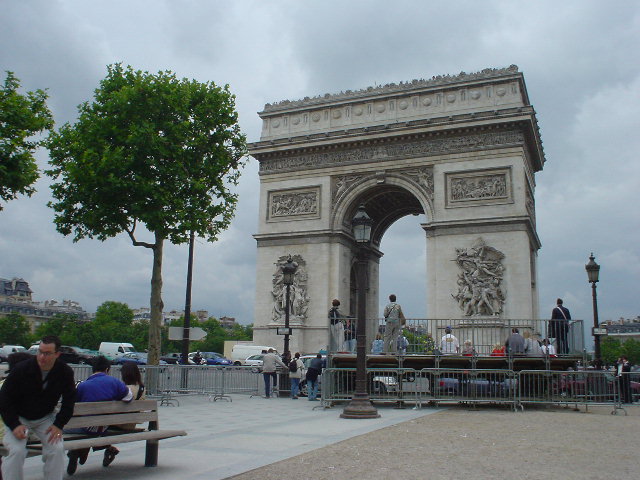
SO I PRETTY MUCH SPENT ALL DAY running errands like I thought I would. However, walking around Paris and taking its Metro, you cover a lot of ground anyway. On my way, I saw the Arc de Triomphe (picture above), the Place de la Concorde (whose central obelisk was taken from the Temple of Luxor in Egypt), the Eiffel Tower, the Seine, and Notre Dame. Even the train platform at the Louvre-Rivoli Metro stop had classical sculptures on display for people on the go. As much running around as I did around town, I didn’t neglect to make the obligatory stop as a Pulp Fiction fan to get a beer at McDonald’s. In lieu of a “Royale with cheese” to have it with, I got a Happy Meal instead.
I was planning to spend the rest of the day writing, but realized it was Monday, one of the two days the Louvre Museum was open late, so I decided to take advantage. On the way, I made the obligatory stop as an admirer of Ernest Hemingway to the Shakespeare & Co. bookstore, whose original store Hemingway often frequented during his days in Paris. It is a place that some call “the world’s most celebrated English book shop.”
Inspired by the original Shakespeare & Co. run by Sylvia Beach in the early 20th century, “Shakespeare & Co.” has been the literary embassy for many of the great writers, from Hemingway to Joyce. A tiny store about the size of two The Body Shops stacked on top of each other, it is home of tens of thousands of books in English prose and poetry and a few small beds amidst the bookshelves on the second floor. Sylvia Beach always saw her store as a haven for writers — the tradition is continued in the new store — letting writers crash (Hemingway amongst them) for a night or two. In the new store, there is even a typewriter in a small writing room (the size of a closet) that the great writers tapped away on. With my copy of Hyenas Laughed At Me and Now I Know Why… in my bag, I went to investigate if I could get a free home stay, or rather, store stay.
“Are you one of the people that stays here?” I asked a Swedish girl retrieving items from her bag in the storage closet.
“Yes.”
“How does it work?”
“Well, you just sort of show up and ask him if you can stay,” she said. “Are you thinking of doing it?”
“Maybe.”
“You have to work two hours a day.”
Two hours? Whoa. Did this qualify for medical and dental? Was there a 401k plan? Two hours? I was already thinking of asking for time off. Between having to run around to get visas and catching up on The Blog and seeing stuff, I really couldn’t spare the time. Besides, the store wasn’t a place conducive to write anyway (for me); open until midnight seven days a week, the place was packed with people coming and going in the summer (including Bohemian types sitting on the beds and singing Beatles tunes with an acoustic guitar). According to the Swede, “quiet time” didn’t come until about 3 a.m.
Even with that idea gone, I paid my respects to the owner anyway, a distinguished-looking laid back old American named George Whitman, the grandson of great American writer Walt Whitman, who kept the original spirit of Shakespeare & Co. alive. He was in a small back room in a suit, reading the paper.
“Are you George Whitman?”
“That’s me. Where are you from?”
“New York.”
“What brings you here?”
“Well, this place is famous. I’m sort of making my pilgrimage.”
“Well, you’re always welcome.”
“I remember seeing you on the Michael Palin show,” I said, referring to the former Monty Python’s travel mini-series that followed the trail of Ernest Hemingway.
“Oh, that was years ago.”
“So,” I said, trying to think of something to say. I had met Mr. Whitman’s one-time interviewer Michael Palin himself at a signing of one of his travel books in a New York bookstore and drew a blank when I finally got to speak with him one on one and I didn’t want the same thing to happen again. “So, do you just sort of sit here and, uh…” thinking, thinking, “...read?”
“Yeah, pretty much.”
“Well nice to meet you.”
“You’re always welcome.”
I left, happy to know that while the embassies of Russia and China maybe closed, the literary American one would be open to me.
THE LOUVRE, without a doubt, is the world’s most famous art museum, housing some of the world’s most famous classical works of art, most prominently Da Vinci’s Mona Lisa. I had missed out on the Louvre on my last visit to Paris and so this time around, I made the obligatory stop as an American tourist to visit it, camera in hand.
Trying to cover four floors in three wings of a tremendous museum is impossible in three hours, so I sort of just went to see the more prominent things pointed out by my floor plan map, in a sort of photographic scavenger hunt. Most of the things that weren’t so significant I just skipped over, knowing that I could see similar works anytime back home in the New York’s Metropolitan Museum of Art (and at a lower price). I wondered through the galleries and halls of French, Spanish, Italian, Greek, Etruscan, Egyptian, Mesopotamian, Levantian, Iranian, Coptic, Islamic and medieval artifacts, paintings and sculptures. Halfway through my scavenger hunt I discovered that about a third of the museum was closed for the Monday night extended hours, which was okay because there was too much available to see anyway.
Amongst the highlights of my photographic scavenger hunt of prominent works (and others that just caught my attention) were:
Venus de Milo (chick with no arms)
Winged Victory of Samothrace (chick with no head)
Michelangelo’s The Dying Slave (classical porn for women)
Code of Hammurabi (the deciphering phallus)
The Borghese Gladiator (Wow, they had Tae Bo back then?)
The Capital of Apadana (fat woman not included)
Statue of Ain Ghazal (Gumby’s Jordanian cousin)
L’Enfant à l’oie (Is that French for “Boy choking the chicken?”)
La Mastaba (Could this title be any more set up for a joke?)
The Cycladic Idol (Add glasses and you have Muppet Professor Honeydew!)
Down the long hallway of Italian paintings (including Da Vinci’s Madonna of the Rocks), I saved the most famous for last, the Mona Lisa herself (chick with no eyebrows) and managed to get a fairly decent shot without a flash after working my way through a small crowd. (Flash photography only gets you a photo of your reflected flash.)
THE LOUVRE CLOSED shortly after, leaving me to wander the lively Place de St. Michel, amongst other places. While that neighborhood was open late, the neighborhood I was in closed relatively early — which was fine because I’d have to get up early and beat the morning rush when the Russian embassy opened in the morning.
Next entry: Paris Lost
Previous entry: The Race to Paris
Commenting is not available in this channel entry.
Comments for “Open and Closed”
HEY ALL… slowly catching up… bear with me!
Posted by .(JavaScript must be enabled to view this email address) on 07/16 at 08:30 PM
wow those paintings are HUGE.
Posted by .(JavaScript must be enabled to view this email address) on 07/16 at 08:44 PM
hahah..choking the chicken…
great subtitles…
Posted by .(JavaScript must be enabled to view this email address) on 07/16 at 08:50 PM
Hey Erik - Venus de Milo and Winged Victory of Samothrace are mixed up… I was really confused for a minute when I thought I had the wrong statue in mind for Venus de Milo. Thank goodness for the “chick with no head/arms” comments LOL
Posted by Liz on 07/16 at 08:50 PM
Oh, and all the art pics are great. I also missed the Louvre when I was in Paris (Musee D’Orsay instead - which is great). I’m hoping to spend a few days wandering through it when I get to Paris again.
The commentary is hilarious. The muppets one killed me.Posted by Liz on 07/16 at 08:55 PM
Erik…you are in my favourite city! You make me want to jump on a plane! I see you found the great restaurant district. I have the same pic of the Gladiator but with me sitting between his legs! You can sure get tired trying to see the Louvre in one day. Impossible!Beware of people helping at the Metro for tickets. I got ripped off by someone who helped by using his prepaid card (I gave his cash and he gave me ticket…which was good for one stop!) Take a trip by train to Giverny(about 1 hr. north/west)Monet’s home and famous lily pond. This time of year the flowers will be gorgeous or to Versailles which is steeped with history. Rose
Posted by .(JavaScript must be enabled to view this email address) on 07/16 at 09:07 PM
Wonderful! I’m so jealous - I want to go to the Louvre… all that classical stuff is wonderful! Did you do stuff relating to the Da Vinci Code? Thanks for the pics, and the commentary. Yes, the Honeydew comment is RIGHT ON!
Thanks for the updates, they are VERY welcome in my world!Posted by .(JavaScript must be enabled to view this email address) on 07/17 at 07:51 AM
That’s no chicken…that’s a goose. (L’enfant a l’oie = the child has the goose)
And Rose and I have met the same guy, or at least someone pulling the same scam. I’ve never had that problem on any other metro system, what’s wrong with these Pariseans.
Posted by .(JavaScript must be enabled to view this email address) on 07/17 at 10:56 AM
Oh, and personal recommendation if you’re still there…for art museums in Paris, I found the Mus?e d’Ors?e, just across the river, much better than the l’Ouvre. Not as many crowds, and, in my opinion anyway, the art’s more interesting.
Posted by .(JavaScript must be enabled to view this email address) on 07/17 at 11:00 AM
I never thought to just take pictures of everyday things like trains in the metro. It really helps with the story.
Now, is there any chance George Whitman ISN’T really the grandson of Walt Whitman?
Posted by .(JavaScript must be enabled to view this email address) on 07/17 at 07:12 PM
Sorry I was late on the Barcelona bar info.
George Whitman was a classic. Did you get a chance to pose with him in a shot?Dude! The Capital of Apadana looks awesome! The Notre Dame felt small… paintings were huge! Professor Honeydew rocks! Do you still open the doors yourself at the metro?
Best of luck at the respective Embassies!!
Posted by .(JavaScript must be enabled to view this email address) on 07/18 at 01:55 AM
I’ll tell ya—whenever in a foriegn country trying to find something to eat, those Goldn Arches never fail!
Word Life!
Moman!
Posted by Moman on 07/18 at 07:04 AM
Erik: Hey what do they call “French Fries” in France?
Rose & Neil: similiar scam I ran into in NYC-Chinatown, Damn kids!Posted by .(JavaScript must be enabled to view this email address) on 07/18 at 04:55 PM
Oogy - I agree - the Notre Dame DOES look small. I thought it would be bigger.
Posted by .(JavaScript must be enabled to view this email address) on 07/18 at 05:12 PM
SIM - haha…sucker!
Posted by .(JavaScript must be enabled to view this email address) on 07/18 at 05:21 PM
You should take an hour or two and go up to Sacre C’ur. Its the white cathedral on the hill with the best views of the entire city. Behind the Cathedral there is an amazing artists square surrounded by some of the best cafes. Go up there, order les moules frites and a glass of wine for me!
Posted by .(JavaScript must be enabled to view this email address) on 07/18 at 06:00 PM
ERIK: What’s the name of the hostel you are staying at called.
Posted by .(JavaScript must be enabled to view this email address) on 07/18 at 06:29 PM
wow, i am so jealous. i always wanted to go to the louvre. i am willing to spend an entire vacation week in there.
Posted by .(JavaScript must be enabled to view this email address) on 07/18 at 07:26 PM
HEY ALL… GREETINGS FROM FLORENCE (FIRENZE), ITALY… Yes, that means I’m now THREE cities behind, four if you include my little day trip to Pisa this afternoon… Don’t worry, I have plenty of train time in the coming week to catch up… Now if only I had a power outlet….
Here are the A’s to your Q’s:
NOELLE: Da Vinci Code, yes… look at the file names of the Da Vinci files I uploaded… I should have had the book on me to get the details I forgot, but get this… there are NO windows in either of the men’s bathrooms in the Italian painting wing!
NEIL: Yes, I know it’s a goose… stop ruining my bit!
 I’m out of Paris now, so Musee d’Orsee will have to wait for another time around… thanks for the suggestion though!
TJW: Dunno, ask George; “You’re always welcome.” Seriously, look him up on the net and the fact should match. Glad you appreciate the everyday photo thing… I do it for exactly that reason; to make the reader feel like he/she is there too.
OOGY: No shot with George. D’oh. Actually it didn’t occur to me at the time. Yes, you still open the Metro doors by yourself…
SIM: Anything but “Freedom Fries.”
DTELLA: I did Sacre Coeur on a previous Paris trip, so I skipped it this time. Picture of moules frites to come in an entry about Avignon…
NEVEN: It’s the Centre International de Paris.
Posted by .(JavaScript must be enabled to view this email address) on 07/19 at 12:54 AM
I’m trying NOT to use the blonde brain cells, but can you help me figure out where those files are? Are they someplace secret, or someplace where I should see them? Help, per favore.
Posted by .(JavaScript must be enabled to view this email address) on 07/19 at 01:43 AM
beer and a happy meal. interesting. do they typically serve alcohol to the parisiene youth?
Posted by .(JavaScript must be enabled to view this email address) on 07/19 at 01:47 AM
NOELLE - Scroll over the “Madonna of the Rocks” text link to the picture and then look at the bottom left corner of you web browser and notice the file name…
yes i’m a dork and i’m proud of it
Posted by .(JavaScript must be enabled to view this email address) on 07/19 at 01:53 AM
I officially name you “Michael Palin” of the new millenium! Great stuff!
Posted by .(JavaScript must be enabled to view this email address) on 07/19 at 02:43 AM
Well, I know that beer with my meal makes me happy

Posted by .(JavaScript must be enabled to view this email address) on 07/19 at 06:37 AM
Is that the only one? That’s so much fun.
 I usually watch those names closely - apparently the blonde was thinking more today… or sleeping.
Posted by .(JavaScript must be enabled to view this email address) on 07/19 at 09:29 AM
“It was my abrupt awakening to the hustle and bustle of Paris, France’s capital city, a modern metropolis that seems to be perpetually giving homage to his rich historical past.”
That’s got to be one of my favourites Erik!!
Posted by .(JavaScript must be enabled to view this email address) on 07/20 at 05:38 PM
TDOT - I’m still sticking to my favorite line from Day 9:
“It’s a shame I couldn’t take anymore photos because there was one classical painting of the Virgin Mary breast feeding Baby Jesus. And why wouldn’t the internet need a picture of Jesus sucking on a titty?”
Posted by .(JavaScript must be enabled to view this email address) on 07/20 at 06:11 PM
Oh yeah!!! That one is classic!!
Posted by .(JavaScript must be enabled to view this email address) on 07/20 at 06:24 PM
SUPER JEALOUS!!! I spent a grueling 8 hours in the Louvre… and it was worth every moment. So psyched you took photos of the galleries. Tho I swear the room with the Mona Lisa has changed *significantly* since 1998 when I was there. Now you’re in my favorite city… FIRENZE. I don’t think there’s a word for the level of jealousy I’m experiencing!
Thanks especially for the scavenger hunt pics. You covered Nike, my most favorite classical sculpture. But for all my love of things muppet, I never noticed the Honeydew connection before! LOL!
Posted by .(JavaScript must be enabled to view this email address) on 07/21 at 12:27 AM
Oh, by the way DaVinci did not sculpt the Venus di Milo—it’s ancient Greek.
—ChristyPosted by .(JavaScript must be enabled to view this email address) on 07/21 at 05:16 AM
Erik,
Patrick speaking now. If you get a chance, get to Trattoria Antellesi,near San Lorenzo, for dinner. Tell Joe and Rene that you are friends of Patrick and Christy, the Americans who spent 4 days dining with them last October. If they need further info to remember us by, my sister lives in Boston and knows her cousin who owns Francesca’s in the North End.
Posted by .(JavaScript must be enabled to view this email address) on 07/21 at 05:25 AM
SHARE THIS TRAVEL DISPATCH:
Follow The Global Trip on Twitter
Follow The Global Trip in Instagram
Become a TGT Fan on Facebook
Subscribe to the RSS Feed
This blog post is one of over 500 travel dispatches from the trip blog, "The Global Trip 2004: Sixteen Months Around The World (Or Until Money Runs Out, Whichever Comes First)," originally hosted by BootsnAll.com. It chronicled a trip around the world from October 2003 to March 2005, which encompassed travel through thirty-seven countries in North America, South America, Africa, Europe, and Asia. It was this blog that "started it all," where Erik evolved and honed his style of travel blogging — it starts to come into focus around the time he arrives in Africa.
 Praised and recommended by USA Today, RickSteves.com, and readers of BootsnAll and Lonely Planet's Thorn Tree, The Global Trip blog was selected by the editors of PC Magazine for the "Top 100 Sites You Didn't Know You Couldn't Live Without" (in the travel category) in 2005.
Next entry:
Paris Lost
Previous entry:
The Race to Paris
THE GLOBAL TRIP GLOSSARY
Confused at some of the jargon that's developed with this blog and its readers over the years? Here's what they mean:
BFFN: acronym for "Best Friend For Now"; a friend made on the road, who will share travel experiences for the time being, only to part ways and lose touch withThe Big Trip: the original sixteen month around-the-world trip that started it all, spanning 37 countries in 5 continents over 503 days (October 2003–March 2005)
NIZ: acronym for "No Internet Zone"; a place where there is little to no Internet access, thus preventing dispatches from being posted.
SBR: acronym for "Silent Blog Reader"; a person who has regularly followed The Global Trip blog for years without ever commenting or making his/her presence known to the rest of the reading community. (Breaking this silence by commenting is encouraged.)
Stupid o'clock: any time of the early morning that you have to wake up to catch a train, bus, plane, or tour. Usually any time before 6 a.m. is automatically “stupid o’clock.”
The Trinidad Show: a nickname of The Global Trip blog, used particularly by travelers that have been written about, who are self-aware that they have become "characters" in a long-running story — like characters in the Jim Carrey movie, The Truman Show.
WHMMR: acronym for "Western Hemisphere Monday Morning Rush"; an unofficial deadline to get new content up by a Monday morning, in time for readers in the western hemisphere (i.e. the majority North American audience) heading back to their computers.
1981ers: people born after 1981. Originally, this was to designate groups of young backpackers fresh out of school, many of which were loud, boorish and/or annoying. However, time has passed and 1981ers have matured and have been quite pleasant to travel with. The term still refers to young annoying backpackers, regardless of year — I guess you could call them "1991ers" in 2013 — young, entitled millennials on the road these days, essentially.
Spelling or grammar error? A picture not loading properly? Help keep this blog as good as it can be by reporting bugs.