Mistaken Identities
This blog entry about the events of Sunday, September 05, 2004 was originally posted on September 12, 2004.
DAY 323: As an American born from a bloodline from the Philippines — the southeast Asian archipelago country once colonized by the Spanish — I have a certain façade that has been mistaken for other nationalities, depending on what country I’m in. In South America, locals often approached me with words in Spanish under the assumption that perhaps I was one of them, and whenever I had trouble responding right away, they assumed I was just from the neighboring country. Ecuadorians thought I might have been Peruvian. Brazilians thought I might have been Bolivian.
Not only do I have an ambiguous Latino look, but an ambiguous Asian one as well. The same phenomenon from South America has happened to me in Asia, particularly in China. People often assume I’m Chinese at first glance and approach me in Mandarin, or in the case of southern China, Cantonese — a completely different language altogether, “as different as Spanish is to French” says Lonely Planet.
FROM WUHAN, I JOURNEYED TO CANTONESE SOUTHERN CHINA to the city of Guilin via overnight sleeper bus. The name “Guilin” hadn’t shouted at me when I originally entered China (nothing did really), but I knew that one of my must see’s was to see the famous mountains that “look like big camel humps” (as I described them to people with the literacy level of a second grader) — I’d wanted to see them since I saw them in the 1993 movie adaptation of Amy Tan’s The Joy Luck Club. Blogreader oogy and Elisa (Xi’an) both directed me to the city of Guilin, but Mandy and Sean (Yangzi River) pointed me to the smaller city of Yangshou south of Guilin, the cheaper, more tourist-friendly way to see the “camel humps.”
From Guilin’s bus terminal I bid Nicole and Sabine goodbye and hopped on a bus for Yangshou. The 45-minute ride took me and a group of Chinese — some of which tried to communicate things to me in Mandarin or Cantonese with no success — giving me my first glance of the famous “camel humps” that are, get this, actually made of limestone. I was dropped off in Yangshou on an overcast day, confused as to where to go, and asked for directions for the nearest HI youth hostel. When I finally found someone who didn’t reply back to me in Cantonese, it was a guy who was only trying to get me to stay at his hotel.
I learned right away that competition was tough in Yangshou — the adjective “tourist-friendly” was an understatement. I don’t know if it’s because Yangshou was highlighted on the colored country map of Lonely Planet’s China guidebook as a “backpacker haven,” but it was definitely a huge tourist draw — more so than upmarket Guilin I believe — not only for Western backpackers but for the masses of Chinese tourists that packed the streets as well. The most packed of these streets was Xi Jie or “West Street,” which was not named ironically because it’s actually in the eastern part of the city, but because it was the main strip that catered to Westerners. Bicycle rental stands, bootleg CD/DVD stores and tourist agencies lined the pedestrian mall along side many souvenir shops selling everything from classic Chinese paintings inspired by the surrounding limestone peaks to kitschy SARS t-shirts. The many cafes and restaurants on the main strip and its smaller side streets offered foreigners familiar Western foods with something I hadn’t seen in a long time: forks.
My experience walking up and down the street was a familiar one. With my squinty-eyed, brown-skinned façade I blended in fairly well, the way I had in South America, Mongolia and northern China, and as I wandered passed tour and restaurant touts I was often ignored and passed up for a Caucasian person. Shopkeepers approached me in Chinese until I spoke English to them in an American accent, and I often received responses like “You speak Chinese?” or “Oh, I thought you were Chinese.” They all knew I had some sort of Asian background and thought it was odd that I couldn’t comprehend even a little Cantonese — I had to keep explaining that the Philippines was a Spanish colony. One woman in a CD store pegged me for a “mix of Chinese and some Western country,” and I’m sure it was simply an icebreaker so that perhaps I’d buy something.
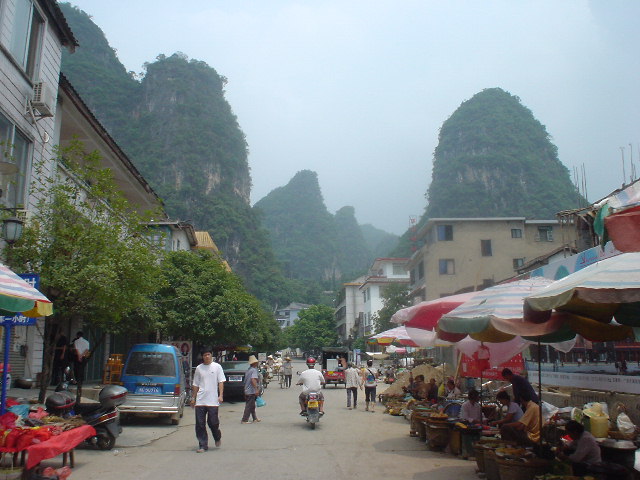
Not all of Yangshou was a Westernized goldmine for vendors selling cheap goods “made in China” to foreigners; the other side of the city was still a regular small Chinese town (picture above) with markets, locals zipping around by bicycle and kids going to and coming from school with their funny yellow school baseball caps. I suppose the whole town had a sort of yin-yang/east-west balance to it, but it was hard to explore it when a downpour came in the early afternoon and rained for most of the day. I took refuge indoors, which was fine by me; I had much catching up to do on The Blog.
“CAN I HELP YOU?” I asked the two Asian women who came into the hostel dorm room.
“Huh?” the older- (but still young-) looking one said in English. “We’re staying here.” I felt sheepish with my foot in my mouth after my apparent faux pas — what goes around, comes around as they say. Just because they are Chinese doesn’t mean they’re staff, dummy, I thought to myself. That thought was another faux pas because neither of them was Chinese — the older one, Sulan, was Taiwanese and the other, Jisong, was Korean and they had only met the day before in the dorm.
“Excuse me, are you busy?” Jisong asked me. I was diligently working on my laptop at the desk. “Do you want to join us for dinner?”
“Uh,” I started with the constant debate in my mind — please The Blog or go out and do something — “Sure.”
ACCORDING TO JISONG’S LONELY PLANET BOOK, the big must-have dish in Yangshou was Beer Duck and/or Beer Fish — not that there was much of alcoholic value in either since most of the alcohol evaporates away in the cooking process. There’s not much taste of beer leftover either with all the chili peppers spicing up the meat, but it was a tasty dish nonetheless. Sulan was fluent in Cantonese and so it was no problem getting “authentic” Chinese food away from the tourist traps of West Street. The three of us East-Asian faced travelers — none of us Chinese as much as it might have appeared at first glance — sat around for the usual swapping of traveler tales. As a former government worker in Taiwan, Sulan had really milked her multi-lingual talents traveling through mainland China, often getting cheaper deals than any Westerner could try to negotiate. Jisong, like me, was also in her tenth month of traveling around the world — three months of which were wisely spent in the relaxation mecca of Dahab, Egypt alone. Dinner didn’t last all night because I had to run off to a night tour I had booked: to spend an hour with a cormorant fisherman to see how he did his thing.
CORMORANT FISHING HAS BEEN A METHOD OF FISHING the rivers in the Guangxi province for generations. I wasn’t exactly sure what was involved; I just knew only that people cormorant fished nearby and that one of the things to do in Yangshou was to go on a short tour, which happens at dusk. I had anticipated fishing myself in old traditional ways along with an old, distinguished-looking Chinese man, but in fact, not even the fisherman we followed around actually fished. He was more of a “cormorant pimp” that piloted a boat with five cormorant birds who did the actual fishing, each attached to the boat by a string. The birds swam along side the main boat, like a web-footed cavalcade and dived into the water whenever a fish might be caught. The five birds swam like soldiers until it was “go time,” sometimes coming back to the surface with a fish in its mouth. The fisherman would extend a bamboo pole for the bird to perch on and bring him back in to dump the fish out of the bird’s mouth and into a basket.
At first I thought it was pretty cruel for the birds to be tied to their master to do his bidding, but when we docked on shore for a photographic opportunity, I saw that the birds were cared for properly. Even when they were untied they never strayed away, and they seemed willing to part away from their catch.
THE STREETS WERE LIT UP on West Street as they were every night, full of travelers both foreign and domestic shopping, eating, drinking and being merry. Jisong, Sulan and I each had early morning sunrise tours the next day and called it an early night in our dorm. I was confident I could go out any night of that week anyway to mingle with the town dwellers, no matter what nationality they thought I was.
Next entry: A Couple of Monkeys
Previous entry: The Tower in the Detroit of China
Commenting is not available in this channel entry.
Comments for “Mistaken Identities”
Oooh, do I get the privilege of being first? Spiffy! Question - you alternate between contacts and glasses, eh? How is it having to deal with your contacts and solution? Just wondering… and were there bones in your Beer Duck?
Posted by .(JavaScript must be enabled to view this email address) on 09/12 at 09:24 AM
NOELLE: Contacts and solution, no problem. I have a year and half worth of disposable contact lenses with me… Solution I buy as needed.
Bones in the Beer Duck? Yes, and the duck bill too!
Posted by .(JavaScript must be enabled to view this email address) on 09/12 at 03:23 PM
cormorant birds are cool!
Posted by .(JavaScript must be enabled to view this email address) on 09/12 at 05:57 PM
I know… I’d be pissed if someone was pulling food out of my throat!
Posted by .(JavaScript must be enabled to view this email address) on 09/12 at 06:00 PM
Interesting info on cormorants. I never thought that they would be a useful bird! In this area they can be very destructive birds, there are islands here in the Muskoka Lakes that have been destroyed by them, they shit everywhere destroying the trees and literally killing the island, they can be one of the worst things for the watershed here in this area!
Erik, I thought you would apppreciate the “shit” reference….sorry no picture for you! Has anyone actually counted the number of times you have taken pictures of said subject? I am still reading the archives, but haven’t taken a running total! LOL
Posted by .(JavaScript must be enabled to view this email address) on 09/12 at 06:36 PM
The duck bill was in your beer duck? how funny! I have been reading about all the crazy things you can eat in Asia (well, SE Asia anyway) - one good Lonely Planet publication is the “LP World Food” series. Cobra Heart, anyone? Partially-formed egg embryo? I may have to try the snake wine.
Posted by .(JavaScript must be enabled to view this email address) on 09/12 at 06:43 PM
Still behind… Sorry; I’ve got writer’s block on the next one… I may have to rush through it to just get it over with…
Posted by .(JavaScript must be enabled to view this email address) on 09/12 at 07:32 PM
wow…that’ll be a big hit here in the US if you can teach them to ‘fetch’ other things besides fish. Here’s a few ideas:
-fetch stinky socks under the bed
-fetch remote control on the other sofa
-fetch newspaperPosted by .(JavaScript must be enabled to view this email address) on 09/12 at 07:46 PM
Hey erik! thanks for the post card, SURE do love getting mail. I’ll have to catchup ... again! but i was also wondering what the link to your “what if” video, i wanted to show it to one of my co-workers… thanks! enjoy

Posted by .(JavaScript must be enabled to view this email address) on 09/12 at 07:46 PM
LP: Hey, you forgot the Beer! ...
Posted by .(JavaScript must be enabled to view this email address) on 09/12 at 08:17 PM
Lisa are you up in Muskoka area?! I spend some of the summer up in Honey Harbour, and Port Sevren.
Posted by .(JavaScript must be enabled to view this email address) on 09/12 at 08:31 PM
NIKKIJ - Just go to the drop down menu and select the “Would You” slideshow…
Posted by .(JavaScript must be enabled to view this email address) on 09/12 at 09:05 PM
Td0t, yes I live here in Muskoka, about 25 minutes north of Honey Harbour….Port Carling to be exact!
Posted by .(JavaScript must be enabled to view this email address) on 09/12 at 09:06 PM
Hey Mr. E
I am also taking a short break and am travelling, in Tamil Nadu, south India. But I thought I should send you this linkElections in the state of Maharashtra where Mumbai (Bombay) is, are on October 13. Check this out.
http://ww1.mid-day.com/news/city/2004/september/92297.htmPolitical friction and ugliness has begun. Best to avoid landing in Mumbai.
I dont know how many days you will be in India, I generally recommend landing in Mumbai, but perhaps this time, it would be best for you to land in Delhi.
In fact, if your schedule is tight you can do the must see’s using Delhi as the starting point.
These would be Agra (Taj Mahal), I would recommend, Jaipur, Udaipur, Varanasi, Rishikesh…
Check with PC, she is a better judge.
Posted by .(JavaScript must be enabled to view this email address) on 09/12 at 09:26 PM
EW! Duck BILL?? Ugh… but, you’re way more adventurous than I am, most likely…
Posted by .(JavaScript must be enabled to view this email address) on 09/13 at 01:12 AM
Eew on the duck bill & bones. I prefer my food to have no physical characteristics of the original critter. Don’t like my fish to have eyes/head either. Nope. Just give me meat wrapped in celophane, thank you. Last time I ordered fish and it came “whole”, I covered it’s head with a napkin so it wasn’t staring at me while I ate it. Shellfish is probably ok—clams on the halfshell, shrimp, lobster, etc. But even that’s a bit weird sometimes—like when the chef’s presentation sets it up to “model” for you.
Posted by .(JavaScript must be enabled to view this email address) on 09/13 at 02:57 AM
Christy - I’m totally with you on the eyes/head thing. People here (in Japan) think I am very weird when I ask for the head to be cut off. I don’t like small fish here either cuz they don’t clean the guts out and they taste rather yucky.
Posted by Liz on 09/13 at 04:28 AM
Erik - did they have the rope tied around the cormorants’ necks? They have the fishing in Japan as well (although it seems you got a much more up close and personal view than you can here where you are stuck in a separate boat several feet away). Here the birds have a ring around their neck to prevent them from swollowing the fish.
Posted by Liz on 09/13 at 04:30 AM
LIZ: The cormorants were tied to their legs, not their necks.
As for fish heads, I grew up with them, so no problem there… Actually, I DO think its weird when people ask for the heads to be cut off… Seeing a whole fish has always been normal for me. Cheek meat is often the most tender, and no bones either!
Posted by .(JavaScript must be enabled to view this email address) on 09/13 at 05:01 AM
you don’t know what you are missing with fried crunchy fish eyeballs or the ear of a roasted pig!
sao sao good…
Posted by .(JavaScript must be enabled to view this email address) on 09/13 at 05:38 AM
Erik- I think my problem with heads/eyes comes from being a former vegetarian. I still think the fish is pleading ‘Don’t eat me’ when I see the head. Fish cheek is good though, especially tuna cheek. Yum! I just can’t deal with the pleading eyes LOL
Posted by Liz on 09/13 at 12:38 PM
I think the idea of having the fish head and eyes/fins, etc means it’s fresh and not all torn up. It kind of has that “Look how fresh I am, I was just caught this morning!” look. Having cleaned-up meat with no eyes or guts is an American thing, (I think..) But I don’t like it when they don’t de-vein shrimp! eew! Take that gross digestive tract out.
Posted by .(JavaScript must be enabled to view this email address) on 09/13 at 06:19 PM
hmm..i thought we de-vein shrimp because of the mercury content. Right?
Posted by .(JavaScript must be enabled to view this email address) on 09/13 at 06:26 PM
SHARE THIS TRAVEL DISPATCH:
Follow The Global Trip on Twitter
Follow The Global Trip in Instagram
Become a TGT Fan on Facebook
Subscribe to the RSS Feed
This blog post is one of over 500 travel dispatches from the trip blog, "The Global Trip 2004: Sixteen Months Around The World (Or Until Money Runs Out, Whichever Comes First)," originally hosted by BootsnAll.com. It chronicled a trip around the world from October 2003 to March 2005, which encompassed travel through thirty-seven countries in North America, South America, Africa, Europe, and Asia. It was this blog that "started it all," where Erik evolved and honed his style of travel blogging — it starts to come into focus around the time he arrives in Africa.
 Praised and recommended by USA Today, RickSteves.com, and readers of BootsnAll and Lonely Planet's Thorn Tree, The Global Trip blog was selected by the editors of PC Magazine for the "Top 100 Sites You Didn't Know You Couldn't Live Without" (in the travel category) in 2005.
Next entry:
A Couple of Monkeys
Previous entry:
The Tower in the Detroit of China
THE GLOBAL TRIP GLOSSARY
Confused at some of the jargon that's developed with this blog and its readers over the years? Here's what they mean:
BFFN: acronym for "Best Friend For Now"; a friend made on the road, who will share travel experiences for the time being, only to part ways and lose touch withThe Big Trip: the original sixteen month around-the-world trip that started it all, spanning 37 countries in 5 continents over 503 days (October 2003–March 2005)
NIZ: acronym for "No Internet Zone"; a place where there is little to no Internet access, thus preventing dispatches from being posted.
SBR: acronym for "Silent Blog Reader"; a person who has regularly followed The Global Trip blog for years without ever commenting or making his/her presence known to the rest of the reading community. (Breaking this silence by commenting is encouraged.)
Stupid o'clock: any time of the early morning that you have to wake up to catch a train, bus, plane, or tour. Usually any time before 6 a.m. is automatically “stupid o’clock.”
The Trinidad Show: a nickname of The Global Trip blog, used particularly by travelers that have been written about, who are self-aware that they have become "characters" in a long-running story — like characters in the Jim Carrey movie, The Truman Show.
WHMMR: acronym for "Western Hemisphere Monday Morning Rush"; an unofficial deadline to get new content up by a Monday morning, in time for readers in the western hemisphere (i.e. the majority North American audience) heading back to their computers.
1981ers: people born after 1981. Originally, this was to designate groups of young backpackers fresh out of school, many of which were loud, boorish and/or annoying. However, time has passed and 1981ers have matured and have been quite pleasant to travel with. The term still refers to young annoying backpackers, regardless of year — I guess you could call them "1991ers" in 2013 — young, entitled millennials on the road these days, essentially.
Spelling or grammar error? A picture not loading properly? Help keep this blog as good as it can be by reporting bugs.