House of Superheroes
This blog entry about the events of Thursday, July 22, 2004 was originally posted on July 31, 2004.
DAY 278: Design is a much more important part of society that the average person may think. For example, what would society be without graphic design? Every magazine layout, advertisement poster or web page that is effective to its viewer is like that because of graphic design. Passports, airline tickets and even money looks official because of graphic design. A diploma or certificate of authenticity just looks fake and illegitimate without graphic design. And really, which would you trust more: a company that has an established logo and corporate identity design scheme, or one that uses clip art from Microsoft Word?
Face it, everything that is legitimate and official, slick and stylish is like that because of graphic design. When you are a graphic designer, you are nothing short of a demigod in modern society. Whatever you produce transforms intangible ideas into a believable and accepted commercial reality.
ALL THE CREATIVE THINKING behind all modern and post-modern design as we know it today comes out of the avant-garde thinking of one place: the Bauhaus, a German school of art and design during the early 20th century founded by Walter Gropius, originally located in Weimar. It’s surviving artifacts exist in Berlin’s Bauhaus-Archiv Für Gestaltung Museum, on the south street of the Victory Column on Klingelhöferstrasse.
In 1907, Walter Gropius, already an established architect, felt that in the 20th century the “building of the future [would require] a new type of artist.” This new type of artist would be trained in “art and technology, a new unity.” It was then that the very idea of the fusion of form and function — so evidently seen in today’s products, from computers to cars to silverware — came to be.
Gropius wrote up a manifesto for his new way of creative thinking and started a new, specialized school in Weimar known as the Bauhaus. From there he recruited a league of students, who eventually became the forefathers of contemporary design, each with his/her own specialty.
Since learning about the Bauhaus in design history class in college, I always thought of the avant-garde art school as a sort of house of superheroes, each with his/her own special powers. To name a few, there was: Paul Klee, master of colors and printmaking; Marcel Breuer, master of the chair; Lazlo Moholy-Nagy, master of photography; Herbert Bayer, master of fonts and typography; Marianne Brandt, master of industrial design; Oskar Schlemmer, master of sculpture and dance; Vassily Kadinsky, master of painting; and Joost Schmidt, master of graphic design. These designing superheroes were led by their faithful leader and master architect Walter Gropius, and worked together in the Bauhaus like the Superfriends in the Hall of Justice. If not for this band of designers and artists, we might not have had slick looking iPods, Nokia phones or IKEA furniture — the lifestyle known as “metrosexuality” would cease to exist.
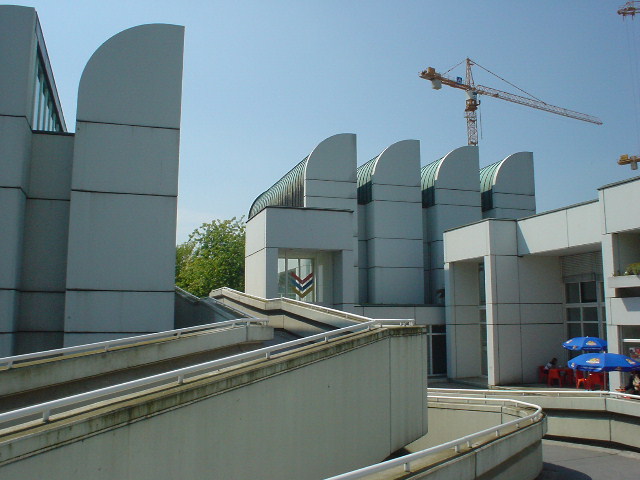
TO THE NORMAL MILD-MANNERED TOURIST in Berlin, the Bauhaus-Archive Museum might not be an exciting place to visit — it’s not recommended by any guidebook — but as a designer myself, one of today’s many descendants of superheroes, I felt an obligation to pay my respects to the forefathers of the other life I lead. With great power comes great responsibility. Setting foot on the grounds of the museum, I felt like I was coming home to a sacred place where all the magic happens, like Batman to the Batcave and Superman to the Fortress of Solitude. The museum itself was a work of art (picture above), designed by Bauhaus founder Gropius himself.
Inside the museum were original works I had learned about in design school, from Breuer’s slick-looking, ahead-of-its-time furniture, to Moholy-Nagy’s photos, to Klee’s studies of color theory, to Schlemmer’s sculptures, to a model of the original Bauhaus in Weimar, also designed by Gropius. Again, not so exciting to the average person, but exhilarating and inspiring to anyone that has studied modern design.
NO LEAGUE OF SUPERHEROES IS COMPLETE without an equally powerful nemesis, a band of bad guys, and in the Bauhaus’ case it was the Nazi party. While the new thinking and commercial work coming out of the Bauhaus was a success and beloved by most of the German public, it was the Nazis that wanted to put an end to it all. One day in 1932, Hitler’s goons raided the Bauhaus, arresting over thirty students for their non-conformist thinking. Soon after, The Third Reich dismantled the Bauhaus, forcing its team of superheroes to disband and flee the country like refugees. However, this didn’t stop the Bauhaus; in 1937, Moholy-Nagy opened the New Bauhaus in Chicago.
While the Nazis may have suppressed modern design in Germany, they had only won a battle but not a war. Nowadays, modern design reigns supreme, particularly in a city like Berlin, a city continually in construction of new, sleek-looking post-modern buildings. None is more evident to this than Berlin’s crown jewel of post-modern architecture, the futuristic-looking Sony Center, and ultra-slick superstructure that truly symbolizes Gropius’ original idea: “art and technology, a new unity.”
The triumph of the avant-garde thinking of the Bauhaus over stuffy old regimes is also evident in the fine art world, as seen in my visit to the 1970s and 80s installation art work of Joseph Beuys in the Hamburger Bahnhof, a former train station-turned-contemporary art museum. More recently than that are the colorful graffiti murals painted in the East Side Gallery, a preserved section of the Berlin Wall about a mile long. But nothing really hits the point home more than what has happened to the Reichstag, the government palace where the Nazis once ruled — now there is an ultra-modern observation dome on its roof (complete with a solar cone inside that powers the building).
AFTER A LONG DAY OF WALKING THE STREETS and through the Tiergarten, riding on trains to the modern and contemporary sights of “New Berlin,” I was really exhausted. I fell asleep pretty early that night when I merely put my head down to rest. What can I say? Superheroes, and the descendants thereof, need their rest too, you know.
Next entry: Perfect Strangers
Previous entry: History On Wheels
Commenting is not available in this channel entry.
Comments for “House of Superheroes”
Could I be first?
I didn’t know about this museum, very cool. Thanks for the history lesson.Posted by .(JavaScript must be enabled to view this email address) on 07/31 at 05:41 PM
I agree - thanks for the history lesson. I used to go to a Bauhaus coffee shop in high school in Seattle, but never knew its origins.
So, does the solar cone power the entire building, like are they “off the grid?” Or do they have to rely on some other sorts of power? That’s really cool.
Awesome pics again.Posted by .(JavaScript must be enabled to view this email address) on 07/31 at 06:56 PM
ummm…can you say design nerd? hahaha….
it’s ok tho, i get like this excited over wireless technology…
Posted by .(JavaScript must be enabled to view this email address) on 08/01 at 07:27 AM
MARKYT: Hahaha… I’m WiFi-ing it right now in a Moscow shopping mall…
Posted by .(JavaScript must be enabled to view this email address) on 08/01 at 04:31 PM
Erik - I saw THE BOURNE SUPREMACY last night and there’s a wicked awesome car chase that happens in Moscow. So now I’m just on pins and needles waiting to hear your story about the city…
Posted by .(JavaScript must be enabled to view this email address) on 08/01 at 04:53 PM
NOELLE: I didn’t see the Bourne movies, but did Matt Damon get stopped randomly by Russian officers on the street asking to see his passport and visa? It happens all over and one little glitch and it costs you a bribe…
Posted by .(JavaScript must be enabled to view this email address) on 08/01 at 04:57 PM
Erik - Be careful of Russian “police” asking to see your passport - many of them aren’t police at all, and are just looking for a bribe or worse, to take your money. They target tourists who don’t know any better - they will ask to see your passport, say there is a problem, then give you the run around ofr an hour or so and ask for a bribe to get rid of them. Happened to a friend of mine twice in St Petersburg before she wised up. If it happens again, insist you go to the police station or the US embassy to sort it all out - that ususally sends them running.
Posted by dunlavey on 08/01 at 05:54 PM
PS - If they DO go to the police station, stick to the main streets with them - don’t take any suggested “shortcuts” to the police station through alleyways and such. This is a pretty common scam in Russia - by both scam artists and legitimate police. They aren’t out to hurt you or anything - but you could get robbed for everything - once again. Be safe!
Posted by dunlavey on 08/01 at 05:58 PM
I remember all those designers from college art history! That museum is so cool. I don’t work in design but I really hate ugly furniture, cheap-looking logos, etc. You are right - design is important! Who knew the nazis went after that too.
Posted by .(JavaScript must be enabled to view this email address) on 08/01 at 06:46 PM
likin’ the lessons in history here…i had no idea! keep up the great work and enjoy! don’t stress too much on keeping up with the blog.
on another note, you kept talking about the superfriends and i couldn’t help but remember this awesome work of art by rex naverette:
http://fractalcow.com/rex/index.html
Posted by .(JavaScript must be enabled to view this email address) on 08/01 at 10:05 PM
STEPHANIE - definitely classic rex!
Posted by .(JavaScript must be enabled to view this email address) on 08/02 at 01:30 AM
Erik - he does get chased by a crooked agent, though… It’s a great chase scene - but if you’re easily sick, don’t watch it… it is all handheld cameras!!
Fantastic… I wanna go back to Moscow!
Posted by .(JavaScript must be enabled to view this email address) on 08/02 at 03:58 AM
DUNLAVEY: Thanks for the tip; my traveling friend Sam already had “US Embassy in Moscow” on his cell phone as a pre-dial to threaten fake cops with… We haven’t needed it though; I’ve notice that the cops (or so-called-cops) only check people who are in their regular walking path; they don’t go searching for victims. Simply avoid them and avoid an inspection…
Posted by .(JavaScript must be enabled to view this email address) on 08/02 at 11:02 AM
SHARE THIS TRAVEL DISPATCH:
Follow The Global Trip on Twitter
Follow The Global Trip in Instagram
Become a TGT Fan on Facebook
Subscribe to the RSS Feed
This blog post is one of over 500 travel dispatches from the trip blog, "The Global Trip 2004: Sixteen Months Around The World (Or Until Money Runs Out, Whichever Comes First)," originally hosted by BootsnAll.com. It chronicled a trip around the world from October 2003 to March 2005, which encompassed travel through thirty-seven countries in North America, South America, Africa, Europe, and Asia. It was this blog that "started it all," where Erik evolved and honed his style of travel blogging — it starts to come into focus around the time he arrives in Africa.
 Praised and recommended by USA Today, RickSteves.com, and readers of BootsnAll and Lonely Planet's Thorn Tree, The Global Trip blog was selected by the editors of PC Magazine for the "Top 100 Sites You Didn't Know You Couldn't Live Without" (in the travel category) in 2005.
Next entry:
Perfect Strangers
Previous entry:
History On Wheels
THE GLOBAL TRIP GLOSSARY
Confused at some of the jargon that's developed with this blog and its readers over the years? Here's what they mean:
BFFN: acronym for "Best Friend For Now"; a friend made on the road, who will share travel experiences for the time being, only to part ways and lose touch withThe Big Trip: the original sixteen month around-the-world trip that started it all, spanning 37 countries in 5 continents over 503 days (October 2003–March 2005)
NIZ: acronym for "No Internet Zone"; a place where there is little to no Internet access, thus preventing dispatches from being posted.
SBR: acronym for "Silent Blog Reader"; a person who has regularly followed The Global Trip blog for years without ever commenting or making his/her presence known to the rest of the reading community. (Breaking this silence by commenting is encouraged.)
Stupid o'clock: any time of the early morning that you have to wake up to catch a train, bus, plane, or tour. Usually any time before 6 a.m. is automatically “stupid o’clock.”
The Trinidad Show: a nickname of The Global Trip blog, used particularly by travelers that have been written about, who are self-aware that they have become "characters" in a long-running story — like characters in the Jim Carrey movie, The Truman Show.
WHMMR: acronym for "Western Hemisphere Monday Morning Rush"; an unofficial deadline to get new content up by a Monday morning, in time for readers in the western hemisphere (i.e. the majority North American audience) heading back to their computers.
1981ers: people born after 1981. Originally, this was to designate groups of young backpackers fresh out of school, many of which were loud, boorish and/or annoying. However, time has passed and 1981ers have matured and have been quite pleasant to travel with. The term still refers to young annoying backpackers, regardless of year — I guess you could call them "1991ers" in 2013 — young, entitled millennials on the road these days, essentially.
Spelling or grammar error? A picture not loading properly? Help keep this blog as good as it can be by reporting bugs.