Heels On The Hill
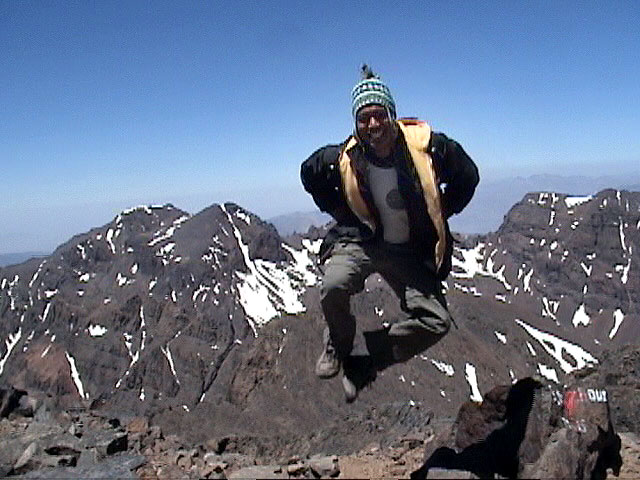
This blog entry about the events of Wednesday, June 23, 2004 was originally posted on June 28, 2004.
DAY 249: One of the dangers of mountain trekking is mountain sickness, caused by the lack of sufficient oxygen to the brain in high altitudes. Mountain sickness (or “altitude sickness”) affects different people in different ways at different levels of severity. For example, when I climbed to the altitude of 5681m. up Mount Kilimanjaro with a Japanese guy named Kenji, the thin air caused me to vomit three times and it put Kenji into a delirious, near-vegetable state.
The effects of mountain sickness were bound to happen again as I continued the second day of a two-day trek up to the peak of Djebel Toubkal at 4167m. ASL, this time not with a Japanese vegetable but a Canadian named Sebastian.
A SLICE OF CANTALOUPE CAME AT THE BEGINNING of our estimated two-hour trek from the refuge to the peak, up a steeper trail that sometimes passed through snow patches. Two hours was the estimated time according to the book, and when we ran into Aussie Jess already on her way down, she said it took her two hours too. But for us, we took twice that amount of time, reason being we always managed to follow a trail that we thought was the right way but discovered that it just diminished into nothing. What made it worse was that all these fake trails went up slopes of loose rocks and the entire ascent was a balancing act. One step up sometimes took you one step down in rubble. What made it more worse was when we got up to about the 4000m. mark and the air really began to thin out, mild mountain sickness took its toll on us in different ways.
“You alright?” Sebastian asked me from time to time. He was always about twenty feet ahead of me.
“Yeah,” I said, catching my breath. I grunted as my thighs started to burn.
“You’re walking like a drunken zombie!” he said, laughing hysterically.
The thin air was affecting us in opposite ways, making me sluggish and tired and making Sebastian all giggly like he was a dentist abusing his supply of nitrous oxide after hours. During one of our numerous breaks for Laughing Cow cheese sandwiches, I attempted to sit on a nearby rock in my stupor, missing it entirely. My ass didn’t even make any sort of contact with the stone and Sebastian laughed his head off at me (not with me).
Episodes like this continued as we took our time up to the peak, and it epitomized after we took a break in a area where we could finally see the very top — up until then the peak was hidden from us with a steep rock face. I got a second wind, sprung up from my seat and started a funny power walk up the trail, my arms swinging side to side like Popeye. Sebastian started laughing so hard that he couldn’t move and just crouched down, clenching his stomach in hysterics. I kicked it up a notch when I ran and kicked my heels in the air like in an Irish jig, and he almost died laughing — literally that is; he was laughing so hard he might have fallen backwards down a steep drop.
We reached the peak around 10:30, after most groups had come and started their approach back down the way they came already. One group of about a dozen French remained, but kept to themselves with their guide and fancy food. Sebastian and I just rested a bit at the top with our Laughing Cow cheese sandwiches, inhaling the thin, but fresh mountain air, enjoying the view, climbing the peak marker, pissing off the side of the top and — our new simple pleasure — goofing off with Irish jigs (picture above).
“AH, THICK AIR,” Sebastian said. “Should we set a timer?” In the few days that I had known him, Sebastian was notorious for timing things on his stopwatch for fun.
“Sure.”
“How much time?”
“Three hours.”
“How about three and a half?”
“Three twenty.”
“Okay,” he said, setting the timer. “So what happens if we don’t make it in three twenty?”
“All of Morocco will blow up,” I said. This was an amazing goal to set because those were the same stakes when we set a timer the day before over and over, and apparently, Morocco had already blown up three times.
Coming down the mountain from the peak to the refuge wasn’t as hard a chore as the ascent, although it was much more of a balancing act walking downhill on the loose rocks. Our knees absorbed the shocks of our weight bouncing down — except for when we passed through a couple of snow patches and slid down.
After some more Laughing Cow cheese sandwiches and swigs of my obsession, Pom’s apple soda, we were back on the gradually descending trail back down to the base of the valley with our big backpacks on. The gradual increase of oxygen only made us go faster than any one else and we overtook about fifty people all the way down, one of which was annoyed with us when we tried to pass her.
“There’s something called manners you know,” the elderly British hag said with her stiff British accent. “Must you be on my heels!”
“I’m sorry, I’m just trying to catch up to my friend,” I said, pointing to Sebastian far ahead of me around a bend. I ditched the old hag and caught up, thinking that perhaps a little Irish jig might have raised her spirits.
“I guess we’re obligated to not have her catch up,” Sebastian said to me.
WITH OUR OXYGEN-POWERED SPEED, we made it back down to the village of Imlil in two hours, one hour ahead of the average time, saving all of Morocco from total oblivion. We walked across the village, passed its villagers and their livestock — Sebastian got busted trying to a photo of a Muslim woman, her kid, her sheep and her cow — and arrived at the parking lot where all the grand taxis picked up and dropped off passengers. We met two French women there waiting for more people to fill the six-person quota for a taxi to Asni, or if it would take us, all the way back to Marrakesh.
“[There are no more taxis here,]” a guy told us as one taxi was filling by some trekkers that reserved it in advance. The shady guy was trying to lead us to another part of town. The French women and I skeptically believed him until Sebastian asked a third party if it was true.
“[He just told me there is another taxi coming here,]” Sebastian told the guy.
“[You are from the toilet,]” he said. Meanwhile, another guy nearby whipped out some Moroccan bracelets and daggers from under his galabiyya cloak trying to make a sale, but we declined.
TWO TAXI RIDES LATER, two Moroccan men, two French women, one Canadian and I arrived back in Marrakesh. “Let’s go rock the hammam,” I said. After a muscular strenuous day of trekking up and down north Africa’s highest peak, a steam bath and massage was in order, no matter how awkward it was to feel the touch of another man’s hand near my privates. For my second and Sebastian’s first hammam, we decided to rock the hammam not at the Hotel Ali, but at the public hammam in town in attempts to get a more authentic experience. Its authenticity couldn’t be more perfect, with wrinkly old guys bathing us in a much more thorough and rigorous manner than Mohammed the Pizza Man at the Hammam Ali. More scrubbing, more lathering and more kneading of the muscles and body contortion “relaxed” us as we lay on the ceramic floor like animals. I put “relaxed” in quotes because it was less like a bath and more like a steamy hot workout.
“I don’t know if I’m more tired from the trek or the hammam,” I told Sebastian, staggering through the Place Djemaa el-Fna the way I did at the high altitude earlier that day. We went out for dinner at one of the many food stands in the main square. Regardless of my sore body muscles, I was still pretty content with the events of the day and showed it by kicking my heels in the air once again. After all, Morocco was still in one piece.
Next entry: High, Dry and Hassle-Free
Previous entry: Animated Ascent
Commenting is not available in this channel entry.
Comments for “Heels On The Hill”
BLOG HOGS, SBRs AND NEWCOMERS: Hey, I’m still playing catch up; that’s all I have for now. I’m officially four days behind now, but will catch up on Blog duties during my long 2-day journey from Fez, Morocco to Barcelona, Spain…
Stay tuned!
Posted by .(JavaScript must be enabled to view this email address) on 06/28 at 02:38 PM
ERIK - you know what I’m thinking already about the main pic….hahahaha….
it would have been waaay funnier if you pushed the old british hag down the mountain….or if you called up good old acme and ordered an anvil to drop on her head…
Posted by .(JavaScript must be enabled to view this email address) on 06/28 at 05:34 PM
i wonder if the british lady is a distant cousin of the shawl….. i am pretty sure the trail is big enough for the both of you to walk on, she was just grouchy. though those mountains would make a good setting for a road runner/wile e. coyote parody in the trinidad show. =)
Posted by .(JavaScript must be enabled to view this email address) on 06/28 at 05:55 PM
Wow - you can do an Irish jig when you’re high with altitude sickness - I’m impressed… glad you didn’t fall.
Where’s an anvil when you need one?
Posted by .(JavaScript must be enabled to view this email address) on 06/28 at 06:08 PM
that opening picture makes me wanna sing “ooooompa loooompa dooooompety doooo”
whoa.
Posted by hanalei on 06/28 at 06:55 PM
Are you going to miss those hammams when you get to Spain?
Sadly, after you run with the bulls you might have to take a normal shower. (with the same little green olive-oil soap they seem to put in every pensione shower in Spain)
Posted by .(JavaScript must be enabled to view this email address) on 06/28 at 07:07 PM
Good stuff Erik. So how many mountains does that make? Weren’t there a few in South America too?
Posted by .(JavaScript must be enabled to view this email address) on 06/28 at 09:22 PM
Erik -
East coast girl here. I stumbled onto your blog accidentally and have spent a lot of my “precious” work time just reading and enjoying your blog…and it makes me appear busy too! So, not only am I entertained but people don’t bother me because I look immersed in my “work”. Your blog has made me feel like your traveling companion and encouraged me to really go for my RTW dream trip. I look forward to more posts.
Thanks.
Posted by .(JavaScript must be enabled to view this email address) on 06/29 at 12:35 AM
CASEY - ooohh..another east coaster converted! yes!...welcome on behalf of the all the BHs!...
Posted by .(JavaScript must be enabled to view this email address) on 06/29 at 01:37 AM
Okay, all I’m doing is seconding people’s comments now - yeah, Mr. E - how many mountains is that so far?
To be honest with you, I wasn’t aware that there were mountains that high in Africa, other than Kili…
Posted by .(JavaScript must be enabled to view this email address) on 06/29 at 01:45 AM
speaking of mountains…
did you know that the maximum height of a mountain on earth is 21.7 miles?
Posted by .(JavaScript must be enabled to view this email address) on 06/29 at 03:28 AM
Is that the max recorded height? And does that include underwater mountains?
But, thank you for that lovely piece of useless info, Markyt.
Posted by .(JavaScript must be enabled to view this email address) on 06/29 at 04:48 AM
it’s not the max recorded height, it’s the max scientific height….it has something to do with equilibrium with pressure at the base…
i dunno…just read it in the latest wired magazine…
Posted by .(JavaScript must be enabled to view this email address) on 06/29 at 07:49 AM
What a lovely jig on top of a mountain!
LovePenny: It’s just Isa

Posted by .(JavaScript must be enabled to view this email address) on 06/29 at 04:33 PM
YO E - off to montreal…so if you need anything uploaded or anything like that…just email me…and i can still get it down on some free wifi i’ll find…
Posted by .(JavaScript must be enabled to view this email address) on 06/29 at 05:11 PM
Nice hat!
Posted by .(JavaScript must be enabled to view this email address) on 06/29 at 05:28 PM
NIZ Helper: http://www.trevorvanmeter.com/flyguy/
Posted by .(JavaScript must be enabled to view this email address) on 06/29 at 05:41 PM
NIZ Helper: http://www.trevorvanmeter.com/flyguy/
Posted by .(JavaScript must be enabled to view this email address) on 06/29 at 05:41 PM
LP - cute

Posted by .(JavaScript must be enabled to view this email address) on 06/29 at 05:59 PM
NIZ ? here’s something ; http://www.superlaugh.com/1/bushgirl.htm
Posted by .(JavaScript must be enabled to view this email address) on 06/29 at 08:13 PM
Bye Erik! Fun times. We laughed, we cried, we blew up Morocco of several occasions.
re: yesterday?s cartoons
Okokok, I don?t have long to try to explain this right now, but I fear that I have been misunderstood. I?ll see if I can?t clarify: the idea was not so much that it was the first cartoon to do recognize it?s own cartoon nature, but more that it was the end of an era of cartoon naivete that existed (ex. tale spin, tom and jerry, ducktales….), where cartoons could truly exist independantly of reality; I believe Darkwing Duck to be the dawning of a new era of irony, sarcasm, and introspection (there were several-I?ll try to provide some more examples later, but the Animaniacs were perhaps the epitome). This is not to say that Bugs Bunny had not, in the past, drawn himself, talked to his creators, or that Wile E. Coyote did not know that we knew that he was headed off that cliff, but that the impact was not the same on the cartoon world. Once darkwing duck, a cartoon superhero himself, actually started subtly and not-so-subtly mocking cartoon superheros, all was changed. I don?t quite know why it had to be him, and maybe it was the whole conjuncture, but our animated friends could just never quite ignore his assaults on the cartoon world, and for a long time things were just not quite the same. Hence the heralding of post-modern Saturday mornings.
I?ve not really been up to date on these matters recently, but it strikes me that after a period of readjustment, things seemed to have more or less normalized. That is, that they have accepted their cartoon status, dealt with it, and moved on to other things. Being two-dimensional is not shameful, but at some point or other it simply had to be acknowledged.Just some thoughts for y’all. Perhaps I lack a broader historical perspective, or perhaps it was the lack of oxygen that made me say it, but yet, even as a mere child, I sensed that something, somewhere, in that seemingly harmless cartoon just wasn?t quite right….
Posted by .(JavaScript must be enabled to view this email address) on 06/29 at 08:29 PM
Bye Erik! Fun times. We laughed, we cried, we blew up Morocco of several occasions.
re: yesterday?s cartoons
Okokok, I don?t have long to try to explain this right now, but I fear that I have been misunderstood. I?ll see if I can?t clarify: the idea was not so much that it was the first cartoon to do recognize it?s own cartoon nature, but more that it was the end of an era of cartoon naivete that existed (ex. tale spin, tom and jerry, ducktales….), where cartoons could truly exist independantly of reality; I believe Darkwing Duck to be the dawning of a new era of irony, sarcasm, and introspection (there were several-I?ll try to provide some more examples later, but the Animaniacs were perhaps the epitome). This is not to say that Bugs Bunny had not, in the past, drawn himself, talked to his creators, or that Wile E. Coyote did not know that we knew that he was headed off that cliff, but that the impact was not the same on the cartoon world. Once darkwing duck, a cartoon superhero himself, actually started subtly and not-so-subtly mocking cartoon superheros, all was changed. I don?t quite know why it had to be him, and maybe it was the whole conjuncture, but our animated friends could just never quite ignore his assaults on the cartoon world, and for a long time things were just not quite the same. Hence the heralding of post-modern Saturday mornings.
I?ve not really been up to date on these matters recently, but it strikes me that after a period of readjustment, things seemed to have more or less normalized. That is, that they have accepted their cartoon status, dealt with it, and moved on to other things. Being two-dimensional is not shameful, but at some point or other it simply had to be acknowledged.Just some thoughts for y’all. Perhaps I lack a broader historical perspective, or perhaps it was the lack of oxygen that made me say it, but yet, even as a mere child, I sensed that something, somewhere, in that seemingly harmless cartoon just wasn?t quite right….
Posted by .(JavaScript must be enabled to view this email address) on 06/29 at 08:29 PM
Bye Erik! Fun times. We laughed, we cried, we blew up Morocco of several occasions.
re: yesterday?s cartoons
Okokok, I don?t have long to try to explain this right now, but I fear that I have been misunderstood. I?ll see if I can?t clarify: the idea was not so much that it was the first cartoon to do recognize it?s own cartoon nature, but more that it was the end of an era of cartoon naivete that existed (ex. tale spin, tom and jerry, ducktales….), where cartoons could truly exist independantly of reality; I believe Darkwing Duck to be the dawning of a new era of irony, sarcasm, and introspection (there were several-I?ll try to provide some more examples later, but the Animaniacs were perhaps the epitome). This is not to say that Bugs Bunny had not, in the past, drawn himself, talked to his creators, or that Wile E. Coyote did not know that we knew that he was headed off that cliff, but that the impact was not the same on the cartoon world. Once darkwing duck, a cartoon superhero himself, actually started subtly and not-so-subtly mocking cartoon superheros, all was changed. I don?t quite know why it had to be him, and maybe it was the whole conjuncture, but our animated friends could just never quite ignore his assaults on the cartoon world, and for a long time things were just not quite the same. Hence the heralding of post-modern Saturday mornings.
I?ve not really been up to date on these matters recently, but it strikes me that after a period of readjustment, things seemed to have more or less normalized. That is, that they have accepted their cartoon status, dealt with it, and moved on to other things. Being two-dimensional is not shameful, but at some point or other it simply had to be acknowledged.Just some thoughts for y’all. Perhaps I lack a broader historical perspective, or perhaps it was the lack of oxygen that made me say it, but yet, even as a mere child, I sensed that something, somewhere, in that seemingly harmless cartoon just wasn?t quite right….
Posted by .(JavaScript must be enabled to view this email address) on 06/29 at 08:29 PM
Bye Erik! Fun times. We laughed, we cried, we blew up Morocco of several occasions.
re: yesterday?s cartoons
Okokok, I don?t have long to try to explain this right now, but I fear that I have been misunderstood. I?ll see if I can?t clarify: the idea was not so much that it was the first cartoon to do recognize it?s own cartoon nature, but more that it was the end of an era of cartoon naivete that existed (ex. tale spin, tom and jerry, ducktales….), where cartoons could truly exist independantly of reality; I believe Darkwing Duck to be the dawning of a new era of irony, sarcasm, and introspection (there were several-I?ll try to provide some more examples later, but the Animaniacs were perhaps the epitome). This is not to say that Bugs Bunny had not, in the past, drawn himself, talked to his creators, or that Wile E. Coyote did not know that we knew that he was headed off that cliff, but that the impact was not the same on the cartoon world. Once darkwing duck, a cartoon superhero himself, actually started subtly and not-so-subtly mocking cartoon superheros, all was changed. I don?t quite know why it had to be him, and maybe it was the whole conjuncture, but our animated friends could just never quite ignore his assaults on the cartoon world, and for a long time things were just not quite the same. Hence the heralding of post-modern Saturday mornings.
I?ve not really been up to date on these matters recently, but it strikes me that after a period of readjustment, things seemed to have more or less normalized. That is, that they have accepted their cartoon status, dealt with it, and moved on to other things. Being two-dimensional is not shameful, but at some point or other it simply had to be acknowledged.Just some thoughts for y’all. Perhaps I lack a broader historical perspective, or perhaps it was the lack of oxygen that made me say it, but yet, even as a mere child, I sensed that something, somewhere, in that seemingly harmless cartoon just wasn?t quite right….
Posted by .(JavaScript must be enabled to view this email address) on 06/29 at 08:29 PM
Bye Erik! Fun times. We laughed, we cried, we blew up Morocco of several occasions.
re: yesterday?s cartoons
Okokok, I don?t have long to try to explain this right now, but I fear that I have been misunderstood. I?ll see if I can?t clarify: the idea was not so much that it was the first cartoon to do recognize it?s own cartoon nature, but more that it was the end of an era of cartoon naivete that existed (ex. tale spin, tom and jerry, ducktales….), where cartoons could truly exist independantly of reality; I believe Darkwing Duck to be the dawning of a new era of irony, sarcasm, and introspection (there were several-I?ll try to provide some more examples later, but the Animaniacs were perhaps the epitome). This is not to say that Bugs Bunny had not, in the past, drawn himself, talked to his creators, or that Wile E. Coyote did not know that we knew that he was headed off that cliff, but that the impact was not the same on the cartoon world. Once darkwing duck, a cartoon superhero himself, actually started subtly and not-so-subtly mocking cartoon superheros, all was changed. I don?t quite know why it had to be him, and maybe it was the whole conjuncture, but our animated friends could just never quite ignore his assaults on the cartoon world, and for a long time things were just not quite the same. Hence the heralding of post-modern Saturday mornings.
I?ve not really been up to date on these matters recently, but it strikes me that after a period of readjustment, things seemed to have more or less normalized. That is, that they have accepted their cartoon status, dealt with it, and moved on to other things. Being two-dimensional is not shameful, but at some point or other it simply had to be acknowledged.Just some thoughts for y’all. Perhaps I lack a broader historical perspective, or perhaps it was the lack of oxygen that made me say it, but yet, even as a mere child, I sensed that something, somewhere, in that seemingly harmless cartoon just wasn?t quite right….
Posted by .(JavaScript must be enabled to view this email address) on 06/29 at 08:29 PM
i think you hit the ‘enter’ button 4 times.
Posted by .(JavaScript must be enabled to view this email address) on 06/29 at 10:12 PM
LP - that’s funny. And a wonderful way to waste time… thanks.
Posted by .(JavaScript must be enabled to view this email address) on 06/29 at 10:34 PM
Sim - ew, that’s just WRONG!!
Posted by .(JavaScript must be enabled to view this email address) on 06/29 at 10:35 PM
markyt -
Thanks for the warm welcome.! Looks like you had a great time in Rio.
Are you going to meet up with Eric on any of his other travels before he comes back to the U.S.?Posted by .(JavaScript must be enabled to view this email address) on 06/29 at 10:38 PM
Confessions of a FBH (Former Blog Hog)
I am still enjoying your journeys… haven’t really had the time to post anything, having the in-laws with us has been great, but killed my IM schedule. There’s just no knowing when you are going to post if I don’t have AIM or MSN running all day and night…. which usually means no “first” posts :-(
Happy Trails E-double! Keep up the good work.D.
Posted by .(JavaScript must be enabled to view this email address) on 06/29 at 10:47 PM
GREETINGS FROM SPAIN… im at an internet kiosk in Madrid…. more to come from Barcelona soon!
Posted by .(JavaScript must be enabled to view this email address) on 06/29 at 11:54 PM
GREETINGS FROM SPAIN… im at an internet kiosk in Madrid…. more to come from Barcelona soon!
Posted by .(JavaScript must be enabled to view this email address) on 06/29 at 11:55 PM
HAPPY SPAIN!!! I’m living vicariously!
Posted by .(JavaScript must be enabled to view this email address) on 06/30 at 03:26 AM
CASEY - it doesn’t look like it….but you never know…..i like producing behind the scenes anyway….
DUAINE - you’ve got plenty more posts to get that pole position my friend….
Posted by .(JavaScript must be enabled to view this email address) on 06/30 at 04:05 AM
SABASTIAN: That was beautiful! I completly agree. Animaniacs was without doubt, the epitome of cartoon self-awareness.
Posted by .(JavaScript must be enabled to view this email address) on 06/30 at 07:36 AM
you guys are having too much fun !!!
wish i was there
wwPosted by .(JavaScript must be enabled to view this email address) on 06/30 at 07:59 AM
CASEY & WENDY: Welcome to The Fellowship of The Blog! Pass the word along!
Posted by .(JavaScript must be enabled to view this email address) on 06/30 at 11:15 AM
Tdot: thanks
Erik: I think I hit the enter button a bunch of times. Yesterday too. Call it fervour. Then delete the copies.Posted by .(JavaScript must be enabled to view this email address) on 06/30 at 09:05 PM
SHARE THIS TRAVEL DISPATCH:
Follow The Global Trip on Twitter
Follow The Global Trip in Instagram
Become a TGT Fan on Facebook
Subscribe to the RSS Feed
This blog post is one of over 500 travel dispatches from the trip blog, "The Global Trip 2004: Sixteen Months Around The World (Or Until Money Runs Out, Whichever Comes First)," originally hosted by BootsnAll.com. It chronicled a trip around the world from October 2003 to March 2005, which encompassed travel through thirty-seven countries in North America, South America, Africa, Europe, and Asia. It was this blog that "started it all," where Erik evolved and honed his style of travel blogging — it starts to come into focus around the time he arrives in Africa.
 Praised and recommended by USA Today, RickSteves.com, and readers of BootsnAll and Lonely Planet's Thorn Tree, The Global Trip blog was selected by the editors of PC Magazine for the "Top 100 Sites You Didn't Know You Couldn't Live Without" (in the travel category) in 2005.
Next entry:
High, Dry and Hassle-Free
Previous entry:
Animated Ascent
THE GLOBAL TRIP GLOSSARY
Confused at some of the jargon that's developed with this blog and its readers over the years? Here's what they mean:
BFFN: acronym for "Best Friend For Now"; a friend made on the road, who will share travel experiences for the time being, only to part ways and lose touch withThe Big Trip: the original sixteen month around-the-world trip that started it all, spanning 37 countries in 5 continents over 503 days (October 2003–March 2005)
NIZ: acronym for "No Internet Zone"; a place where there is little to no Internet access, thus preventing dispatches from being posted.
SBR: acronym for "Silent Blog Reader"; a person who has regularly followed The Global Trip blog for years without ever commenting or making his/her presence known to the rest of the reading community. (Breaking this silence by commenting is encouraged.)
Stupid o'clock: any time of the early morning that you have to wake up to catch a train, bus, plane, or tour. Usually any time before 6 a.m. is automatically “stupid o’clock.”
The Trinidad Show: a nickname of The Global Trip blog, used particularly by travelers that have been written about, who are self-aware that they have become "characters" in a long-running story — like characters in the Jim Carrey movie, The Truman Show.
WHMMR: acronym for "Western Hemisphere Monday Morning Rush"; an unofficial deadline to get new content up by a Monday morning, in time for readers in the western hemisphere (i.e. the majority North American audience) heading back to their computers.
1981ers: people born after 1981. Originally, this was to designate groups of young backpackers fresh out of school, many of which were loud, boorish and/or annoying. However, time has passed and 1981ers have matured and have been quite pleasant to travel with. The term still refers to young annoying backpackers, regardless of year — I guess you could call them "1991ers" in 2013 — young, entitled millennials on the road these days, essentially.
Spelling or grammar error? A picture not loading properly? Help keep this blog as good as it can be by reporting bugs.