Guidance Counseling
This blog entry about the events of Sunday, March 19, 2006 was originally posted on March 20, 2006.
DAY 3: “Est la musée nationale ouvert aujourd’hui?” I asked Omar, the guy in the hotel restaurant who spoke a little English. Contrary to both my guidebooks, he said it was in fact open. (The books said it was closed every Monday.)
“Est-ce qu’il y a une banke pour echanger l’argent?” (“Is there a bank for exchanging money?”) I asked in my high school French. He told me the general direction, but stammered in the translation and only confused me. Then he offered to take me there if I wanted.
“D’accord. [At eleven,]” I told him. He said he had some errands to run, but would meet me. He left while I attended to my coffee and bread alone in the restaurant, until another face stopped by to greet me. It was Hassan, the tout from the night before, coming to offer me more business. He sat at my table uninvited, and pushed some tourist pictures on me along with some small binder with itineraries and a hokey-looking certificate of tourism — a must-have for all touts around the world. I gazed at them but declined. Then he offered to take me to a place to exchange money, and I declined again. Seeing that I wasn’t going to give me any business, he went with Plan B and accused me of short-changing him the night before. In his rhetoric, he told me that I still owed him CFA 1000 because I only gave X amount to the driver and X amount to him, and X amount went towards the drinking water. I told him he should take it up with the driver and that I didn’t have any change anyway. I walked away and went back to my room.
I CHOSE THE HOTEL “LE DJENNÉ” as a place to stay in Bamako as both my guidebooks raved about its decor — it is the only mid-range hotel in Bamako that actually has any character with the entire place decorated by Malian artists, with traditional paintings, sculptures around everywhere. Moreover, the staff was friendly, especially Abraham, a kind Muslim man in a galabiyya, the only guy on staff that could speak a little English.
At eleven, Omar was a no-show and Hassan was ready to pounce me outside, so I went to Abraham to ask him for a place to exchange money. He said the hotel would just do it for me, and he sent one of the staff members to change my eighty bucks at a reputable place on the black market. Hassan had peeked in and saw that I had no use for him anymore, but wouldn’t stop hounding me. “I can take you to the museum.”
“It’s okay,” I said. “I don’t need a guide.”
Abraham looked on with concern and yelled at him to get out of there and leave me alone — but Hassan wouldn’t leave. “You have to give me one thousand francs,” he said again, citing the same argument as before.
“Take it up with the driver.”
He made some excuse and yadda yadda yadda, and I knew the situation would drag on, so I gave him a US buck in hopes to shut him up. “This is only five hundred,” he said correctly. “You have to give me one thousand.” Sighing, I just gave him another buck, which finally satisfied him. I might have felt cheated, but I had read on the Bootsnall.com travel boards that someone else had been in a similar situation in Mali, and the tout went as far as to follow her all the way to another town to threaten police action against her. I figured two bucks was worth eliminating that drama.
With the two dollars in hand, Hassan finally left me, snapped his fingers and called out “Vamos!” (in Spanish?) to his two cronies who had accompanied him to scam me the rest of the day. Abraham looked on and shook his head in disappointment — I wasn’t sure it if was for me for giving in, or for Hassan for being a disgrace to Mali’s future. In the end, I hadn’t seen Hassan again for the rest of the day. Omar finally showed up and I politely told him that I was just going to walk to the museum, which he was okay with.
THE LONELY PLANET AND BRADT GUIDE had it right when they said the National Museum was closed on Mondays. I found out myself when I took the thirty-minute walk over there, near the base of the Manding Mountains that flank the north of the city. Other museums were closed as well and so I just wandered the streets on foot to get a feel of Mali’s capital. The guidebooks had it right when describing it as “gritty” and “sprawling” as I saw firsthand walking from neighborhood to neighborhood. Like most African urban centers, it had its crowded market streets, ghettos, and the occasional modern-looking building like the towering West African Bank headquarters.
That’s not to say that collectively it’s all a bad thing; African cities are what they are, and they do have buzz: young men hauling goods on wagons, people wandering selling everything from belts to fruit, women in colorful textiles with baskets on their heads and babies strapped to their backs, little barber shop huts, and of course, motorbikes galore — including one I saw with live goats strapped to the handlebars.
Walking through Bamako’s urban chaos, I expected to be approached by more touts and wannabe guides, but that wasn’t such the case. Only occasionally was I called over with “Salut! Salut!” or the puckering kiss sounds common of Muslim men to call attention. Other than the one guy who begged me for money, claiming he was from Liberia, I was more or less left alone.
The worst part of wandering the city wasn’t the people, nor the pollution, but the heat. At over 100 degrees, the sun doesn’t shine down any harder than in Africa, and it was really talking its toll on me. I thought I could use the towering minarets of the Grand Mosque as a reference not to get lost, but I managed to do so at the hottest part of the day when I thought I might collapse from heat stroke. Luckily I stumbled upon the five-star luxury Kempinski Hotel El Farouk where I grabbed an ice cold Coke at the bar.
“Where are you from?” asked Diarra, the happy concierge at the front desk when I asked for directions back to my hotel.
“United States,” I answered truthfully. He got excited as many of his favorite clients at the hotel were American. We got to talking and he raved about the beauty of Mali, more so the things outside the capital.
“You can see [places] in pictures, but when you actually see it, and touch it, you think, ‘how can a human make this?’” He was very proud of his country and his role in the tourism business. “To show a guest [from another country the beautiful things] of my country,” he said, “it is all we can give.” He said he was willing to take anyone out to see the more impressive things outside the city for free — minus gas costs — but alas, he was working at the hotel. I told him I’d eventually be back in Bamako and we swapped emails.
“You can stay here when you come back,” he pitched.
“Oh, it’s too expensive.”
“You want to see a room?”
“Sure.” My Bradt guide said the best way to see a view of the city was to go to a fancy hotel and look out the window when looking at a room. The rooms on the fourth floor were immaculate, but generically Western with A/C, cable TV and internet. The terrace was the big draw, with views of the city to the north and the Niger River to the south, where fishermen were at work.
Diarra then showed me the ambassador suite at about $350/night. “You can stay here,” he told me.
“I am not an ambassador.”
“Ah,” he chuckled. “If you are American, then you are an Ambassador!”
I noticed the American sentiment in this Muslim country is fairly positive — we didn’t invade them for their oil after all — and I’d seen many American flag designs on signs and buses. Like most countries in the world, American pop culture also has its impact; at one market stall I saw 50 Cent T-shirts and even on the TV in my room, The Tyra Banks Show and Harold and Kumar Go To White Castle were playing on regular broadcast TV (from a Nigerian TV station). Love it or hate it, that’s the way it is; however that night I went looking for something a bit more local.
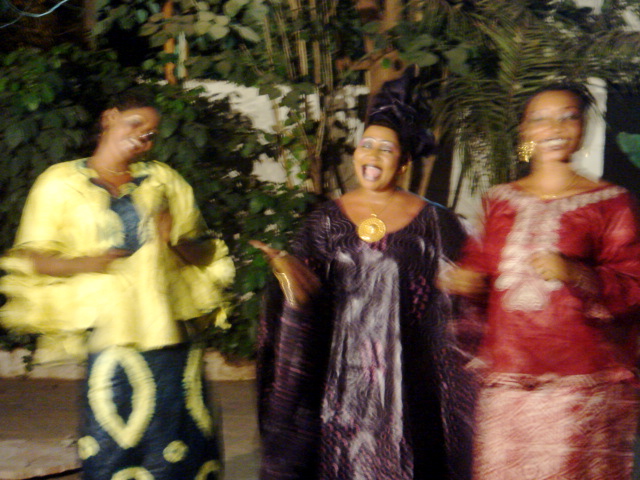
THE NIGHT MANAGER guided me to walk the dark streets to San Toro, a restaurant created by the same guy who did the Le Djenné hotel, the former Minister of Culture and Tourism. While most of Mali’s world-renowned music scene happens on the weekend, San Toro had live music from the kora, a traditional harp-like instrument made of natural elements. It accompanied the traditional decor and the Malian food (mutton with spices). Outside the restaurant I was lucky enough to stumble upon the making of a local music video by some Malian diva (picture above).
“Qui est ça?” (“Who is that?”) I asked one of the guys walking by.
“Tomany Kouyate,” he answered. I had him help me spell it out on paper and realized that sometimes a little guidance in Bamako is helpful after all.
Next entry: To Segou
Previous entry: African Games
Commenting is not available in this channel entry.
Comments for “Guidance Counseling”
Alright, I’m still on schedule. I’ve decided to go to Segou today (3 hrs
away), the next town on the classic trek along the Niger to Timbuktu…Posted by Erik TGT
Keep posting =) I’m reading :D
Posted by chup
Hi Eric!
Enjoying the blog so far, the hastle in a place like that is tough but I
guess you get back into it pretty quickly huh? Looking forward to the
next entry.Posted by Barney
Orsome,
I enjoy reading your blog every day, living life vicariously through
you… keep it up Eric.Posted by bil Chamberlin
It has been awhile since we last heard/saw you Erik so during the next
few weeks make sure you post a picture of yourself doing something wild
& crazy!Posted by Anonymous on 03/20 at 01:16 PM
wow, you only been there for a day, and already you been harrassed by a
tout and met new nice people. ain’t wasting any time. =)Posted by alice on 03/20 at 01:18 PM
Hey Erik, glad to be reading this trip’s blog while it’s underway. I
found your round-the-world blog after you had returned. Keep posting!Posted by Dan3 on 03/20 at 01:33 PM
That bank looks awesome. Love the pics from around town - it helps us
get a feel for the place too.Posted by Liz
Erik, I’m amazed that you can remember that much high school French. I
took it for years but can’t remember anything! Impressive.Posted by sara
Gotta love those food pics. Make sure you try some Castel, it’s the
Queen of Beers!Posted by Anonymous on 03/20 at 02:33 PM
Gotta love those food pics. Make sure you try some Castel, it’s the
Queen of Beers!Posted by Jordan
I was afraid to click on the *Diarra* link.
Posted by tjw on 03/20 at 03:25 PM
greetings from segou, on the niger river… its about 20 min to the only
internet cafe in town so i might be a couple days late on postings…
stay tuned!Posted by Erik TGT
too funny tjw!
Erik, I’m glad to hear an experienced traveler like you say that Mali is
challenging travel - I was afraid maybe I was just a wuss because I
thought it was damn hard, but worth it.Thank you for giving us something to look forward for the next couple of
weeks. May you keep finding internet connections . . .Posted by Amie on 03/20 at 04:33 PM
This post has been removed by a blog administrator.
Posted by Elisa
Erik:
Glad to see that aside from Hassan’s antics, you are finding some kind
people to help guide you on your way.
I am really enjoying the eyecandy ! Keep shootin’ -Posted by Elisa
I’m happy that the blog is back. *<:o)
Posted by Les Morceaux de Reese
still no TDOT…i wonder….
Posted by markyt on 03/20 at 10:59 PM
So, in how many countries are bananas a staple?? I can think of quite a
few… mmm… or were they platanos? Regardless, similar… Excellent.
I’m jealous.Posted by tallgirl
This post has been removed by a blog administrator.
Posted by bil Chamberlin
Whats under the bed? maybe you should hide something there? for the next
traveler…pourquoi pas?Posted by bil Chamberlin
There’s still snow here maybe Tdot is snowboarding…..or maybe he’s not
travel vicariously….maybe he has a blog of his own somewhere in
cyberland!!!Erik, love the entry!!!
Posted by Lisa on 03/21 at 12:04 PM
what???s better - bamako or THE WHALE?
(i???m STILL jealous)
—elaine
Posted by Anonymous on 03/22 at 06:13 PM