Fugu Me
This blog entry about the events of Sunday, September 19, 2004 was originally posted on September 26, 2004.
DAY 337: One thing I never expected this Blog to do is actually have influence on the course of The Trip; usually a travel Blog is just a report on stuff that happens without ever actually being a part of the story that it is telling. Of all the incredible things The Blog has done for me, one was introduce me to new people, faithful readers of my (mis)adventures. (At the time of writing, I believe there are more readers that I’ve never met than people I know — and even more if more of you SBRs would speak up!)
One of these unknown Blogreaders — neigh, Blog Hogs — was Liz, who opted to be on “The Trinidad Show” by inviting me to her home in Japan, a country I always wanted to go but wouldn’t unless I had a place to crash since it’s so expensive. Liz, a Canadian ex-pat from Windsor, Ontario provided me that place to crash in her humble apartment in central Tokyo, which she shared with her Japanese husband Hiroshi. She told me to come on over so she could play host for me — she even had episodes of The Amazing Race saved up for me to watch. She also entertained my idea that one night we’d go out for fugu, the poisonous blowfish immortalized in an episode of The Simpsons, a food that could kill you if not cut and prepared properly due to its inherent natural presence of tetrodotoxin. (There is a 50% fatality rate according to an FDA report. Some regard eating fugu as playing the culinary equivalent of Russian Roulette.)
THE DAY STARTED AT MY ROOM TO CRASH not in Tokyo, but 1800 miles away in Hong Kong. I said my goodbyes to Aviva and Moe and head off to the Hong Kong airport before Moe even left for work. The Airport Express train took me to the airport on Lantau Island and soon I was high above Hong Kong bound for my next destination. I flew to Tokyo via Taipei on Cathay Pacific, which entertained me with a whole bunch of in-flight movies to choose from, from Ghostbusters, Van Helsing and Shrek 2.
Immigration formalities were easier than I thought; I had no address to write down on my entry form (and no guidebook to provide me with one), but the immigration officer didn’t seem to care as long as I wrote down Liz’s phone number. The only worry I had during my official entry into Japan was holding in my sneezes; with the fear of the spread of SARS, all the Asian airports have been on full alert for suspiciously sick people. In fact, you must declare if you have a fever or diarrhea at one of the checkpoints.
Can you imagine what an interview would be like with a border health official if you declared diarrhea?
Government Health Official (with clipboard in hand): Okay, Number One… Actually, Number Two. Ha ha, get it?
Traveler with Diarrhea (holding it in): Just ask me the goddam question… Grrrr… Uh… Ohhh…
Government Health Official: What countries have you visited in the past fourteen days?
Traveler with Diarrhea (still holding it in to the point of grunting): Uh… Oh… Aaah—China—OH… Can I please go to the toilet now?
Government Health Official (calmly): When we’re done.
Traveler: Oh… Oh… Oh God… Nooo…. (farting noise) Uh, too late.
A train took me from Narita Airport to Tokyo Station in Central Tokyo. Out the window I saw that Tokyo’s suburbs were perhaps more familiar than I thought they’d be, with stores like The Sports Authority and Toys “R” Us whizzing by. I arrived in central Tokyo about an hour later and it too was a familiar scene, a big modern city — but hardly “generic” being arguably the most modern city in the world. Technology was used every which way for the convenience of Man — that is, if you knew Japanese. It took me a while to figure out the pay phone/calling card system, but eventually managed to call up Liz’s mobile phone without any major faux pas.
“Hey Liz, I’m here by the turnstiles at the Yaesu Exit,” I said.
“Okay, I’ll be right there.”
Liz and I found each other almost immediately and she was the great host and guide she promised to be from the get go. She taught me how to use the above-ground train debit card system and took us to her stop not too far away. On the way we zipped by different neighborhoods, each one looking just as flashy as the previous with the neon lights of advertising billboards, restaurants, arcades, karaoke bars and Pachinko parlors.
“Before we go to the bank we have to go to the supermarket,” Liz said. I put my bag on a shopping cart and we zig-zagged through the aisles of Japanese goods. “If you see anything you like, just put it in the cart and I’ll pay for it,” Liz said. Wow, how’s that for hospitality? I thought. We filled a cart up with assorted Japanese goodies — chocolate and cookie “Pocky” sticks and seaweed flavored potato chips to name a few — and then walked over to the local Citibank for me to get some cash. Two more blocks of walking passed restaurants, a five-story karaoke house, a couple of 7-Elevens and a Denny’s family restaurant, we arrived at Liz’s apartment complex on a smaller, quieter street away from the Tokyo neon. Her husband Hiroshi was away at his mother’s to handle some private family matters, leaving the apartment for just me, Liz and those episodes of The Amazing Race that she saved for me.
“What should we do for dinner?” Liz asked me.
“I don’t know,” I said. “It doesn’t matter, I’m not picky.”
“Well, I can cook or we can go out for fugu,” Liz suggested. In her five years in Japan she hadn’t tried fugu either — which was probably why she lasted those five years.
Wow, fugu so soon? I thought. I just got here. But it didn’t take me that long to make up my mind. “Fugu me,” I said in the immortal words of Homer Simpson (before he later thought he was going to die). Whether or not I’d end up dead or in a hospital (or in an interview with a witty Government Health Official), I didn’t know yet. Perhaps my first day in Tokyo would be my last.
AS WE WAITED FOR THE FIRST COURSE of our ultimate fugu meal set to arrive at the table in the Genpin Fugu restaurant down the block, I noticed another thing about the Japanese. They don’t say yes, they shout it. The Japanese word for “yes” is “hai,” but no one pronounces it “hai.” No, they shout “hai!” and it sounds like they are either: A) about to attack you with a samurai sword; or B) choking on a chicken bone. The phrasebooks and translation dictionaries really need to add the exclamation point at the end. When the word is said in the middle of a sentence, all of a sudden the tone of voice gets louder for that one syllable. ”[Something something something] HAI! [something something] HAI! [something something something] HAI! [something.]”
It probably gets confusing for a man dying from fugu poisoning to tell someone he is in pain:
Maitre d’: Hello there, how is everything? Ah, sir, I see that you have selected the fugu. Fine choice.
Patron (gasping for air): HAI!
Maitre d’: Oh, wonderful, wonderful. I’m glad you are enjoying it—
Patron (feeling the poison spread through his arteries): HAI!
Maitre d’: —because our usual chef called in sick and we had to have his roommate Sato prepare it, even though he hadn’t really done it before in his life.
Patron (starting to feel paralysis in his legs): HAI!
Maitre d’: You seem a little flustered sir, would you like me to get you some water?
Patron (starting to go blind): HAI!
Maitre d’: Okay, just a—what the…? Wait a minute, are you choking on a chicken bone?
Patron falls to the floor, producing the sound effect you hear when Charlie Brown falls after missing kicking the football.
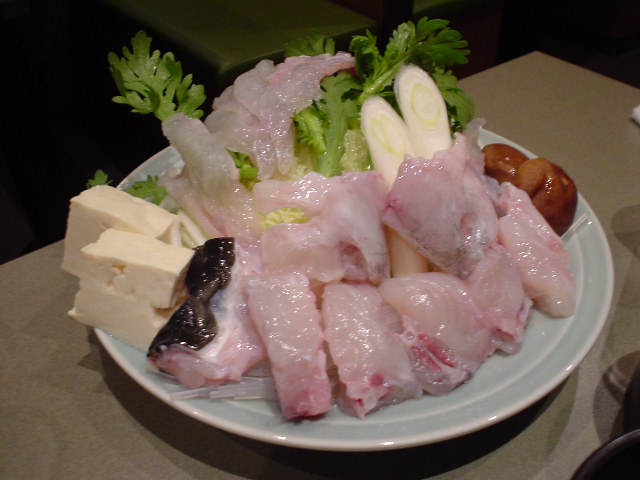
Our fugu dinner set was prepared not by an amateur, but by a chef who went to school specifically to master the preparation of fugu without killing anyone — or so I hoped. The chef prepared the fish in every which way a poisonous blowfish could, each style with a unique taste: cut up in slices as fugu sashimi (tastes like yellowtail); cut up in pieces to be placed in a boiling hot pot of fugu broth with tofu and Japanese vegetables (tastes like squid); and breaded and fried as fugu katsu (tastes like chicken). Some of the raw pieces (picture above) were so freshly cut from the fish that they were still twitching and “breathing” (that’s not a joke) while some pieces (the fins) were broiled and placed in my fugu-flavored hot sake.
Each bite was a test of bravery, that game of Culinary Russian Roulette, but for some reason I just had good faith in the restaurant since it did nothing but specialize in fugu preparation. Besides, fugu tasted good. Funny, I don’t feel like I’m about to die, I thought to myself. If the chef did call in sick only to have his inexperienced roommate to prepare it, I didn’t want to know.
In the end, neither Liz or I died that night, which was a good thing because I had all those episodes of The Amazing Race to watch.
Next entry: We Gonna Rock Down To Electric Avenue
Previous entry: Last Time for Tea Time
Commenting is not available in this channel entry.
Comments for “Fugu Me”
first!
and 13 entries behind!
yikes.Posted by Alyson on 09/26 at 10:29 AM
PLEASE VOTE! Nepal or no Nepal? So far it is 2 -0 in favor of Nepal…
Posted by .(JavaScript must be enabled to view this email address) on 09/26 at 01:45 PM
Definately Nepal! I’m planning on 2 months there. Don’t know how much trekking you’re up for, but I wouldn’t miss it if you have the time.
Posted by Dan on 09/26 at 05:20 PM
Glad you are both alive….Liz you are the hostess with the mostess!
I vote for Nepal! Go for it Erik!
Posted by .(JavaScript must be enabled to view this email address) on 09/26 at 05:21 PM
No Nepal
Posted by .(JavaScript must be enabled to view this email address) on 09/26 at 05:24 PM
I found these links that are a bit more current:
http://travel.state.gov/travel/nepal_warning.html
http://www.smartraveller.gov.au/zw-cgi/view/Advice/Nepal
http://www.voyage.gc.ca/dest/report-en.asp?country=205000
The US, Australian, Canadian gov’ts all say don’t go there. I’d say don’t risk it.
I know the government advisories are overly pessimistic, but you don’t want to get blown up for your birthday. :(Posted by Liz on 09/26 at 05:39 PM
I vote—not this year.
Posted by .(JavaScript must be enabled to view this email address) on 09/26 at 05:59 PM
THANKS FOR THE INPUT; Keep it coming! (Even you SBRs!) Please read the URLs before voting; sure Nepal is a great place to go, the question really is “Nepal now? (in two weeks) or not now?”
I’m really 50/50 on this; your vote counts. So far, my cons on Nepal are: not only have the Maoists kicked it up a notch with recent bombings, but Nepal in general is pissed off at Americans because of their loss in Iraq; Pros: it’s not like I haven’t been to a place the US told me to stay away from before (i.e. Tanzania/Zanzibar)...
Posted by .(JavaScript must be enabled to view this email address) on 09/26 at 06:12 PM
Hey - Sorry I’ve been MIA. I heard you gave Cheryl and me a shout out during your rock climbing experience in China. Cool!

Glad you didn’t die eating fugu.
 I’m disappointed that it only tasted “good” though (as you described). With the danger about eating it and all, I thought the taste would be awesome. To die for…no pun intended. Why would you risk your life on something that just tasted “good”? Well, I guess you can just say that you’ve tasted it and lived.
It’s funny how much culture you can get from watching “The Simpsons”. I love the Fugu episode.
Posted by .(JavaScript must be enabled to view this email address) on 09/26 at 06:58 PM
No to Nepal…not worth the risk
Posted by .(JavaScript must be enabled to view this email address) on 09/26 at 07:20 PM
Nepal = No
Hong Kong = AffirmativePosted by .(JavaScript must be enabled to view this email address) on 09/26 at 07:29 PM
ERIK - fix the “a five-story karaoke house” pic…
Posted by .(JavaScript must be enabled to view this email address) on 09/26 at 07:39 PM
You ate the blowfish! That’s so cool. I love that Simpsons episode.
If it were me, I would not go to Nepal. (But maybe because you blend in everywhere, it might be a little easier for you…) I know that trekking on your 30th birthday sounds fantastic. I do like that you DON’T always take the safe and easy route, (and that gives us great stories!) but I wouldn’t push my luck with this one. I vote no. But of course, you know us blog readers support you whether you go or not!
Posted by .(JavaScript must be enabled to view this email address) on 09/26 at 07:47 PM
Nepal - i’m 50/50 on that…i would say yeah go, cuz you do only live once…
but…shiet…you ONLY live once… and as Moman always says… “Word Life!”
you wanna keep that life…
Posted by .(JavaScript must be enabled to view this email address) on 09/26 at 07:53 PM
would be nice for you to finish this 16 month trip, so better skip nepal.
Posted by .(JavaScript must be enabled to view this email address) on 09/26 at 08:14 PM
i’m going to vote NO based on liz’s links. the situation seems worse than before. and i’d like to see you make it to your next b-day! i’m sure you can make another trip out there later in life.
Posted by .(JavaScript must be enabled to view this email address) on 09/26 at 08:39 PM
Another link worth looking into is the LP discussion (18pages, so go to the end for most recent):
http://thorntree.lonelyplanet.com/messagepost.cfm
?postaction=reply&catid=16&threadid=440864
&messid=3665884&STARTPAGE=1&parentid=0&from=1[THIS LINK HAS BEEN SPLIT IN THREE TO RESOLVE FORMATTING ISSUES. PLEASE COPY AND PASTE IT IN THREE PARTS.]
It has reports of travelers who have returned or are currently in Nepal along with their take on security and the situation there.
Whatever your decision, best of luck Erik and be safe.
Posted by Dan on 09/26 at 08:55 PM
No to Nepal, live to drink another day. You cant see everything, even in 16 months (or until the money runs out)
“a five-story karaoke house, ” Linky no worky.
Posted by .(JavaScript must be enabled to view this email address) on 09/26 at 09:01 PM
Erik, here’s a completely random question: What does “eeyartee” mean?
Posted by .(JavaScript must be enabled to view this email address) on 09/26 at 09:20 PM
SARA - just go to http://www.eeyartee.com and sound it out phonetically and you’ll see what it means…
Posted by .(JavaScript must be enabled to view this email address) on 09/26 at 09:52 PM
Hi Erik!
Just back from Thailand. I flew through Narita as well. Dig the free yahoo net cafe!
Glad to hear you are having such a great time. the one year anniversary is coming up, eh? When are you heading back to the big NJ? You missed yet another great flick honoring our homestead, Garden StatePosted by .(JavaScript must be enabled to view this email address) on 09/26 at 11:49 PM
I say NO to Nepal - at least for this year. Remember the small “demonstration” that we (you, me and WHEAT) witnessed in Barcelona? It seems the situation in Nepal will be worse.
Posted by .(JavaScript must be enabled to view this email address) on 09/27 at 12:15 AM
JEN102: HEY! There you are…
“Garden State”? I thought the “great flick honoring our homestead” was “Harold and Kumar Go To White Castle”!
Posted by .(JavaScript must be enabled to view this email address) on 09/27 at 02:43 AM
i vote not now. maoists have road blocks up around the city, and there’s been abductions. katmandu is nominally “safe” from what i’m hearing, but getting into and out of the city isn’t safe. i know of a westerner who’s trying to get out of nepal at the moment, but is unsure if she’ll be able to.
Posted by Alyson on 09/27 at 03:50 AM
I’m going to say, like many others have said: no, not this year - on going to Nepal… love the stories, but I’d love to host you in SoCal in one piece.
Question - do they have the sashimi stuff like they have at Sushi Samba? I forget the name… but it’s like a fruit/vinegar sauce over the sashimi?? Dunno if that’s mainly a S. American thing…
Posted by .(JavaScript must be enabled to view this email address) on 09/27 at 03:57 AM
No nepal! Go fugu!
Posted by .(JavaScript must be enabled to view this email address) on 09/27 at 04:33 AM
No to Nepal. I’m good friends with Aviva - we went to junior high together in New York. Aren’t the Raichelsons great?
Anyway, I’m really enjoying your travel stories. Take care.
Posted by .(JavaScript must be enabled to view this email address) on 09/27 at 11:45 PM
I’m with the group. No Nepal. Even though I’m sure you’d be safe. I wouldn’t want you taking the chance of that being the end of the global trip.
Posted by .(JavaScript must be enabled to view this email address) on 09/28 at 04:20 AM
I vote NOT NOW for NEPAL too. Take some time to see how things develop first.
Btw, I would assume I am one of the SBRs, but what exactly does that stand for?Posted by .(JavaScript must be enabled to view this email address) on 09/28 at 06:21 AM
LETS: Silent Blog Reader. Which you are no longer since you spoke up. Thanks!
Posted by .(JavaScript must be enabled to view this email address) on 09/28 at 06:32 AM
SHARE THIS TRAVEL DISPATCH:
Follow The Global Trip on Twitter
Follow The Global Trip in Instagram
Become a TGT Fan on Facebook
Subscribe to the RSS Feed
This blog post is one of over 500 travel dispatches from the trip blog, "The Global Trip 2004: Sixteen Months Around The World (Or Until Money Runs Out, Whichever Comes First)," originally hosted by BootsnAll.com. It chronicled a trip around the world from October 2003 to March 2005, which encompassed travel through thirty-seven countries in North America, South America, Africa, Europe, and Asia. It was this blog that "started it all," where Erik evolved and honed his style of travel blogging — it starts to come into focus around the time he arrives in Africa.
 Praised and recommended by USA Today, RickSteves.com, and readers of BootsnAll and Lonely Planet's Thorn Tree, The Global Trip blog was selected by the editors of PC Magazine for the "Top 100 Sites You Didn't Know You Couldn't Live Without" (in the travel category) in 2005.
Next entry:
We Gonna Rock Down To Electric Avenue
Previous entry:
Last Time for Tea Time
THE GLOBAL TRIP GLOSSARY
Confused at some of the jargon that's developed with this blog and its readers over the years? Here's what they mean:
BFFN: acronym for "Best Friend For Now"; a friend made on the road, who will share travel experiences for the time being, only to part ways and lose touch withThe Big Trip: the original sixteen month around-the-world trip that started it all, spanning 37 countries in 5 continents over 503 days (October 2003–March 2005)
NIZ: acronym for "No Internet Zone"; a place where there is little to no Internet access, thus preventing dispatches from being posted.
SBR: acronym for "Silent Blog Reader"; a person who has regularly followed The Global Trip blog for years without ever commenting or making his/her presence known to the rest of the reading community. (Breaking this silence by commenting is encouraged.)
Stupid o'clock: any time of the early morning that you have to wake up to catch a train, bus, plane, or tour. Usually any time before 6 a.m. is automatically “stupid o’clock.”
The Trinidad Show: a nickname of The Global Trip blog, used particularly by travelers that have been written about, who are self-aware that they have become "characters" in a long-running story — like characters in the Jim Carrey movie, The Truman Show.
WHMMR: acronym for "Western Hemisphere Monday Morning Rush"; an unofficial deadline to get new content up by a Monday morning, in time for readers in the western hemisphere (i.e. the majority North American audience) heading back to their computers.
1981ers: people born after 1981. Originally, this was to designate groups of young backpackers fresh out of school, many of which were loud, boorish and/or annoying. However, time has passed and 1981ers have matured and have been quite pleasant to travel with. The term still refers to young annoying backpackers, regardless of year — I guess you could call them "1991ers" in 2013 — young, entitled millennials on the road these days, essentially.
Spelling or grammar error? A picture not loading properly? Help keep this blog as good as it can be by reporting bugs.