Erik Trinidad and The Bolivian Temple of Doom
This blog entry about the events of Tuesday, January 20, 2004 was originally posted on January 21, 2004.
DAY 94: Potosi isn’t just the world’s highest city; at one point in history it used to be the richest city in Latin America. Its wealth came from the abundance of silver discovered in the Cerro Rico, the big mountain overlooking the town. Mines were created in the 1500’s to extract the silver and other valuable metals, to process them and export them. Back in the day, many of the people in the mine worked as slaves that lived under poor conditions, including children — much like in Indiana Jones and the Temple of Doom, the 1984 Steven Spielberg classic where Indiana Jones (played by Harrison Ford) encounters a secret Thuggee cult financially supported by underground mines.
I embraced the notion of adventuring like Indiana Jones into the mines when I signed up for a tour, but with my Asian-looking features and my vintage New York Yankees hat, I looked more like his sidekick Short Round. My hopes of traveling in the likeness of Short Round tanked when my guide Alfredo led me and my group to a changing house where we put on rubber boots, helmets, bright yellow pants and pullovers. Rob, a 22-year-old from Scotland, said we looked like The Village People — I thought to myself, “Oh no, not more references to the Village People!” — so I tried to convince them that we looked more like The Beastie Boys in their “Intergalactic” video.
Also in my group was Steve, Rob’s friend and traveling companion in their four-month journey through South America, and Simon, a nice German guy traveling solo. We hopped in a jeep with our new uniforms on, and then Alfredo and the driver took us to the miner’s market for gifts and supplies.
IT IS CUSTOMARY WHEN VISITING THE MINES to bring gifts to the workers. The most common gifts are a bag of coca leaves, a pack of cigarettes or a bottle of this liquor they drink with 96% alcohol in it — it evaporates off your tongue as soon as it hits it — but one additional option was to bring explosives. We were a group of four boys — “explosives” was the magic word.
Alfredo took us to an explosives store, which looked like any other hardware store. Collectively we bought four explosion kits — three for gifts, one to blow up — each with a stick of dynamite, a fuse and some extra combustible material for extra BANG! Alfredo cracked open a dynamite stick to show us the nitroglycerin inside — it looked like a big hunk of wasabi and I was careful not to get too much all over my hands.
WITH STICKS OF DYNAMITE IN OUR HANDS, we rode up the Cerro Rico along a winding dusty road. Rob tried chewing some coca leaves while Steve put his stick of dynamite between his legs for a photo. “This one goes up on the wall.”
We stopped at an ore processing area, where women sat in sections to literally sort through the rubble. A woman gave us a demonstration of the different ores — zinc, copper, silver to name a few — and we gave her a bag of coca leaves for her troubles. Then went on our way up to the top of the mountain to “blow shit up.”
Alfredo unwrapped one of the sticks of dynamite and remolded the wasabi-looking nitroglycerin for extra oompf. With a sadistic smile, he attached a fuse to the wad and inserted the wad into a plastic bag with the extra combustible material. He tied it up tightly to form the bomb — which we all happily posed for pictures with.
Our guide took the bomb a way down the hill to an open area for the “explosives demonstration.” He lit the three minute fuse and walked back up to us as we patiently waited in anticipation for the bomb to go off. (This is a 34 sec. QuickTime Movie file.) Needless to say, the demonstration went off with a bang.
NEAR THE ENTRANCE TO THE MINE, Alfredo mixed water and calcium carbonite into little canisters, which we hooked around our belts like Batman. The chemical reaction of the two produced a flammable stream of gas that went up a tube and to the lamps in our helmets, like a propane torch. The four of us were joined by three Bolivian tourists from Santa Cruz from the same tour company, and like seven dwarfs in yellow suits and flames on our heads, we ventured into the mine.
IN INDIANA JONES AND THE TEMPLE OF DOOM, the Thuggee cult worshiped the deity Kali, whom they pledged their devotion to with an offering of flesh and blood. In this Bolivian “temple of doom,” the miners worshiped a similar deity that was a little more down to earth; they called him “Tio Jorge” (Uncle George) and instead of human sacrifice, they offered him coca leaves, liquor and cigarettes. We paid our respects to Uncle George, spread some coca leaves in his lap, lit a cigarette and put it in his mouth, and poured him some of the liquor we bought — plus some on the floor “for his homies.” With a blessing from Uncle George, we went off into the mines.
THE POTOSI MINES, NOW PRIVATIZED, ARE NO LONGER operated with a state of slavery. The mines are now “cooperative mines,” in which workers voluntarily put in hard hours per day to gather materials to split between himself and a smelter. The conditions however, haven’t changed; according to Lonely Planet, miners usually die of silicosis pneumonia within ten years of daily work from all the noxious materials in the air. Some tunnels have poisonous chemical reactions on them; others had fibers of pure asbestos.
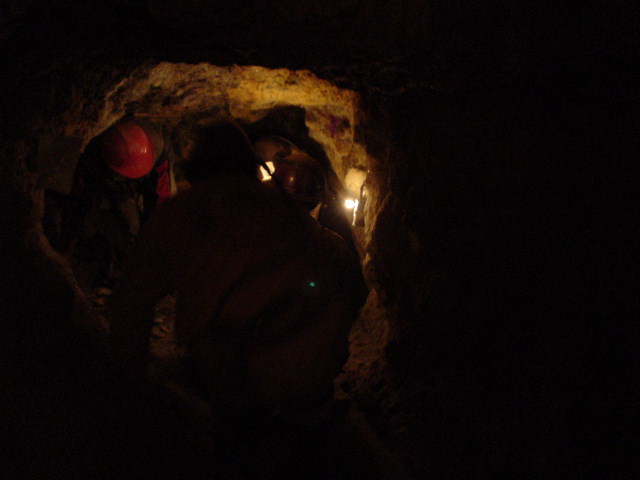
The seven of us made our way through the claustrophobic underground passages — it was like being in a human-sized ant colony. We made our way down into little holes, through low and narrow crawlspaces (picture above), over pits with planks of wood and up ladders with rungs three feet apart from each other. Some ladders had broken rungs and we had to be careful not to fall. At times the flame in our torches would go out and we needed to “kiss” another helmet for a light. There was a span of time when the stream of gas coming from my waist canister was weak and I needed to be “kissed” every twenty seconds.
Like the good guys in Indiana Jones and the Temple of Doom, we helped out the miners as they went away with hammers, picks and for some, pile-drivers. Since they were all in the mine on their own free will, there was no need to free them like the children in the Spielburg movie — instead we just gave them cigarettes, liquor, coca leaves and sticks of dynamite. I’m sure the workers appreciated the explosives; at one point, we felt the vibrations of an explosion above us. Well, boys will be boys.
The boys in our group continued to be boys. Using the flames from their head torches, Steve and Rob wrote their names in the rocky walls. Rob even drew a nice big picture of Uncle George in the passageway where men with wheelbarrows went back and forth.
OUR GROUP OF SEVEN SPLIT UP and it was just the four of us who followed Alfredo down a small rabbit hole, which had to be crawled through backwards. The tunnels led out to an area with a big gaping hole that went down about two stories. One by one, we made our way down it with the help of a rope dangling from somewhere up in the darkness. As I reached for the rope, the flame in my helmet came in direct contact with my left hand — which ultimately left me with yet another scar on my global trip thus far. I grabbed the rope with both hands to rappel down the chasm, but my foot slipped on a rock and I swung to the far side of the hole, holding the rope for dear life the whole time with my injured hand. Eventually I got my bearing and made my way down into the empty, deserted tunnel underneath.
Our guide Alfredo suddenly started feeling dizzy, which wasn’t such a good thing when he was the only one that knew the way out of the underground maze of claustrophobia and hazardous materials. He took a swig of water and ventured on. We followed him through the narrowness of the mines to a fork in the tube. He made a left, which took us to the light at the end of the tunnel. If he had gone right like Indiana Jones and Short Round had done in the movie, we might have gone on an exciting mine cart chase, but after inhaling God-knows-what for hours, it was just good to be out in the fresh air.
THE REST OF THE DAY wasn’t nearly as exciting. I wandered around town, ate some food and bought some bootleg CDs to listen to while working on the freelance design work I had. I took many short breaks from my work to record, watch and re-watch the explosion video from earlier in the day. Watching the big boom from the nitroglycerin didn’t seem to get tired — it’s no wonder the miners don’t mind working in their conditions; they get to play with dynamite everyday.
Next entry: Loogeys in Potosi
Previous entry: High and On-Line
Commenting is not available in this channel entry.
Comments for “Erik Trinidad and The Bolivian Temple of Doom”
first! Had to do it.
Btw - I really enjoyed the salt flats. And I woke up this morning singing the “lola” song.
Posted by .(JavaScript must be enabled to view this email address) on 01/21 at 02:01 PM
ESCHOOLers: What’s the deal with our W-2 tax slips?
Posted by .(JavaScript must be enabled to view this email address) on 01/21 at 02:02 PM
Just curious, how many people out there actually have The Blog main page as their browser’s start page?
Posted by .(JavaScript must be enabled to view this email address) on 01/21 at 02:05 PM
“I step where you step. I touch nothing.”
“You cheat Dr. Jones, you cheat.”
“To get out you must take the left tunnel.”
“Moloram, prepare to meet Kali in Hell!”
“Cover your heart!”
“You become like dem.”
“Ahhh, snake surprise.”
“On the way to Dehli, you will stop at Pangkot Palace”
“You call him Dr. Jones, doll”
“You my best friend. You come with me to America, we ride in circus. You my best friend.”
MOELICIOUS - you know you like that…
Posted by .(JavaScript must be enabled to view this email address) on 01/21 at 02:18 PM
-If you like movies that make you say Very funny HAHHAHHAH Very funnyHAHH!
or movies that make you say “Not very funny! Then Indiana Jones and the Temple of Doom is JUST for you…..-I’m Rich Beeeeeooooootch!
-Hunt that little s*it down and find m those detonators
Can’t beat me….
Posted by .(JavaScript must be enabled to view this email address) on 01/21 at 02:22 PM
wow, that looks so scary. i dunno if i would ever be able to go into a dark enclosed space like that, but the sticks of dynamite is cool. lucky. i wish i can blow up something also. and i have no clue what is going on with the w2s. i have a feeling that actv w2s are coming from opentv, and they are slow as hell at getting anything done. the hr dept there sucks.
Posted by .(JavaScript must be enabled to view this email address) on 01/21 at 02:23 PM
ALICE: Yeah, travellers have describe the mine tour as either the best or the worst thing they’ve done in Bolivia.
Posted by .(JavaScript must be enabled to view this email address) on 01/21 at 02:28 PM
DY-NO-MITE!
Posted by .(JavaScript must be enabled to view this email address) on 01/21 at 02:41 PM
Erik and Alise: I spoke to some woman named Priscilla at Opentv…well actually I called twice and she never called back so I emailed her and she finally got back to me. She told me that their payroll is taking care of it. I dont have the # anymore but I got it from Doug Tinerello(s?) who is still over in the old office with the same #.
Hope that helps!Posted by .(JavaScript must be enabled to view this email address) on 01/21 at 02:48 PM
Erik and Alice: I spoke to some woman named Priscilla at Opentv…well actually I called twice and she never called back so I emailed her and she finally got back to me. She told me that their payroll is taking care of it. I dont have the # anymore but I got it from Doug Tinerello(s?) who is still over in the old office with the same #.
Hope that helps!Posted by .(JavaScript must be enabled to view this email address) on 01/21 at 02:48 PM
KALI MA!!!!!
This trip of yours is just one big Indiana Jones adventure. No way would I go in that mine, too scarey, but I would want to blow shit up too! (dynomite isn’t just for boys)
Posted by .(JavaScript must be enabled to view this email address) on 01/21 at 02:50 PM
Erik,
Got my organic, homemade postcard from Lake Snicker-snicker too. Mucho thanks! You’re right. I’m still ultimate Olde Skool: preferring photos of shimmering salt-flats, kinky llamas and down-deep-in-the-mines to your own floating brown islands. But if a guy (or gal) can’t appreciate a photo of a mummy with a sprawling bush, then that’s his own damn fault.PS—Saw DavidK last week and we spoke of sending you our thousands of ACTV stock options. Not to fund your trip, as our stash of options plus $1.50 will pay your PATH fare back to Jersey City. Thought you might want them for emergency toilet paper. (Sound of drumstick hitting cymbal) How’s that for potty humor? I’m sure Matt’s laughing his head off. Stay well.
Posted by .(JavaScript must be enabled to view this email address) on 01/21 at 03:16 PM
its scary to think that anyone is qualified to by dynomite and bring it in the mine. some crazy person could easily light one up and blow down the entrance.
...oh and asbestos is no joke. HOLD YOUR BREATH!
Posted by .(JavaScript must be enabled to view this email address) on 01/21 at 03:24 PM
I would do the mine if I didn’t have to wear those yellow pants. They don’t go well with my complextion. :D
But if I were you when you burnt your hand and lost your footing climbing down that hole, I wouldn’t have the upper body strength to pull myself together.
You got to blow shit up… I’m jealous. lol
Posted by .(JavaScript must be enabled to view this email address) on 01/21 at 07:22 PM
LOVEPENNY: Funny, after my tour of the mine, my congestion cleared right up! (The fumes probably melted away any lingering mucus.)
Posted by .(JavaScript must be enabled to view this email address) on 01/21 at 07:55 PM
EMILE4REAL: Send them stock options over…you can never have enough toilet paper down here!
I could also use the stock options to spit my chewed gum into… or even better, to make those origami fortune teller things!
Posted by .(JavaScript must be enabled to view this email address) on 01/21 at 07:57 PM
hey erik, sorry i was gone all day at work and dont get to check my im’s til i get home at night..
i’m sooo behind!!! so i’m just writing this to say hi and good luck.. i haven’t even read today’s entry because i don’t wanna be out of sequence.. tty when i catch up!!
cuidado…
Posted by .(JavaScript must be enabled to view this email address) on 01/21 at 10:51 PM
Dont pretend you dont harbour secret urges to be one of the Village People Erik…bet you were dying to start a little YMCA mine action…
Posted by .(JavaScript must be enabled to view this email address) on 01/22 at 02:26 AM
I’m soo late tonight!!
That mine trip is crazY awsome! But I can’t believe how haphazard it is. Anyone could walking in with TNT and a pick whenever. No foremen or safety inspections, or carbon monoxide detectors or anything?!?!
Woah!
Posted by .(JavaScript must be enabled to view this email address) on 01/22 at 02:55 AM
In response to your question. My homepage is news.bbc.co.uk only because I have an insatiable need to keep up with global current events. But I ALWAYS visit the blog right after!
Posted by .(JavaScript must be enabled to view this email address) on 01/22 at 02:59 AM
Hi Erik,
Just got caught up on the blog. Got back from Argentina last week. Was there with Navid for 3 weeks (so I had alot of catching up to do). Had a really really great time!! I can now appreciate and understand more of your travels. The pictures are so amazing!!
I feel like I know you. I am always talking of your adventures to friends and telling them about your blog. So keep it up, you have an audience.
Also the Dali surreal world, Oh my God!! Those pictures were fantastic, surreal is an understatement, I think it’s my favorite so far. Thanks for sharing with all of us!!!!! BrenPosted by .(JavaScript must be enabled to view this email address) on 01/22 at 03:33 AM
SAM: Okay, okay, you got me… I DID have the urge to “get myself clean, have a good meal, do whatever I feel…”
Posted by .(JavaScript must be enabled to view this email address) on 01/22 at 01:12 PM
SAM/ZOE: Hey, I’m headed off to Sucre today (Friday, 23rd)... are you still there? If so, where are you staying?
Posted by .(JavaScript must be enabled to view this email address) on 01/22 at 01:15 PM
BRENDA: Thanks! How did you like Argentina? Hope you weren’t a vegetarian…the steaks there are awesome! Funny, last I heard from Navid, he was in Mendoza…I take it you were in the internet cafe with him when he posted that comment?
Posted by .(JavaScript must be enabled to view this email address) on 01/22 at 01:19 PM
dude! i got your postcard yesterday, it is so awesome!! thank you. =) i love how it looks, the child who drew the picture did a real good job. and i like the natural looking paper it was drawn on. is that made outta the same reeds that everything else there is made outta? now i have a piece of lake titicaca, i am happy. =)
Posted by .(JavaScript must be enabled to view this email address) on 01/22 at 02:57 PM
ALL: more fun and games: http://bq.fi/penguin.swf
Posted by .(JavaScript must be enabled to view this email address) on 01/22 at 06:53 PM
oh yeah…578.1!!!
i own this penguin!
Posted by .(JavaScript must be enabled to view this email address) on 01/22 at 07:18 PM
Looked like a sweet tour. Why didn’t they have stuff this ridiculously dangerous in Cuzco? It’s not fun unless there is a better than 25% chance you’ll die… get it above 50% and it’s CRAZY fun!
I need to get back out on the road, use your freelance money to fly Adam and I down for carnival… I’ll buy you a drink to make it worth your while! I may even make it a Machu Picchu…
Posted by Tony on 01/22 at 07:41 PM
TONY! What’s up man? 50% dangerous is CRAZY fun, but anything above that is LUDICROUS fun! (“Bah, buckle this… Ludicrous fun… GO!!!”)
Hmmm…ambiguously gay Machu Picchu drinks for Carnivale… don’t tempt me!!!
Posted by .(JavaScript must be enabled to view this email address) on 01/22 at 07:59 PM
593.5 ! beat that!
I own this penguin now.
Posted by .(JavaScript must be enabled to view this email address) on 01/22 at 08:48 PM
593.5!!! Dtella is good….First one over 600 is the master…
Posted by .(JavaScript must be enabled to view this email address) on 01/22 at 08:58 PM
DTELLA - I have matched you after too many tries…but yes…I did.
Posted by .(JavaScript must be enabled to view this email address) on 01/22 at 09:20 PM
hmmm.. guess I’m the only one that thought of playing with a can of hairspray and the headlamps
Posted by .(JavaScript must be enabled to view this email address) on 01/22 at 09:29 PM
Hey erik…youre here in Sucre…yay! We?re staying in hostel Vera Cruz (room 14) on Ravelo… til Sunday eve now cos we had a couple of sick days…a doctor tried to kill Zoe…we?ll tell u all about it!!! We?re going for dinner at a restaurant called Biblioteca tonite just off the main plaza…check Lonely planet…its got live 80s music!!! Or tomoz come meet in front of the cathedral in the main Plaza between half 11 and 12…we?ll be waiting for a bus to the dinosaur site (Jurassic park!!!)...or leave a note for us at the hostel if all else fails. Hope to see you soon sweets xxx
Posted by .(JavaScript must be enabled to view this email address) on 01/22 at 11:09 PM
SAM: Hola… hey…I’m here… staying at the Casa de…San Marcos (no. 10 in the LP book)... I’ll try and track you down as that concert in the plaza is over now… BTW, i’m in dorm 2 in the hostel…
Posted by .(JavaScript must be enabled to view this email address) on 01/23 at 12:34 AM
Holy crazy! You are officialy LOCO! Underground, explosives, darkness, gas-produced fire on your head, gaping holes, broken ladders… I hope your Mom reads this and yells at you! This gets a higher rating on the crazy scale than your Amazon excursion.
As for the homepage question: you are my Work AND Home homepage. I was just telling the PH crew about boobies and titicaca. They don’t believe me. Suckers.
Posted by .(JavaScript must be enabled to view this email address) on 01/23 at 08:50 PM
SHARE THIS TRAVEL DISPATCH:
Follow The Global Trip on Twitter
Follow The Global Trip in Instagram
Become a TGT Fan on Facebook
Subscribe to the RSS Feed
This blog post is one of over 500 travel dispatches from the trip blog, "The Global Trip 2004: Sixteen Months Around The World (Or Until Money Runs Out, Whichever Comes First)," originally hosted by BootsnAll.com. It chronicled a trip around the world from October 2003 to March 2005, which encompassed travel through thirty-seven countries in North America, South America, Africa, Europe, and Asia. It was this blog that "started it all," where Erik evolved and honed his style of travel blogging — it starts to come into focus around the time he arrives in Africa.
 Praised and recommended by USA Today, RickSteves.com, and readers of BootsnAll and Lonely Planet's Thorn Tree, The Global Trip blog was selected by the editors of PC Magazine for the "Top 100 Sites You Didn't Know You Couldn't Live Without" (in the travel category) in 2005.
Next entry:
Loogeys in Potosi
Previous entry:
High and On-Line
THE GLOBAL TRIP GLOSSARY
Confused at some of the jargon that's developed with this blog and its readers over the years? Here's what they mean:
BFFN: acronym for "Best Friend For Now"; a friend made on the road, who will share travel experiences for the time being, only to part ways and lose touch withThe Big Trip: the original sixteen month around-the-world trip that started it all, spanning 37 countries in 5 continents over 503 days (October 2003–March 2005)
NIZ: acronym for "No Internet Zone"; a place where there is little to no Internet access, thus preventing dispatches from being posted.
SBR: acronym for "Silent Blog Reader"; a person who has regularly followed The Global Trip blog for years without ever commenting or making his/her presence known to the rest of the reading community. (Breaking this silence by commenting is encouraged.)
Stupid o'clock: any time of the early morning that you have to wake up to catch a train, bus, plane, or tour. Usually any time before 6 a.m. is automatically “stupid o’clock.”
The Trinidad Show: a nickname of The Global Trip blog, used particularly by travelers that have been written about, who are self-aware that they have become "characters" in a long-running story — like characters in the Jim Carrey movie, The Truman Show.
WHMMR: acronym for "Western Hemisphere Monday Morning Rush"; an unofficial deadline to get new content up by a Monday morning, in time for readers in the western hemisphere (i.e. the majority North American audience) heading back to their computers.
1981ers: people born after 1981. Originally, this was to designate groups of young backpackers fresh out of school, many of which were loud, boorish and/or annoying. However, time has passed and 1981ers have matured and have been quite pleasant to travel with. The term still refers to young annoying backpackers, regardless of year — I guess you could call them "1991ers" in 2013 — young, entitled millennials on the road these days, essentially.
Spelling or grammar error? A picture not loading properly? Help keep this blog as good as it can be by reporting bugs.