Erik Falls On Mount Pinatubo
This blog entry about the events of Sunday, January 02, 2005 was originally posted on January 05, 2005.
DAY 442: As we’ve seen in recent history, natural disasters can strike at any time, especially earthquakes. Fourteen and a half years before the 8.9 quake that rocked the floor of the Indian Ocean, causing the Asian Tsunami of 2004 — the “largest natural disaster in recent history” according to many news outlets — there was a 7.8 that shook another part of Asia that had lasting effects for almost a decade. This quake in the Philippines in 1990 caused a geological chain reaction that was epitomized eleven months later with the eruption of Mount Pinatubo on June 15, 1991 — the second largest volcanic eruption of the 20th century — which spawned not a killer wave of ocean water, but a killer storm of fire, ash and dust in the sky of Biblical proportions.
While the death toll of the 1991 Pinatubo eruption (800 fatalities) was a mere fraction of the tragedy in South Asia 2004, it was tragic nonetheless; 100,000 people ended up homeless with an estimated half a billion dollars in damage. Geologically speaking, it was tragic as well; the emission of gases from the eruption was so great that it widened the hole in the ozone layer to a new level and further progressed the phenomenon of global warming.
Tragedy is a part of life; bad things happen, people fall down. As restless and guilty I felt being on vacation in the Philippines while people were dying not too far away in another part of the continent — There are bigger things happening than me and The Blog, I thought — there wasn’t much I could do other than send a donation to UNICEF and get on with it. Until I go back to Thailand to try and do some hands-on volunteer work, the show must go on.
“THE TRINIDAD SHOW” CONTINUED ON that day with a day-hike organized by my Tito Mike and Tita Connie on Mount Pinatubo, 90 km. northwest of Manila. To beat the back-to-work-after-New-Year’s MMR (Monday Morning Rush), we started before dawn at 4 a.m. when a driver sent from the tour agency picked Tito Mike and me up in a car designated for use by the press. Less than two hours later we arrived an hour ahead of schedule in Angeles City where we’d meet our trekking guide. While waiting, we had breakfast at a 24-hour Jollibee, the big Philippines’ fast food chain that rivaled McDonald’s, so big that locations had surfaced all the way in California, USA.
“This place used to be swarming with Americans,” Tito Mike told me.
“That’s why there are a lot of mestizos here,” Rudy the driver added.
Angeles City is home to the former Clark U.S. Air Force Base, the main military outpost for United States’ forces in the Philippines during World War II, not too far from Subic Bay, where the U.S. Navy was stationed. The city had evolved into a haven for at-ease G.I.s, with many places serving up booze and women, for a fee of course. Not surprisingly, many fair-skinned mestizos were born from the eggs of Filipina women and the sperm of American Caucasian men, thus the abundance of them in the area.
Our Pinatubo trek was organized locally by the Premiere Hotel, a fancy resort catering to, from what I saw, the Caucasian American and European men who still come to Angeles City for some Filipino R&R and, like in Thailand, to partake in the depressing but thriving sex tourism industry. The place was run by a Swiss German from Luzern named Rene, who was a decent old man that decided to settle in the Philippines after working with the Americans on the Clark Base. It was he who put us in touch with our guide for the day, a youthful 65-year-old Filipino man named Fred who had also worked with the Americans at Clark for decades, before his days as a gardener and freelance tour guide. Fred turned out to be quite a character.
To my chagrin, Tito Mike introduced me, as always, right off the bat as a guy who didn’t know any Tagalog, which was fine by Fred because most of his clientele was English-speaking anyway: Americans, Australians and a whole lot of Germans. “Let me ask you a question,” Fred said to me. “Who owns nature?”
“Uh, Mother Nature,” I replied. Is this a trick question? “We do too.”
“That’s good! Mother Nature. God,” he said. “People who can appreciate nature. [Not many people have the right answer].” Fred was a self-proclaimed nature lover who preferred trekking up to the crater rather than riding in a 4x4 “like the Korean tourists,” as well as a devout Catholic man of God — although he said he didn’t believe in going to Church on the grounds that there are so many young attractive women that go to Church, it’s hard to concentrate on praying. (He prays best at home.)
FRED’S BROTHER-IN-LAW BEN DROVE US in a 4x4 through the former Clark Air Force Base, which was no longer in use; after the 1991 Pinatubo eruption, the damage was so severe, the Americans simply abandoned it and gave the land back to the Philippine government to deal with. We went through the rural countryside and ended up at the base of the volcano at the local village of Target, named not after the retail store where you can by a TV, bedsheets, and a bottle of Tums all in one visit, but after the fact that it was the site of the former target range of American troops.
While there were many Caucasian and fair-skinned mestizos in the Angeles City area, it may be of note that the indigenous people of Target and the surrounding region were, to put it bluntly, black people of the Negrito tribe, the Philippines’ oldest surviving race, descendant from Africans. (My dark skin genes may or may not be due to the possibility that from many generations ago, I am part black.) Negritos don’t look “typically Filipino;” they have dark skin, African facial features and kinky Afro hair. Seeing them in the village, they reminded me of Jamaicans.
In Target, Fred picked up our Negrito liaison for our trek, a young man named Carlos who wasn’t introduced to me by my uncle and therefore was with whom I got to practice a little bit of Tagalog as we trekked through the long grass, although it was nothing major. It was Fred who did most of the talking, explaining his philosophies on life and telling us anecdotes of his former treks on the mountain.
“[I guided an American from Idaho once, and he asked me, ‘What’s the name of that spring?’ I told him that we didn’t normally name things like they do in America and Europe, and so he named it Fred Spring, after me,]” Fred explained to me. (All quotes from Fred are paraphrased here since I cannot remember his exact words, nor did I jot them down. I really need to start carrying around a tape recorder like a real journalist.)
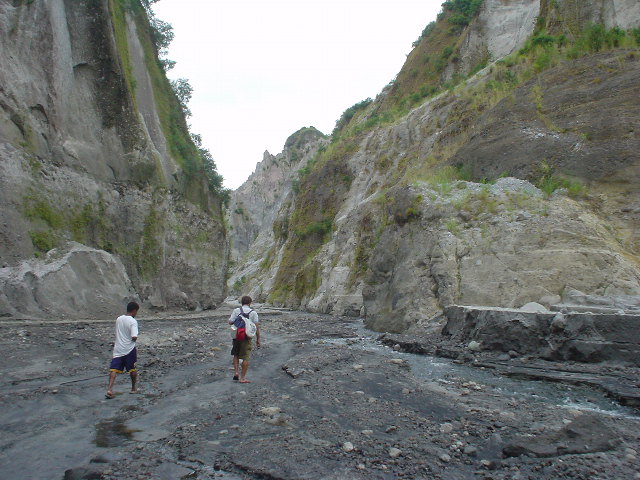
At a viewpoint, Carlos, uncle and I stopped for Fred to take our photo, and so that we could get a glimpse of the Pinatubo crater far away, shrouded in clouds. From there we continued the trek upwards (picture above) through the wide and narrow canyons, passed the rock formation that Fred called his “pet elephant.” The landscape was reminiscent of any mountain trail with a river running through it, except for the fact that there was a 200-foot or more pile up of fine volcanic ash everywhere. The pile up was so big that some piles looked like stand alone mountains, with peaks created by erosion and rain. Some of the trees that had survived the fires of the eruption were completely buried in ash.
Hours of trekking went by. Fred entertained us with tales of leading treks with Germans and Aussies and one Korean newscaster who almost ran out of food on a multi-day trek, as we traversed the river back and forth in accordance with the easier way, wary of the ashy edges that would crumble under our feet. My Tito Mike pointed out that the water was getting warmer and warmer the higher we ascended, and it came to piping hot temperatures when we arrived at our goal of the day, the end of the particular trail we were on, about halfway up the main caldera of Pinatubo. Steam rose from the flowing hot springs where, in some areas, it slightly reeked from the yellow natural sulfur. Nearby, a Korean group had harnessed the natural hot springs and built a jacuzzi for an upcoming visit of Korean VIPs. Concurrently, they were widening the trail and having support ramps built so they could simply drive to the jacuzzi in a 4x4.
My Tito Mike was a bit winded from the trek — he was a city slicker unaccustomed to any sort of nature trekking — leaving me and Fred to climb as high as possible in the area, up to the steamier environment that fogged up my glasses. There was a big steaming waterfall whose droplets scalded my skin when I got too close. “So what’s the name of this waterfall?” I asked Fred.
He smiled. “[There’s no name,]” he said.
Oh right, I forgot. They don’t name things in these parts. “So we can name it after me then? Erik Falls.”
“[Yeah, Erik Falls.]”
I tried to inscribe my name somewhere in the ash but it wasn’t really happening with all the pebbles inside. Instead, I went to the Koreans’ private jacuzzi before their arrival and soaked my feet while eating a Spam sandwich to celebrate the unofficial inauguration of Erik Falls on Mount Pinatubo.
NATURAL DISASTERS ARE AN INEVITABILITY on this planet we call home, but in the ashes of tragedy life goes on. I think it was John Lennon who said, “Time heals all wounds;” thirteen years after the big eruption of Mount Pinatubo, things have healed and life prospers with steamy waterfalls, Korean jacuzzis and eco-tourism. From what I saw on the news that night back in Greenhills, South Asia was on its way to a slow, but steady recovery with the heartwarming and overwhelming support of the international community. Perhaps in thirteen years the tears in South Asia will be all gone, along with the idea that there might actually be a waterfall named after me in the Philippines.
YOU CAN DONATE TO THE VICTIMS OF THE ASIAN TSUNAMI OF 2004 AT WWW.UNICEF.ORG
SAVE THE DATE; DAY 503 IS COMING. MARCH 5, 2005, NYC.
THE TRAILER GOES ONLINE SUPERBOWL SUNDAY
Next entry: Civilization
Previous entry: Quoth The Cousin
Commenting is not available in this channel entry.
Comments for “Erik Falls On Mount Pinatubo”
THERE YOU GO; that’s the latest… This is actually two days behind as I write this comment now, but nothing exciting has happened since then, so I’m pretty much caught up.
I’m off to Boracay tomorrow!
Posted by .(JavaScript must be enabled to view this email address) on 01/05 at 04:59 AM
ERIK/MARK: May I. It is now “Bilog ang Mundo” ad (with sexy bikini dancers dancing to a tune on a beach, and a fat guy who has to swim an island to get a bottle of gin and return back macho trim in the process) that is being played for GINEBRA SAN MIGUEL, a gin brand company-relateD to SMBEER.
Literally, it means-“The Earth is Round”. Another, as Jaypee put it-“Anything is Possible”.
Log on to http://www.eradioportal.com to listen to 88.3 JAM
...sing along…play along…whenever you please…JAM 88.3…
Posted by .(JavaScript must be enabled to view this email address) on 01/05 at 05:51 AM
‘daddy would you like some sausage! daddy would you like some sausages!’
(Tom Green, Freddy Got Fingered)Posted by .(JavaScript must be enabled to view this email address) on 01/05 at 09:54 AM
JAYPEE: ZEBRAS IN AMERICA!!!
Posted by .(JavaScript must be enabled to view this email address) on 01/05 at 02:33 PM
Cool. Steamed up your glasses, eh? An your girly wasn’t even there. Hmmph. Someday it may be the UNESCO site Erik Falls on Mt. Pinatubo.
Posted by .(JavaScript must be enabled to view this email address) on 01/05 at 05:29 PM
they can name it paul palls….so they can say paul, be carepal that you might slip and pall down the paul palls…
Posted by .(JavaScript must be enabled to view this email address) on 01/05 at 05:53 PM
AR6 - Jonathan is an ass….
Posted by .(JavaScript must be enabled to view this email address) on 01/05 at 07:38 PM
I’ll be off for a day… I’m off to Borocay now. (Borocay is to Manila what pre-tsunami Koh Samui is to Bangkok.)
Posted by .(JavaScript must be enabled to view this email address) on 01/05 at 10:05 PM
I just got an e-mail from some guy putting together a travel resource website of “First World” backpackers of “Third World” descent. If you have on-line travel content that fits such a description, fire me an e-mail…
Posted by .(JavaScript must be enabled to view this email address) on 01/05 at 10:09 PM
markyt, I think ass is putting in mildly!
Posted by .(JavaScript must be enabled to view this email address) on 01/05 at 10:13 PM
Wow. Great perspective on Natural Disasters. Alot of people were mad when tourists started sunbathing again after the recent tsunami but I was like wtf, the last thing we should do (like post 9/11) is stop the wheels of commerce which will help the people return to life (ever changed, but life nonetheless) in every way that we can. Kudos to you for sharing your POV.
Posted by .(JavaScript must be enabled to view this email address) on 01/05 at 10:34 PM
After reading these past few entries and seeing all the pictures, it’s clear where Erik and Markyt get their distintic brand of humor. (besides SNL alumni movies)
Posted by .(JavaScript must be enabled to view this email address) on 01/06 at 06:00 PM
Gonna find my baby, gonna hold her tight
Gonna grab some Afternoon Delight
My motto’s always been “When it’s right, it’s right.”
Why wait until the middle of a cold, dark night?When everythings a little clearer in the light of day?
And we know the night is always gonna be here anyway?Thinkin ‘bout you’s working up my appetite
Lookin’ forward to a little Afternoon Delight
Rubbin’ sticks and stones together makes the sparks ignite
And the thought of rubbin’ you is gettin’ so excitingSkyrockets in flight!
Afternoon Delight!
Afternoon Delight!
Afternoon Delight!Started out this morning feeling so polite,
I always thought a fish could not be caught who didn’t bite.
But you got some bait a-waiting and I think I might
Try nibblin’ a little Afternoon DelightSkyrockets in flight!
Afternoon Delight!
Afternoon Delight!
Afternoon Delight!Be waiting for me, baby, when I come around.
We can make a lot of loving ‘fore the sun goes downThinkin’ of you’s workin’ up a’ appetite
Lookin’ forward to a little afternoon delight
Rubbin’ sticks and stones together makes the sparks ignite
And the thought of rubbin’ you is gettin’ so excitingSkyrockets in flight!
Afternoon Delight!
Afternoon Delight!Afternoon Delight!
(a madrigal fugue)
Afternoon Delight!
Posted by .(JavaScript must be enabled to view this email address) on 01/07 at 01:47 AM
JAYPEE: Get “Old School” and you’ll be singing “Dust In The Wind.”
Posted by .(JavaScript must be enabled to view this email address) on 01/07 at 09:26 AM
GREETINGS FROM BOROCAY! Wow. I have to say, as a travel destination, the Philippines has skyrocketed to my top five countries in the world. And I mean that in a totally unbiased way.
More to come for the WHMMR…
Posted by .(JavaScript must be enabled to view this email address) on 01/07 at 09:29 AM
quoting markyt: “they can name it paul palls….so they can say paul, be carepal that you might slip and pall down the paul palls…”
AH HA HA HA HA HA
looking forward to party trailer!
Posted by .(JavaScript must be enabled to view this email address) on 01/07 at 01:08 PM
BARBARA FROM VA: Thanks for the pledge!
Posted by .(JavaScript must be enabled to view this email address) on 01/07 at 02:50 PM
JayPee: You NEED to see Old School Right now!
“You took that right in the jugular, THAT"S AWSOME!”
Posted by .(JavaScript must be enabled to view this email address) on 01/07 at 05:27 PM
Hows Boracay? Ive never been there.
Posted by Jessica T on 01/08 at 03:59 AM
Hey E!
 I’m BARBARA from VA, now I have to kill you for blowing my cover you nancy boy! It only took me a year! See you in NY…
Fun
Posted by .(JavaScript must be enabled to view this email address) on 01/08 at 05:22 AM
Okay wait, I just realized that I blew my OWN cover. This is why you should not drink and comment.
Fun
Posted by .(JavaScript must be enabled to view this email address) on 01/08 at 05:34 AM
JESSICA T: Boracay is beautiful. The guys here say it’s “astig!”
Posted by .(JavaScript must be enabled to view this email address) on 01/09 at 07:41 AM
aaaawy… i wish i could go there! hehe…
Posted by jessica t on 01/09 at 09:35 AM
i saw my very first post in the delhi thing i said i was bored but you told me if you came i wont be… well thats kinda true! (i was jek [my nickname])
Posted by jessica t on 01/09 at 10:01 AM
SHARE THIS TRAVEL DISPATCH:
Follow The Global Trip on Twitter
Follow The Global Trip in Instagram
Become a TGT Fan on Facebook
Subscribe to the RSS Feed
This blog post is one of over 500 travel dispatches from the trip blog, "The Global Trip 2004: Sixteen Months Around The World (Or Until Money Runs Out, Whichever Comes First)," originally hosted by BootsnAll.com. It chronicled a trip around the world from October 2003 to March 2005, which encompassed travel through thirty-seven countries in North America, South America, Africa, Europe, and Asia. It was this blog that "started it all," where Erik evolved and honed his style of travel blogging — it starts to come into focus around the time he arrives in Africa.
 Praised and recommended by USA Today, RickSteves.com, and readers of BootsnAll and Lonely Planet's Thorn Tree, The Global Trip blog was selected by the editors of PC Magazine for the "Top 100 Sites You Didn't Know You Couldn't Live Without" (in the travel category) in 2005.
Next entry:
Civilization
Previous entry:
Quoth The Cousin
THE GLOBAL TRIP GLOSSARY
Confused at some of the jargon that's developed with this blog and its readers over the years? Here's what they mean:
BFFN: acronym for "Best Friend For Now"; a friend made on the road, who will share travel experiences for the time being, only to part ways and lose touch withThe Big Trip: the original sixteen month around-the-world trip that started it all, spanning 37 countries in 5 continents over 503 days (October 2003–March 2005)
NIZ: acronym for "No Internet Zone"; a place where there is little to no Internet access, thus preventing dispatches from being posted.
SBR: acronym for "Silent Blog Reader"; a person who has regularly followed The Global Trip blog for years without ever commenting or making his/her presence known to the rest of the reading community. (Breaking this silence by commenting is encouraged.)
Stupid o'clock: any time of the early morning that you have to wake up to catch a train, bus, plane, or tour. Usually any time before 6 a.m. is automatically “stupid o’clock.”
The Trinidad Show: a nickname of The Global Trip blog, used particularly by travelers that have been written about, who are self-aware that they have become "characters" in a long-running story — like characters in the Jim Carrey movie, The Truman Show.
WHMMR: acronym for "Western Hemisphere Monday Morning Rush"; an unofficial deadline to get new content up by a Monday morning, in time for readers in the western hemisphere (i.e. the majority North American audience) heading back to their computers.
1981ers: people born after 1981. Originally, this was to designate groups of young backpackers fresh out of school, many of which were loud, boorish and/or annoying. However, time has passed and 1981ers have matured and have been quite pleasant to travel with. The term still refers to young annoying backpackers, regardless of year — I guess you could call them "1991ers" in 2013 — young, entitled millennials on the road these days, essentially.
Spelling or grammar error? A picture not loading properly? Help keep this blog as good as it can be by reporting bugs.