Dominoes
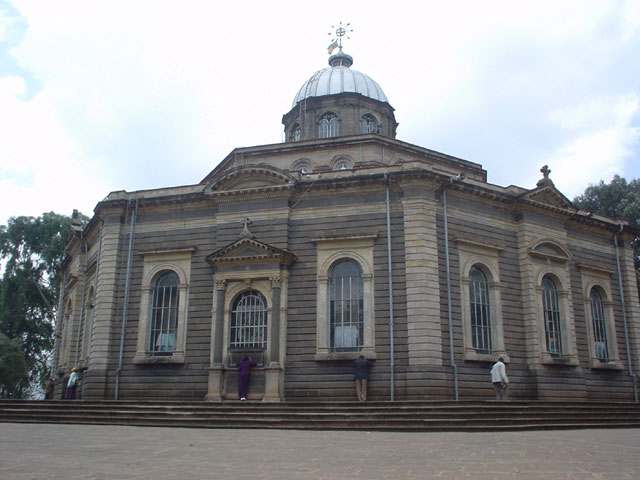
This blog entry about the events of Sunday, May 23, 2004 was originally posted on June 02, 2004.
DAY 218: With the weekend over, I could finally get the wheels in motion for my pilgrimage to the Ethiopian holy sites north of Addis Ababa. All my bookings were put on hold until I could confirm with Egypt Air that I could switch my flight from Addis Ababa to Cairo to a later date — after that, everything would fall into place like a set of dominoes.
It was Monday, the day most working Americans dread more than the day they after, when they also have to go to work. The same Monday morning rush happened in Addis Ababa with its citizens — and in this case, one tourist. I took a shared minivan into downtown and walked up to the Egypt Air office. I was hoping the whole thing would be a straightforward affair, but as my luck would have it, the system was down. Elsa, the woman at the desk told me I would have no problem getting the flight to Cairo on the day I wanted and would book it as soon as the system returned.
“It will be no problem. Come back tomorrow,” she told me.
“But I’m leaving Addis tomorrow to go north,” I told her. She had no idea that the flight date change would start a whole set of dominoes afterwards. “There’s no way I can get it today?”
She told me the system might be back after two in the afternoon. In the meantime, she handwrote the date of my flight on a correction sticker. I put my faith in the flight change and presumed with the rest of the plan.
I booked the three flights that were available to me at Ethiopian Airlines, and with that set in stone, I could book my guides at the National Tour Operations office. Hamere, the woman at NTO wrote up my guide vouchers, one for each of the four sites I’d travel to either by bus or plane. The whole thing worked out very tightly with no real room for error — if one appointment wasn’t met, the effect would trickle down like another set of dominoes. I pre-paid my tours with American Express; NTO was something out of one of the commercials, it was the preferred card and anything else would receive an extra surcharge. (Visa 1, American Express 1, MasterCard 0.)
The last booking to be made was for a bus from Addis Ababe to the first city, Bahir Dar, a day and a half away overland. (I would have flown if it was available.) A taxi took me to the Merkato, Africa’s largest open air market, where a bus company sold me a ticket for the next morning, departing at 11:00 a.m. Ethiopian Time. Suddenly the reason of my encounter with Priya in Dar es Salaam became clear; she had explained to me the weird way Ethiopians tell time, using the Gregorian clock: the day starts at 6:00 a.m. and the numbers of the hours begin after that. So 7 a.m. is actually 1:00 p.m., 8 a.m. is actually 2:00 p.m. — it goes up to 6 p.m. (12 a.m. Ethiopian) and starts over again.
Confusing, yes. Organizing a taxi to bring me from the hotel to the bus station was something out of an Abbott and Costello routine and I hoped the driver would pick me up at the right time.
BACK AT EGYPT AIR, the system was back on-line and everything officially fell into place. I got the flight I wanted and even bought an onward flight from Cairo to Casablanca to show Egyptian immigration. Immigration authorities are funny; on the notes on Elsa’s computer screen, Morocco states that admission might not be permitted if a person has a “hippy appearance.” Everything went smooth at Egypt Air and they too preferred the use of American Express.
WITH MY SELF-TAILORED “PILGRIMAGE” FINALLY SET UP, it was time to get a primer on just what I was going to see. So I visited St. George’s Cathedral (picture above), the main Ethiopian Orthodox Church in the center of the city, where Arch Deacon Mebratu gave me a personal tour even though the church and museum were closed on Mondays. It was a beginning look into the Ethiopian Orthodox faith, which according to the arch deacon, was similar to Catholicism in theory. In practice, it looks very foreign (at least to me and my Catholic upbringing), with a different ancient customs mixed in.
The St. George Cathedral, like the similar Orthodox churches in the country were not designed in a rectangular shape like in Western culture, but in circles to represent the Virgin Mary’s womb. Services are conducted by a priest and deacon in the center of this circle, while the faithful and the choir sit around them in a ring on a lower tier, one step below from the middle. The choir sings praise to God to the rhythms of prayer sticks, bells and drums — all of which Arch Deacon Mebratu demonstrated for me. The makda, the sacred center of the church (which is only accessible to the priest and the deacon) is surrounded by walls painted with murals depicting stories of the church. Inside the makda lies a tabot, a replica of the Ark of the Covenant, which gives a church its sanctity with God in the eyes of the Ethiopian Orthodox Church.
The museum of St. George Cathedral was especially interesting, further explaining the history of the church and the clergy, from its beginnings in the fourth century A.D. when Christianity was introduced, to the construction of the cathedral with influence of the Italians in 1896 after the Battle of Adwa. Even more notable was the church’s ties with the regent of Empress Zaudito, a one Ras Tafari, whose legacy is still seen today in Rastarianism. Ras Tafari took the name Haile Selassie in 1930 when he became emperor at the Zaudito’s death, and brought Ethiopia into the modern world with its theo-monarchy until 1974.
All the history was sort of overwhelming so I just bought a book from the deacon to read on the long bus ride the next day. I was hoping it would spawn a domino effect of acquired knowledge as I saw the sites in the upcoming week, but they read like stereo instructions.
Next entry: Get A Room You Two
Previous entry: Cradle of Humanity
Commenting is not available in this channel entry.
Comments for “Dominoes”
I think round churches are a great idea. That’s cool. The murals and the drum were beautiful.
Posted by Liz on 06/02 at 03:40 PM
hippy appearance? ummm ok…
Posted by .(JavaScript must be enabled to view this email address) on 06/03 at 06:32 PM
I like churches in the round as well - it always annoys me when the communion is given in Catholic churchs facing away from the congregation. Neat insturments.
How do they define “hippy appearance?” Anything resembling Kate Winslet in “Hideous Kinky?”

Good to be back - had to attend a graduation with sporadic (at best!) web access.
Posted by .(JavaScript must be enabled to view this email address) on 06/07 at 10:29 AM
SHARE THIS TRAVEL DISPATCH:
Follow The Global Trip on Twitter
Follow The Global Trip in Instagram
Become a TGT Fan on Facebook
Subscribe to the RSS Feed
This blog post is one of over 500 travel dispatches from the trip blog, "The Global Trip 2004: Sixteen Months Around The World (Or Until Money Runs Out, Whichever Comes First)," originally hosted by BootsnAll.com. It chronicled a trip around the world from October 2003 to March 2005, which encompassed travel through thirty-seven countries in North America, South America, Africa, Europe, and Asia. It was this blog that "started it all," where Erik evolved and honed his style of travel blogging — it starts to come into focus around the time he arrives in Africa.
 Praised and recommended by USA Today, RickSteves.com, and readers of BootsnAll and Lonely Planet's Thorn Tree, The Global Trip blog was selected by the editors of PC Magazine for the "Top 100 Sites You Didn't Know You Couldn't Live Without" (in the travel category) in 2005.
Next entry:
Get A Room You Two
Previous entry:
Cradle of Humanity
THE GLOBAL TRIP GLOSSARY
Confused at some of the jargon that's developed with this blog and its readers over the years? Here's what they mean:
BFFN: acronym for "Best Friend For Now"; a friend made on the road, who will share travel experiences for the time being, only to part ways and lose touch withThe Big Trip: the original sixteen month around-the-world trip that started it all, spanning 37 countries in 5 continents over 503 days (October 2003–March 2005)
NIZ: acronym for "No Internet Zone"; a place where there is little to no Internet access, thus preventing dispatches from being posted.
SBR: acronym for "Silent Blog Reader"; a person who has regularly followed The Global Trip blog for years without ever commenting or making his/her presence known to the rest of the reading community. (Breaking this silence by commenting is encouraged.)
Stupid o'clock: any time of the early morning that you have to wake up to catch a train, bus, plane, or tour. Usually any time before 6 a.m. is automatically “stupid o’clock.”
The Trinidad Show: a nickname of The Global Trip blog, used particularly by travelers that have been written about, who are self-aware that they have become "characters" in a long-running story — like characters in the Jim Carrey movie, The Truman Show.
WHMMR: acronym for "Western Hemisphere Monday Morning Rush"; an unofficial deadline to get new content up by a Monday morning, in time for readers in the western hemisphere (i.e. the majority North American audience) heading back to their computers.
1981ers: people born after 1981. Originally, this was to designate groups of young backpackers fresh out of school, many of which were loud, boorish and/or annoying. However, time has passed and 1981ers have matured and have been quite pleasant to travel with. The term still refers to young annoying backpackers, regardless of year — I guess you could call them "1991ers" in 2013 — young, entitled millennials on the road these days, essentially.
Spelling or grammar error? A picture not loading properly? Help keep this blog as good as it can be by reporting bugs.