Classic Colombia
This blog entry about the events of Wednesday, December 19, 2007 was originally posted on January 04, 2008.
DAYS 28-32 (PART 2): The Colombian capital city of Bogota is like two cities in one: the classic, colonial area to the south, and the modern, commercial and residential area to the north. It was in the former that Steph and I had decided to base ourselves, to do the tourist sightseeing thing before crashing at Monica’s brother’s apartment in the residential north to see what “real” Bogota life is like, outside of the tourism bubble.
After a humble breakfast at La Puerta Falsa, a local cafe known not for its Colombian coffee but for its hot chocolate, we continued to explore La Candelaria. The day was a lot sunnier than the day before, with blue skies shining over the main Cathedral — not that you could tell from the inside. Next door was the Capilla del Sagrario, which was also impressive. Both holy buildings flanked the southeast side of the Plaza de Bolivar, named after Simon Bolivar, credited for liberating most of Latin America from Spanish colonialism. As important a figure he was to the history of Colombia, his memory was only replaced by a plaza full of pigeons, big Christmas balls, and one lone Filipino-American tourist.
It was a stroll along Avenida Jimenez that came next for us, the south’s main commercial drag with many mom and pop stores and markets selling everything from glasses to shoes. Most notably, it was along this strip that another item that the region is known for, was sold: emeralds. Steph wandered from emerald importer stand to emerald importer stand at the Emerald World Trade center, browsing the shiny green gems. As sparkly was they were, Steph didn’t buy any, mostly for lack of a knowledge in what to look for in an emerald. “I’m not about to spend over a hundred dollars in something I know nothing about,” she said. “This is a time when the Frommer’s would come in handy instead of the Lonely Planet.” Emeraldless, we left and were on our way.
Our “way” was eastbound, towards another classic site of the tourism list: Monserrate, a mountain top viewpoint towering the southern part of the city, accessible via funicular (yet another one to add to our list of funiculars). Once the two of us were on top, we were awarded with breathtaking views of the city — breathtaking literally, since it added a couple hundred feet above sea level more than Bogota’s already higher elevation. “Is it me, or are you exhausted?” I asked Steph as we huffed our way up the stairs to the church on top.
However, the elevation wasn’t on Steph’s mind; at another everything market (even food) behind the church and beyond the nativity scene, one item caught her attention more than the shiniest emerald down below: a generic Rubik’s cube, which she started obsessing over, having learned (but forgotten) the algorithm to solve it from her sister Lizzie. Of course, her playing with one only got me envious and soon both of us were ignoring the views, occupied with trying to make at least one of the sides all white, even during lunch at the fancy restaurant.
TWO NIGHTS IN LA CANDELARIA was enough to see what was there, and soon after hotel checkout we were in the north, in the company of Hugo and Gloria, Monica’s parents. Gloria, whom I’d met before in New York, was the spitting image of her daughter — an older sister lookalike if you will. “She has Monica’s cute nose,” Steph pointed out. Hugo on the other hand, was a big jovial man, with a wide smile, who made himself laugh all the time, especially when he tried to make conversation in English. (Monica had warned us that her family didn’t really speak English and that we’d have to get by with what we had in Spanish, which was a good thing anyway, to practice, especially for Steph who was still fumbling with French terms.)
“[You speak very good Spanish!]” Hugo told me in Spanish.
“[Only a little,]” I said modestly.
“[Oh, Stephanie, you are pretty!]” he said matter-of-factly.
“Gracias,” she said in Spanish, although I think she almost said “merci” instead. I told her she’d be fluent by the end of the trip.
Monica’s parents’ apartment was in the northern residential part of the city, an area of high rise buildings for the middle and upper middle classes. Regardless of apartment size, everyone apparently had a housekeeper — Rosa in their case — who prepared for us a lovely lunch of meat, rice and salad. From there, it was off to the apartment complex of their son, Monica’s brother Victor Hugo (no relation to the French playwright), not too far away. It was at Victor Hugo’s bigger apartment (it had a loft and another housekeeper) that Steph and I would stay in his spare bed room, in the company of not only him, but his new labrador puppy Bruno. Steph took an immediate liking to the little perro (perhaps because of withdrawal of her own cute puppy Zoey); in turn, Bruno took a liking to me when biting my feet, shoes, legs, and pants, as he was in his biting/teething stage.
While Victor Hugo had a car of his own (a classic 80’s Oldsmobile Cutlass Supreme that he was trying to fix up since his Beamer got totaled in an accident), he was always busy those days before Christmas. It was still his father Hugo who drove us around to the malls and the other sites in and around Bogota, including the Salt Cathedral in Zipaquira, another classic Colombian site to see on the outskirts of the city, drawing thousands of tourists a day.
“Colombian music!” Hugo would say in English, turning on the salsa music of the radio before each ride. His limited English continued as he commented along the drive. “Traffic is crazy!” he announced, making himself laugh. “Hahahahahahaha! I speak very good English! Hahahahahahaha!” His wide-mouth belly laughs were infectious.
THE SALT CATHEDRAL is exactly what you think it is: a cathedral made entirely of salt. However, it wasn’t a traditional cathedral with a steeple and nave, standing tall next to some Spanish colonial plaza mayor (like in the downtown area of Zipaquira). This cathedral in the suburbs was built inside a working salt mine, inside and underground a salt-rich mountain. Tunnels connect the different sections of the subterranean cathedral, from the twelve stations of the cross to the nave, the main room with the pews and the altar. Steph was sure to taste the walls to confirm the walls were what they said they were.
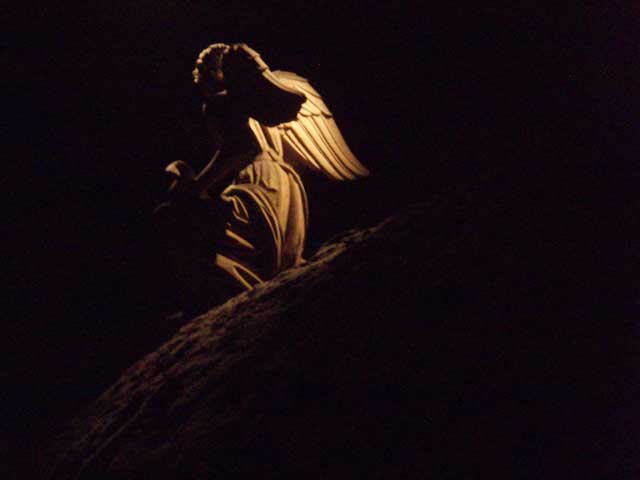
The original salt cathedral was completed in 1950s, but with the vibrations of the working salt mine in the other tunnels (still active today), there was structural damage, making the cathedral unsafe. It wasn’t until the mid-1990s that the salt cathedral went through an overhaul, with the help of a winning modern architect, who designed the holy place in a minimal, contemporary style using simple lines, symbols and lighting techniques. The darkness of the cathedral gave it a new sort of slant on Catholicism — just look at the angel Gabriel (picture above) — and it was like the Pope meets Batman. (FYI, the Pope part might not actually be true; according to Wikipedia [the most trusted name in speculative information], the Salt Cathedral of Zipaquira has no bishop and therefore no official status in the Catholic Church, even though 3,000 people go to mass there on Sundays.)
Whilst in Zipaquira, we checked out the Archaeological Museum (with its curious artifacts of regional tribes) before going out to lunch at the “galleria,” a series of food stalls that Hugo was excited to take us to; it was there that many a trip with his kids Monica and Victor Hugo had gone to for a bite with the locals. “This is fine,” Steph said encouragingly. “Bring it on.”
There we ate local soups, and shared a platter of gallina (mature chicken, a bit tougher and gameyer than regular chicken) with potatoes and tortillas, which we ate with our hands as the locals did.
“Que rico,” we agreed.
We washed it down with revajo, a tasty blend of soda and beer. “[I am very happy that you are here,]” Hugo told us proudly in Spanish. “[This place isn’t all…]” and then he did a funny gesture of a guy straightening his tie all mockingly like he was all snooty at a fancy restaurant. Rather than throw away our leftovers, Hugo happily gave our unwanted food to a homeless guy, who finished it at the next table, giving his scraps to a patient stray dog.
And so, Steph and I not only got our fill of typical Colombian food, but our fill of the typical sights to see in and around the Bogota area. But Bogota wasn’t just colonial cathedrals of stone or salt, for there was an entirely different side of Bogota that we’d soon discover.
As relatively safe Bogota is, it isn’t 100%, and everyone had told us that you shouldn’t just hail a cab off the street like you can in New York City — you should always call one, or have one called for you. (Hailing a cab off the street may lead to ATM robberies where you are brought to ATMs throughout the city at gunpoint, kidnapped until you empty your cash reserves for one really expensive cab fare.)
However, after coming down from Monserrate, Steph couldn’t walk anymore with her lack of good walking shoes (just this one time), and we attempted to hail a cab off the street anyway to get back to our hotel in La Candelaria. We weren’t the only ones, so it seemed okay; we even gave up one cab to a woman traveling with a little girl. After waiting and waiting, a cab finally arrived, zipping really fast down the mountain road, and into the traffic of downtown. We told him our address in Spanish but couldn’t figure out what he was trying to say back in Spanish. He got us as far as Avenida Jimenez, about ten blocks short of our destination, and pulled up to a corner for us to get out. Confused, we tried to tell him in broken Spanish it was the wrong address, but he wouldn’t budge — perhaps because he didn’t want to deal with the traffic ahead. So we tried to pay him for our half fare, but he just insisted that we get out — even without pay. We walked from there, confused, but fortunately that was the worst of our street cab hailing experience.
Next entry: New Friends In The New Bogota
Previous entry: Rendezvous In Bogota
Commenting is not available in this channel entry.
Comments for “Classic Colombia”
Sorry these are coming in piecemeal, but be glad they’re still coming, as I’ve decided to finish this blog for a sense of closure. Happy New Year everyone!
Stay tuned…
Posted by .(JavaScript must be enabled to view this email address) on 01/04 at 03:43 PM
Good Choice, Thanks Erik
Posted by .(JavaScript must be enabled to view this email address) on 01/07 at 03:43 PM
Do not search for effort if you want it, simply do what you enjoy and think in, and result will come with our professional research papers writing service.
Posted by FrancisJulie on 06/10 at 12:34 AM
great range of Ed Hardy products. Ed Hardy Women’s Ellerise Lowrise Sneaker · Ed Hardy Women’s
ed hardy jeans, ed hardy hoody, ed hardy shirt, ed hardy clothing, ed hardy cap, ed glasses, ed belts,
women fashion shoes, men’s clothes. helping .perhaps you will like
Ed Hardy
Ed Hardy shoes
Ed Hardy shirts
Ed Hardy clothes
Ed Hardy clothing
Ed Hardy shoes
Don Ed Hardy is an American tattoo collector raised in Southern California
Ed Hardy Clothing,Christian Audigier,Ed Hardy Shoes,Ed Hardy Swimwear,Ed Hardy Hat,
ED Hardy Caps
Ed Hardy Sunglasses
Ed Hardy Wallets
EdHardy
Gucci outlet store online, numerous cheap Gucci bags, handbags, wallets, purses, totes, shoes on sale,
cheap prices and authentic qualities
gucci handbags
gucci jewelrytjhytjPosted by .(JavaScript must be enabled to view this email address) on 07/09 at 02:58 AM
Gucci Watches;
Rado Watches;
Bvlgari Watches;
replica gucci Watches;
Cartier Watches;Posted by brand wathes on save on 10/29 at 06:13 PM
Entering Race in 2012By louis vuitton wallets 2012By MARY BRUCENov.
17, 2010 Sarah Palin <u>fake prada</u> Palin says she is seriously considering a replica wallets a run for the White House, and <h4>wallets women</h4> and she believes
she could beat President <h4>wallets for sale</h4> President Obama in 2012, the former Alaska vivienne westwood earrings Alaska governor told ABC News’ Barbara Walters.“I’m fendi zucchino wallet Walters.“I’m looking at
the lay of the fake prada bags the land now, and ... trying toPosted by burberry online on 11/23 at 02:47 AM
Yeah zoom is made up like a sponge almost it is a lot more responsive cheap nike shoes won great honor for world production and supply of comfortable Nike Air Griffey Max to consumers around the lot. Nike Dunks were originally produced for the basketball team until 1985. Over time, these dunks shoes became very popular with audiences and new styles were introduced. They are publicly known for their durability and comfort. nike air force 1 These basketball shoes have changed category to a fashion icon for allPeople.
nike dunk high invested a lot of experience with the latest technology and best quality raw materials for the manufacture of Nike air max 90. The result of all these efforts, the sense of the consumer, nike air jordan safety and comfort. Many people do not know how to separate life are the nike basketball for play and daily, but they do not want to compromise on quality. air max 2011 is designed to meet these needs and provide quality, lebron james shoes. You can bring in your daily life and during the gamerequire pivoting and jumping, etcPosted by nike shoes on 11/30 at 04:55 AM