Big Cats, Big Birds and Telephones
This blog entry about the events of Monday, March 15, 2004 was originally posted on March 20, 2004.
DAY 149: The Cango region just north of the mountains of the Garden Route has many attractions, each with its own brochure fighting for the tourist dollar. Sorting through the options was a bit daunting, but luckily the Bok Bus people figured out three main highlights.
After breakfast on the deck overlooking the beach, we hopped in the minivan and headed to our first highlight: the Cango Caves. We drove over the mountains and through the Little Karoo semi-desert, passed ostrich herders moving their flock along, to the natural wonder found under a very developed tourist complex with restaurants and shops. There were two ways to see the caves: via the Standard Tour or, as me and the Germans Birgit, Verona, Andy and Sonja saw it, via the Adventure Tour.
The Adventure Tour included a walk around the Standard’s major caverns, but then added a walk, climb, crawl and slide through narrow passages in the back end of the cave network. Our guide Ilse, a Belgian of South African heritage, started us off in the first chamber, a huge cavern of stalactites, such as the famous “Organ Pipes,” and stalagmites, such as the famous “Cleopatra’s Needle.” With its great acoustics, the first chamber was once used for concerts until too many people used to sneak in the back and break off pieces of the rock to take home. In fact, there is still a reward up for any information leading to the conviction of cave vandals.
The second chamber was just as impressive as the first, with all of the lime rock formations dramatically lit with lamps from the network of electrical cables along the edge of the walls. It was a tourist photographer’s smorgasbord and everyone went to town — some panned around the room with camcorders, some spent lots of time setting up their tripods for the perfect shot. Meanwhile, amidst all the natural underground beauty, my mind was somewhere else.
“Hey, did you notice there’s a telephone down here?” I pointed out to Sonja. There was one on the light switchbox.
“I use that to call for food,” Ilse said. “It’s only to be used for emergencies, but sometimes food is an emergency,” she joked.
Ilse led the twenty-two of us up and down steps and through small tunnels, pointing out the crystals in the ceiling, the rimstone jutting out of the walls and the pools of calcium-rich water on the floor. She taught us the history of how each chamber was discovered at different times, and spoke of how Richard Chamberlain and Sharon Stone were in one cavern during the filming of 1985’s King Solomon’s Mines. Interesting stuff indeed; I pointed out another telephone in the corner.
THE “ADVENTURE” PART OF THE ADVENTURE TOUR involved contorting one’s body through hot, humid and narrow passageways only about 50 centimeters wide — all with less oxygen too since it only came from the main entrance hundreds of meters away — but at least the tunnels were lit to keep the spiders away, which made the arachnophobic Sonja really happy.
All of us walked through the “Tunnel of Love,” which wasn’t such a romantic thing because you had to walk in single file with your head and back lowered. But the worst of these passageways was the “Devil’s Chimney,” a skinny chute that could only be done one at a time, where you really had to swing your legs around to catch the holds in the rock. Some actually chickened out on it and and one woman even slipped on the damp rocks and nearly broke her ribs. When it was my turn to go up the chimney, I couldn’t really get the hang of it either. Ilse was at the top guiding everyone with advice. She saw me struggling.
“Swing your right leg up there and then put your foot there.”
I couldn’t get it.
“Um, you have to know your left from your right first.”
“Oh, right.”
(To this day, I still have to think about left and right.)
I managed to squeeze myself up the fifteen-foot 80° climb, only to be alone in a cave. Where the others had gone I didn’t know, but the trail led to a tiny slit in the rocks known as the “Post Box.” With a height of just 25 cm., I thought this can’t be the way, but people had already slipped through to the other side. I slid on through with Sonja behind and eventually all the mails (and femails) had been delivered.
AFTER AN OSTRICH FILLET BURGER at the Cango Caves cafe, we drove to the source of such a meal: the Cango Ostrich Farm, one of the 400 farms in the area where ostriches were bred for meat, leather and feathers. The nearby city of Oudtshoorn used to be the capital in the hey day of ostrich farming in the 1880s. Back then, the elite of the world turned to Oudtshoorn for ostrich products, particularly feathers for ladies’ dresses, hats and boas.
Due to a lack of good marketing in a World War I era, this “feather boom” in Oudtshoorn declined in the late 1910’s. In addition to those factors, the car had gone public by that time, and women stopped buying ostrich feather hats because they would just blow away while riding in an open-roof vehicle.
Although the hey day of Oudtshoorn has been over for a long time, the elite still turn to the nearby ostrich farms for ostrich products: feathers (for dusters); leather (Ferrari interiors are upholstered with it); and ostrich meat, which although technically fowl, is a red meat similar to beef but with just three grams of fat per serving and no cholesterol. On the flip-side, one ostrich egg, a so-called “cholesterol bomb,” has the cholesterol of twenty-four chicken eggs.
“Eat three and you will die,” Christopher our ostrich farm guide told us, who was also responsible for all the ostrich historical trivia you just read.
Christopher was an energetic one, who led us from the history room to the incubation room where newly-hatched ostrich chicks sat in incubators to keep warm — until the occasional tourist came along for photo opps. From the babies of the infirmary, we met the adults outside, the first being a female named Linda who, if you put a food pellet between your lips, would “kiss” you. Let me tell you, it was more frightening than romantic to be kissed by a big bird, it staring you in the face with its big bug eyes before lunging at you with its beak (244k Quicktime MOVie).
“That’s the first kiss I’ve had in months,” Chris said. Luckily for him, he didn’t kiss the older and more aggressive Eve who would have probably ripped his lips off with her beak.
From the pens, we went to the place where, as Christopher said, “all your dreams come true:” the ostrich rodeo, where willing participants could actually ride an ostrich.
HOW TO RIDE AN OSTRICH
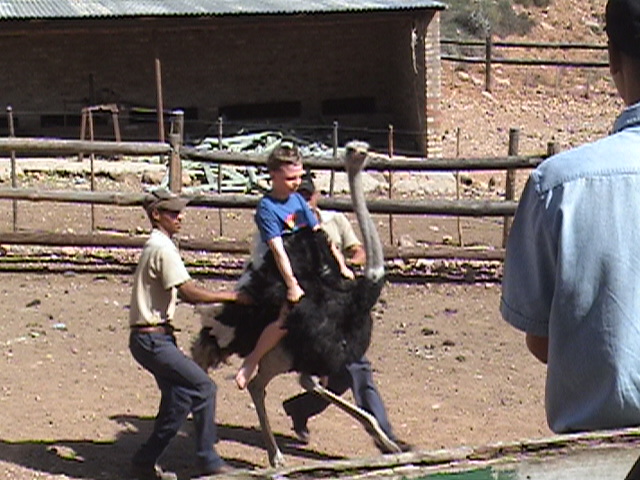
Step 1: Round up an ostrich. First, find an ostrich. You may find this easy if you go to an ostrich farm outside of Oudtshoorn, South Africa. Have two ostrich wranglers chase one of the big, flightless birds — one to hook its neck with that big hook thing they used to pull bad vaudeville acts off stage; and the other to put a canvas bag over the ostrich’s head.
“Ostriches are stupid birds,” according to guide Christopher. “They think if they can’t see you, you can’t see them.” (This is why ostriches put their heads in the ground to “hide” from predators.) With the bag over the bird’s head, have the two wranglers simply escort the bird to a mounting area.
Step 2: Mount your ostrich. When your guide asks the audience in the stands, “Okay, who wants to go first?” and everyone is quiet and wishy-washy, raise your hand and say, “Alright, let’s go.” Stand up and walk down to the mounting area. This will be accompanied with applause and people cheering, “Go Erik!” (assuming your name is “Erik”).
Using the V-shaped fence where the ostrich is in, climb the first rung and swing your right leg around the bird’s back. (You have to know your left from your right first.) Tuck your feet under the bird’s front and cross your legs as best you can. Hold onto the elbows of the wings to keep yourself from falling when you lean back, back straight towards the bird’s tail.
Step 3: Ride the ostrich. (picture above) When the guide removes the canvas bag from the ostrich’s head, it will soon realize that not only is it not invisible, but there is some guy sitting on its back. This will cause the bird to run around the rodeo like a three-year-old that has had way too much sugar. Hang on for your life — the ride will only last for about ten seconds. To transcribe the words coming out of this author’s mouth:
“Oh Jesus! Whoa! Hahahahahaaa! Woooo! Hahahahahaha! Okay, falling off, falling off, falling off…”
Hopefully the two ostrich wranglers have been running behind the ostrich the whole time and will help you dismount the bird. Walk back to the bleachers and receive your applause.
(Click here for the 424k Quicktime MOVie.)
AFTER FEEDING THE BIG BIRDS, we went to a feeding of big reptiles and big cats at the Cango Wildlife Park. The Bok Bus arrived just in time for the feedings of the American alligators and the Nile crocodiles on ostrich wing tips. On the other side of the zoo were big cats: pumas, leopards and tigers, all feeding on antelope or, if you were in the “royal” lion family, calves’ heads. The park looked like your run-of-the-mill zoo — reptile house, cute mammals in little pens, kids with sloppy ice cream mouths — but the main thing that distinguished them from others was that the park’s mission was to breed the almost extinct cheetah back into existence, which they had been doing for several years.
FROM THE CHEETAHS BRED IN CAPTIVITY, we drove 69 kilometers into the wilderness — Wilderness the town that is, for our accommodations of the night: The Fairy Knowe Backpackers. (The term “backpackers” is a noun in South Africa which means “(youth) hostel.” Set in the lush green land between the mountains and the beach, the backpackers was the former summer home of a farmer and the oldest existing building in Wilderness. The place was run by Elmerie who not only had to single-handedly manage, cook, clean and bartend for our group and a handful of pairs, but for a whole busful of French students on an English language school trip.
The Frenchies kept amongst themselves at the pool table as the Bok Bus group dined outside near a fireplace with bowls of lamb potjie (stew) and rice. Elmerie served up beers, local ciders and Nordic Ices while Tom went out for a marshmellow run.
While roasting marshmallows on the fire that I volunteered to tend to, I met a couple from Seattle working and studying medicine in Johannesburg, on vacation for a couple of weeks. They were doing the Garden Route in a rental car in the reverse direction as we were and were planning to see the ostrich farms the following day. Having been there earlier that day, I could have given them directions, but then again, it was probably better if I knew my left from my right first.
Next entry: Superlatives
Previous entry: The Little Green Van
Commenting is not available in this channel entry.
Comments for “Big Cats, Big Birds and Telephones”
HEY GANG… I’m back from the NIZ… here’s three entries so far. More to come as the day progresses.
Sorry about the influx of pharm and porn spam… I’m told the good people at BootsnAll are on it.
COMING SOON: Flying a plane, diving with sharks and… Foofie sliding!
Posted by .(JavaScript must be enabled to view this email address) on 03/20 at 07:16 AM
First again

Love the cave pics!! Makes me want to go there!
BTW - my mom loved your Bolivian salt flat pics and is sending “tons” of people to your site. She’s prone to exaggeration, so that might mean 3, but just wanted to let you know that the salt flat pics are a big hit!Posted by Liz on 03/20 at 07:27 AM
LIZ: Congrats on being first two entries in a row!
LIZ’S MOM: Thanks for passing the word along! Welcome aboard!
LIZ’S MOM’S THREE FRIENDS: Hey there, and welcome to the Fellowship of the Blog! Enjoy the stories and pictures and pass the word along to three more friends!
Posted by .(JavaScript must be enabled to view this email address) on 03/20 at 07:40 AM
SIM: Hope you like that The Global Trip mug… postcard to come! (First African round most likely from Namibia.)
Posted by .(JavaScript must be enabled to view this email address) on 03/20 at 07:41 AM
CALVES HEADS!!!...SHIET!!!..
Thanks for the instructions and instructional video…
LP - I think there is an ostrich garage over on the westside in the 40s….let’s go mount em and ride em…ahaha…
ok…wishful thinking..
Posted by .(JavaScript must be enabled to view this email address) on 03/20 at 09:39 AM
CRIKEY!
Posted by .(JavaScript must be enabled to view this email address) on 03/20 at 11:32 AM
I knew I shouldn’t have slept lastnight.
Oh well, I hope that Ostrich didn’t get to fresh with you!
Posted by .(JavaScript must be enabled to view this email address) on 03/20 at 12:54 PM
HEY GANG! Guess what? I’ve just been mugged at knifepoint! On what was to be my last day in Cape Town! I just LOVE South Africa!
I’m trying to be a good sport about it, laughing about it with others and all, but it was actually a pretty fucked up experience… story to be told in an upcoming Blog entry.
Long story short: a man working with a boy (to look non-threatening) rushed me with a knife, and took my camera and wallet, just around the corner from the hostel where I have walked by for the past two weeks with no problem. My bag and passport and important documents are fine. I’M fine, just a little shaken up. They took a $50 travelers check, about $250 in cash, my debit card, my diver certification card, and some notes. What’s worse is they took my little spy camera, but luckily I had just backed up my photos up on my laptop until the day before, so not all is lost (just the camera and my memory card).
Not to worry, all of those can be replaced. Fortunately, I managed to keep my notepad with notes for my journal.
*They can have my money, but they can’t have THE BLOG!!!*
I will be in Cape Town for the week now, waiting for replacement stuff to arrive from the States. In the meantime, I’ll have plenty of time to catch up on Blog duties… stay tuned!
Needless to say, I’m drinking in the hostel bar now…
Posted by .(JavaScript must be enabled to view this email address) on 03/20 at 03:37 PM
I bet if you called the guy a fat whore he would have ran! It works all the time!
Posted by .(JavaScript must be enabled to view this email address) on 03/20 at 03:42 PM
Sorry about the Money and cam… glad you are OK!
Just doing some quick snooping around…. here’s a place you can find cameras online in South Africa.
http://www.wholesaledigital.co.za/
and another
and another… not too much sony stock though
http://www.memstore.co.za/Sony.htm
That’s about it. Can’t find an african resellerratings

Posted by .(JavaScript must be enabled to view this email address) on 03/20 at 04:12 PM
Found it… http://www.dealmccoy.co.za
and what I hope are better stores
http://www.digitalexpress.co.za/
http://www.incredible.co.za/services/catalog/features.asp?rcat=Cameras&menu_id=5#imhere
Posted by .(JavaScript must be enabled to view this email address) on 03/20 at 04:24 PM
Holy crap! So glad you’re ok—not hurt that is. It must have scared the daylights out of you. Keep up that positive attitude it will serve you well. And you’re quite right—all that stuff is replaceable.
Did you file a police report? Is anything being done on that front?
Love you’re assertive platform “*They can have my money, but they can’t have THE BLOG!!!*” Good stuff, my friend.
Just when I thought my comment was going to be all about knowing left from right (me too on that), and ostrich riding… BTW there is a farm just around the block from me (way out in NW NJ) that had emus. You think they’d go for that?
Stay safe, drink heavily, and post often!
Posted by .(JavaScript must be enabled to view this email address) on 03/20 at 05:27 PM
sorry about your theft & glad you are allright! I just went through a vacation theft with my friend last month in Costa Rica. Sometimes all you can do at the end of the day is laugh and have a beer. I highly enjoyed the ostrich videos and trivia!
Posted by .(JavaScript must be enabled to view this email address) on 03/20 at 06:19 PM
BASTARDS!!!
Posted by .(JavaScript must be enabled to view this email address) on 03/20 at 06:21 PM
Holy crap!!! I’m sooooo glad that you are not hurt. That’s horrible. Yes, go have a beer… or twenty! Stay safe and hopefully everything will get straightened out on the paperwork/insurance side with little hassle (assuming you had theft ins).
Posted by Liz on 03/20 at 08:28 PM
*They can have my money, but they can’t have THE BLOG!!!* you got that right!!!
:( poor you!! i still can’t believe you got mugged! a knife…YIKES!! thank goodness they didn’t hurt you! looking forward to hearing the long story.
(i’m NOT jealous! haha.)
ps- an ostrich’s eye is bigger than its brain.
Posted by .(JavaScript must be enabled to view this email address) on 03/20 at 08:57 PM
Rik!
Rat Motherfuckers! I’m glad that you’re ok….I can’t believe that you got mugged like that…but I am so glad that you didn’t get hurt! Sonso’bitches!
Posted by .(JavaScript must be enabled to view this email address) on 03/20 at 09:08 PM
Maybe the assailent thought you were Japanese and he wanted to be the frist BASTARD on the block with the latest Sony gadgets.
Posted by .(JavaScript must be enabled to view this email address) on 03/20 at 10:36 PM
HOLY SHIT - I’m glad you’re ok Erik. That really, really sucks. In my experience the best thing to do in a mugging is to just run like hell.
Hey - Liza and I are going to Hong Kong, Cambodia and Vietnam in late Sept / early October - maybe we can hook up then.
Great cave pics!Posted by dunlavey on 03/21 at 03:01 AM
Thanks for your support guys… The mugging happened on what was to be my last night in Cape Town, but now I’m “stuck” here waiting for replacement cards to arrive. It cuts into my Namibia time, but I’ll try to work things out.
Stay tuned for more entries! I have all week to write them now!
Posted by .(JavaScript must be enabled to view this email address) on 03/21 at 06:04 AM
MARKYT: From the wholesale places that Duaine recommends, a new U20 will run me about $500 w/o a memory stick here… If you can beat that price (for a U30), factoring in cost for a 256MB mem stick and the cost for shipment to Cape Town, send it down… Let me know.
Posted by .(JavaScript must be enabled to view this email address) on 03/21 at 06:10 AM
ERIK - I can beat that with a U50 if you wanted that!....let me know, going to j and r or b&h today…
u30 - 199 u50 - 249 (but uses that small ass mem stick duo, so the 512 u got won’t work)...
u30 i’ll just get…
Posted by .(JavaScript must be enabled to view this email address) on 03/21 at 10:09 AM
OMG!! I’m so glad you are ok.
Damn bastards with their greedy selves.
Be careful.On a lighter note, I love the two videos. Laughed so freakin hard.
Posted by .(JavaScript must be enabled to view this email address) on 03/21 at 10:43 AM
What an IceHoE! ... glad our ok man ... & thanks for protecting the Blog .. dunno what we could’ve done without it. the entries were great ... its miller Time, go out & get FUNdaMENTAL!!! down but not out !
Posted by .(JavaScript must be enabled to view this email address) on 03/21 at 10:44 AM
wow…thanks for saving the blog! Seriously tho, we’re glad you’re safe and drinking. Get some Nike Airs shoes…you can outrun anyone in ‘em (unless they’re also wearing them too).
Posted by .(JavaScript must be enabled to view this email address) on 03/21 at 11:27 AM
HEY ALL… as predicted, I’m am getting fundamental right now… thanks for the support! A new spy camera is en route… my cards are canceled with replacements on the way…. refunds for my trav checks en route as well… not all is lost… stay tuned for a massive entry upload, hopefully tomorrow!
Posted by .(JavaScript must be enabled to view this email address) on 03/21 at 12:25 PM
ALL: P.S. I’m just “fundatmental” enough right now that I’m fondling all of you telepathically…
Posted by .(JavaScript must be enabled to view this email address) on 03/21 at 12:33 PM
damn bastards! i bet if they read the blog they’d give it back. but its good thing u didn’t get hurt. i still don’t get it though.. unscathed from a knife mugging but u go to the ER for washing dishes and falling signs.
keep it up!Posted by .(JavaScript must be enabled to view this email address) on 03/21 at 12:35 PM
EROCK: here are the links to the SSI replacement card info
http://www.ssiusa.com/diver_lostcard.htm
and the red sea sites: http://www.ssiusa.com/dealerdb/index.cfm?action=get&pkey=22&pid=1
fill out the form and send it with a request to have your card sent to one of the red sea facilities.
Posted by .(JavaScript must be enabled to view this email address) on 03/21 at 12:55 PM
Glad you’re alive and well and drunk Erik.
I ask all fellow lurkers to help this fella out! They didn’t steal YOUR credit card, so mosey on over to PAYPAL.com and cha-ching, cha-ching some $$$ his way. We all love the photos, so let’s help buy the freakin’ camera!!!
(Sorry if this sounds like a PBS fund-drive, but the same logic applies . . . )
Posted by .(JavaScript must be enabled to view this email address) on 03/21 at 01:19 PM
ERIK: Glad that you’re safe. Sorry that you went through that ish. Be careful and have a beer. Murtinho nobre.
Posted by .(JavaScript must be enabled to view this email address) on 03/21 at 04:56 PM
To hell with telepathic fondling… get busy with some ACTUAL fondling! Milk that pity card dude!
Posted by .(JavaScript must be enabled to view this email address) on 03/21 at 06:08 PM
EMILE4REAL: Wow, thanks for the donation! No more fecal matter pictures for you!
Posted by .(JavaScript must be enabled to view this email address) on 03/22 at 10:00 AM
holy shit dude!! i am glad you are ok. sorry, been a bit behind on blog reading. those fuckers. they deserve to have their balls skinned with the same knife they pulled on you. i am glad they only got the smaller camera, and not your laptop and other stuff. that would definitely be bad. if you need anything, just let us know. very glad you are ok. =)
Posted by .(JavaScript must be enabled to view this email address) on 03/22 at 11:44 AM
Hi Erik,
Glad you are okay and sorry about your camera.
Too bad you did not have a canvas bad with you, you could have threw it over your head and became invisible.
I liked the cave pictures. What happened to the people that did not want to climb up the “Devils Chimney?” Dd they have to walk back out of the cave without a guide?
Posted by .(JavaScript must be enabled to view this email address) on 03/22 at 12:16 PM
Wow, glad you’re alright . .
Posted by Alyson on 03/22 at 09:14 PM
WARREN: The Adventure Trail went in a circle… you they just backtracked back to the starting point, the easy way…
Posted by .(JavaScript must be enabled to view this email address) on 03/23 at 08:24 AM
keep on truckin erik! glad to see you’re in good spirits
Posted by .(JavaScript must be enabled to view this email address) on 04/01 at 01:21 PM
SHARE THIS TRAVEL DISPATCH:
Follow The Global Trip on Twitter
Follow The Global Trip in Instagram
Become a TGT Fan on Facebook
Subscribe to the RSS Feed
This blog post is one of over 500 travel dispatches from the trip blog, "The Global Trip 2004: Sixteen Months Around The World (Or Until Money Runs Out, Whichever Comes First)," originally hosted by BootsnAll.com. It chronicled a trip around the world from October 2003 to March 2005, which encompassed travel through thirty-seven countries in North America, South America, Africa, Europe, and Asia. It was this blog that "started it all," where Erik evolved and honed his style of travel blogging — it starts to come into focus around the time he arrives in Africa.
 Praised and recommended by USA Today, RickSteves.com, and readers of BootsnAll and Lonely Planet's Thorn Tree, The Global Trip blog was selected by the editors of PC Magazine for the "Top 100 Sites You Didn't Know You Couldn't Live Without" (in the travel category) in 2005.
Next entry:
Superlatives
Previous entry:
The Little Green Van
THE GLOBAL TRIP GLOSSARY
Confused at some of the jargon that's developed with this blog and its readers over the years? Here's what they mean:
BFFN: acronym for "Best Friend For Now"; a friend made on the road, who will share travel experiences for the time being, only to part ways and lose touch withThe Big Trip: the original sixteen month around-the-world trip that started it all, spanning 37 countries in 5 continents over 503 days (October 2003–March 2005)
NIZ: acronym for "No Internet Zone"; a place where there is little to no Internet access, thus preventing dispatches from being posted.
SBR: acronym for "Silent Blog Reader"; a person who has regularly followed The Global Trip blog for years without ever commenting or making his/her presence known to the rest of the reading community. (Breaking this silence by commenting is encouraged.)
Stupid o'clock: any time of the early morning that you have to wake up to catch a train, bus, plane, or tour. Usually any time before 6 a.m. is automatically “stupid o’clock.”
The Trinidad Show: a nickname of The Global Trip blog, used particularly by travelers that have been written about, who are self-aware that they have become "characters" in a long-running story — like characters in the Jim Carrey movie, The Truman Show.
WHMMR: acronym for "Western Hemisphere Monday Morning Rush"; an unofficial deadline to get new content up by a Monday morning, in time for readers in the western hemisphere (i.e. the majority North American audience) heading back to their computers.
1981ers: people born after 1981. Originally, this was to designate groups of young backpackers fresh out of school, many of which were loud, boorish and/or annoying. However, time has passed and 1981ers have matured and have been quite pleasant to travel with. The term still refers to young annoying backpackers, regardless of year — I guess you could call them "1991ers" in 2013 — young, entitled millennials on the road these days, essentially.
Spelling or grammar error? A picture not loading properly? Help keep this blog as good as it can be by reporting bugs.