Animated Ascent
This blog entry about the events of Tuesday, June 22, 2004 was originally posted on June 28, 2004.
DAY 248: “If there was any one song you could have in your head while riding the camels, what would it be?” Sebastian the 20-year-old Vancouverite asked me. I drew a blank.
“I don’t know.”
Sebastian revealed the one he had in mind, a song from his childhood when he was ten and I was in college:
Prince Ali, mighty as he, Ali Ababwa…
(from Disney’s animated feature Aladdin)
This was just one of the many references to cartoons throughout the day as we hiked up Djebel Toubkal, north Africa’s highest peak at 4167m. ASL.
We had a pretty late start in the day — blame The Blog for eating up most of the morning — but by 12:30 we were in a shared grand taxi (a beat-up old Mercedes that transports six) to the smaller town of Asni, 50 odd kilometers to the south. After stocking up on uncooked couscous, bread and Laughing Cow cheese wedges (a backpacker staple), we were in another shared grand taxi to ride the additional 17 km. to Imlil, the starting point of treks up Djebel Toubkal and other trails in and around the High Atlas range. We were approached by the usual touts, asking to be our guide up the mountain, but most of them stayed clear when Sebastian pointed to me and told them that he already had a Moroccan guide. Ah, the advantages of dark, sun-tanned skin.
THERE WAS AN EPISODE OF THE SIMPSONS in its first season when Marge considered having an affair with a Frenchman named Jacques that Sebastian and I reminisced about. We kept on quoting one conversation in particular:
Marge: What’s brunch?
Jacques (in thick, French accent): It’s not quite breakfast, it’s not quite lunch, but you get a slice of cantaloupe at the end.
It was this constant reference to this conversation that inspired a purchase on our way out of Imlil and onto the trail. “Hey, they have cantaloupe!” I said as we stood near a fruit stand.
Having the cantaloupe actually excited us (it didn’t take much to do that), and our brunch would come in time.
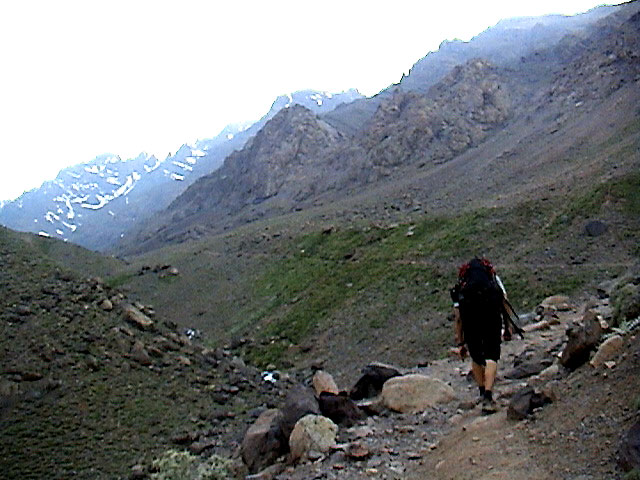
USING NO MAP BUT A DECENT WRITTEN DESCRIPTION of the trail in Sebastian’s Let’s Go guide, we made our way southbound through the valley on a well-marked, low-impact, gradually ascending trail (picture above) that followed a river upstream towards its source. There weren’t many people hiking along with us since we had a fairly late start — we started the average six-hour leg to the refuge at 2:30 in the afternoon — which was sort of a welcome change from the craziness and crowds of Marrakesh. I had Sebastian set a timer on his digital watch to count down six hours from then, with the nonsensical but wishful thinking that the more time counted down, the closer our destination would get nearer, even if we spent most of the time taking breaks.
About a third of the way up, we stopped under the shade of a tree for a lunch of Laughing Cow cheese sandwiches and to dry out our sweat-drenched shirts in the sun. It was the sort of time and place where one could look at the tall surrounding mountains and the distant waterfalls and truly have some deep thoughts.
“Here’s one for you,” Sebastian said. “What’s the first cartoon that started to know it was a cartoon?” Cartoons swirled through my head from old Disney cartoons to classic Warner Bros. cartoons, but I was drawing a blank.
“Darkwing Duck,” he said, citing an answer from his generation of early 1990’s after-school cartoons. “I remember watching it once and thinking, something’s not quite right here.” (Mind you, this was coming from a guy who read Sartre in the minibus during the camel trek tour.)
And so, our deep conversation about the self-aware post-modernist style of Darkwing Duck and other cartoons led us up the peak. I think it’s safe to say it was the first conversation of its kind in the High Atlas mountains, or perhaps Morocco, or the entire continent of Africa. (I’m sure there are some Fan Boys in the U.S. who’ve had it.)
ABOUT HALFWAY UPHILL (in terms of distance, not our timer countdown), we reached Sidi Chamarouch, a small collection of houses surrounding a Muslim shrine not open to non-Muslims. the tiny village was everything the guidebook said it would be, with price-inflated drinks and guys telling us to spend the night (and our money) there because the refuge “[is far, four hours away.]” We politely declined the man’s pitch — the refuge was only three hours away according to the book — and skipped out on the expensive drinks by filling our water bottles with fresh mountain water, right from the source.
We took our time as we leisurely continued up the trail with our conversations of cartoons. “I’m actually really excited about the cantaloupe,” I said.
“Did we get that because of The Simpsons?”
“Totally.”
THERE WAS SOME TRUTH IN WHAT THE GUY SAID at Sidi Chamarouch; with our casual pace, four hours to the refuge seemed to be about right. We walked up and up, passed herds of goats and beautiful waterfalls showering down from above in the distance. When Sebastian’s watch alarm beeped signaling that we should have reached the refuge already, the refuge was still an hour away. The temperature dropped considerable when night fell and we only had a slight moonlight to illuminate the trail for us — just bright enough for us to stay clear of the horse turds peppered on the trail. The lights of the refuge at 3207m. ASL guided us like a lighthouse does to ships in a fog, and by 9:30 we arrived and checked into the fairly modern refuges, a hostel on a hill, and into one of the big communal dorm rooms that held up to twenty people.
For dinner, Sebastian attempted to make a fire with his portable gas stove so we could make Marmite-flavored couscous (talk about improvisization), but it sort of went out of control and started to melt the plastic covering on the picnic table we had it on. The uncontrollable flames of the mini-stove continued when Sebastian put it on the ground with no success of taming it. We drew quite a crowd of staff members, including the young ones that couldn’t have been older than twelve.
In the end, we just used the stoves provided by the refuge’s kitchen.
SINCE WE ARRIVED RELATIVELY LATE AT THE REFUGE, most people were already asleep for their early morning rise to trek the rest of the way up to the peak. One of the few remaining people awake (and the only other person whose first language was English) was an Australian woman named Jess, who was quite happy to hear English from our voices. Eventually she went to bed while Sebastian and I had dinner. We tried to eat in the living room of the refuge, with its cushioned couches, but one of the kid staff members scolded us almost immediately. “Can’t you read the people?” he said in broken English while pointing to a sign we didn’t notice. (We figured he could have dropped the “the.”) The sign stated that no eating was allowed there, only in the designated dining hall. We moved away from the cushions, but not away from the grumpy stares of the two boys apparently working at the refuge with their families. Whenever we asked a simple question, the boy would start off with an attitude, like we were intruding on his house.
“I don’t like taking orders from infants,” Sebastian joked to me. Perhaps the grumpiness spawned from a lack of sleep, but it didn’t matter; we called it a “hostile hostel” anyway.
Disgruntled adolescence? These guys really could use a couple hours of cartoons…
Next entry: Heels On The Hill
Previous entry: Profit Mohammed
Commenting is not available in this channel entry.
Comments for “Animated Ascent”
just to say hello & to say first….
enjoying the blog, you are traveling the world for us. thanks a million.
nice to meet different faces too…marrakesh is really neat, the dunes are awesome. .
Posted by .(JavaScript must be enabled to view this email address) on 06/28 at 04:20 AM
....right, and as if it weren’t Erik who started every conversation with, “and did you see that episode of ......”
Posted by .(JavaScript must be enabled to view this email address) on 06/28 at 04:29 AM
We stumbled upon your travelblog three days ago, and it being weekend we have been pretty much reading it for three days in a row.
We think it’s great, sure will make a bestseller. Keep up the good work and take care of yourself.Posted by .(JavaScript must be enabled to view this email address) on 06/28 at 06:47 AM
wow, the scenery is beautiful. i love the waterfalls. that seems like a really nice hike to go on, i am jealous. and as for the cartoon who realizes that s/he is a cartoon, i would say it is actually the warner brothers episodes with bugs, elmer fudd and daffy, in which they take turns “drawing” each other one the white paper backgrounds, purposely making mistakes. i think my favorite was when elmer fudd erases bugs’ ear, and replaces them with human ears, in which the response is “these are human ears, my friend. i want rabbit ears, looong ones.” =)
Posted by .(JavaScript must be enabled to view this email address) on 06/28 at 06:50 AM
Alice is right - the scenery is beautiful. I love pictures of waterfalls - top notch, Mr. Erik.
I think it’s funny that you’re having conversations about cartoons while hiking in Morocco - such real life/meaningful stuff!! I wanna be there discussing the Triplets of Belleville - and adding that to the convo!
The goats are cute! Were they mean or nice?
Posted by .(JavaScript must be enabled to view this email address) on 06/28 at 10:43 AM
ADRIENNE: Glad you like it… three days in a row? Awesome.
Welcome aboard and pass the word along!
Posted by .(JavaScript must be enabled to view this email address) on 06/28 at 02:14 PM
SILENT ADMIRER: I can still see your email address, Mom… ;P
Posted by .(JavaScript must be enabled to view this email address) on 06/28 at 02:15 PM
darkwing duck? the first self-aware cartoon…hmm..wouldn’t Who Framed Roger Rabbit be the first? Since it was filmed in 1988 while DD was 1991-1995. Oh..but there’s also Cool World..and didn’t Bugs Bunny et. al always talked to the audience giving that impression that they are also under a spotlight? oh..and then there’s that superfriends episode…
Posted by .(JavaScript must be enabled to view this email address) on 06/28 at 04:41 PM
LP - yeah man…darkwing duck is sooooooo not the first…i’d have to agree with ALICE’s comment with those looney tunes guys…
“i’m not bad….i’m just drawn that way”
Posted by .(JavaScript must be enabled to view this email address) on 06/28 at 05:12 PM
Definately WB cartoons. Why else would Wile E. Coyote hold up a little sign just before he plumetted off a cliff that read “YIKES!” He knew we were watching! And then there’s one of my favorite Bugs episodes, the one with the rabbititus outbreak…
“It’s just a gag, a’ course. Why if you had rabbititus you’d see red & yellow spots before your eyes… and they’d start swirling and swirling… then suddenly everything would just go black! heeheehee.”Posted by .(JavaScript must be enabled to view this email address) on 06/28 at 09:13 PM
Oh, and the pics were very cool in this one! Sometimes I get caught up in the Hogumentary.
Posted by .(JavaScript must be enabled to view this email address) on 06/28 at 09:14 PM
I would have to agree - the original looney tunes were classic - and they knew we were watching. Bugs would look directly at the “camera” when he was tormenting Elmer Fudd.
Posted by .(JavaScript must be enabled to view this email address) on 06/28 at 10:52 PM
After seeing the goat and the mountain, I feel like yodeling.

Posted by .(JavaScript must be enabled to view this email address) on 06/29 at 05:25 PM
Okokok, I don?t have long to try to explain this right now, but I fear that I have been misunderstood. I?ll see if I can?t clarify: the idea was not so much that it was the first cartoon to do recognize it?s own cartoon nature, but more that it was the end of an era of cartoon naivete that existed (ex. tale spin, tom and jerry, ducktales….), where cartoons could truly exist independantly of reality; I believe Darkwing Duck to be the dawning of a new era of irony, sarcasm, and introspection (there were several-I?ll try to provide some more examples later, but the Animaniacs were perhaps the epitome). This is not to say that Bugs Bunny had not, in the past, drawn himself, talked to his creators, or that Wile E. Coyote did not know that we knew that he was headed off that cliff, but that the impact was not the same on the cartoon world. Once darkwing duck, a cartoon superhero himself, actually started subtly and not-so-subtly mocking cartoon superheros, all was changed. I don?t quite know why it had to be him, and maybe it was the whole conjuncture, but our animated friends could just never quite ignore his assaults on the cartoon world, and for a long time things were just not quite the same. Hence the heralding of post-modern Saturday mornings.
I?ve not really been up to date on these matters recently, but it strikes me that after a period of readjustment, things seemed to have more or less normalized. That is, that they have accepted their cartoon status, dealt with it, and moved on to other things. Being two-dimensional is not shameful, but at some point or other it simply had to be acknowledged.Just some thoughts for y’all. Perhaps I lack a broader historical perspective, or perhaps it was the lack of oxygen that made me say it, but yet, even as a mere child, I sensed that something, somewhere, in that seemingly harmless cartoon just wasn?t quite right….
Posted by .(JavaScript must be enabled to view this email address) on 06/29 at 08:29 PM
Okokok, I don?t have long to try to explain this right now, but I fear that I have been misunderstood. I?ll see if I can?t clarify: the idea was not so much that it was the first cartoon to do recognize it?s own cartoon nature, but more that it was the end of an era of cartoon naivete that existed (ex. tale spin, tom and jerry, ducktales….), where cartoons could truly exist independantly of reality; I believe Darkwing Duck to be the dawning of a new era of irony, sarcasm, and introspection (there were several-I?ll try to provide some more examples later, but the Animaniacs were perhaps the epitome). This is not to say that Bugs Bunny had not, in the past, drawn himself, talked to his creators, or that Wile E. Coyote did not know that we knew that he was headed off that cliff, but that the impact was not the same on the cartoon world. Once darkwing duck, a cartoon superhero himself, actually started subtly and not-so-subtly mocking cartoon superheros, all was changed. I don?t quite know why it had to be him, and maybe it was the whole conjuncture, but our animated friends could just never quite ignore his assaults on the cartoon world, and for a long time things were just not quite the same. Hence the heralding of post-modern Saturday mornings.
I?ve not really been up to date on these matters recently, but it strikes me that after a period of readjustment, things seemed to have more or less normalized. That is, that they have accepted their cartoon status, dealt with it, and moved on to other things. Being two-dimensional is not shameful, but at some point or other it simply had to be acknowledged.Just some thoughts for y’all. Perhaps I lack a broader historical perspective, or perhaps it was the lack of oxygen that made me say it, but yet, even as a mere child, I sensed that something, somewhere, in that seemingly harmless cartoon just wasn?t quite right….
Posted by .(JavaScript must be enabled to view this email address) on 06/29 at 08:29 PM
Okokok, I don?t have long to try to explain this right now, but I fear that I have been misunderstood. I?ll see if I can?t clarify: the idea was not so much that it was the first cartoon to do recognize it?s own cartoon nature, but more that it was the end of an era of cartoon naivete that existed (ex. tale spin, tom and jerry, ducktales….), where cartoons could truly exist independantly of reality; I believe Darkwing Duck to be the dawning of a new era of irony, sarcasm, and introspection (there were several-I?ll try to provide some more examples later, but the Animaniacs were perhaps the epitome). This is not to say that Bugs Bunny had not, in the past, drawn himself, talked to his creators, or that Wile E. Coyote did not know that we knew that he was headed off that cliff, but that the impact was not the same on the cartoon world. Once darkwing duck, a cartoon superhero himself, actually started subtly and not-so-subtly mocking cartoon superheros, all was changed. I don?t quite know why it had to be him, and maybe it was the whole conjuncture, but our animated friends could just never quite ignore his assaults on the cartoon world, and for a long time things were just not quite the same. Hence the heralding of post-modern Saturday mornings.
I?ve not really been up to date on these matters recently, but it strikes me that after a period of readjustment, things seemed to have more or less normalized. That is, that they have accepted their cartoon status, dealt with it, and moved on to other things. Being two-dimensional is not shameful, but at some point or other it simply had to be acknowledged.Just some thoughts for y’all. Perhaps I lack a broader historical perspective, or perhaps it was the lack of oxygen that made me say it, but yet, even as a mere child, I sensed that something, somewhere, in that seemingly harmless cartoon just wasn?t quite right….
Posted by .(JavaScript must be enabled to view this email address) on 06/29 at 08:30 PM
Hey Everybody!
Erik, glad you are doing well and have good company. Sebastian seems like a character (no pun or reference to the cartoon discussion intended). Love the camel/dessert/market pics. The blog just keeps getting better. I’m certainly not suggesting you do this but I was thinking we are all so addicted at this point (uh, how many people are reading this at work?)...that you could prolly charge an access fee…(laugh)
Hi Erik’s Mom…Glad you are “chillin” per your last non anonymous note (smile) don’t get too crunked to maintain the hustle…(keep on keepin’ on).
Posted by .(JavaScript must be enabled to view this email address) on 06/30 at 06:51 AM
“Let’s get Dangerous!”
Posted by .(JavaScript must be enabled to view this email address) on 06/30 at 07:17 AM
FUNCHILDE - access charge, although interesting and i agree, people would pay…
BUT, The Blog is priceless….
anyhow..it’s the best global marketing for future books, videos, and all that good stuff….
Posted by .(JavaScript must be enabled to view this email address) on 06/30 at 03:27 PM
SHARE THIS TRAVEL DISPATCH:
Follow The Global Trip on Twitter
Follow The Global Trip in Instagram
Become a TGT Fan on Facebook
Subscribe to the RSS Feed
This blog post is one of over 500 travel dispatches from the trip blog, "The Global Trip 2004: Sixteen Months Around The World (Or Until Money Runs Out, Whichever Comes First)," originally hosted by BootsnAll.com. It chronicled a trip around the world from October 2003 to March 2005, which encompassed travel through thirty-seven countries in North America, South America, Africa, Europe, and Asia. It was this blog that "started it all," where Erik evolved and honed his style of travel blogging — it starts to come into focus around the time he arrives in Africa.
 Praised and recommended by USA Today, RickSteves.com, and readers of BootsnAll and Lonely Planet's Thorn Tree, The Global Trip blog was selected by the editors of PC Magazine for the "Top 100 Sites You Didn't Know You Couldn't Live Without" (in the travel category) in 2005.
Next entry:
Heels On The Hill
Previous entry:
Profit Mohammed
THE GLOBAL TRIP GLOSSARY
Confused at some of the jargon that's developed with this blog and its readers over the years? Here's what they mean:
BFFN: acronym for "Best Friend For Now"; a friend made on the road, who will share travel experiences for the time being, only to part ways and lose touch withThe Big Trip: the original sixteen month around-the-world trip that started it all, spanning 37 countries in 5 continents over 503 days (October 2003–March 2005)
NIZ: acronym for "No Internet Zone"; a place where there is little to no Internet access, thus preventing dispatches from being posted.
SBR: acronym for "Silent Blog Reader"; a person who has regularly followed The Global Trip blog for years without ever commenting or making his/her presence known to the rest of the reading community. (Breaking this silence by commenting is encouraged.)
Stupid o'clock: any time of the early morning that you have to wake up to catch a train, bus, plane, or tour. Usually any time before 6 a.m. is automatically “stupid o’clock.”
The Trinidad Show: a nickname of The Global Trip blog, used particularly by travelers that have been written about, who are self-aware that they have become "characters" in a long-running story — like characters in the Jim Carrey movie, The Truman Show.
WHMMR: acronym for "Western Hemisphere Monday Morning Rush"; an unofficial deadline to get new content up by a Monday morning, in time for readers in the western hemisphere (i.e. the majority North American audience) heading back to their computers.
1981ers: people born after 1981. Originally, this was to designate groups of young backpackers fresh out of school, many of which were loud, boorish and/or annoying. However, time has passed and 1981ers have matured and have been quite pleasant to travel with. The term still refers to young annoying backpackers, regardless of year — I guess you could call them "1991ers" in 2013 — young, entitled millennials on the road these days, essentially.
Spelling or grammar error? A picture not loading properly? Help keep this blog as good as it can be by reporting bugs.