The Real Siberia
This blog entry about the events of Monday, August 09, 2004 was originally posted on August 11, 2004.
DAY 296: The sun rose around six to burn off the morning mist of the Siberian countryside. I was awake before my alarm clock set for seven — my internal body clock was all out of whack with the constant adjust of time zones every other day.
Seven thirty-three a.m., right on schedule. My train arrived in Irkutsk on a cold morning, cold enough that it finally felt like my stereotypical conception of Siberia, just without snow. I saw my breath in the air as a sign handwritten in bright orange magic marker stared me in the face: “ERIK TRINIDAD.” Holding it was Martina, a Russian woman sent from the agency that didn’t speak any English. She was friendly anyway, and escorted me to the taxi that took us over the frigid Angara River into town to my homestay for the next three nights. We arrived at an apartment complex on the quieter end of the main strip of town. On the third floor of one of the buildings I met Nina, an old woman living with her cat in a nice humble place with a lot of houseplants.
It’s always a hit-or-miss with a homestay, and so far I was two for two on hits. Despite Julia’s (Novosibirsk) notion that it was a requirement for a homestay to have at least one English-speaking person, Nina only spoke Russian — and her cat didn’t say much at all, not even a “meow.”
No matter, we got by with body language, and my limited reading from my phrasebook. In a way, it was almost exactly the way I imagined a homestay: a cold day with an old woman and a language barrier in a humble little home. I had finally found “The Real Siberia,” just without snow.
I took a nap for the rest of the morning and awoke at eleven for a shower and breakfast. Nina had prepared a spread of meat, cheese, bread, tomatoes and cucumbers for me, but wasn’t much of a conversationalist. It seemed to me that she was doing the homestay service only as a means of additional income, and only performed her obligations as required by contract: provide a private room and make breakfast. The friendships I had made in Yekaterinburg and Novosibirsk were just a part of life’s little bonuses.
THAT WAS THE END OF “THE REAL SIBERIA” for the meantime. The sun came out and warmed Irkutsk to a hot summer day, shorts weather almost. Although not a big modern city like Yekaterinburg and Novosibirsk, Irkutsk still had a modern edge. With a population of about 600,000, it was more like a modern suburban town. Walking down its main strip Karl Marx Street, it felt like I was walking down Main Street, U.S.A. with all the familiar shops and stores selling shoes and clothes — there was even a bowling alley. Once known as the “Paris of Siberia,” Irkutsk had many stores selling gold and imported goods during an 1880s gold rush, which as far as I could see, were long gone.
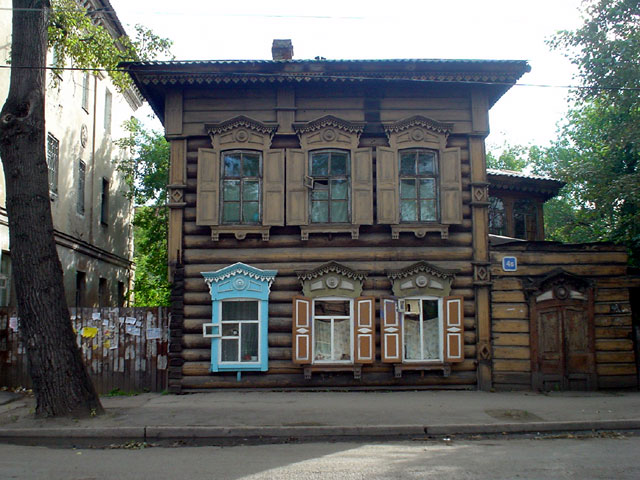
I left my fleece jacket back at the house and went exploring the sights, starting with the Volkonsky House, one of the houses built by the Decembrists, a group of intellectual rebels who had staged a coup against Tsar Nicholas I in 1825, only to fail and to be banished to Siberia. It was a prime example of Irkutsk’s distinct wooden houses (picture above) — some with intricate decorative wooden carvings known as “wooden lace” — found in all neighborhoods of town where modern construction hadn’t found its way to yet.
I walked the entire strip of Karl Marx strip, passed a group of leftover war tanks on display in a parking lot, the Academic Drama Theater and to the obligatory statue of Lenin found in a main plaza. Another statue, one of Alexanary was found at the end, near the Angara River. In the center of the river was Youth Island, a sort of relaxation park accessible via a footbridge, which was a nice place to sit out for a while and watch the Angara River go by.
In the Irkutsk Regional Museum (just $2 with my “student” discount), displays and exhibitions showed off artifacts of all the cultural aspects of the region throughout history, from the Ice Age to the nomadic tribes, to the southern Asian influence, the colonial influence and the Soviet one. Across the street was the White House, the former home of the governors general of Eastern Siberia, now a university library.
IRKUTSK DIDN’T LOOK LIKE it had more to offer for more than a day of sightseeing, so I went over to the only tour agency that was both mentioned in the Lonely Planet guidebook and on the map. Why Lonely Planet didn’t mention the others on the map (even if off the map) I didn’t know, and I hated them for it. No matter, I figured there would be a group of tourists like me at the one in town since it was on the map, only to find myself the only one there talking to the woman who spoke basic English. I tried to get a tour to nearby Lake Baikal, and she offered me one where I’d have to go on a train for 12-hours. I knew there was another way — it’s only an hour by bus — so I politely left and went to go look for another tour agency in the book.
After an internet session, I asked for directions to the Green Express agency, which was on the other side of the river somewhere. I walked, and searched and searched, only to find out that Lonely Planet’s map had the streets mislabeled, costing me time. (Damn you Lonely Planet!) I finally found the building, only to find it had closed for the day at five. (The next day, I found out it didn’t matter because the agency had moved entirely since Lonely Planet’s publication date.)
I WALKED BACK OVER THE BRIDGE into town to see the other sights — there was still a good six hours of daylight left. I wandered the Plaza Kirova, near the Church of the Savior, the Polish Catholic Church, and a new church bigger than both that wasn’t even mentioned in my Lonely Planet guidebook. (I swear, Lonely Planet; I bought your latest edition too! I understand that maybe you couldn’t put in every detailed in an abridged “Shoestring” book, but I was using your guidebook specifically for the Trans-Siberian Railway and the cities and sights on the way.)
Hungry, I went looking for a place to eat in town, but in this small time suburban place, all the cafes and cheap eateries seemed to shut down by seven, even with four more hours of daylight left. I guess Irkutsk wasn’t the big city or town after all; perhaps I really was in a place as remote as Siberia.
I went walking to try and find an open place, but was soon followed by a beggar woman who wouldn’t leave me alone, and just went back home. I settled for one of my spare ramen noodle bowls — Nina boiled some water for me, although it seemed to me like she felt like was perhaps doing too much. Her cat, who reminded me of Mr. Jinx in 2000’s Meet the Parents, visited me in my room often, even opening the door with his paws. I thought in the daytime he might try and scratch up my stuff in my bags, but then I remembered he didn’t have any opposable thumbs.
THAT NIGHT I JUST WROTE on my laptop until I was all caught up on The Blog. The weather outside got cold, and I was in The Real Siberia once again.
Next entry: No Aunt May
Previous entry: Lucky Lazy Day
Commenting is not available in this channel entry.
Comments for “The Real Siberia”
WOW, NOW I’m all caught up… so much there’s no more to right; today’s not over yet…
I await your comments (specific to the individual entry, please)—that includes you SBRs!
Posted by .(JavaScript must be enabled to view this email address) on 08/10 at 01:33 PM
Opposable thumbs! LOL!!
I’m Blog ODing!! What a great start to a Wednesday morning!
I’ve always wonderd about the fabled capitol of Siberia. Now I know… Thanks Erik!
BWT, AR5 was in Luxor last night… Thanks to you, I knew all about it!
Posted by .(JavaScript must be enabled to view this email address) on 08/10 at 04:49 PM
So, question for you: what does it cost to make a phone call on a public payphone? Have they upgraded them beyond the 10 kopeek pieces they used to cost? 10 years ago those coins were going for like 20 rubles in stores, b/c they had taken them out of circulation, even tho they were needed for the phones.
Now that’s thinkin’! I just wondered b/c I saw the picture of the phone booth and the lady on it.
Thanks for the pictures of the wooden lace - definitely very interesting. And all the influences - wow. I like your sunrise pics all the time!!!Posted by .(JavaScript must be enabled to view this email address) on 08/10 at 05:08 PM
AR5 - thankfully someone uploaded it to the net quickly this week
 And YAY moms! I’m so relieved. Both my husband and I were cheering when they made that flight. Mirna is sooo annoying - can she talk any more stupidly to local people? And hey was that black shirt just flattering or do you think Charla has lost a ton of weight?
Posted by Liz on 08/10 at 06:43 PM
whew…im all caught up too!
Those train incidents could’ve gone more sour and i am sure you didn’t mention all the details but we’re glad you’re alright.
I am also a bit dissappointed and enlightened. Siberia is not the snowy cold winter land that i thought it would be….and maybe coz its the summer. heh.
What’s next Mongolia? Maybe you’ll run into some Hun’s?
great pix btw.
Posted by .(JavaScript must be enabled to view this email address) on 08/10 at 08:17 PM
Erik: I am so glad you got caught up. I have so enjoyed looking busy at work while reading about your trip. Thanks!
Posted by .(JavaScript must be enabled to view this email address) on 08/10 at 09:33 PM
all caught up too…
Posted by .(JavaScript must be enabled to view this email address) on 08/10 at 09:49 PM
ERIKTGT: are you going to go to Wrangel Island?
Posted by .(JavaScript must be enabled to view this email address) on 08/10 at 10:32 PM
Well, I’m all caught up too now:)
The Train Ride: Glad you made it out of that one safely! 34 bucks is nothing much considering…
I love the ‘something-something’ conversations, I was laughing out loud in the post ordering food in the dinning car!
Looks like you really lucked out with the 2 homestays so far! It seems like a full day in each of those cities is enough time for them.
Great inside look of Siberia! Thanks!
Mongolia next uuh….I’m trying REAL hard NOt to be too jealous….but it’s not easy man!!
Stay safe, and have a great time!
P.S. As always, great, enjoyable writing, and awesome pics!
Posted by .(JavaScript must be enabled to view this email address) on 08/10 at 11:27 PM
that cat does look just like the cat from Meet the Parents! And the picture you took of your host through the doorway - It looks like a sneaky spy picture. Like she had no idea you were taking her photo, haha. She doesn’t seem like a barrel of laughs. When I go to Vietnam/Thailand over Christmas I think I want to do a homestay for a night or two!
Posted by .(JavaScript must be enabled to view this email address) on 08/10 at 11:38 PM
Siberia, eh? doesn’t seem much of a threat. unless you don’t know the language
 looks pretty cool, stay warm. N
 Posted by .(JavaScript must be enabled to view this email address) on 08/10 at 11:47 PM
Great stuff Erik. The Russia leg of the trip has really turned out to be a great read, especially Siberia. Stay safe and as always we’ll be following along (event those of us who often times slip into the SBR zone)!
Posted by .(JavaScript must be enabled to view this email address) on 08/11 at 04:19 AM
hey erik, long time no comment.. i think i hold the record for being behind on the blog- i’m still in namibia!! being home and in the philippines with dial-up will do that to you… anyway, just wanted to say hola and i hope all is well… can’t wait to be caught up! i’m starting today and i’ll hopefully be caught up by the time i get back to the east coast…
cuidado
Posted by .(JavaScript must be enabled to view this email address) on 08/11 at 04:51 AM
Hi
Lonely Planet is a sect, they take your money and leave you in the s#it.
If you come to China with that book you’ll hate them even more, ‘cause the China LP is one of the crapest and hey it’s not the place where everybody speaks English, either.” It seemed to me that she was doing the homestay service only as a means of additional income”
excuse me there dude what do you expect in a country where people, especially pensioners have no income at all?Great story otherwise, I would teach your stuff to kids, better than a lot of Geography classes…:)
Posted by .(JavaScript must be enabled to view this email address) on 08/11 at 05:07 AM
Erike: All caught up too! Great read, great pics! We expect nothing less and you always come through!
AR5 Fans: Don’t you agree that it wouldn’t be as entertaining without Mirna & Charla? Mirna and her dramatic “I’m going to die, Charla” Geesh, she was only picking up goats! I think they are hilarious. I would hate to see them go and lose that entertainment factor!
Erik: AR5 is kind of doing your trip backwards. Thanks to you we are all familiar with the locations and recognize the sites! You will enjoy watching it when you get back home. (Hopefully your brother is still taping each episode?)
Posted by .(JavaScript must be enabled to view this email address) on 08/11 at 12:53 PM
Janice - I’m not taping them - Hopefully LIZ will be able to show them to him over in Japan….
Posted by .(JavaScript must be enabled to view this email address) on 08/11 at 03:47 PM
Yep - I’ve got them stored away for Erik’s viewing / vegging pleasure. Should be up to around episode 10 or 11 then. He’ll be all addicted and have to wait to view the last three episodes LOL
Also have full season 1 which I just finished watching. Good stuff. Now if only someone would put up seasons 2-4!Posted by Liz on 08/11 at 03:50 PM
Liz - is there something like Netflix over there? I am not sure if Netflix here has any seasons of AR, but they have everything else!
Posted by .(JavaScript must be enabled to view this email address) on 08/11 at 04:52 PM
Noelle - Thanks for the suggestion! There isn’t anything like that here. :( Japanese people are really suss about giving credit card details over the internet so the whole online shopping thing isn’t so big ... that might be a good thing though LOL
Some nice soul put all of season 1 up on suprnova.org last week (download site of questionable legality) so I’m hoping that they’re an AR freak who will upload all the other seasons too!
Posted by Liz on 08/11 at 05:01 PM
ERIK - Breaking News - Gov. McGreevey just came out of the Closet..
http://www.cnn.com/2004/ALLPOLITICS/08/12/mcgreevey.nj/index.html
Posted by .(JavaScript must be enabled to view this email address) on 08/12 at 12:49 AM
HEY ALL… greetings from The Really REAL Siberia… in the countryside with mountains and little cabins and the big Lake Baikal… Of course, there is internet…
I could be in the NIZ for the next three days as I head off to Mongolia… Stay tuned, and sorry, I don’t have the time right now to answer to questions individually…
Posted by .(JavaScript must be enabled to view this email address) on 08/12 at 05:49 AM
Erik,
If I were to take 12 months off how much $$ would I need? I am trying to build some type of budget and need some place to start. Your traveling styles are (I hope) similar to mine, when and if I go.
Use the email dacarlo at doyonuniversal com
Thanks,
Darlitia
AlaskaPosted by .(JavaScript must be enabled to view this email address) on 08/12 at 11:12 PM
NOELLE: All the payphones use calling cards now.
Posted by .(JavaScript must be enabled to view this email address) on 08/13 at 05:49 AM
EL ZEE: Where is that exactly?
Posted by .(JavaScript must be enabled to view this email address) on 08/13 at 05:51 AM
F LEVANTE: Yes, I know… but play “host” a little bit you know what I mean? Every time I’d try to speak Russian to her, she’d have no patience and just walk away all pissy…
Posted by .(JavaScript must be enabled to view this email address) on 08/13 at 05:53 AM
DARLITA: It really depends on where you want to go; on average, say $1000 per month… that’s average, taking into account that some countries will be a lot under and some a lot over…
Posted by .(JavaScript must be enabled to view this email address) on 08/13 at 05:55 AM
HEY ALL: So I managed to find internet access one last time before I hop on the Trans-Mongolian to Ulan Baatar (pronounced Ulan BAAT’r)... Currently I’m in Ulan Ude (Ulan Uday), chilling out for a couple of hours… I have a 14 hour ride ahead of me, where I will catch up on the past couple of days… Stay tuned!
BLOG SPONSORS: A new round of postcards from Lake Baikal is on the way, “from Russia with love.” Did anyone get a postcard from Egypt yet?
A word about postcards: at this point, my funds are starting to run low, and I’m going to have to start a fresh mailing list of new sponsors (i.e. please pledge me if you want to remain on [or be added to] the mailing list!) It’s not that I don’t mind sending postcards, it’s just a money thing… Thanks!
Posted by .(JavaScript must be enabled to view this email address) on 08/13 at 05:56 AM
PLEDGE DRIVE TIME - have you sponsored Erik yet? Send the guy some cash if you haven’t. How much would you spend to go to watch a movie? How much entertainment value do you get each week from reading the blog?
Remember, he has to pay every time he goes online, so send some funds his way. Even if it is only 10 bucks. If a bunch of people send ten bucks that will add up to months of internet access
Oh and maybe a beer or two LOL The man could use a beer or two after his encounter on the the Trans-Sib.Click on the pull down menu at the top left hand side of the blog (where it says “contents (click here)” and then buy a t-shirt or just send some money via Pay-Pal.
Posted by Liz on 08/13 at 07:23 AM
Look at you, ms Fund-raiser. That’s MY job - apparently I’m not doig too well at it today… that’s my DAY job, at night I just veg…
Wow - they don’t even TAKE change at the pay phones? Amazing….
Not to mention that everyone has cell phones…Posted by .(JavaScript must be enabled to view this email address) on 08/13 at 10:06 AM
Oh I see (about your host), remember Boney M? “Crazy Russians”
just word of advice to China try to get TimeOut’s Beijing and if they have Shanghai, they are very decent city guides
good luck to Mo(o)ngolia!Posted by .(JavaScript must be enabled to view this email address) on 08/13 at 04:23 PM
Good work, yo!! Glad to see you’re in Siberia. It’s not as bleak as I thought it would be.
I’m an SBR now. Mad bizzy with the woman from Oz (yes, you know who I’m talking about). Anyhow, keep on writin’ in the free world!!
Word Life!
Moman!!
Posted by Moman on 08/13 at 09:38 PM
BTW - nope, haven’t received a postcard from Egypt - is it on the slow boat? That seems like it was super long ago… am I wrong about the time?? I’ll keep you posted.
Posted by .(JavaScript must be enabled to view this email address) on 08/15 at 09:15 AM
WOW, no one got the postcard from Egypt yet? That was MONTHS ago… I hope it was a post box I put them into and not a trash receptacle!
Posted by .(JavaScript must be enabled to view this email address) on 08/15 at 12:18 PM
Well, it’s just me that’s responded so far - I thought since I ask you questions all the time (and you answer them), I’d answer a question you had for us.
Anyone else want to chime in?Posted by .(JavaScript must be enabled to view this email address) on 08/15 at 05:00 PM
I hope you sent me a postcard from Egypt. I was hinting quite a bit. But no, my last postcard was from Malawi.
I’m WAY behind. So I’ll catch-up over the next few days.
Posted by .(JavaScript must be enabled to view this email address) on 08/24 at 10:23 PM
SHARE THIS TRAVEL DISPATCH:
Follow The Global Trip on Twitter
Follow The Global Trip in Instagram
Become a TGT Fan on Facebook
Subscribe to the RSS Feed
This blog post is one of over 500 travel dispatches from the trip blog, "The Global Trip 2004: Sixteen Months Around The World (Or Until Money Runs Out, Whichever Comes First)," originally hosted by BootsnAll.com. It chronicled a trip around the world from October 2003 to March 2005, which encompassed travel through thirty-seven countries in North America, South America, Africa, Europe, and Asia. It was this blog that "started it all," where Erik evolved and honed his style of travel blogging — it starts to come into focus around the time he arrives in Africa.
 Praised and recommended by USA Today, RickSteves.com, and readers of BootsnAll and Lonely Planet's Thorn Tree, The Global Trip blog was selected by the editors of PC Magazine for the "Top 100 Sites You Didn't Know You Couldn't Live Without" (in the travel category) in 2005.
Next entry:
No Aunt May
Previous entry:
Lucky Lazy Day
THE GLOBAL TRIP GLOSSARY
Confused at some of the jargon that's developed with this blog and its readers over the years? Here's what they mean:
BFFN: acronym for "Best Friend For Now"; a friend made on the road, who will share travel experiences for the time being, only to part ways and lose touch withThe Big Trip: the original sixteen month around-the-world trip that started it all, spanning 37 countries in 5 continents over 503 days (October 2003–March 2005)
NIZ: acronym for "No Internet Zone"; a place where there is little to no Internet access, thus preventing dispatches from being posted.
SBR: acronym for "Silent Blog Reader"; a person who has regularly followed The Global Trip blog for years without ever commenting or making his/her presence known to the rest of the reading community. (Breaking this silence by commenting is encouraged.)
Stupid o'clock: any time of the early morning that you have to wake up to catch a train, bus, plane, or tour. Usually any time before 6 a.m. is automatically “stupid o’clock.”
The Trinidad Show: a nickname of The Global Trip blog, used particularly by travelers that have been written about, who are self-aware that they have become "characters" in a long-running story — like characters in the Jim Carrey movie, The Truman Show.
WHMMR: acronym for "Western Hemisphere Monday Morning Rush"; an unofficial deadline to get new content up by a Monday morning, in time for readers in the western hemisphere (i.e. the majority North American audience) heading back to their computers.
1981ers: people born after 1981. Originally, this was to designate groups of young backpackers fresh out of school, many of which were loud, boorish and/or annoying. However, time has passed and 1981ers have matured and have been quite pleasant to travel with. The term still refers to young annoying backpackers, regardless of year — I guess you could call them "1991ers" in 2013 — young, entitled millennials on the road these days, essentially.
Spelling or grammar error? A picture not loading properly? Help keep this blog as good as it can be by reporting bugs.