The Japanese Connection
This blog entry about the events of Saturday, October 02, 2004 was originally posted on October 09, 2004.
DAY 350: When I was on a tour to ride camels in the Sahara desert of Morocco, I met a young Japanese guy in my group named Muzza. He, along with the cartoon philosophical Vancouverite Sebastian and others including myself, rode camels into the sunset, slept in a Bedouin camp and climb big Saharan sand dunes. My times with Muzza were short but he gave me his contact info and told me to get in touch with him once I got to Japan.
Muzza lived in a small town west of Tokyo near Mt. Fuji, where in the summers he worked as a guide. In the typhoon season and winter times he worked in a teahouse and poured tea all day, all week — which was the reason why he couldn’t managed to find a time to meet me.
The next best thing he did for me was to put me in touch with his “friend” in Kyoto, and it was perfect timing when I received his email in Kyoto. I put “friend” in quotes because when I finally met the guy, he told me that he probably knew Muzza just as much as I did; they had merely crossed paths on a Mt. Fuji trek. Nevertheless I depended on the kindness of strangers yet again, and met him under Kyoto Tower near the train station.
“Are you Yusuke?” I asked the confused-looking Japanese guy waiting by the entrance at noon. He seemed surprised that the “American” he was supposed to meet looked more “Asian.”
“Erik?”
Yusuke was used to meeting strangers since he was a member of the Free Guide Club at his school, Kyoto University for Foreign Studies, where students volunteered to show foreigners around to practice their English skills. He was all set to give me the “standard” tour until I told him that I had been to most of those places already.
“Where do you want to go?” he asked me.
“I don’t know. Can we go east? I haven’t seen the east.”
EASTERN KYOTO, LIKE THE NORTHWEST, was also full of many temples built in the ages of feudalism, way back before Nintendo and the PlayStation, many of which had been destroyed but reconstructed over the centuries. Yusuke and I took a bus out east to sample a few; it took an hour to get there and in that hour we just sort of sat on the bus with less than small talk. There must have been something lost in translation in everything that we said because we really didn’t make a connection. Possibly it was because he already had a whole spiel to tell me if we did the “standard tour” but he was at a loss.
An hour later we awoke and arrived at the Ginkaku-Ji Temple, the former retreat house of Shogun Ashikaga Yoshimasa built in 1482, now a Zen temple of the Rinzai school. The street leading there from the bus stop was adorned with touristy shops selling everything from cheap samurai swords to yatsuhashi (the Kyoto sweet), so people could buy them and bring them home for friends and co-workers — or, if you were like me, so you could eat the free samples offered at the front tables.
We wandered Ginkaku-Ji Temple, with its high-hedge corridor that lead to the main building and meticulously landscaped gardens. The pathway was so crowded with weekend tourists that there wasn’t much of an opportunity to just wander off the designated “usual route” marked with arrows.
“What do you think of this place?” Yusuke asked me.
“All the gardens are very beautiful.”
“It makes me feel very comfortable.”
That was the gist of our disjointed conversations, until we went back to the shop lane and got more sweet samples.
TO DITCH THE CROWDS FOR A WHILE, we walked along the scenic Path of Philosophy, a nearby walkway and tourist trap during April’s big cherry blossom season, and then up path up Mt. Daimonji-yama, the site of an annual August 16th festival when a big patch of the mountain is set in flames in the form of the character for “great,” believed to guide the souls of the dead home. It took us a good long hour up the inclined nature trail and up a long stone staircase, but at the end we were rewarded with a perfect view of the entire expanse of Kyoto and the surrounding mountains. Japanese eagles soared above while old Japanese men in full hiking attire (boots, hiking poles, hat) made their way up below us.
“Temple or shrine?” Yusuke asked me.
Temple or shrine? I thought. I think I’m templed and shrined out in Kyoto already. “If I wasn’t here, where would you go?”
“Temple?”
“No, if you weren’t showing me around today, what would you be doing? Where would you go?” I was interested in seeing how Kyotoites kicked it on the weekends.
“Maybe a fast food shop or a coffee shop.”
“Hmmm…”
“Oh, can we go to the [yatsuhashi] store? I love that place because you eat for free.”
“Okay.” If we had any common bond, it was the belief in the motto: If it’s free, it’s for me.
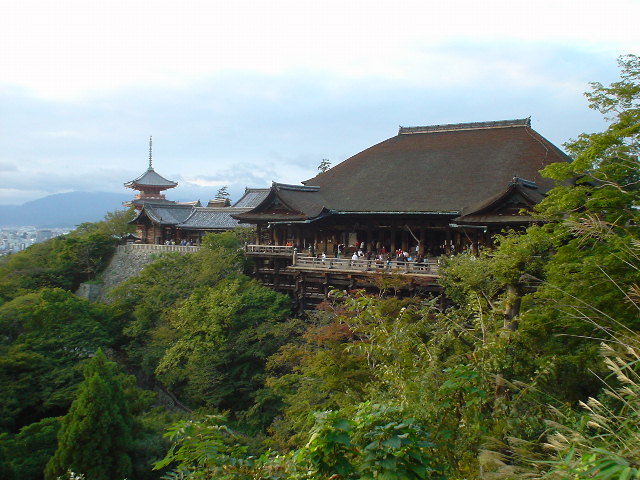
We descended the mountain and got some more free samples at the store down the hill before hopping on a bus southbound to the famous Teapot Lane, near the even more famous Kiyomiza-Ji Temple, with geishas in training and its big center veranda that looked out to the sunset (picture above), made of multiple tiers but no nails. We walked by these things, following the weekend crowd pedestrian traffic, also passed the pagoda and Jishu Shrine — frequented by women for its matchmaking power — and then sacred triple waterfall that invited hordes of tourists for cleansing. We sort of rushed through it all because we knew that the store with the free food would be closing soon.
We made it inside before they closed the door and were offered cups of tea. Then, for maybe twenty minutes straight we just went to the sales counter and ate free samples of different flavors of yatsuhashi and other sweets, pretending we were interested in buying some — the best were the strawberry and the chocolate and banana ones. I eventually caved and bought some packs to bring back to Liz and Hiroshi.
“I think I ate too much,” Yusuke told me, holding his stomach.
I GOT FINALLY GOT A TASTE OF REAL KYOTO LIFE when I went with Yusuke beyond the tourist draws (like the nearby Yasaka shrine), and went to the Gion District, Kyoto’s lively center of nightlife. Yusuke called up a friend and we went out to do the quinessential Japanese pastime: karaoke.
“How many times do you go karaoke?” I asked Yusuke.
“Maybe once a month. How about you?”
“Maybe twice a year,” I told him. Karaoke wasn’t exactly the quintessential American pastime; that honors goes to watching other people sing on reality TV programs like American Idol.
“Wow, that’s so little.”
“I have friends who have karaoke machines in their house.”
“Oh, so you don’t have to go out to the karaoke bars then.”
“Actually, karaoke isn’t that popular in the States.”
“How long do you get at the bars? One hour, two hours?”
“It depends how drunk I am.”
Beers and cocktails warranted a whole two hour session and we rocked the mic in a private room at the karaoke place where Yusuke and his friends go to all the time. We were only met by one friend named Yoske, who was the best singer out of the three of us. I thought I did okay (bar a couple of off-notes and voice cracks of course), and as for Yusuke — let’s just say Simon Cowell would have wanted to jump out the window, particularly when he sang many songs by the Backstreet Boys.
With the younger crowd of about five years, I strayed away from the classic 80s and sang more familiar tunes of Avril Lavigne and Linkin Park — plus I had enough alcohol in me for Backstreet Boys’ “I Want It That Way.” In the end, it was karaoke that finally connected the estranged Kyotoite with me.
“Do you want me to put you in touch with my friend in Osaka?” he asked before we parted ways on two different bus routes.
“Sure!”
And so, my Japanese connection that had started all the way in Morocco would be extended another day, all thanks to free food and the Backstreet Boys.
Next entry: A Castle Tale
Previous entry: Zen and The Art of Bicycle Maintenance
Commenting is not available in this channel entry.
Comments for “The Japanese Connection”
GREETINGS FROM BANGKOK INT’L AIRPORT… I’m about to take off for “One Night in Dhaka”... Stay tuned for more!
Posted by .(JavaScript must be enabled to view this email address) on 10/08 at 03:56 PM
WARREN: If you were serious about meeting me in Vietnam, it looks like I’ll be there 3rd or 4th week of November…
Posted by .(JavaScript must be enabled to view this email address) on 10/08 at 03:58 PM
I had to laugh at the picture of you and Yosuke at the temple at the top of the hill - he just offended all of your British readers LOL
Posted by Liz on 10/08 at 06:15 PM
Again - wow - so green and wonderful!!!
Thanks for the pictures.I love how you get behind all the tourist stuff in so many places… great fun!!
Posted by .(JavaScript must be enabled to view this email address) on 10/08 at 06:20 PM
Wicked pics Erik… I have to get off the beaten track next time I’m in Kyoto!
Have fun in Dhaka! I’m interested to see what that city looks like!
Posted by .(JavaScript must be enabled to view this email address) on 10/09 at 03:03 AM
Liz: I was about to say the same thing.

Erik: High hedge corridor looks pretty wild. How long was that corridor? Was it maze-like or just one long extension?
Awesome pics.. esp the ones that look like it was about twilight.
Posted by .(JavaScript must be enabled to view this email address) on 10/09 at 03:13 AM
Hey Erik. Too bad you couldn’t say hi to Muzza for us in person…
Posted by .(JavaScript must be enabled to view this email address) on 10/09 at 02:26 PM
GREETINGS FROM THE “DANGER ZONE,” KATHMANDU—so far, the media has seriously overhyped the violence here.
Get this, I accidentally slipped my status as a travel writer here and now I’m being given the red carpet treatment…
Hopefully after I’m being schmoozed all night tonight I’ll find time to post some new entries… Stay tuned!
Posted by .(JavaScript must be enabled to view this email address) on 10/09 at 04:15 PM
cuz i want it that way….hahah
cool red carpet status…but i still think it’s funny when WHEAT flashes his UN badge as said he was with the UN press to get into the NYC Fashion Week stuff…
haha
Posted by .(JavaScript must be enabled to view this email address) on 10/09 at 04:37 PM
SHARE THIS TRAVEL DISPATCH:
Follow The Global Trip on Twitter
Follow The Global Trip in Instagram
Become a TGT Fan on Facebook
Subscribe to the RSS Feed
This blog post is one of over 500 travel dispatches from the trip blog, "The Global Trip 2004: Sixteen Months Around The World (Or Until Money Runs Out, Whichever Comes First)," originally hosted by BootsnAll.com. It chronicled a trip around the world from October 2003 to March 2005, which encompassed travel through thirty-seven countries in North America, South America, Africa, Europe, and Asia. It was this blog that "started it all," where Erik evolved and honed his style of travel blogging — it starts to come into focus around the time he arrives in Africa.
 Praised and recommended by USA Today, RickSteves.com, and readers of BootsnAll and Lonely Planet's Thorn Tree, The Global Trip blog was selected by the editors of PC Magazine for the "Top 100 Sites You Didn't Know You Couldn't Live Without" (in the travel category) in 2005.
Next entry:
A Castle Tale
Previous entry:
Zen and The Art of Bicycle Maintenance
THE GLOBAL TRIP GLOSSARY
Confused at some of the jargon that's developed with this blog and its readers over the years? Here's what they mean:
BFFN: acronym for "Best Friend For Now"; a friend made on the road, who will share travel experiences for the time being, only to part ways and lose touch withThe Big Trip: the original sixteen month around-the-world trip that started it all, spanning 37 countries in 5 continents over 503 days (October 2003–March 2005)
NIZ: acronym for "No Internet Zone"; a place where there is little to no Internet access, thus preventing dispatches from being posted.
SBR: acronym for "Silent Blog Reader"; a person who has regularly followed The Global Trip blog for years without ever commenting or making his/her presence known to the rest of the reading community. (Breaking this silence by commenting is encouraged.)
Stupid o'clock: any time of the early morning that you have to wake up to catch a train, bus, plane, or tour. Usually any time before 6 a.m. is automatically “stupid o’clock.”
The Trinidad Show: a nickname of The Global Trip blog, used particularly by travelers that have been written about, who are self-aware that they have become "characters" in a long-running story — like characters in the Jim Carrey movie, The Truman Show.
WHMMR: acronym for "Western Hemisphere Monday Morning Rush"; an unofficial deadline to get new content up by a Monday morning, in time for readers in the western hemisphere (i.e. the majority North American audience) heading back to their computers.
1981ers: people born after 1981. Originally, this was to designate groups of young backpackers fresh out of school, many of which were loud, boorish and/or annoying. However, time has passed and 1981ers have matured and have been quite pleasant to travel with. The term still refers to young annoying backpackers, regardless of year — I guess you could call them "1991ers" in 2013 — young, entitled millennials on the road these days, essentially.
Spelling or grammar error? A picture not loading properly? Help keep this blog as good as it can be by reporting bugs.