Monkeys, Elephants and Pangkot Palace
This blog entry about the events of Monday, November 01, 2004 was originally posted on November 02, 2004.
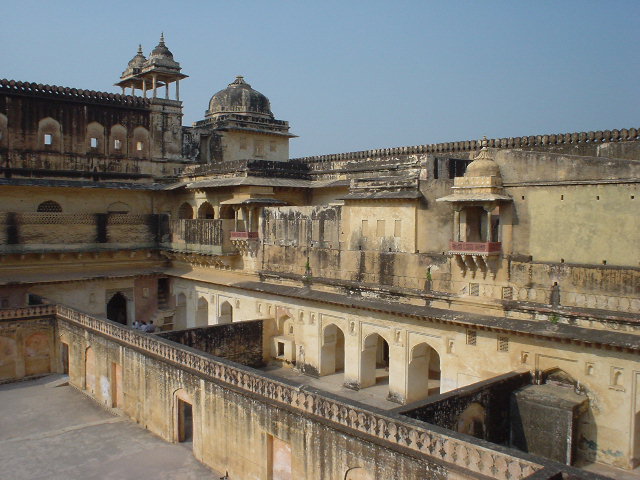
DAY 380: According to the tips provided by Blogreaders Duaine and markyt, the fictional Pangkot Palace from Indiana Jones and the Temple of Doom is not just a set in a British sound stage. The exterior shots were filmed on location in India, more specifically at one of the palaces in Jaipur. While “palace in Jaipur” is like saying “skyscraper in New York City” or “church in Rome,” it was narrowed down to one palace, the Amber Fort, the former residential fort and palace complex built by Maharaja Man Singh in 1592. While the current Maharaja Sawai Bhawani Singh (forty odd generations down from Man Singh) chooses to live not the 11 km. north of the city where the Amber Fort is, but in the City Palace itself (it’s closer to the movie theater and the Pizza Hut), the inspiration for Pangkot Palace still remains on a hilltop for tourists to wander and for filmmakers, particularly the ones in Bollywood, to continue using it as a film location.
BEFORE MY PILGRIMAGE to the real-life Pangkot Palace, I went to another temple, Galta, otherwise known as the Monkey Temple (for obvious monkey-loving reasons). Galta was also outside the city but to the east, a 3 km. hike up and down a mountain eastward from where the city ended rather abruptly outside the Pink City walls. I had a cycle rickshaw cyclist take me to the eastern edge of town, passed the bazaars, the camels and pink paint-marked lamb running through traffic (I assumed on the way to a slaughterhouse), and proceeded on foot up the lonely trail to a hilltop overlooking the city. At the top was the Surya Mandir or Sun Temple, built by Rao Kripa Ram, the envoy of Maharaja Jai Singh II, used to worship Surya the Sun God.
From there it was another pathway down a gorge to the Monkey Temple. I knew I was getting close when I saw the sight of banana peels all scattered on top of a rock. Upon arrival I saw that the Monkey Temple was properly named, as dozens of monkeys gathered around a sacred pool to eat, drink and just sort of hang out. Nearby was another pool for humans to bathe in, as well as other temple buildings, re-purposed as healing centers.
It was at the Monkey Temple that I finally met some other travelers, a group of four young voluptuous Israeli girls that I remembered from the day before; they were in the McDonald’s and one of them had asked the manager to turn down the radio after he had cranked it up when Bon Jovi’s “Living On A Prayer” came on (much to my chagrin).
“Take some good pictures?” one asked me.
Take some good pictures of yourself that you’d like to give me? I thought. “Yeah,” I actually said out loud.
The four of them had come in a car with a driver/guide that they hired for two days to take them to the various sites of Jaipur. They told me they were on their way to the Amber Fort and I told them that I was too. (It was true, not just a feeble pick-up line.) I played the lone-guy-looking-to-bum-a-ride angle in hopes that (if at the very least) perhaps I could hitch a ride with them, but one of them butt in and told me that there really was no room in the car. I sort of hung a bit to see if maybe I’d get a sympathy invite since the only other way to get a ride out of the Galta parking area was to walk up and down the ridge again into town, but again, they gave me the excuse there was no room and abandoned me.
“I’ll see you there then,” I said, walking pathetically the way I came as they hopped in their shiny ride — but I never saw them again that day. Oh well, I thought. They hated Bon Jovi anyway.
ABOUT 45 MINUTES LATER I was the bus stop near the Hawa Mahal or Palace of Winds, and hopped on a cheap public bus northbound to the Amber Fort. Finally, my pilgrimage to “Pangkot Palace,” the palace I grew up knowing as a child of the 80s. I wanted to go the final leg up the hilltop it in the classic Indiana Jones way, by riding on an elephant — rides were provided for a steep fee at the base of the hill.
The bus dropped me off near Maota Lake and I walked to a garden on the side which I thought would bring me to the elephants. At the inner edge of the garden I bumped into one of the small government museums with a couple of artifacts extracted from the palace. “How do I get to the Amber Fort?” I asked one of the men there. One of them volunteered to guide me. I never got his name, but for the sake of this story, let’s just call him, hmmm, I don’t know, Saijnu.
Saijnu guided me up a path towards the palace and I thought we’d arrive at the elephant mounting point, but soon I realized, as people on elephants were going by, that we had missed it. We walk from here, I figured. In five minutes we were near the fort’s main gate already and I had arrived at my Pangkot Palace.
As recommended by my guidebook, I hired an official guide to show me around so that “the palace [would] come alive.” My guide was not Saijnu but an old man named H.K. Gupta (H.K. for Hare Krishna), who did make the palace come to some sort of life with his explanations of the different areas of the palace ground, built at four different times with different maharajas. He led me through the passageways to the Diwani-I-Am hall, the garden, the Hall of Pleasure, the Ganesh Pol where the mahani (queen) would gaze through a window in a room above, and many other rooms with elaborate ceilings and wall reliefs. The pinnacle of the rooms in the Amber Fort was the sparkly Hall of Mirrors, another place to entertain guests as candles were reflected like a big kaleidoscope all around the room. From the outside of the palace interiors, I saw that perhaps the Amber Fort was used perhaps only in one specific shot in Indiana Jones and the Temple of Doom, a brief five-second shot where Indiana Jones asks Short Round where his razor is.
An entire section of the palace was allocated to Maharaja Man Singh’s twelve wives, each in their own ceiling-less room separated from the other by stone walls (picture above), surrounding a central courtyard were they gathered together during festivals. The Maharaja was a smart guy, having built secret passageways from his quarters to any of the twelve wives’ rooms, constructed in a way that one would never know which wife he was visiting (unless of course there was moaning and groaning and yelps from his “Oh!” face). While twelve wives might sound extreme for the monogamist Westerner, let us not forget the 350 women the maharaja had on the side outside of his marriages.
H.K. left me to wander after our tour and I saw for myself just how immense the fort was. There was many secret passageways that could have led anywhere — perhaps even a secret lair where a secret Thugi cult was still in operation — and I went exploring to the less-visited areas where darkness and spider webs were still prevalent. I found no such secret lair and called it a day.
I thought perhaps I’d finally get my elephant ride back down the hill, but the elephant operators were still charging the round-trip fee for the one-way down — and without four busty Israeli girls to split the costs with, I declined. The elephant guys gave me the option of riding around in a circle for Rs. 100, but I thought it was silly to just ride with no real purpose in mind, and so, I skipped out on the elephants entirely, walked down the hill myself and hopped on an auto-rickshaw. It zoomed by faster than any elephant anyway.
PASSED THE JAL MAHAL or Water Fort, a fort that looks like an island in the middle of a lake (unfortunately unopen to the public), I rode the auto-rickshaw to the Birla Mandir south of the city center, another building of another wealthy family in Jaipur, the Birla family which funded the multi-religion temple of worship. Built in only 1985 with bright white marble, the craft and artwork of the temple took ideology and images from Hindu deities, as well as Moses, Jesus, Zarathustra and Socrates in accordance with the Birla family’s pluralist values. Nearby was an obligatory shrine to Lord Shiva and the Motidungri Fort, an old fortification owned by the maharaja.
Speaking of the maharaja, I made a follow-up call to his Principal Private Secretary Mr. Pratikshit that evening to see if his highness was in town and if he’d meet me. After numerous attempts trying to hold the apparent busy man on his mobile phone, he told me that I should call in the morning to find out more specifics.
I hoped for the best, knowing that even if I didn’t get to see the real maharaja, at least I got to see the residence of the maharaja in the Indiana Jones movie, the elephants, and of course, those fun-loving monkeys.
Next entry: Look At The Stars
Previous entry: Jaipur Introduction
Commenting is not available in this channel entry.
Comments for “Monkeys, Elephants and Pangkot Palace”
HOLY LEG UPDATE: I went to the government hospital here in Jaipur (a really scary place) and the doctor said the wound was fine. Unless it hurt, it wasn’t infected, and I told him it didn’t really. (It hurt way more BEFORE the hole in my leg, when the infected pus was a lump under my skin.) I am to just continue my antibiotics and keep the wound dressed in iodine. Too bad I haven’t been able to find any big bandaids around here, otherwise I might not have to bandage it up like a mummy everyday…
Posted by .(JavaScript must be enabled to view this email address) on 12/31 at 07:00 PM
DUSTY: Point taken. I’ll go find a doctor around here somewhere…
Posted by .(JavaScript must be enabled to view this email address) on 11/02 at 03:35 AM
If that fails just hack the whole leg off.
Posted by .(JavaScript must be enabled to view this email address) on 11/02 at 03:44 AM
you could always just ride an elephant in thailand.
Posted by Alyson on 11/02 at 06:53 AM
BILL: Then I can be a peg leg… like a pirate!
Posted by .(JavaScript must be enabled to view this email address) on 11/02 at 09:59 AM
Ask for Johnson&Johson;, square bandaids - premedicated. If not in the main city, you will definately get the same at the chemists shops near the airport. But, true, somehow the big sized ones are always out of stock. glad to went to the doc - scary or otherwise. what is next?
Posted by .(JavaScript must be enabled to view this email address) on 11/02 at 10:28 AM
Not to get ahead of The Blog here, but I’ve just been granted a meeting with the maharaja himself tomorrow morning!
Posted by .(JavaScript must be enabled to view this email address) on 11/02 at 10:44 AM
How cool is that!
Posted by .(JavaScript must be enabled to view this email address) on 11/02 at 12:55 PM
what is a maharaja?? is that like the mayor?
Posted by .(JavaScript must be enabled to view this email address) on 11/02 at 01:42 PM
The maharaja is like a king, but has no political power.
Posted by .(JavaScript must be enabled to view this email address) on 11/02 at 02:40 PM
I’m afraid of Canadian hospitals… I can’t even conceive an Indian one.
Posted by .(JavaScript must be enabled to view this email address) on 11/02 at 02:42 PM
watch out for the monkeys, they may look cute, but they are starting to get aggressive. though you can’t blame them. they really don’t have anywhere to go.
http://www.wnbc.com/news/3886134/detail.html
Posted by .(JavaScript must be enabled to view this email address) on 11/02 at 02:47 PM
Is Kerry really conceding?
Posted by .(JavaScript must be enabled to view this email address) on 11/02 at 03:27 PM
YES. He did.
Posted by .(JavaScript must be enabled to view this email address) on 11/02 at 03:42 PM
guys, looks like the giant Douche just conceded to the Turd sandwich, better luck in 4 years ...
Posted by .(JavaScript must be enabled to view this email address) on 11/02 at 03:54 PM
as neeraj has put it, another 4 years of bushit!
:(Posted by .(JavaScript must be enabled to view this email address) on 11/02 at 05:04 PM
go bush!
Posted by .(JavaScript must be enabled to view this email address) on 11/02 at 05:37 PM
damn that’s a lot of banana peels..
Willie Scott (Kate Capshaw):
“You’re gonna get killed chasing after your damn fortune and glory.”
Indiana Jones ( Harrison Ford ):
“Maybe. But not today.”Posted by .(JavaScript must be enabled to view this email address) on 11/02 at 05:51 PM
YEAAAAAAAH!!!!!!
Posted by .(JavaScript must be enabled to view this email address) on 11/02 at 05:52 PM
just drop it like its hot
Posted by .(JavaScript must be enabled to view this email address) on 11/02 at 05:55 PM
send the killer monkeys to the white house

Posted by .(JavaScript must be enabled to view this email address) on 11/02 at 06:02 PM
Killer monkeys already inhabit the Whitehouse
Posted by .(JavaScript must be enabled to view this email address) on 11/02 at 10:48 PM
It’s settled then; you should all leave the country and join me on my many adventures around the world…
Posted by .(JavaScript must be enabled to view this email address) on 11/03 at 03:07 AM
WHEAT: Nice quote. I don’t get the Lil’ Jon jokes, but you can explain on AIM when I log on…
Posted by .(JavaScript must be enabled to view this email address) on 11/03 at 03:11 AM
I’m about to move to Thailand - my credit card will last a while there…
Posted by .(JavaScript must be enabled to view this email address) on 11/03 at 05:56 AM
NOELLE: If you’re serious, I’ll see you there, Nov. 16th…
Posted by .(JavaScript must be enabled to view this email address) on 11/03 at 06:27 AM
Well, how long will you be there? I will have to seriously contemplate it…
Posted by .(JavaScript must be enabled to view this email address) on 11/03 at 06:33 AM
NOELLE: I’ll be zipping around continental SE Asia for five weeks, Bangkok to Singapore, before I fly to Manila for X-mas…
Seriously, “Noelle Royer, come on down! You’re the next contestant on The Blog is Right!”
Posted by .(JavaScript must be enabled to view this email address) on 11/03 at 06:41 AM
hey erik, bush won. see if you can extend your global trip for another 4 years, cause you definitely shouldn’t come back to this. i think you are better off being scammed in india by taxi drivers than coming back to being scammed by your own president.
Posted by .(JavaScript must be enabled to view this email address) on 11/03 at 02:46 PM
e: Love the Maota Lake and Motidungri Fort shots! What is that building across the lake? Also, when we see shots of white buildings, are those all marble?
Posted by .(JavaScript must be enabled to view this email address) on 11/07 at 03:13 AM
OOGY: That’s the museum where I picked up “Saijnu.” Yup, all white equals all marble…
Posted by .(JavaScript must be enabled to view this email address) on 11/07 at 04:59 AM
SHARE THIS TRAVEL DISPATCH:
Follow The Global Trip on Twitter
Follow The Global Trip in Instagram
Become a TGT Fan on Facebook
Subscribe to the RSS Feed
This blog post is one of over 500 travel dispatches from the trip blog, "The Global Trip 2004: Sixteen Months Around The World (Or Until Money Runs Out, Whichever Comes First)," originally hosted by BootsnAll.com. It chronicled a trip around the world from October 2003 to March 2005, which encompassed travel through thirty-seven countries in North America, South America, Africa, Europe, and Asia. It was this blog that "started it all," where Erik evolved and honed his style of travel blogging — it starts to come into focus around the time he arrives in Africa.
 Praised and recommended by USA Today, RickSteves.com, and readers of BootsnAll and Lonely Planet's Thorn Tree, The Global Trip blog was selected by the editors of PC Magazine for the "Top 100 Sites You Didn't Know You Couldn't Live Without" (in the travel category) in 2005.
Next entry:
Look At The Stars
Previous entry:
Jaipur Introduction
THE GLOBAL TRIP GLOSSARY
Confused at some of the jargon that's developed with this blog and its readers over the years? Here's what they mean:
BFFN: acronym for "Best Friend For Now"; a friend made on the road, who will share travel experiences for the time being, only to part ways and lose touch withThe Big Trip: the original sixteen month around-the-world trip that started it all, spanning 37 countries in 5 continents over 503 days (October 2003–March 2005)
NIZ: acronym for "No Internet Zone"; a place where there is little to no Internet access, thus preventing dispatches from being posted.
SBR: acronym for "Silent Blog Reader"; a person who has regularly followed The Global Trip blog for years without ever commenting or making his/her presence known to the rest of the reading community. (Breaking this silence by commenting is encouraged.)
Stupid o'clock: any time of the early morning that you have to wake up to catch a train, bus, plane, or tour. Usually any time before 6 a.m. is automatically “stupid o’clock.”
The Trinidad Show: a nickname of The Global Trip blog, used particularly by travelers that have been written about, who are self-aware that they have become "characters" in a long-running story — like characters in the Jim Carrey movie, The Truman Show.
WHMMR: acronym for "Western Hemisphere Monday Morning Rush"; an unofficial deadline to get new content up by a Monday morning, in time for readers in the western hemisphere (i.e. the majority North American audience) heading back to their computers.
1981ers: people born after 1981. Originally, this was to designate groups of young backpackers fresh out of school, many of which were loud, boorish and/or annoying. However, time has passed and 1981ers have matured and have been quite pleasant to travel with. The term still refers to young annoying backpackers, regardless of year — I guess you could call them "1991ers" in 2013 — young, entitled millennials on the road these days, essentially.
Spelling or grammar error? A picture not loading properly? Help keep this blog as good as it can be by reporting bugs.