Live-Action Japanimation
This blog entry about the events of Wednesday, September 29, 2004 was originally posted on October 07, 2004.
DAY 347: Voltron. Pokémon. G-Force. Yu-Gi-Oh. Speed Racer. Unless you’ve been hiding in a cave for the past fifty years (without a TV), you must recognize at least one of these titles (each one representing a decade since the 1960s). They are the titles of some of the more popular cartoons to be exported out of Japan and into the screens of American television, after being redubbed into English.
Cartoons, like video games, are another of Japan’s major exports. Often referred to as “Japanimation” or “anime,” Japanese cartoons are usually characterized by elements like “speed lines” and wide-eyed characters. Anime isn’t exclusive to the small screen; it is a world capable of being more fantastic than anything live-action film could create, and the genre has spawned many feature-length stories worthy enough to grace celluloid — including the more well-known anime films like Akira and Ghost in the Shell. These two examples, like many anime films, aren’t for kids, with dramatic sci-fi storylines and gratuitous animated sex and violence. In some movies, “violence” is an understatement with really explicit, almost jaw-dropping scenes of gore and blood. One particular adult anime film even involves a race of demonic aliens with about a dozen penises each that come to earth to go around raping women. (Anime fans reading this are smirking because they know just exactly which one I’m talking about.)
This is not to say that all feature-length anime films are ultra-violent. Studio Ghibli, the studio that produces the animated works of world-renowned Japanese animator Hayao Miyazaki, exports many anime movies with compelling storylines good for the whole family. Miyazaki, a “Japanese Disney” if you will, has created a world of many characters over the years, cherished not only by Japanese children and adults, but people around the world (with the global distribution help of the Disney corporation). If you’ve seen Kiki’s Delivery Service, Princess Mononoke or Spirited Away, you’ve already seen fantastic worlds that Miyazaki has created.
Unlike Disney, Miyazaki hasn’t aspired to make an empire of theme parks, but instead has created just one museum inspired by the Studio Ghibli films, located in Mitaka, just outside of central Tokyo. Opened in 2001, the museum is “the kind of museum [Miyazaki] wanted to make,” with the philosophies noted in the museum’s color pamphlet:
“The building must be: put together as it were a film; not an overbearing, flamboyant, gaudy or suffocating building; something to make people want to touch things in it. The museum must be run in such a way as to: treat small children as if they were grown-ups; not force visitors to follow a pre-determined, fixed course; provide exhibits that will stimulate a wealth of ideas, while avoiding worn out displays covered with dust. The displays will be: not only for the benefit of people who are already fans of Studio Ghibli; not memorials to Studio Ghibli with only exhibits from its past films; things and spaces that will allow visitors to appreciate, just by looking, what it’s like to be an animator and to gain a new appreciation for animation… [The museum will not be:] a pretentious museum; an arrogant museum; a museum that treats its contents as if they were more important than people; a museum that displays uninteresting works as if they were significant.”
With that all said, it sounded like a museum-goer’s ultimate dream. However, the pamphlet neglected one other philosophy:
The museum will not: allow photography or video recording.
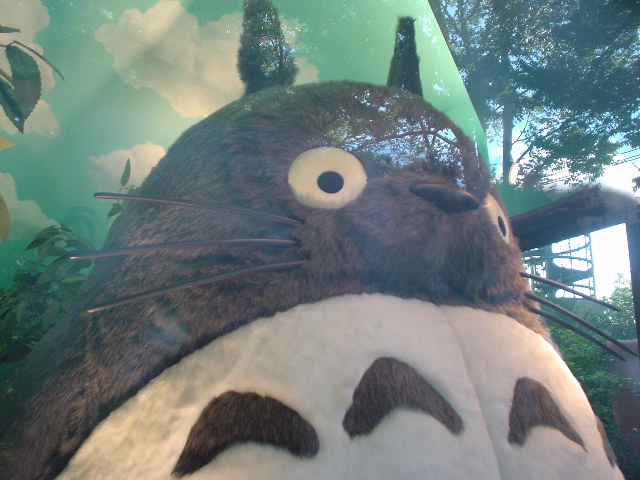
JOHN (A.K.A. BLOGREADER SZLACHTA) HAD GOTTEN US advance tickets for the museum — required to insure crowd control — and met me at the entrance gate with his girlfriend Melissa. “Hey there’s Totoro!” he said, pointing out the iconic Ghibli character (Ghibli’s Mickey Mouse if you will) at the fake “Totoro entrance” (picture above). Seeing Totoro and the whimsical exterior of the museum, we knew we were at a place for the young and the young at heart. Not only was Totoro there, but the giant robot soldier from Laputa: The Castle in the Sky stood on the roof’s wooden garden.
Despite the no photography rule, John and I managed to sneak in a few shots here and there as we wandered the fairy tale house adorned with Ghibli-inspired stained-glass windows. There were exhibits of the process of animation, from concept art to scriptwriting to drawing, coloring and animating. In a crowded room with a classic-looking animator’s drawing board, there was a hands-on camera where one could pan and zoom a scene with a hot air balloon floating over a city.
Only about 60% of the museum exhibited things from Studio Ghibli; a substantial portion was allotted for Pixar, the computer-animation studio under Disney’s distribution wing that brought us Toy Story, Monsters, Inc. and Finding Nemo. They too exhibited fun examples on the process of animation, from storyboarding to animatics. One room was even a promotional room for the upcoming The Invincibles movie. What the exact partnership between Pixar and Studio Ghibli had together to spawn such an exhibit in Japan I wasn’t sure of; fans speculate Pixar will animate an upcoming Miyazaki film, but no details have been given (at the time of writing). Perhaps secrets were a good thing to keep people wondering…
THE ENTIRE MUSEUM WAS CROWDED WITH PEOPLE in every section, not just the kids playing on the big plush Cat Bus inspired by the Cat Bus in My Neighbor Totoro. It was so crowded that the three of us got separated somewhere between the bookstore, the gallery of Pixar posters and the gift shop selling everything from Totoro key chains to Innocence (the sequel to Ghost in the Shell) on DVD. I eventually found Melissa and we tried to find John — which was easier said than done with the museum interior sometimes feeling like an M.C. Escher drawing. It took a while to find him but we eventually did, and we all went to the in-house Saturn Theater to watch Hayao Miyazaki’s latest short film (at the time of writing), The Whale Hunt, about a class of schoolchildren with imaginations so powerful that takes them out to sea.
WE LEFT THE IMAGINARY CHILD WORLD OF STUDIO GHIBLI and re-entered the real world on the way back to Tokyo. Like within the spectrum of anime, John moved from children themes to adult ones. “So do you get lonely on the road?” he asked me.
“Nah, there’s always someone around wherever I go.”
“No, you know what I mean,” he said with a smirk. He was probably speaking for many male Blogreaders wondering the same thing. (Funny how many guys come to this travel Blog for sex, when there are exactly 1.3 gojillion websites specifically for that already.)
I smirked back. “I’ve had my moments.”
“Oh, so you do!” he said excitedly. “Because you never write about that stuff.”
“There’s a line I draw between stuff that goes public and stuff that remains private,” I told him. “That stuff stays outside the boundaries.”
“[Yeah, I figured it gets pretty lonely on the road,]” he said. “That’s why I brought her along,” he joked, pointing at Melissa.
“OKAY, WHERE’S FUJI?” Nicaraguan doctor Melissa said like an stern E.R. surgeon as the elevator doors opened. We had arrived at the 45th floor of the Tokyo Metropolitan Government building for the free look out the observation deck. Typhoon 21 had swept away all the lingering rain clouds and pollution over Tokyo, leaving a clear sky to see the big expanse of Mega-Tokyo. The sky was clear enough that we could see the famous Mt. Fuji to the west, which was closer than I thought it was — or perhaps just a lot bigger — flanking Tokyo in a glowing orange sky. The orange turned to darkness and the sparkly lights of Tokyo came out.
With multiple voicemails to Liz (since I didn’t have a number for her to call me back), Liz directed us to the kaiten-zuchi (conveyor belt sushi) place we went to before, since I raved about it to John and Melissa. The three of us sat at a table for beers, green tea and plenty of sushi — Melissa and I even had the moving shrimp sushi, with tail ends that jiggled outside our lips when we took our bites.
At the end of my animated day with John and Melissa, we split up to go our own ways, all before the Tokyo subway system closed at the painfully early weekday closing time of ten o’clock. In Tokyo, no matter if you were into the family-oriented anime of Studio Ghibli or the grown up kind with demonic sex-crazed aliens — or a little of both like John — the train lines always seemed to keep everyone in line like it was a school night.
Next entry: Bullet Time
Previous entry: Indoor Fun
Commenting is not available in this channel entry.
Comments for “Live-Action Japanimation”
Could it be… Former BH turned SBR… back in FIRST!!!!!...
Posted by .(JavaScript must be enabled to view this email address) on 10/06 at 08:50 PM
SORRY I’M STILL BEHIND!
If you’re following The Blog closely, there are two timelines: the one in the entries (the latest being the events of this one), and the one in the comments (closer to real time).
The entries are about a week behind real time (at the time of writing this comment)... I hope to catch up soon… promise!
To keep you up-to-date, I am leaving Japan in the morning, bound for a layover city (Bangkok) where I will get tickets for my next destination…
(drumroll)...
...Nepal.
THANKS LIZ AND HIROSHI FOR AN AWESOME TIME! ARIGATO GOZAIMASU!
Posted by .(JavaScript must be enabled to view this email address) on 10/06 at 08:54 PM
“I… fly… to… the.. Danger Zone…” Ha, look at that—I never even saw “Top Gun.”
Posted by .(JavaScript must be enabled to view this email address) on 10/06 at 08:59 PM
=D
Posted by .(JavaScript must be enabled to view this email address) on 10/06 at 09:01 PM
TOP GUN references make me happy…
Love that picture of the night sky and the mountain… awesome…
I want to go to that museum - looks so nifty!!
Posted by .(JavaScript must be enabled to view this email address) on 10/06 at 10:22 PM
ERIK:
You travels through Japan braught back SO MANY memories for me. Japanese hospitality, the sushi bars, Onomono-yaki, cute characters on everything, even our American embassy order was the same (Fish dippers with Wasabi sauce!) Thanks for taking me right back to the best two weeks of my trip!
BWT: Did you notice that everytime uniformed staff entered or exited a train car, they’d turn their back to door and face the passangers, bow, and then proceed to the next car?
Posted by .(JavaScript must be enabled to view this email address) on 10/06 at 11:43 PM
I liked your whole Japan experience. It’s moved up on list of places I want to go. I always thought it would be too crowded and confusing but you showed us “charming Japan”. Liz and Hiroshi seemed like such nice hosts!
can’t wait to go to Asia - 2 more months. Maybe they have some sushi in the Tokyo airport for my layover.
Posted by .(JavaScript must be enabled to view this email address) on 10/07 at 12:02 AM
BTW: Onomono is a palindrome…
Posted by .(JavaScript must be enabled to view this email address) on 10/07 at 12:52 AM
Can’t wait to read the Nepal entries - have fun and stay safe.
Posted by Dan on 10/07 at 12:55 AM
10pm closing? That totally sucks! Weeknights are the best nights to PARTY!
Posted by .(JavaScript must be enabled to view this email address) on 10/07 at 02:19 AM
Bye Erik - have a safe trip! It was great to finally meet you in person!
Posted by Liz on 10/07 at 03:20 AM
YAYYY! NEPAL!!!!
Posted by .(JavaScript must be enabled to view this email address) on 10/07 at 06:58 AM
E: You call yourself a child of the 80s and you haven’t seen TopGun!!!
Droollll (Studio Ghibli)... Did you see any reference to Lupin III? Now those movies are hilarious!
Looking forward to Hiroshima entry! And Nepal!
Hats off to Liz and Hiroshi! You guys rock!
Posted by .(JavaScript must be enabled to view this email address) on 10/07 at 07:57 AM
SBR posting for first time. I have enjoyed reading your posts for 4+ months and look forward to reading them almost every day. I would vote yes for nepal. I trekked the annapurna circuit in 2000. Everything else pales in comparision to that experience for me. If you need a place to stay in southern India(Hyderabad) I can arrange for that. Most people never make it there anyway.
Good Luck and keep writing!Posted by .(JavaScript must be enabled to view this email address) on 10/07 at 04:11 PM
posting from Amsterdam !!! Thanks MarkyT “The Flying Pig ” is a cool lil’ spot… this place is wild! .. Good pics Erik .. looking forward to Nepal ! BH’s rule !
Posted by .(JavaScript must be enabled to view this email address) on 10/07 at 05:00 PM
Simf2p:
If you get down to Switzerland, check out a cool mountain hostel called Challet Martin. It’s in a small town outside of Lausanne called Gryon.
http://www.gryon.com
My favourite hostel in Europe so far… Although I’ve never been to the flying pig.Posted by .(JavaScript must be enabled to view this email address) on 10/07 at 05:58 PM
TDOT: Right off the bat, I noticed that Japanese service people are very emotional with their hands… They always wave their palms to present things like product models, even with presenting change at the cashier—it’s like everyone is a magician.
Posted by .(JavaScript must be enabled to view this email address) on 10/07 at 05:58 PM
If you get there. Don’t miss the hotsprings excursion!
Posted by .(JavaScript must be enabled to view this email address) on 10/07 at 06:00 PM
SIMFP2 - Awesome…Stay outta trouble….
Posted by .(JavaScript must be enabled to view this email address) on 10/07 at 06:03 PM
OOGY: Who has time to watch “Top Gun” when you’ve too busy rewatching (over and over and over): Ghostbusters, the Back to the Future trilogy, Star Wars trilogy, Indiana Jones trilogy—and GOONIES!
Truffle Shuffle!
Posted by .(JavaScript must be enabled to view this email address) on 10/07 at 06:04 PM
ERIK:
I found that the Japanese really know how to treat people! They have created such a pleasant society, it puts the Canadian stereotype of politeness to shame!
Posted by .(JavaScript must be enabled to view this email address) on 10/07 at 06:05 PM
SARA: Hey, Japan entries aren’t over yet, there’s still a week’s worth of content to come!
Posted by .(JavaScript must be enabled to view this email address) on 10/07 at 06:07 PM
LIZ / HIROSHI: THANKS AGAIN SO MUCH FOR YOUR MORE-THAN-GRACIOUS HOSPITALITY!!! Thank you also for that “special” farewell dinner (which I will reveal to the rest when that entry comes up).
I hope our paths cross again one day… Try to make it out to New York in March for the big welcome back party!
Posted by .(JavaScript must be enabled to view this email address) on 10/07 at 06:10 PM
MAD: Thanks for breaking the silence! Seriously, I’m in my rut again about whether or not it’s worth writing, and hearing from new SBRs makes me feel an extra satisfaction.
Southern India? Hook me up! I’ve just booked tickets.
Posted by .(JavaScript must be enabled to view this email address) on 10/07 at 06:12 PM
LOVEPENNY: I actually think you’d like chicken cartilage. You could probably make it yourself; cut away that soft bone section in the middle of a chicken, lightly bread it and fry/grill it on a skewer… Deliciouso!
Posted by .(JavaScript must be enabled to view this email address) on 10/07 at 06:15 PM
GREETINGS FROM BANGKOK! I just arrived here from Tokyo to arrange the flights for my next couple of months since it’s so damn cheap over here. Currently I am on waiting list for a flight to Kathmandu tomorrow night, via Dhaka.
(Yes, I had to look up Dhaka on a map too.)
If I can’t get that flight, I’m “stuck” here in the partyland Koh San District of Bangkok (boo hoo), but I’m grounding myself until I’m all caught up on entries—I’m even paying extra for accomodations with electrical outlets since many of the cheapie places don’t have them in the rooms.
“One night in Bangkok and the world’s your oyster…
The bars are temples but the pearls ain’t free…”Posted by .(JavaScript must be enabled to view this email address) on 10/07 at 06:20 PM
Hey Erik,
Yay for Nepal!
I love Totoro, cute picture!
Ciaociao!
Posted by .(JavaScript must be enabled to view this email address) on 10/07 at 06:53 PM
HEY YOU GUYS!!!!!!!!!! Sorry just had to add my GOONIES reference in there…...Baby RUUUTH!!! Can’t help it, I just loved Sloth….
Posted by .(JavaScript must be enabled to view this email address) on 10/07 at 06:56 PM
Okay, so we’ve got GOONIES references, AND “One night in Bangkok…”
What more can a girl ask for??
Well…Posted by .(JavaScript must be enabled to view this email address) on 10/07 at 09:38 PM
EriK: Please don’t ever doubt that your writing isn’t worth it! We may not always post a comment but so many people depend on your entries for their daily fix. (Right, Lisa?) You are the topic of conversation at many of our family get-togethers! I will be seeing Rose this weekend (Canadian Thanksgiving) and we always talk about your travels! Really enjoyed the Japan entries. Last time I saw Liz & Hiroshi was Xmas 2002. I will say a little prayer for your safe travel in Nepal. Happy Canadian Thanksgiving everyone!
Posted by .(JavaScript must be enabled to view this email address) on 10/08 at 06:14 AM
NOELLE: I was actually going to quote Mikey:
“Up there, it’s their time. It’s their time up there. But down here, it’s our time, it’s our time down here. And it will all be over the second we go up Troy’s bucket…” (inhale)
Posted by .(JavaScript must be enabled to view this email address) on 10/08 at 07:58 AM
Erik: Great posts from Japan. I’m about a week or so behind due to an unexpected biz trip, but I’m looking forward to hearing about your further adventures in Japan and the rest of Asia. Keep up the good work and enjoy yourself to the fullest! We all really appreciate your efforts with the Blog!
Posted by .(JavaScript must be enabled to view this email address) on 10/16 at 10:56 PM
SHARE THIS TRAVEL DISPATCH:
Follow The Global Trip on Twitter
Follow The Global Trip in Instagram
Become a TGT Fan on Facebook
Subscribe to the RSS Feed
This blog post is one of over 500 travel dispatches from the trip blog, "The Global Trip 2004: Sixteen Months Around The World (Or Until Money Runs Out, Whichever Comes First)," originally hosted by BootsnAll.com. It chronicled a trip around the world from October 2003 to March 2005, which encompassed travel through thirty-seven countries in North America, South America, Africa, Europe, and Asia. It was this blog that "started it all," where Erik evolved and honed his style of travel blogging — it starts to come into focus around the time he arrives in Africa.
 Praised and recommended by USA Today, RickSteves.com, and readers of BootsnAll and Lonely Planet's Thorn Tree, The Global Trip blog was selected by the editors of PC Magazine for the "Top 100 Sites You Didn't Know You Couldn't Live Without" (in the travel category) in 2005.
Next entry:
Bullet Time
Previous entry:
Indoor Fun
THE GLOBAL TRIP GLOSSARY
Confused at some of the jargon that's developed with this blog and its readers over the years? Here's what they mean:
BFFN: acronym for "Best Friend For Now"; a friend made on the road, who will share travel experiences for the time being, only to part ways and lose touch withThe Big Trip: the original sixteen month around-the-world trip that started it all, spanning 37 countries in 5 continents over 503 days (October 2003–March 2005)
NIZ: acronym for "No Internet Zone"; a place where there is little to no Internet access, thus preventing dispatches from being posted.
SBR: acronym for "Silent Blog Reader"; a person who has regularly followed The Global Trip blog for years without ever commenting or making his/her presence known to the rest of the reading community. (Breaking this silence by commenting is encouraged.)
Stupid o'clock: any time of the early morning that you have to wake up to catch a train, bus, plane, or tour. Usually any time before 6 a.m. is automatically “stupid o’clock.”
The Trinidad Show: a nickname of The Global Trip blog, used particularly by travelers that have been written about, who are self-aware that they have become "characters" in a long-running story — like characters in the Jim Carrey movie, The Truman Show.
WHMMR: acronym for "Western Hemisphere Monday Morning Rush"; an unofficial deadline to get new content up by a Monday morning, in time for readers in the western hemisphere (i.e. the majority North American audience) heading back to their computers.
1981ers: people born after 1981. Originally, this was to designate groups of young backpackers fresh out of school, many of which were loud, boorish and/or annoying. However, time has passed and 1981ers have matured and have been quite pleasant to travel with. The term still refers to young annoying backpackers, regardless of year — I guess you could call them "1991ers" in 2013 — young, entitled millennials on the road these days, essentially.
Spelling or grammar error? A picture not loading properly? Help keep this blog as good as it can be by reporting bugs.