Cradle of Humanity
This blog entry about the events of Saturday, May 22, 2004 was originally posted on May 24, 2004.
DAY 217: Ethiopia lies in a region known as the Cradle of Humanity, the corner of the globe where it is speculated that Mankind was born — this speculation is supported by paleontological evidence. Many cultures derived from this Creation of Man in Ethiopia, the earliest written history of it recorded in the Bible. With such rich roots to explore in early Man and biblical civilization, Ethiopia’s history blurs the line between reality and folklore and has become a gold mine for paleontologists, anthropologists and archaeologists alike. For tourists, it is also a gold mine; in fact, some consider Ethiopia to be “travel’s best kept secret.”
The easiest way for me to explore Ethiopia’s past was to visit the two main museums that were open presently on a Sunday. I decided to go to the first one, the National Museum on foot, walking the six odd kilometers from my hotel through the downtown area. Along the way I was followed by two shady guys that approached me, one who thought I was Japanese and another who thought I was from Madagascar. I sternly ignored these guys until they got the hint and continued on my way to the museum, stopping for directions at the National Tour Operations office and the fancy Sheraton hotel.
FOR A PLACE THAT HOLDS arguably the most important relic in the study of the evolution of Man, the National Museum was a pretty dusty and abandoned looking place — although as far as museums go, I’d had worse. Security was fairly tight though; I was frisked at the entry gate and inside, my camera was held for the duration of my visit. I thought twice about admitting I had a small little spy camera so that perhaps I could sneak in pictures when no one was watching, but then I noticed the grid of multiple hidden camera views monitoring every inch of the exhibition. (I was only permitted to take photos of the postcards hanging on the wall in the ticket office.)
A majority of the museum was dedicated to artifacts of Ethiopia’s culture and historical past, but the star of the show was the more recently redesigned paleontological exhibition in the basement. The comprehensive presentation took me through rooms about the evolution of early African mammals, including elephants and giraffes, until I found myself in a room dedicated to the mammal known as Man. Inside were the remains of the most complete skeleton of what many considered the missing link between Monkey and Man — a phenomenon that if it existed today, would probably end up doing a guest appearance on The Howard Stern Show. Discovered in 1974 by paleontogists and Beatles fans Donald Johanson and Tom Gray, the 3.2 million-year-old skeleton was dubbed “Lucy,” after “Lucy In The Sky With Diamonds.” Only three and a half feet tall, Lucy was actually discovered in the ground with other minerals and is famous all over the world as the hominid that eventually evolved into the present day human race — although more recent research suggests that perhaps she isn’t the direct ancestor, but the “grand-aunt” of Man.
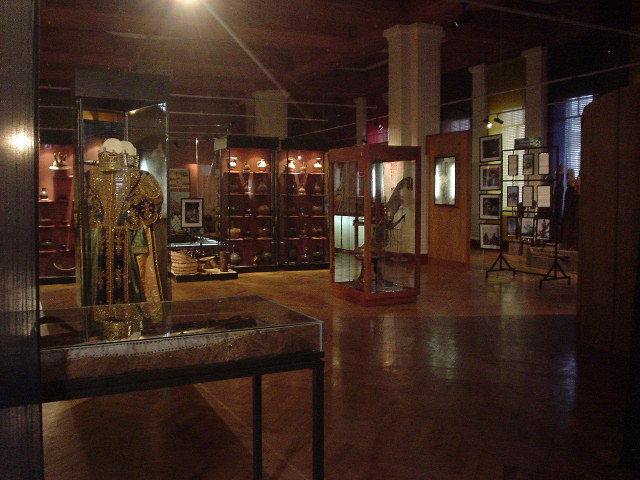
ONCE MANKIND HAD BEEN ESTABLISHED, culture had evolved from the different peoples, particularly the ones spread out across the Cradle of Humanity. The lifestyles of these people were best explained in the Ethnological Museum, found inside the Institute of Ethiopian Studies on the campus of Addis Ababa University, which was converted from the former palace and grounds of Emperor Haile Selassie. The beautifully-designed exhibition (picture above) led me through different tribes of Ethiopia, explaining unique aspects of their culture. For example, the Hamer people of the south have a ritual of passage for men in which one has to walk across the backs of about thirty bulls lined up all in a row, back and forth three times — failing to do so gets him whipped and teased by the women. The Tsemay people of the south have strange wedding rituals, in which the bride and groom shave and butter each other’s heads. As weird as that sounds, it’s probably all worth it; after the marriage ceremony, the couple doesn’t have to go to work for up to a year. And most noticeably, we can not forget the Suri, Karo and Nyangaton people in the west, people who make themselves “attractive” with plates inserted into elongated lips ripped off the face, or with raised markings made in patterns with razor blades. To each his own taste I suppose — or rather, in this case, to each his own face.
The exhibition continued with other aspects of Ethiopian life, from its three major religions — Ethiopian Orthodox Christianity, Ethiopian Judaism and Islam — to its art gallery upstairs, showcasing the craftwork of local musical instruments and religious artifacts collected over the decades. The whole thing wet my appetite for seeing the actual religious sites up north in the coming week.
FROM ETHIOPIAN CULTURE AND HISTORY comes its food, which I ordered back at the hotel restaurant. Contrary to popular belief, the waiter didn’t just bring over a big empty plate, but a big bowl of lamb key wat, a spicy lamb stew served with a big floppy engera, a spongy pancake the size of a big pizza crust that is ripped off by hand into pieces to dip and wrap around the meat and gravy. No starvation here; the portion was actually too big for me to finish — and all for just under two dollars, a tiny fraction of the cost of what the same dish might have cost me in an Ethiopian restaurant in the New York area.
While some things differ between the Ethiopian things in Ethiopia and The States, some things are the same: on the Ethiopian television in my room ran the Oprah Winfrey farewell interview with the cast of Friends — even in the Cradle of Humanity, there was no escape from the hype. Watching Oprah and Friends on the set of the coffeehouse Central Perk reminded me of one interesting tidbit I learned in the Ethnological Museum: not only was Ethiopia the birthplace of Man, but it was the birthplace of coffee, which was actually named after the southwestern Ethiopian region “Kaffa” where it was discovered. With that said, I suppose that means the Cradle of Humanity is also the Cradle of Starbucks.
Next entry: Dominoes
Previous entry: A Long Way Since the Eighties
Commenting is not available in this channel entry.
Comments for “Cradle of Humanity”
That icon is amazing - I guess it’s the whole Orthodox thing. Thanks. I didn’t know that they had Orthodox Christianity in Ethiopia - you learn something new every day! Thanks. I’m now hungry for Ethiopian food! But I’d spend a ton more than you!
Posted by .(JavaScript must be enabled to view this email address) on 05/23 at 06:44 PM
HEY GANG… Okay, this is it for real now… I’ll be in the NIZ for 8-9 days, while I really do go track the actual Ark of the Covenant in the northern city of Aksum. I’ll pretty much be NIZ until June 2-3, where I will report to you from Cairo, Egypt if all goes well….
NEVEN: So I take it you’re a “no” on Cairo?
Posted by .(JavaScript must be enabled to view this email address) on 05/23 at 06:50 PM
Good luck & have fun ... looking forward to Cairo ...
Posted by .(JavaScript must be enabled to view this email address) on 05/23 at 07:07 PM
good luck…and stay safe. thanks for updatin’ the blog!
Posted by .(JavaScript must be enabled to view this email address) on 05/23 at 07:27 PM
i am jealous
Posted by .(JavaScript must be enabled to view this email address) on 05/23 at 09:06 PM
ERIK - Follow your heart to Cairo…hahahahahah….
Posted by .(JavaScript must be enabled to view this email address) on 05/24 at 07:41 AM
...first time in Cairo? Have u ever tasted the national fruit of Egypt??
Posted by .(JavaScript must be enabled to view this email address) on 05/24 at 05:26 PM
DAY 1 of 8/9 Days of NIZ - Need help coping?? Jump on the bandwagon with the WB’s Superstars:
http://www.thewb.com/Shows/GenericShow/0,11116,169159,00.html
Posted by .(JavaScript must be enabled to view this email address) on 05/24 at 06:30 PM
ERIK - Mayor of JC died from a heart attack last nite…
Posted by .(JavaScript must be enabled to view this email address) on 05/25 at 04:50 PM
Yo Bee,
I work with an Ethiopian here in NYC, and told him that you were there. His brother owns a taxi service out there and he said he’d refer you to him to show ya around (though you seem to be doing quite well right now, the intrpid traveler you are!)!!
Make sure you try the local food—it’s quite good!
Keep on keepin’ on!
Tally Ho, Moman!!
Posted by .(JavaScript must be enabled to view this email address) on 05/26 at 06:06 AM
Hey Erik
yeah unfortunately I can’t be in Egypt with you. I went to Australia in January and France in April so I can’t get any more time off. Hope you have a great time.
Posted by .(JavaScript must be enabled to view this email address) on 05/26 at 06:04 PM
I’ve had the engera with various “toppings” before! It was great! Fortunatly I wasn’t raised with devider plates.
Posted by .(JavaScript must be enabled to view this email address) on 05/27 at 08:59 AM
TDOT - You back in Toronto? I’m in Toronto June 1st and 2nd, if you’re around how bout a drink ay?
Posted by .(JavaScript must be enabled to view this email address) on 05/27 at 04:46 PM
GREETINGS FROM GONDAR, Ethiopia… Yes, it sounds like something out of Lord of the Rings… and get this… it IS! It’s a total medieval town with castles from the Middle Ages, right in the heart of Ethiopia! Pictures to come (including the story of how I almost got arrested).
I’m still touring the highlands of Ethiopia en route to the Ark of the Covenant and I must say that Sally Struthers is a total bee-atch… she DID have us all duped into thinking Ethiopia was just a poor, dry country with starving children… So far, all I’ve seen is the opposite—in fact, I dare say that Ethiopia is my favorite African nation so far!
AND they have internet!
Posted by .(JavaScript must be enabled to view this email address) on 05/27 at 06:20 PM
Wahoo! A little ERIK to tide us over. Nice. Does this mean the NIZ pronoucement was premature?
I’m so very jealous that your current travel plans reads like a Indiana Jones script. You suck. If you come across the Well of Souls I’ll scream! Ha! Any how, can’t wait to hear about your near incarceration. Just glad you’re not NIZ in jail.
BTW, that you saw Lucy is AMAZING. I suspect there are few armchair archaeologists that have ever traveled to Ethiopia to see her, and now through you I got a peek. Thanks!
Keep up the good work…
Posted by .(JavaScript must be enabled to view this email address) on 05/27 at 10:44 PM
Sally Struthers - a liar? Imagine that!
I wanna go to Gondar, Ethiopia - can’t wait for the pictures. Although, I kinda just want to go anywhere you’ve gone so far. Yes, I’m a bandwagoner - come back from the NIZ!! Give us stories!
Oh well. Have fun.Posted by .(JavaScript must be enabled to view this email address) on 05/29 at 01:07 AM
MarkyT: June 1st and 2nd!!! I`ll be still in Japan! It`s amazing here BTW.
I should be home on June 10th provided I don`t get bumped by the airline, which Im hoping will happen. You can`t come later in the month?
Posted by .(JavaScript must be enabled to view this email address) on 05/29 at 04:59 PM
TDOT - Can’t come later in the month since I’m going for a conference…
Be safe in you travels ay…
Posted by .(JavaScript must be enabled to view this email address) on 05/31 at 01:46 AM
I HAVE COME TO THE CONCLUSION that traveling is getting me more burnt out than when I HAD a 9-to-5 job… It’s been a crazy couple of days with a lack of cash (no surprise there, huh?), canceled flights, closed banks and Guardian Monks protecting the Ark of the Covenant!
My plan was to write and catch up all day today back in Addis (where I am now), but my early flight was canceled, and had to take a later flight, which ate up my entire day, making me miss appointments and such… and in less than 6 hours, I’m off to the airport again… to go to Cairo!
Ugh, my eyes are red from the stress and lack of sleep… but I will return with stories!
P.S. Two more things. 1) I am looking for a sort of intern to compile a mailing list for me of every commenter since Day One (minus spammers)—those with something better to do need not apply. Payment is a chotskie from the road… and postcards of course. Anyone interested email me at my yahoo address… 2) Any Sony CyberShot users out there? My DSC-U20 spy camera has been acting up since it got damp at Vic Falls, and progressively over time it’s gotten worse… now it’s at the point where I should either spend money to get it repaired or replaced. (Weird clicking sounds, colors are all off, and too much light blows out the picture) Any suggestions? For now, I’m getting a weird “E61:00” error message… does anyone know what that means?
Posted by .(JavaScript must be enabled to view this email address) on 05/31 at 06:34 PM
Erik - You should take a rest from travelling! Take a few days to relax and do nothing. I know you are on a schedule to meet up with people, but maybe a week at the beach with nothing to do but watch the sunset, sleep and regenerate is in order. And don’t think about the blog for that week (did I say that? *grin*).
Take care of yourself and don’t get too stressed out! If you go too hard you’ll burn out… and then we’ll all be blogless if your adventure ends early :(
I’m a firm believer in the beach being the cure for all ills - I’m off to Thailand myself at the end of the month to get rid of my work stress. Go and grab a few days on the coast in Egypt. Apparently the Red Sea is marvellous… not to mention the great diving. Take a vacation!Posted by Liz on 06/01 at 08:37 AM
LIZ et al.: Greetings from Cairo! I just got here… although I almost got deported at immigration… braved a federal interrogation from three officers since it’s suspicious of an “American” who doesn’t look “American” to come to Cairo via Addis Ababa—and with no flight ticket back to the USA either. Shady, no? Anyway, I survived—that’s a story to come…
As for “taking a break…” I’m glad I’m in Cairo, a big world city like New York so I can pretend I’m back home for a while… there’s a McDonald’s down the block and (I hate to say it) I have a Big Mac Attack like you wouldn’t believe!
Stories to come… I plan on staying in most of the day to catch up; although I don’t know how much I’ll do because they have a bunch of good movies on cable! hahaha
Oh, what 8 months of travel does to a person!

Posted by .(JavaScript must be enabled to view this email address) on 06/01 at 11:59 AM
I totally understand the movies and McD’s thing! I’ve lived in Japan for over 5 years now and the first two stops whenever I get home to Canada are 1. Tim Horton’s and 2. Taco Bell. Oh good, cheap coffee… I’m in heaven just thinking about it… and greasy, gooey, cheesy, fries supreme *sigh*
I also just veg out in front of the tv for hours. It is so nice to hear English! Sure, a lot of it is mindless drivel (due to jet lag, I’m often watching the tv at 3 am), but hey, informercials and Little House on the Prairie are awesome when you haven’t seen English tv in a year.

Enjoy kicking back watching the tube with your Big Mac! Do they have any cool Macfood in Cairo? In Japan they have teriyaki chicken burgers, teri-tama burgers (teri for teriyaki, tama for tamago=egg) sometimes, and bacon potato pie. Oh and fish nuggets with wasabi dipping sauce is the latest special menu item.
Posted by Liz on 06/01 at 02:48 PM
ERIK - Send me a list of what to send Jack to bring over to Spain.
All I have is your TGT shirt to give. Let me know if you’ll need a replacement camera? Don’t worry, if I buy it and you don’t need it I can find a buyer fastly.
TDOT - where the hell are the Visa ATMS in Toronto? Everywhere I go has been MasterCard!
Posted by .(JavaScript must be enabled to view this email address) on 06/01 at 03:11 PM
MARKYT: Cairo is a MasterCard town too! Here’s the deal… the “E61:00” error on my camera, according to my manual is an “error that is irreversible.” So I DO need a new camera. I’ve put the blog catch-up on hold for the day to try and track down a new one, but apparently tariffs for digital cameras in Egypt are so high that no one sells them here; if they do, they are 80% more than what they should cost elsewhere.
Rumor has it there is a Sony dealer in town, but I have yet to find it…LIZ: The Big Mac was EXCELLENT… I would have seen Harry Potter next door, but it was sold out today!
Posted by .(JavaScript must be enabled to view this email address) on 06/01 at 05:17 PM
cant your brother or relatives buy one and mail it to you?
Posted by .(JavaScript must be enabled to view this email address) on 06/01 at 05:25 PM
While your pics rock, I can make do without them. Your writing rocks too
Can you tell I’m an addict? I’ve only checked your blog like 4 times today. LOLPosted by Liz on 06/01 at 06:38 PM
MARKYT: There is an underground commercial complex called the PATH connecting all the major downtown office towers. All of the Bank Towers (CIBC, Royal, Scotia, Bank of Montreal) are all on Bay St. Not far from the Metro convention centre (where your conference is?)
There you will find ATMs on every system. You’ll even find ones that will dispense USD. They’re painted like US flags, you can’t miss them.
and its “Eh!” not Ay! Just in case you met any rabid Canadians!
LIZ: I saw the poster for the Wasabi dip sauce and I died laughing… Im in Mei Prefecture near Nagoya, where are you?
Posted by .(JavaScript must be enabled to view this email address) on 06/01 at 06:47 PM
the blog has truly become an international forum & phenomenon ... viva la Globe Trip !
Posted by .(JavaScript must be enabled to view this email address) on 06/01 at 07:27 PM
TD0t / LIZ: Definitely meet up and send pictures… I have yet to see what either of you look like!
MARKYT: Sony’s global site says there are NO dealers in Egypt… closest is in Jordan. I even checked all the underground computer shops today. So, I guess for now, it’s deal with the way I’ve been dealing with the busted camera (it still works 25% of the time) and use the still features on the camcorder until the next shipment arrives via Jack in Barcelona. I’ll email you a long list of things—for now, I need a new headlamp (preferably a nice halogen LED kind, check Campmor [mine has been missing since Serengeti]), and a clear DRY bag (small) so that my camera won’t get damp again!
Posted by .(JavaScript must be enabled to view this email address) on 06/01 at 08:16 PM
hey erik,
maybe you should get an all weather digicam.. my dad bought an olympus that’s an all weather. it’s pretty good and it’s tiny too. unfortunately not as tiny as your spy cam.
Posted by .(JavaScript must be enabled to view this email address) on 06/01 at 08:21 PM
It’s OK Erik! You know you can always post pictures of animals off the internet instead of REAL pictures for a bit. Your funny stories are blog enough (although I still like my Global Trip coffee table photo book idea!)
You’ve got a fan in Chicago!
Posted by .(JavaScript must be enabled to view this email address) on 06/01 at 08:41 PM
Hey! I have been a “lurker” on the blog for about 3 weeks now. I read everything chronologically. Fascinating “Would You?” video was the kick in the pants I needed to get motivated to begin dreaming about next trip.
Keep up the good work, stay safe and healthy. And all you bloggers (TDot, Liz, Jenn, MarkyT..Your comments make the blog so uh..er, robust?)
Ciao!
Fun
Posted by .(JavaScript must be enabled to view this email address) on 06/01 at 08:44 PM
Thanks Funchilde!
Posted by .(JavaScript must be enabled to view this email address) on 06/02 at 04:45 AM
TDOT - I’m hanging out in good ole Tokyo. Have you been here already or are you heading up this way? What the heck are you doing in Mie? That’s like the middle of nowhere. You are in the Kinki region though
Send me an e-mail at ‘datigz’ at ‘ams’ dot ‘odn’ dot ‘ne’ dot ‘jp’ (Spammers will die) and maybe we can meet up!Posted by Liz on 06/02 at 07:23 AM
FUNCHILDE: I love it when SBRs break the silence! Thanks! Yes, I second your comment… the Blog Hogs DO make the Blog more, er, robust.
Posted by .(JavaScript must be enabled to view this email address) on 06/02 at 11:51 AM
JENN: I almost bought the Sony USC U-60 (?)... the new waterproof one up to 15 ft… only it wasn’t as small as the U-20 or U-30… and in the end, it was the size that mattered to me… Most of the pictures you see are all thanks to the fact that I can simply whip out my little spy camera and quickly shoot inconspicously, and I’ve really been accustomed to that camera style…
Is there a new camera out there the size of the u-30 that is waterproof?
Posted by .(JavaScript must be enabled to view this email address) on 06/02 at 11:55 AM
TD0T - I was over at the Metro Convention Centre. I did find a Visa ATM at a TD Waterhouse. Thanks for the advice, but yeah, unless its a bank all the ATMS around are all on the MC network…
Visa everywhere I want it to be? Umm, no…FAWKERS…..
But yes, Toronto was a great time, so I’ll definitely make my way back and hit you up for a drink or 2 or 3 now that I found out about jetsgo airlines (jetblue/easyjet of canada)...
Posted by .(JavaScript must be enabled to view this email address) on 06/03 at 07:35 AM
ERIK - got your email on the list of goodies for the shipment with JACKALZ…
I’ll go get everything. LP/OOGY - Please let me know if you have suggestions on Erik’s head lamp…
JACKALZ - Looks like you’ll be bringing over a camera, some books, and head lamp and stuff. Please let me know your travel plans so I can coordinate a shipment down to Miami accordingly…
Posted by .(JavaScript must be enabled to view this email address) on 06/03 at 07:49 AM
MARKYT: JACKALZ says he is flying from Miami to Barcelona, to land on July 1st, 1 pm… I’ll probably meet him in the Rambla (maybe by the KFC)... MATTO’s a no-go, WHEAT is questionable and DTELLA seems to be MIA. JACKALZ will be The Transporter.
Posted by .(JavaScript must be enabled to view this email address) on 06/03 at 10:53 AM
MARKYT: Just got email from CHERYL implying she may meet up in Europe too… Details to come, but if so, perhaps it’ll be easier for the transport of supplies…
Posted by .(JavaScript must be enabled to view this email address) on 06/03 at 11:08 AM
ERIK/CHERYL - Just let me know. Easier to give Erik’s care package to Cheryl than sending it down to JACKALZ…
Gotta know travel plans soon…
Posted by .(JavaScript must be enabled to view this email address) on 06/03 at 03:16 PM
SHARE THIS TRAVEL DISPATCH:
Follow The Global Trip on Twitter
Follow The Global Trip in Instagram
Become a TGT Fan on Facebook
Subscribe to the RSS Feed
This blog post is one of over 500 travel dispatches from the trip blog, "The Global Trip 2004: Sixteen Months Around The World (Or Until Money Runs Out, Whichever Comes First)," originally hosted by BootsnAll.com. It chronicled a trip around the world from October 2003 to March 2005, which encompassed travel through thirty-seven countries in North America, South America, Africa, Europe, and Asia. It was this blog that "started it all," where Erik evolved and honed his style of travel blogging — it starts to come into focus around the time he arrives in Africa.
 Praised and recommended by USA Today, RickSteves.com, and readers of BootsnAll and Lonely Planet's Thorn Tree, The Global Trip blog was selected by the editors of PC Magazine for the "Top 100 Sites You Didn't Know You Couldn't Live Without" (in the travel category) in 2005.
Next entry:
Dominoes
Previous entry:
A Long Way Since the Eighties
THE GLOBAL TRIP GLOSSARY
Confused at some of the jargon that's developed with this blog and its readers over the years? Here's what they mean:
BFFN: acronym for "Best Friend For Now"; a friend made on the road, who will share travel experiences for the time being, only to part ways and lose touch withThe Big Trip: the original sixteen month around-the-world trip that started it all, spanning 37 countries in 5 continents over 503 days (October 2003–March 2005)
NIZ: acronym for "No Internet Zone"; a place where there is little to no Internet access, thus preventing dispatches from being posted.
SBR: acronym for "Silent Blog Reader"; a person who has regularly followed The Global Trip blog for years without ever commenting or making his/her presence known to the rest of the reading community. (Breaking this silence by commenting is encouraged.)
Stupid o'clock: any time of the early morning that you have to wake up to catch a train, bus, plane, or tour. Usually any time before 6 a.m. is automatically “stupid o’clock.”
The Trinidad Show: a nickname of The Global Trip blog, used particularly by travelers that have been written about, who are self-aware that they have become "characters" in a long-running story — like characters in the Jim Carrey movie, The Truman Show.
WHMMR: acronym for "Western Hemisphere Monday Morning Rush"; an unofficial deadline to get new content up by a Monday morning, in time for readers in the western hemisphere (i.e. the majority North American audience) heading back to their computers.
1981ers: people born after 1981. Originally, this was to designate groups of young backpackers fresh out of school, many of which were loud, boorish and/or annoying. However, time has passed and 1981ers have matured and have been quite pleasant to travel with. The term still refers to young annoying backpackers, regardless of year — I guess you could call them "1991ers" in 2013 — young, entitled millennials on the road these days, essentially.
Spelling or grammar error? A picture not loading properly? Help keep this blog as good as it can be by reporting bugs.